Questions

2 Mark Question

Take a timed test

22 questions · self-marked practice — reveal the answer and mark yourself.

Question 12 Marks
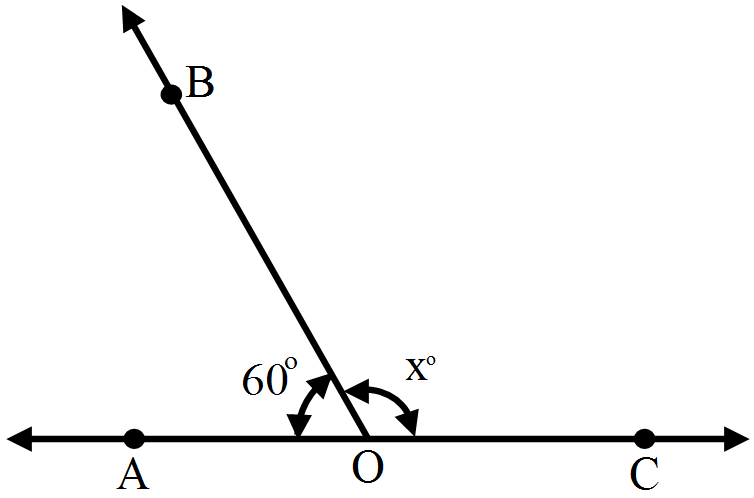
Find the value of x in the following figure.
Answer
Since, $\angle \text{BOA}+\angle \text{BOC}=180^\circ$
Linear pair:
⇒ 60° + x° = 180°
⇒ x° = 180° - 60°
⇒ x° = 120°
View full question & answer
Question 22 Marks
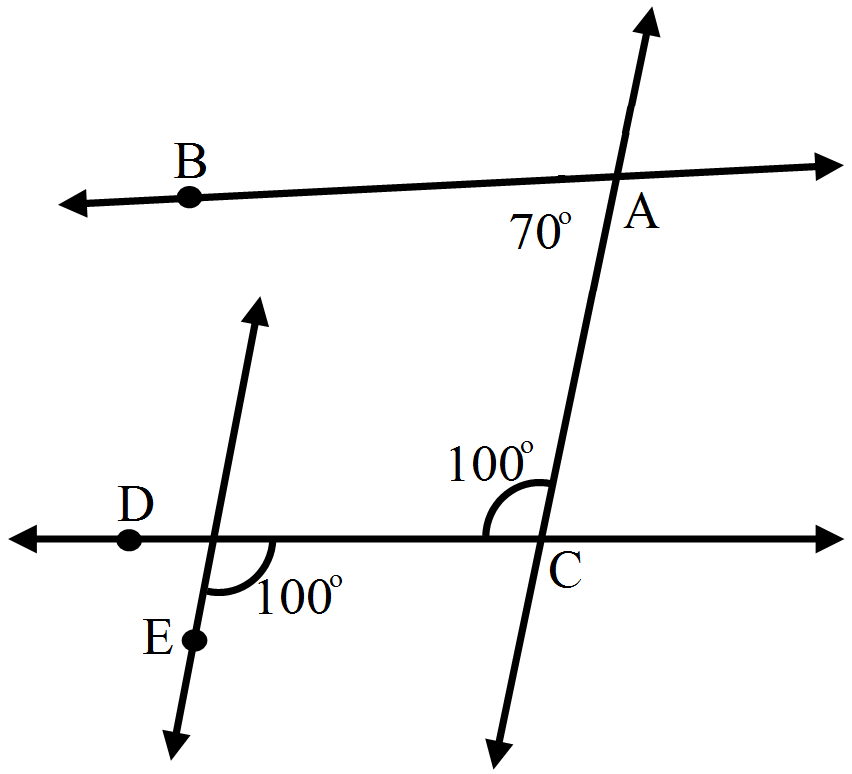
In Figure, state which lines are parallel and why?
Answer
Let, F be the point of intersection of the line CD and the line passing through point E.
Here, $\angle \text{ACD}$ and $\angle \text{CDE}$ are alternate and equal angles.
So, $\angle \text{ACD}=\angle \text{CDE}=100^\circ$
Therefore, $\text{AC}||\text{EF}$
View full question & answer
Question 32 Marks
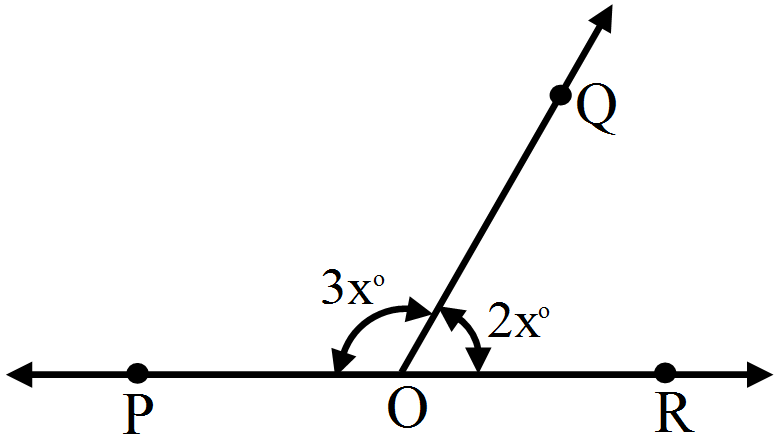
Find the value of x in the following figure.
Answer
Linear pair:
$\Rightarrow 3\text{x}^\circ+2\text{x}^\circ=180^\circ$
$\Rightarrow 5\text{x}^\circ=180^\circ$
$\Rightarrow \text{x}^\circ-\frac{180^\circ}{5}$
$\Rightarrow \text{x}^\circ=36^\circ$
View full question & answer
Question 42 Marks
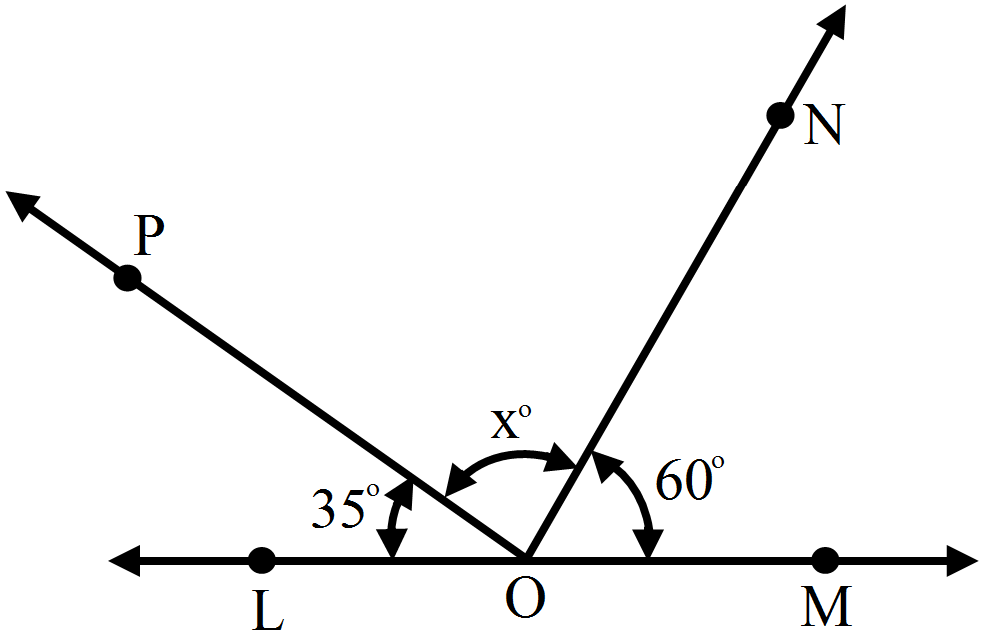
Find the value of x in the following figure.
Answer
Linear pair:
Since, 35° + x° + 60° = 180°
⇒ x° = 180° – 35° - 60°
⇒ x° = 180° - 95°
⇒ x° = 85°
View full question & answer
Question 52 Marks
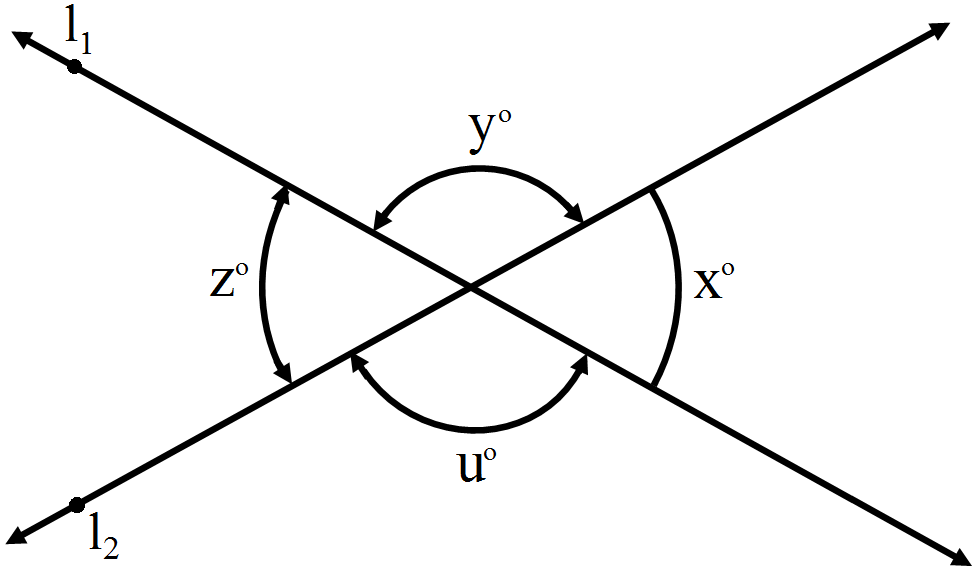
In Figure, lines $I_1$ and $I_2$ intersect at $O$, forming angles as shown in the figure. If $x=45^{\circ}$, find the values of $y, z$ and $u$.
Answer
$\angle z =\angle x =45^{\circ}$ (Vertically opposite angles)
Now,
$\angle x+\angle y=180^{\circ} \text { (Linear pair) }$
$\Rightarrow \angle y=180^{\circ}-45^{\circ}=135^{\circ}$
$\angle u=\angle y=135^{\circ} \text { (Vertically opposite angles }$
View full question & answer
Question 62 Marks
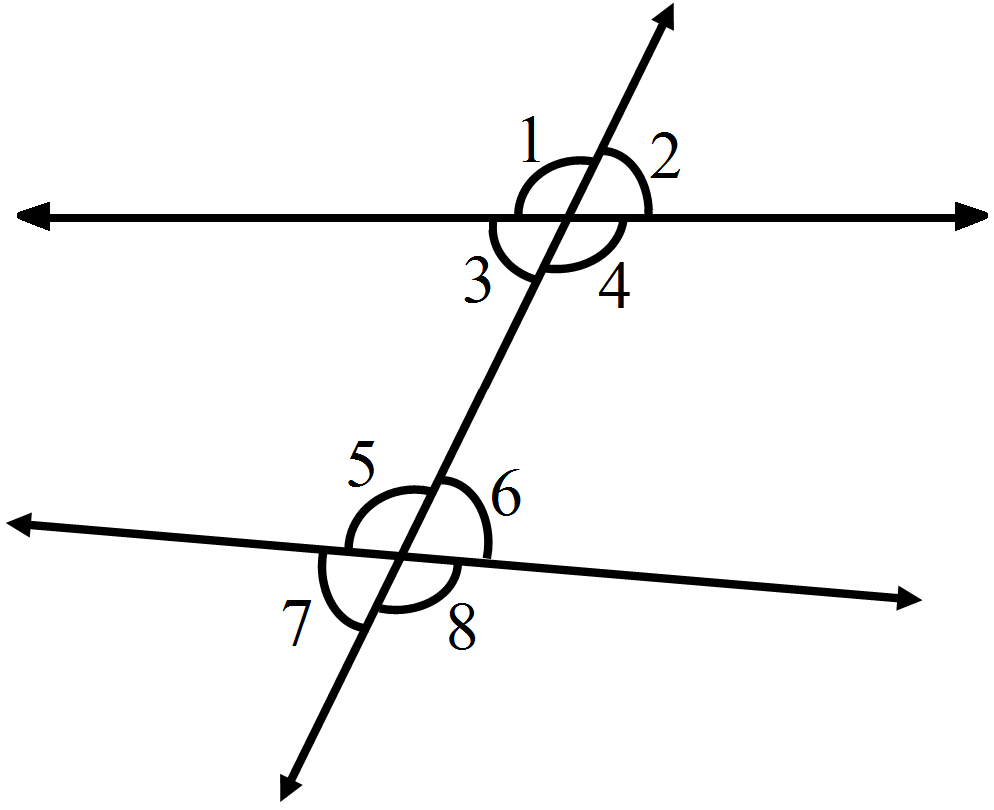
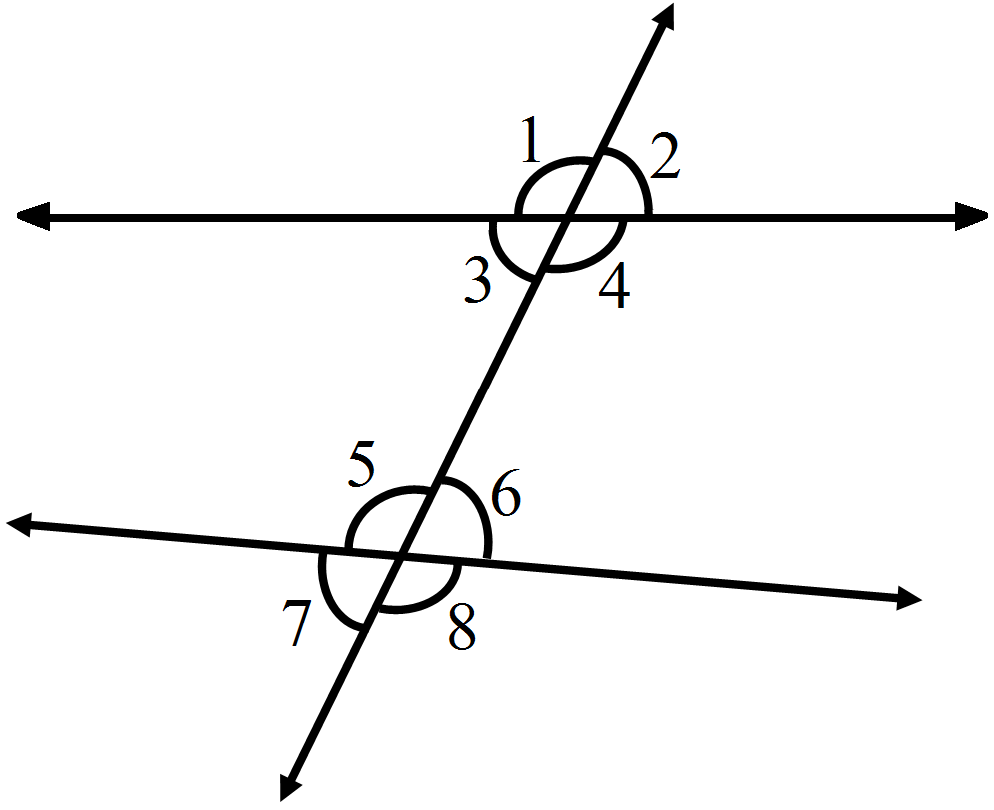
In fig. write down. Each pair of vertically opposite angles.
Answer
The two angles formed by two intersecting lines and have no common arms are called vertically opposite angles.
$\angle1 \text{ and }\angle4$
$\angle2 \text{ and }\angle3$
$\angle5 \text{ and }\angle8$
$\angle6 \text{ and }\angle7$
View full question & answer
Question 72 Marks
Can two obtuse angles be supplementary, if both of them be.
Obtuse?
Answer
No, two obtuse angles cannot be supplementary.
Because, the sum of two angles is greater than 90° so their sum will be greater than 180º.
View full question & answer
Question 82 Marks
If the supplement of an angle is 65°, then find its complement.
Answer
Let x be the required angle
So,
⇒ x + 65° = 180°
⇒ x = 180° - 65°
= 115°
But the complement of the angle cannot be determined.
View full question & answer
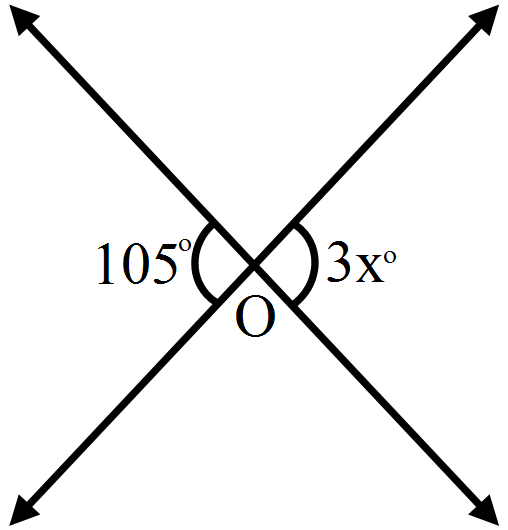
Question 92 Marks
Find the value of x in the following figure.
Answer
Linear pair:
$3\text{x}^\circ=105^\circ$
$\Rightarrow\text{x}^\circ=\frac{105^\circ}{3}$
$\Rightarrow\text{x}^\circ=45^\circ$
View full question & answer
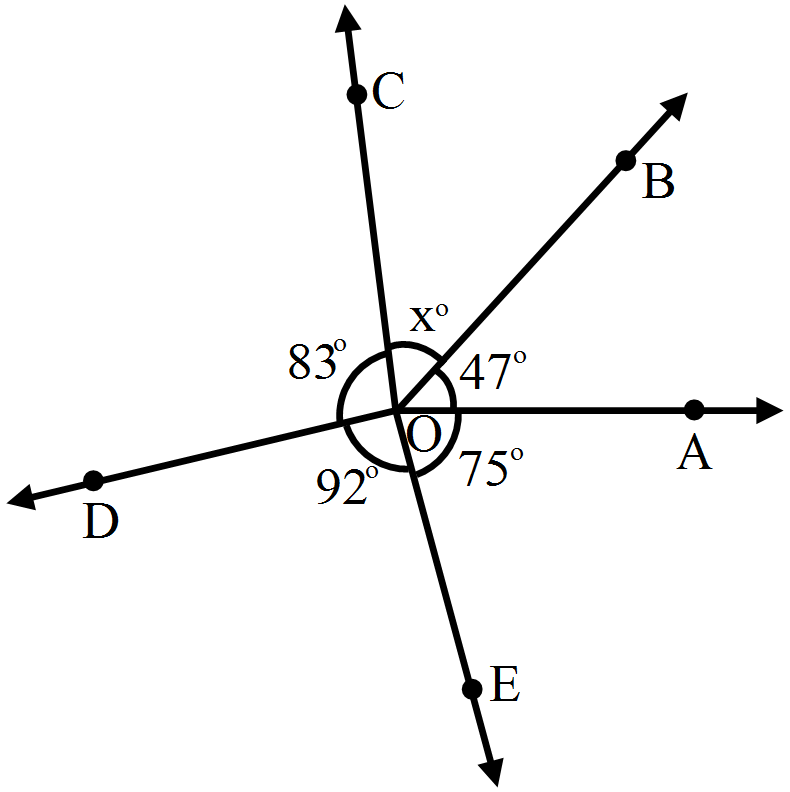
Question 102 Marks
Find the value of x in the following figure.
Answer
Linear pair:
83° + 92° + 47° + 75° + x° = 360°
⇒ x° + 297° = 360°
⇒ x° = 360° – 297°
⇒ x° = 63°
View full question & answer
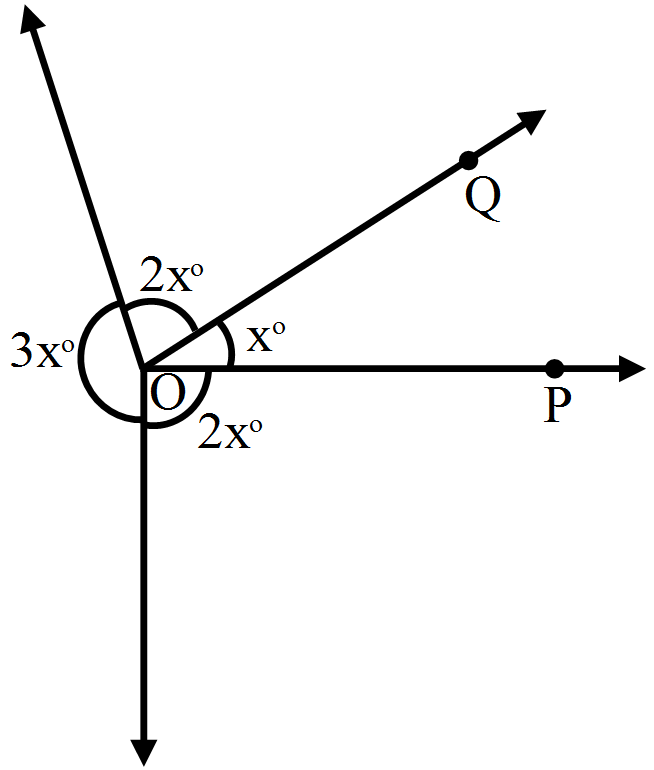
Question 112 Marks
Find the value of x in the following figure.
Answer
Linear pair:
$3\text{x}^\circ+2\text{x}^\circ+\text{x}^\circ+2\text{x}^\circ=360^\circ$
$\Rightarrow8\text{x}^\circ=360^\circ$
$\Rightarrow \text{x}^\circ=\frac{360^\circ}{8}$
$\Rightarrow \text{x}^\circ=45^\circ$
View full question & answer
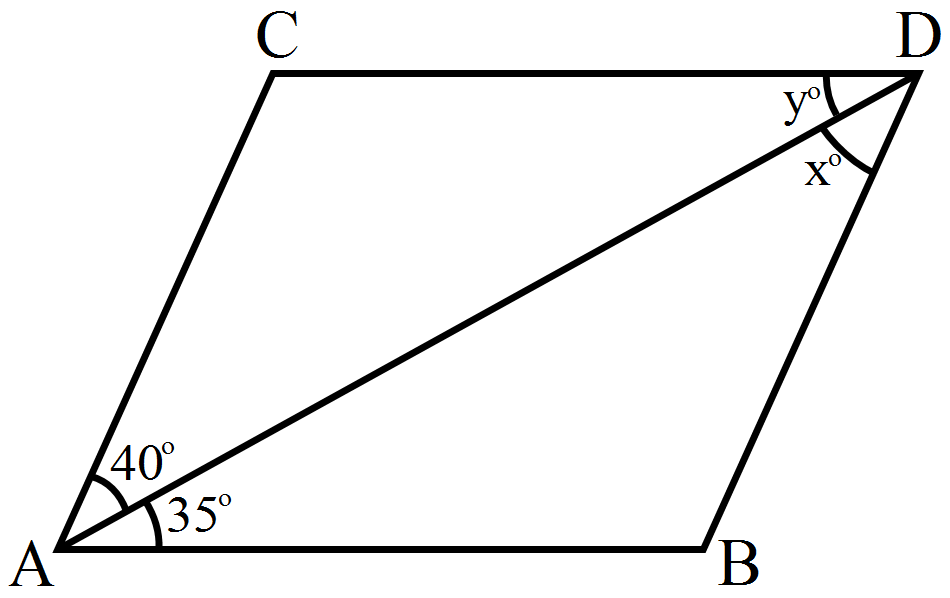
Question 122 Marks
In Figure, AB || CD and AC || BD. Find the values of x, y, z.
Answer
Here,
AC || BD and CD || AB
Alternate interior angles,
$\angle \text{DCA}=\text{x}=40^\circ$
$\angle \text{DAB}=\text{y}=35^\circ$
View full question & answer
Question 132 Marks
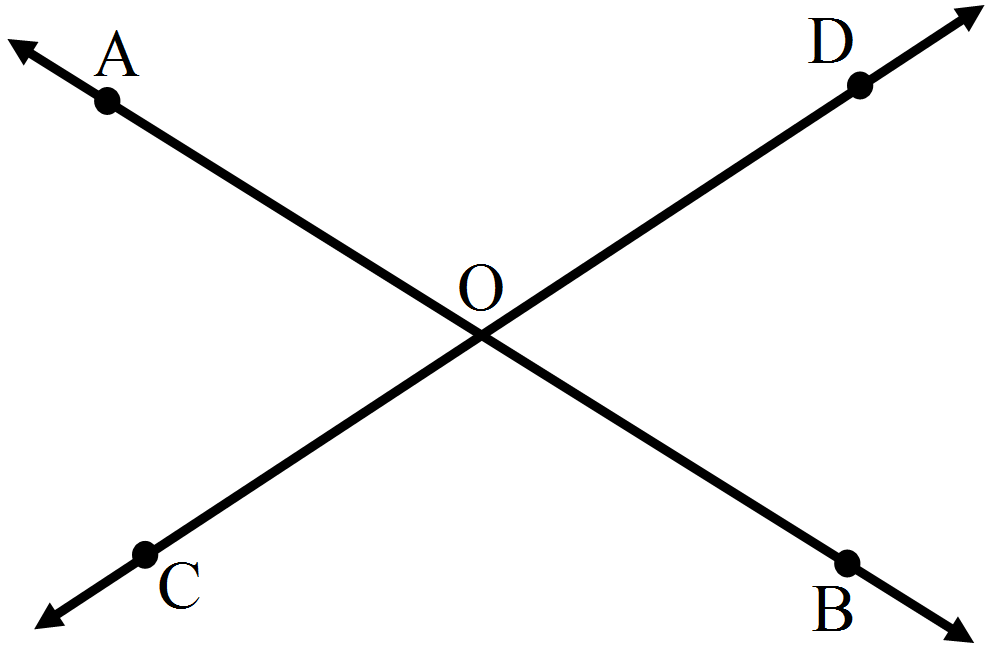
Name the four pairs of supplementary angles shown in Figure.
Answer
The supplementary angles are:
$\angle \text{AOC}\text{ and }\angle\text{COB}$
$\angle \text{BOC}\text{ and }\angle\text{DOB}$
$\angle \text{BOD}\text{ and }\angle\text{DOA}$
$\angle \text{AOC}\text{ and }\angle\text{DOA}$
View full question & answer
Question 142 Marks
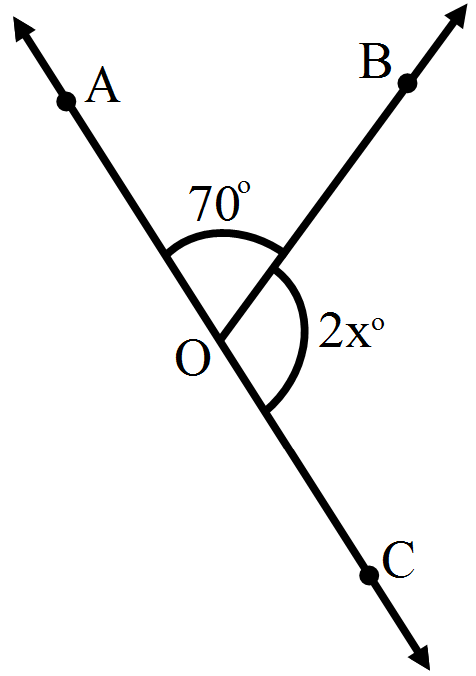
In Figure, AOC is a line, find x.
Answer
$\angle \text{AOB}+\angle \text{BOC}=180^\circ$
Linear pair,
$\Rightarrow 2\text{x}+70^\circ=180^\circ$
$\Rightarrow 2\text{x}=180^\circ-70^\circ$
$\Rightarrow 2\text{x}=110^\circ$
$\Rightarrow \text{x}=\frac{110^\circ}{2}$
$\Rightarrow \text{x}=55^\circ$
View full question & answer
Question 152 Marks
Can two obtuse angles be supplementary, if both of them be.
Right?
Answer
Yes, two right angles can be supplementary.
Because, 90° + 90° = 180°
View full question & answer
Question 162 Marks
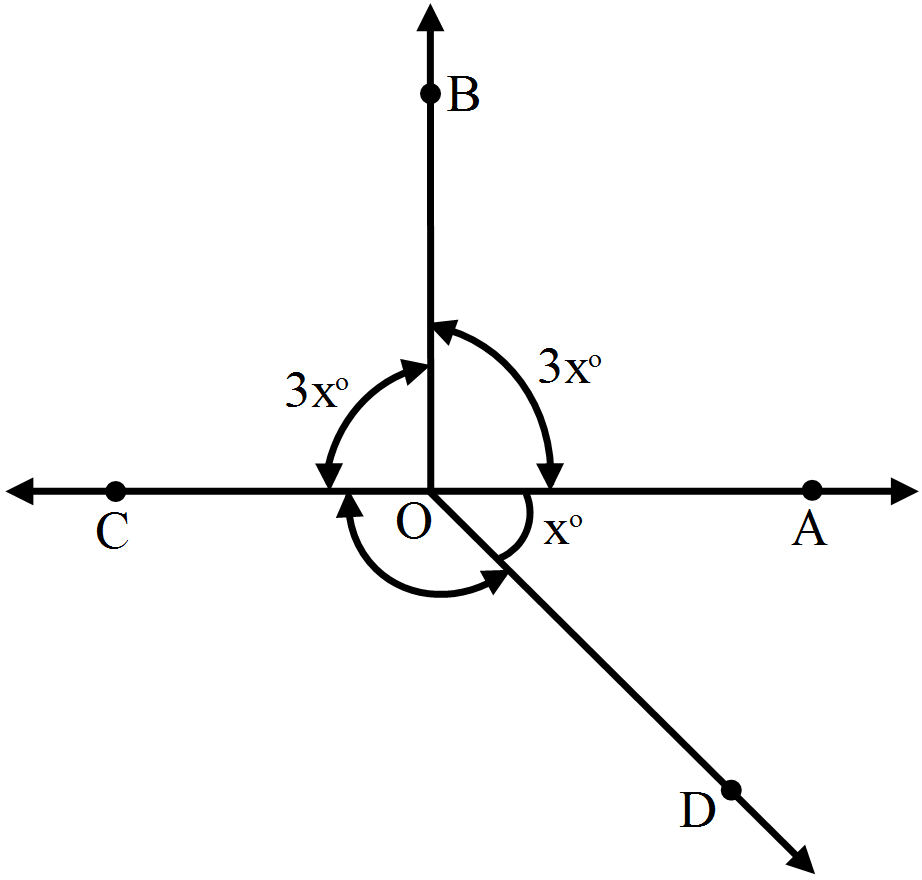
In Figure, determine the value of x.
Answer
Linear pair:
$\angle \text{COB}+\angle \text{AOB}=180^\circ$
$\Rightarrow 3\text{x}^\circ+3\text{x}^\circ=180^\circ$
$\Rightarrow 6\text{x}^\circ=180^\circ$
$\Rightarrow \text{x}^\circ=\frac{180^\circ}{6}$
$\Rightarrow \text{x}^\circ=30^\circ$
View full question & answer
Question 172 Marks
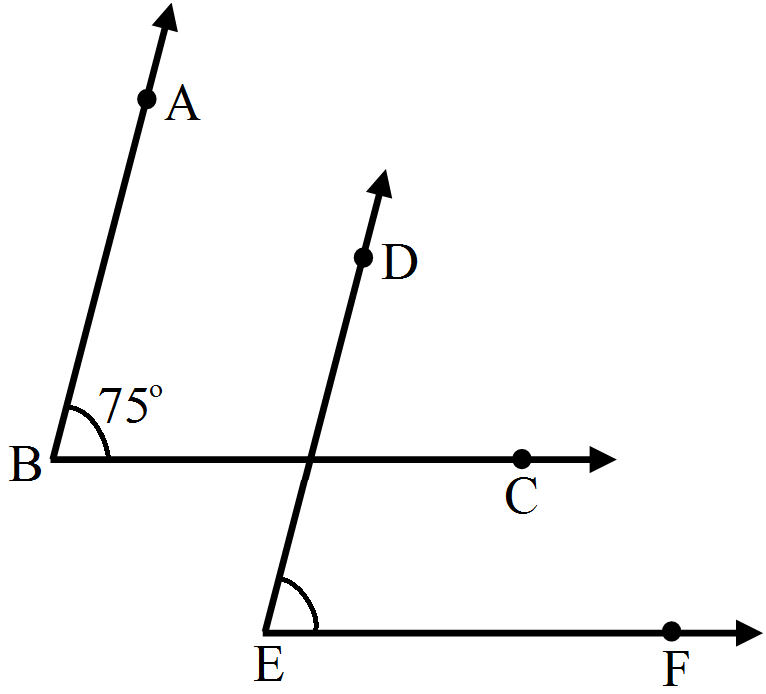
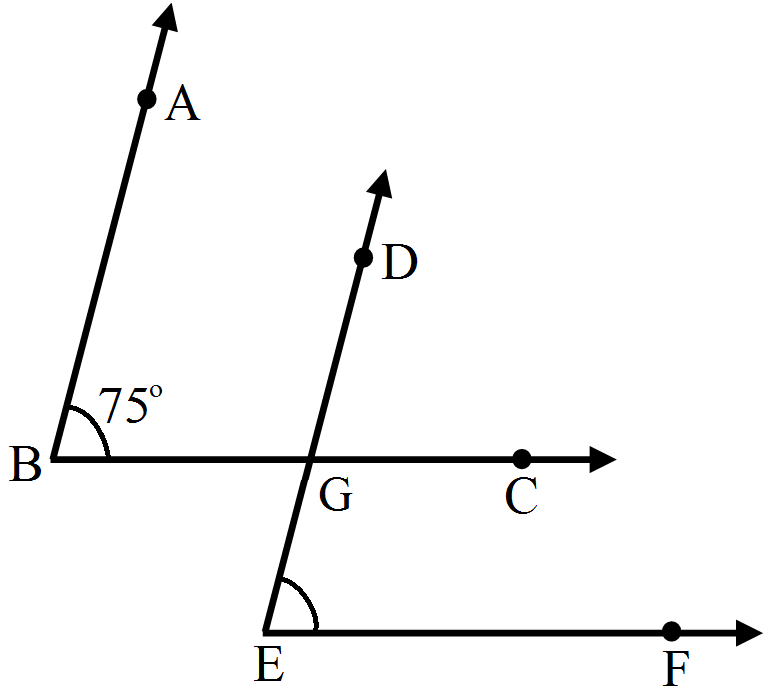
In fig. the corresponding arms of $\angle \text{ABC}$ and $\angle \text{DEF}$ are parallel. $\angle \text{ABC}=75^\circ,$ find $\angle \text{DEF}.$
Answer

Construction: Let G be the point of intersection of lines BC and DE.
$\because \text{AB}||\text{DE}$ and $\text{BC}||\text{EF}$
$\therefore \text{ABC}=\angle \text{DGC}=\angle \text{DEF}=75^\circ$ (Corresponding angles)
View full question & answer
Question 182 Marks
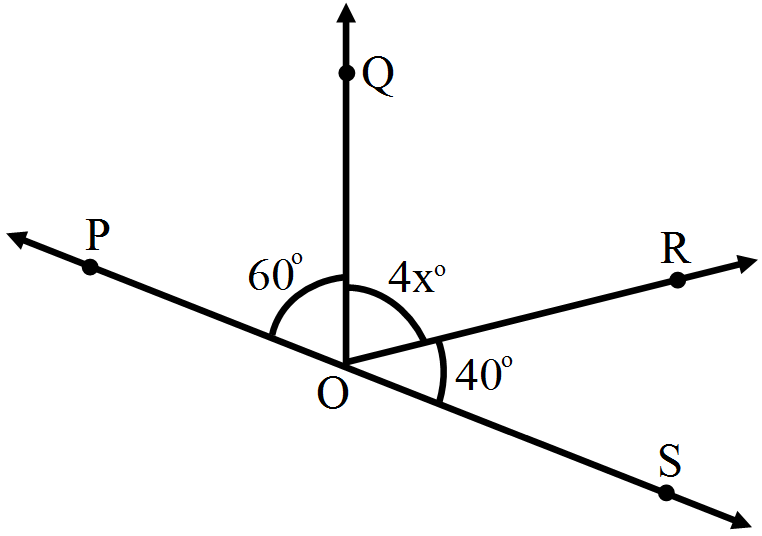
In Figure, POS is a line, find x.
Answer
Angles of a straight line,
$\angle \text{QOP}+\angle \text{QOR}+\angle \text{ROS}=108^\circ$
$\Rightarrow 60^\circ+4\text{x}+40^\circ=180^\circ$
$\Rightarrow 100^\circ+4\text{x}=180^\circ$
$\Rightarrow 4\text{x}=180^\circ-100^\circ$
$\Rightarrow4\text{x}=80^\circ$
$\Rightarrow \text{x}=\frac{80^\circ}{4}$
$\Rightarrow\text{x}=20^\circ$
View full question & answer
Question 192 Marks
Can two obtuse angles be supplementary, if both of them be.
Acute?
Answer
No, two acute angle cannot be supplementary.
Because, the sum of two angles is less than 90º so their sum will also be less tha 90º.
View full question & answer
Question 202 Marks
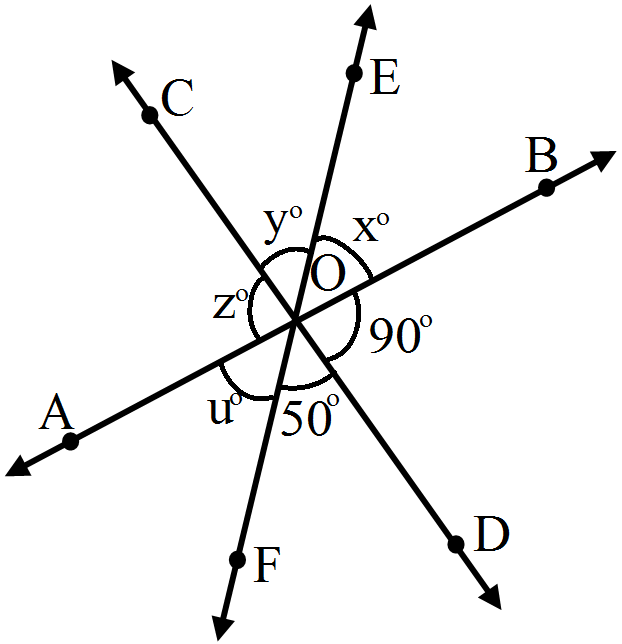
In Figure, three coplanar lines intersect at a point O, forming angles as shown in the figure. Find the values of x, y, z and u.
Answer
$\angle \text{BOD}+\angle \text{DOF}+\angle \text{FOA}=180^\circ$ (Linear pair)
$\therefore \angle \text{FOA}=\angle \text{u}=180^\circ-90^\circ-50^\circ=40^\circ$
$\angle \text{FOA}=\angle \text{x}=40^\circ$ (Vertically opposite angles)
$\angle \text{BOD}=\angle \text{z}=90^\circ$ (Vertically opposite angles)
$\angle \text{EOC}=\angle \text{y}=50^\circ$ (Vertically opposite angles)
View full question & answer
Question 212 Marks
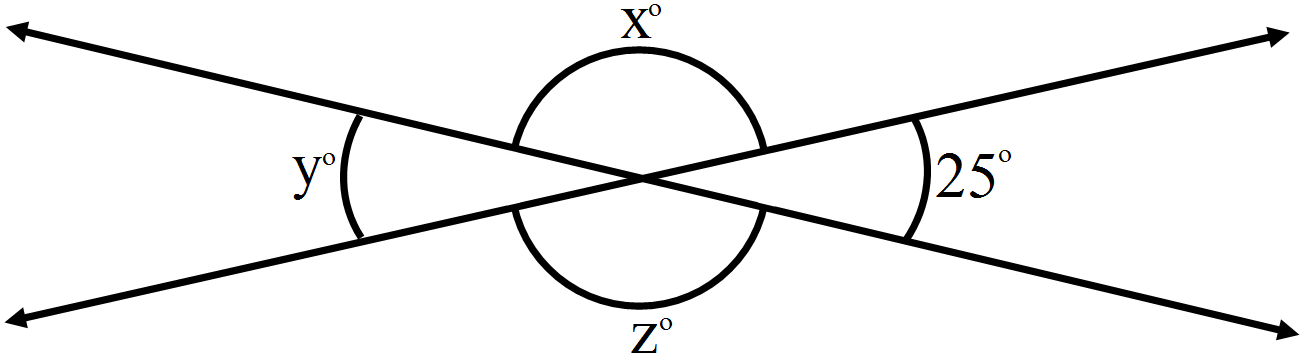
In Figure, find the values of x, y and z.
Answer
$\angle \text{y}=25^\circ$ (Vertically opposite angles)
Since, $\angle \text{x}+\angle \text{y}=180^\circ$ (Linear pair)
$\therefore \angle \text{x}=180^\circ-25^\circ=155^\circ$
$\angle \text{z}=\angle \text{x}=155^\circ$ (Vetically opposite angles)
View full question & answer
Question 222 Marks
In fig. write down.
Each linear pair.
Answer
The two adjacent angles are said to form a linear pair of angles if their non-common arms are two opposite rays.
$\angle1 \text{ and }\angle3$
$\angle1 \text{ and }\angle2$
$\angle4 \text{ and }\angle3$
$\angle4 \text{ and }\angle2$
$\angle5 \text{ and }\angle6$
$\angle5 \text{ and }\angle7$
$\angle6 \text{ and }\angle8$
$\angle7 \text{ and }\angle8$
View full question & answer