Questions

4 Mark Question

Take a timed test

19 questions · self-marked practice — reveal the answer and mark yourself.

Question 14 Marks
In $\triangle \text{ABC}, \ \angle \text{B} =60^\circ, \angle \text{C}=40^\circ,\text{AL}\bot \text{BC}$ and AD bisects $\angle \text{A}$ such that L and D lie on side BC. Find $\angle \text{LAD}$
Answer
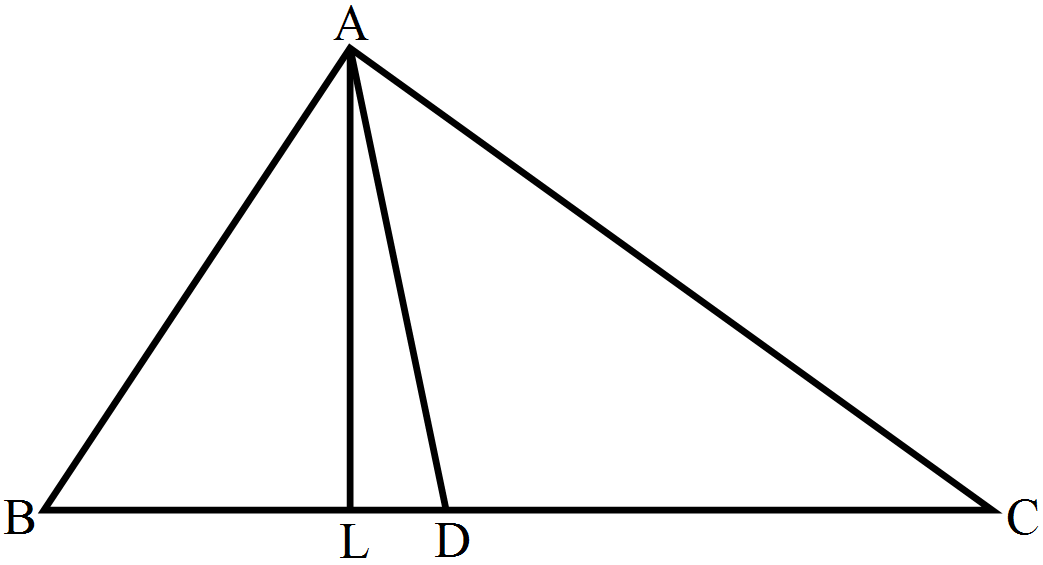
We know that the sum of all angles of a triangle is 180º
Therefore, for $\triangle \text{ABC},$ we can say that:
$\angle \text{A}+\angle \text{B}+\angle \text{C}=180^\circ$
Or,
$\angle \text{A}+60^\circ+40^\circ=180^\circ$
$\Rightarrow\angle \text{A} =80^\circ$
$\angle \text{DAC}=\frac{\angle \text{A}}{2}$ $(\because $ AD bisects $\angle \text{A})$
$\Rightarrow \angle \text{DAC}=\frac{80^\circ}{2}=40^\circ$
If we use the aboce logic on $\triangle \text{ADC},$ we can say that:
$\angle \text{ADC}+\angle \text{DCA}+\angle \text{DAC}=180^\circ$ $($Sum of all angles of $\triangle \text{ADC})$
$\angle \text{ADC}+40^\circ+40^\circ=180^\circ$
$\angle \text{ADC}=180^\circ-80^\circ=100^\circ$
$\angle \text{ADC}=\angle \text{ALD}+\angle \text{LAD}$ (Exterior angle is equal to the sum of two interior opposite angles)
$100^\circ=90^\circ+\angle \text{LAD}$ (AL perpendicular to BC)
$\angle \text{LAD}=90^\circ$
View full question & answer
Question 24 Marks
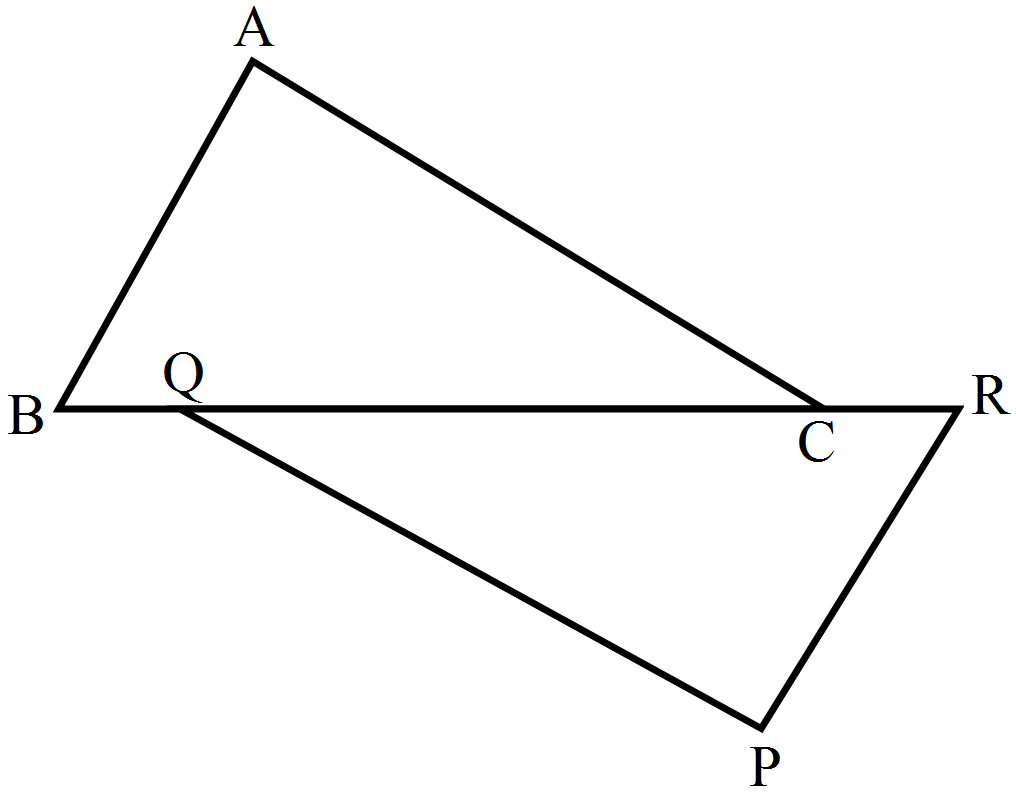
In Figure, $\triangle \text{ABC}$ is right angled at A, Q and R are points on line BC and P is a point such that QP perpendicular to AC and RP perpendicular to AB. Find $\angle \text{P}$
Answer
In the given triangle, AC parallel to QP and BR cuts AC and QP at C and Q, respectively.
$\angle \text{QCA}=\angle \text{CQP}$ (Alternate interior angles)
Because RP parallel to AB and BR cuts AB and RP at B and R, respectively,
$\angle \text{ABC}=\angle \text{PRQ}$ (alternate interior angles)
We know that the sum of all three angles of a triangle is 180°
Hence, for $\triangle \text{ABC},$ we can say that:
$\angle \text{ABC}+\angle \text{ACB}+\angle \text{BAC}=180^\circ$
$\angle \text{ABC}+\angle \text{ACB}+90^\circ=180^\circ$ (Right angled at A)
$\angle \text{ABC}+\angle \text{ACB}=90^\circ$
Using the same logic for $\triangle \text{PQR},$ we can say that:
$\angle \text{PQR}+\angle \text{PRQ}+\angle \text{QPR}=180^\circ$
$\angle \text{ABC}+\angle \text{ACB}+\angle \text{QPR}=180^\circ$ $(\angle \text{ABC}=\angle \text{PRQ} $ and $\angle \text{QCA}=\angle \text{CQP})$
Or,
$90^\circ+\angle \text{QPR}=180^\circ$ $(\angle \text{ABC}+\angle \text{ACB}=90^\circ)$
$\angle \text{QPR}=90^\circ$
View full question & answer
Question 34 Marks
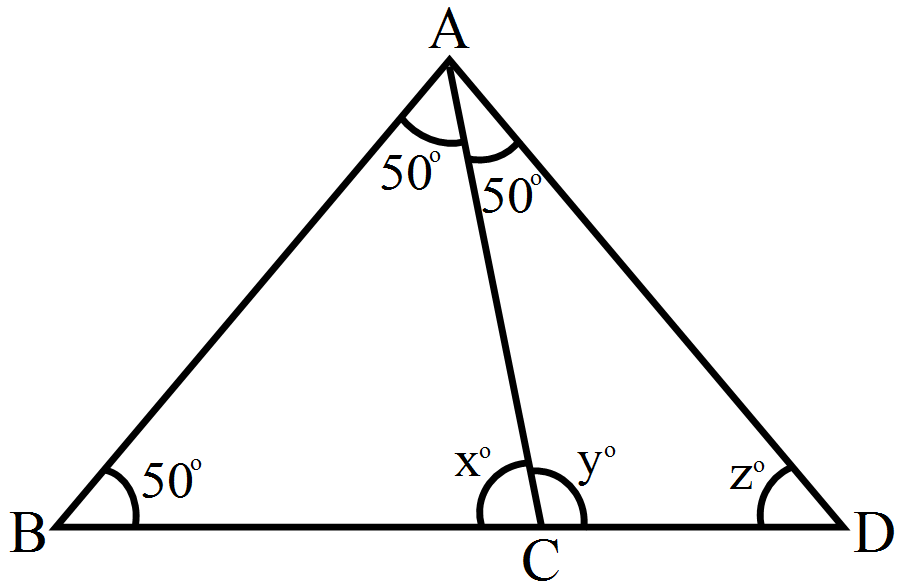
Find x, y, z (whichever is required) from the figure given below:
Answer
We know that the sum of all the angles of a triangle is equal to 180°
Therefore, for $\triangle \text{ABD}:$
$\angle \text{ABD}+\angle \text{ADB}+\angle \text{BAD}=180^\circ$ $($Sum of the angles of $\triangle \text{ABD})$
50° + x + 50° = 180°
100° + x = 180°
x = 180° - 100°
x = 80°
For $\triangle \text{ABC}:$
$\angle \text{ABC}+\angle \text{ACB}+\angle \text{BAC}=180^\circ$ $($Sum of the angles of $\triangle \text{ABC})$
50° + z + (50° + 30°) = 180°
50° + z + 50° + 30° = 180°
z = 180° - 130°
z = 50°
Using the same argument for $\triangle \text{ADC}:$
$\angle \text{ADC}+\angle \text{ACD}+\angle \text{DAC}=180^\circ$ $($Sum of the angles of $\triangle \text{ADC})$
y + z + 30° = 180°
y + 50° + 30° = 180° (z = 50°)
y = 180° - 80°
y = 100°
Therefore, we can conclude that the required angles are 80°, 50° and 100°
View full question & answer
Question 44 Marks
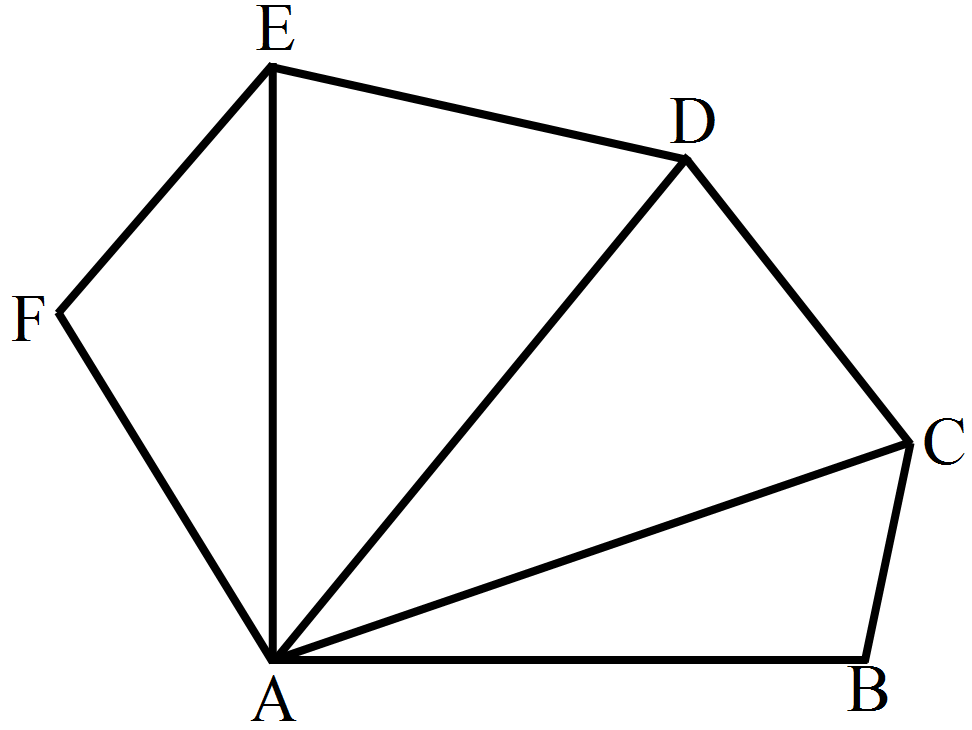
AC, AD and AE are joined. Find.
$\angle \text{FAB}+\angle \text{ABC}+\angle \text{BCD}+\angle \text{CDE} +\angle \text{DEF}+\angle \text{EFA}$
Answer

We know that sum of the angles of a triangle is 180°
Therefore in $\triangle \text{ABC},$ we have
$\angle \text{CAB}+\angle \text{ABC}+\angle \text{BCA}=180^\circ...(\text{i})$
In $\triangle \text{ACD},$ we have
$\angle \text{DAC}+\angle \text{ACD}+\angle \text{CDA}=180^\circ...(\text{ii})$
In $\triangle \text{ADE},$ we have
$\angle \text{EAD}+\angle \text{ADE}+\angle \text{DEA}=180^\circ...(\text{iii})$
In, $\triangle \text{AEF},$ we have
$\angle \text{FAE}+\angle \text{AEF}+\angle \text{EFA}=180^\circ...(\text{iv})$
Adding (i), (ii), (iii), (iv) we get
$\angle \text{CAB}+\angle \text{ABC}+\angle \text{BCA}+\angle \text{DAC}+\angle \text{ACD}\\+\angle \text{CDA}+\angle \text{AD}+\angle \text{ADE}+\angle \text{DEA}+\angle \text{FAE}\\+\angle \text{AEF}+\angle \text{EFA}=720^\circ$
Therefore $\angle \text{FAB}+\angle \text{ABC}+\angle \text{BCD}\\+\angle \text{CDE}+\angle \text{DEF}+\angle \text{EFA}=720^\circ$
View full question & answer
Question 54 Marks
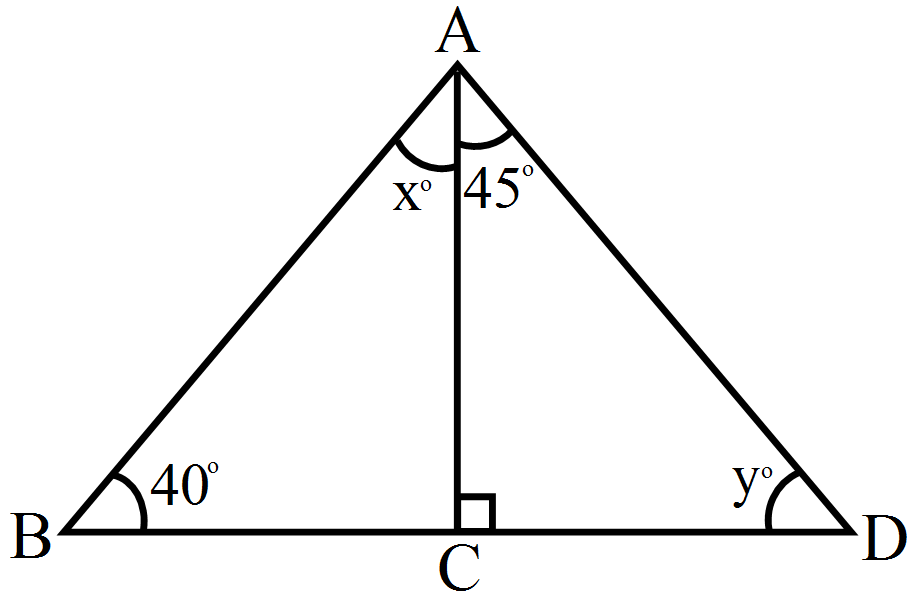
Find x, y, z (whichever is required) from the figure given below:
Answer
We can see that in $\triangle \text{ADC}, \angle \text{ADC}$ is equal to 90°
$(\triangle \text{ADC}$ is a right triangle$)$
We also know that the sum of all the angles of a triangle is equal to 180°
Which means: 45° + 90° + y = 180° $($Sum of the angles of $\triangle \text{ADC})$
135° + y = 180°
y = 180° - 135°
y = 45°
We can also say that in $\triangle \text{ABC},\angle \text{ABC}+\angle \text{ACB}+\angle \text{BAC}$ is equal to 180°
$($Sum of the angles of $\triangle \text{ABC})$
40° + y + (x + 45°) = 180°
40° + 45° + x + 45° = 180° (y = 45°)
x = 180° - 130°
x = 50°
Therefore, we can say that the required angles are 45° and 50°
View full question & answer
Question 64 Marks
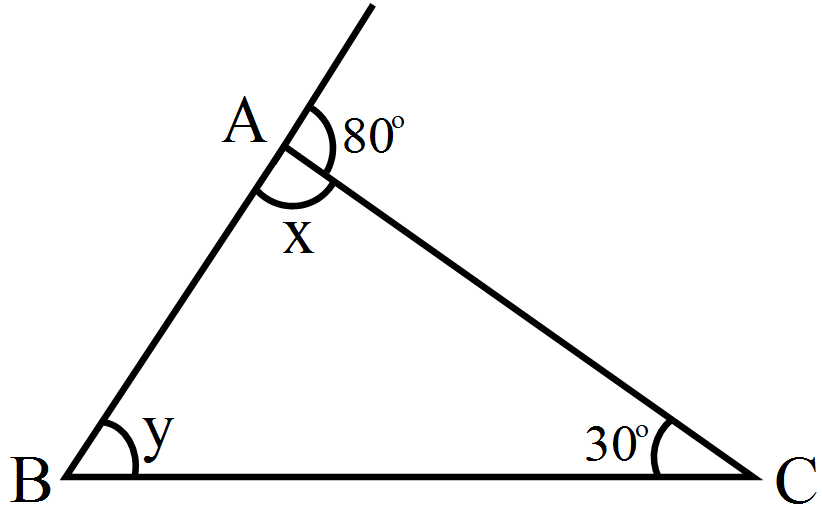
Explain the concept of interior and exterior angle and in the figures given below. Find x and y.
Answer
The interior angles of a triangle are the three angle elements inside the triangle.
The exterior angles are formed by extending the sides of a triangle, and if the side of a triangle is produced, the exterior angle so formed is equal to the sum of the two interior opposite angles.
Using these definitions, we will obtain the values of x and y.
x + 80º = 180º (Linear pair)
x = 100º
In $\triangle \text{ABC}:$
x + y+ 30° = 180° (Angle sum property)
100° + 30° + y = 180°
y = 50°
View full question & answer
Question 74 Marks
If each angle of a triangle is less than the sum of the other two, show that the triangle is acute angled.
Answer
Let the three angles of the triangle be $\angle \text{a}, \angle \text{b}$ and $\angle \text{c}$
We know: $\angle \text{a}<\angle \text{b}+\angle \text{c}....(\text{i})$ (Given)
Which means: $\angle \text{b}<\angle \text{a}+\angle \text{c}$
Or, $\angle \text{c}<\angle \text{a}+\angle \text{b}$
We also know that the sum of all the angles of a triangle is equal to 180º
Which means: $\angle \text{a}+\angle \text{b}+\angle \text{c}=180^\circ$
Or, $\angle \text{b}+\angle \text{c}=180^\circ-\angle \text{a}$
Putting the value of $\angle \text{b}+\angle \text{c}$ in equation (i):
$\angle \text{a}<180^\circ-\angle \text{a}$
$\Rightarrow 2\angle \text{a}<180^\circ$
$\angle \text{a}<90^\circ$
Similary:
$\angle \text{b}<90^\circ$
$\angle \text{c}<90^\circ$
Hence, we can conclude that the given triangle is an acute triangle.
View full question & answer
Question 84 Marks
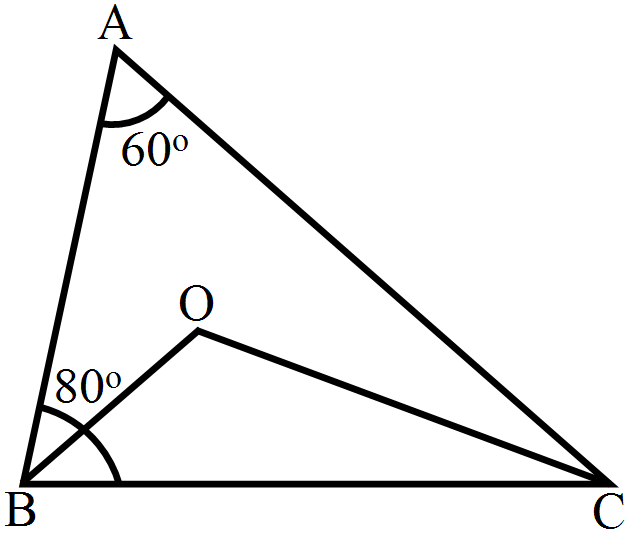
In $\angle \text{ABC}, \angle \text{A}=60^\circ,\ \angle \text{B}=80^\circ, $ and the bisectors of $\angle \text{B}$ and $\angle \text{C},$ meet at O. Find.
  1. $\angle \text{C}$
  2. $\angle \text{BOC}$
Answer

We know that the sum of all three angles of a triangle is 180°
Hence, for $\triangle \text{ABC},$ we can say that:
$\angle \text{A}+\angle \text{B}+\angle \text{C}=180^\circ$ $($Sum of angles of $\triangle \text{ABC})$
$60^\circ+80^\circ+\angle \text{C}=180^\circ$
$\angle \text{C}=180^\circ-140^\circ$
$\angle \text{C}=40^\circ$
For $\angle \text{OBC},$
$\angle \text{OBC}=\angle \text{B}2=\frac{80}{2}$ $($OB bisects $\angle \text{B})$
$\angle \text{OBC}=40^\circ$
$\angle \text{OCB}=\angle \text{C}2=\frac{40}{2}$ $($OC bisects $\angle \text{C})$
$\angle \text{OCB}=20^\circ$
If we apply the above logic to this triangle, we can say that:
$\angle \text{OCB}+\angle \text{OBC}+\angle \text{BOC}=180^\circ$ $($Sum of angles of $\triangle \text{OBC})$
$20^\circ+40^\circ+\angle \text{BOC}=180^\circ$
$\angle \text{BOC}=180^\circ-60^\circ$
$\angle \text{BOC}=120^\circ$
View full question & answer
Question 94 Marks
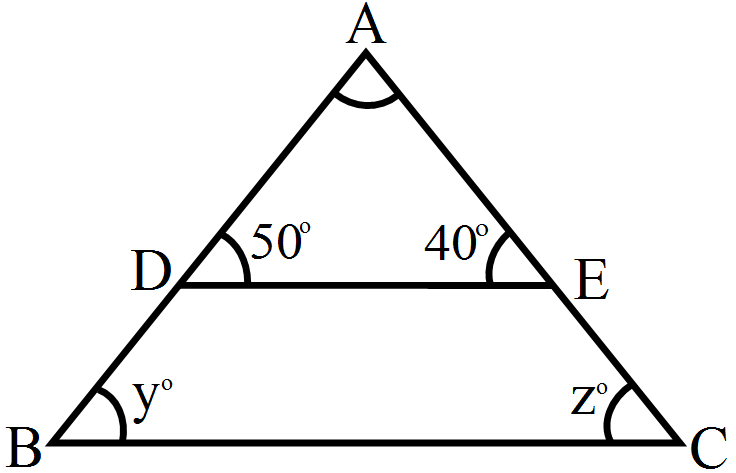
Find x, y, z (whichever is required) from the figure given below:
Answer
In $\triangle \text{ABC}$ and $\triangle \text{ADE}$ we have:
$\angle \text{ADE}=\angle \text{ABC}$ (Corresponding angles)
$\text{y}=50^\circ$
Also, $\angle \text{AED}=\angle \text{ACB}$ (Corresponding angles)
$\text{z}=40^\circ$
We know that the sum of all the three angles of Which means: x + 50° + 40° = 180°
Which means: x + 50° + 40° = 180° $($Angles of $\triangle \text{ADE})$
x = 180° - 90°
x = 90°
Therefore, we can conclude that the required angles are 50°, 40° and 90°
View full question & answer
Question 104 Marks
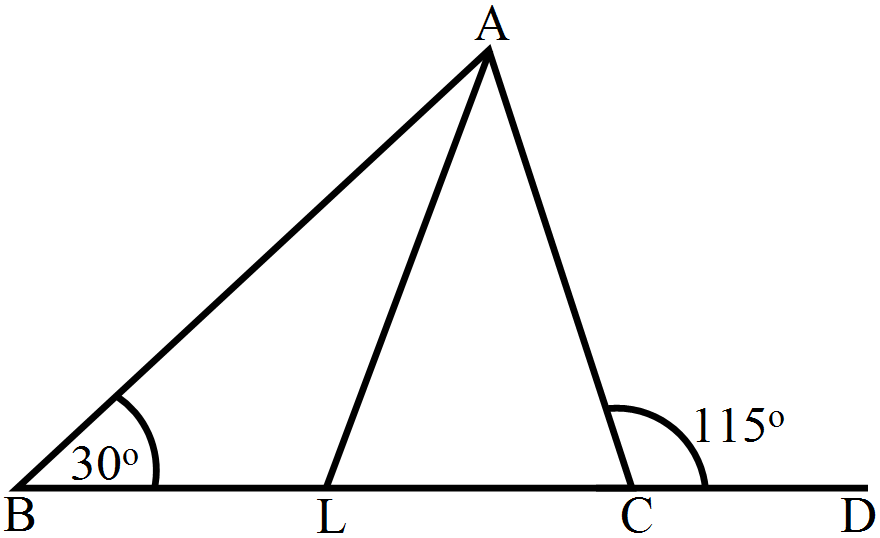
The side BC of $\triangle \text{ABC}$ is produced to a point D. The bisector of $\angle \text{A}$ meets side BC in L. If $\angle \text{ABC}= 30^\circ$ and $\angle \text{ACD}=115^\circ,$ find $\angle \text{ALC}$
Answer

$\angle \text{ACD}$ and $\angle \text{ACL}$ make a linear pair
$\angle \text{ACD}+\angle \text{ACB}=180^\circ$
$115^\circ+\angle \text{ACB}=180^\circ$
$\angle \text{ACB}=180^\circ-115^\circ$
$\angle \text{ACB}=65^\circ$
We know that the sum of all angles of a triangle is 180°
Therefore, for $\triangle \text{ABC}, $ we can say that:
$\angle \text{ABC}+\angle \text{BAC}+\angle \text{ACB}=180^\circ$
$30^\circ+\angle \text{BAC}+65^\circ=180^\circ$
Or,
$\angle \text{BAC}=85^\circ$
$\angle \text{LAC}=\frac{\angle \text{BAC}}{2}=\frac{85}{2}$
Using the above rule for $\triangle \text{ALC},$ we can say that:
$\angle \text{ALC}+\angle \text{LAC}+\angle \text{ACL}=180^\circ$
$\angle \text{ALC}+\frac{82^\circ}{2}+65^\circ=180^\circ$ $(\angle \text{ACL}=\angle \text{ACB})$
Or,
$\angle \text{ALC}=180^\circ-\frac{85^\circ}{2}-65^\circ$
$\angle \text{ALC}=\frac{145^\circ}{2}=72\frac{1}{2}^\circ$
View full question & answer
Question 114 Marks
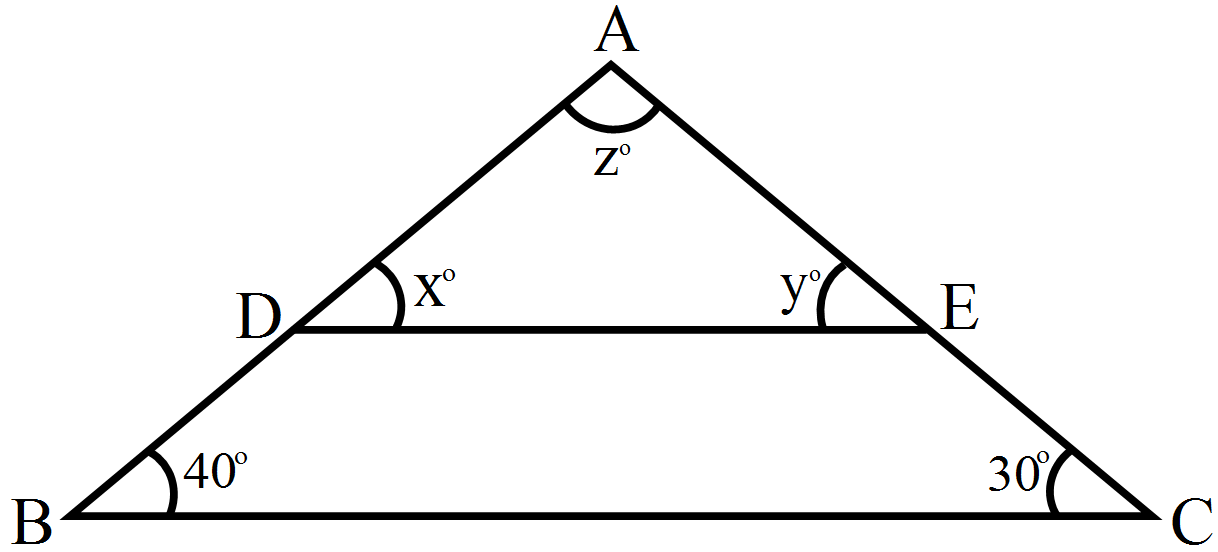
Find x, y, z (whichever is required) from the figure given below:
Answer
In $\triangle \text{ABC}$ and $\triangle \text{ADE}$ we have:
$\angle \text{ADE}=\angle \text{ABC}$ (Corresponding angles)
$\text{x}=40^\circ$
$\angle \text{AED}=\angle \text{ACB}$ (Corresponding angles)
$\text{y}=30^\circ$
We know that the sum of all the three angles of a triangle is equal to 180°
x + y + z = 180° $($Angles of $\triangle \text{ADE})$
Which means: 40° + 30° + z = 180°
z = 180° - 70°
z = 110°
Therefore, we can conclude that the three angles of the given triangle are 40°, 30° and 110°
View full question & answer
Question 124 Marks
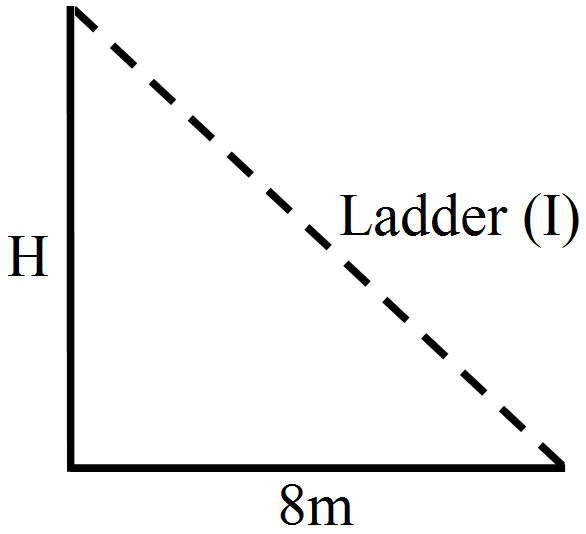
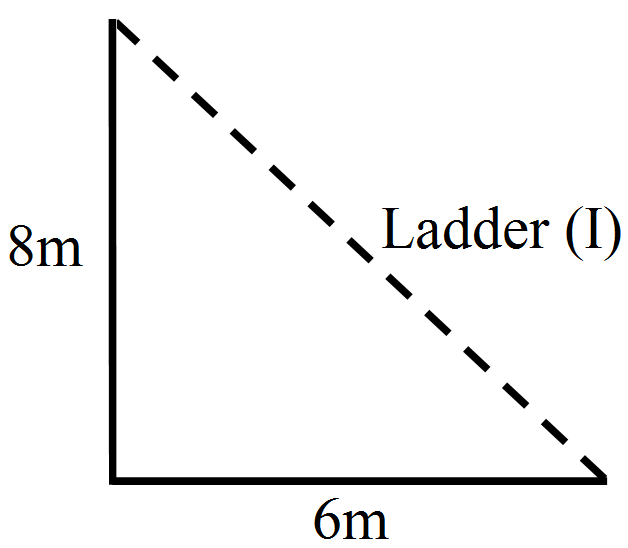
The foot of a ladder is 6m away from a wall and its top reaches a window 8m above the ground. If the ladder is shifted in such a way that its foot is 8m away from the wall, to what height does its top reach?
Answer

Given Let the length of the ladder be L m .
By using the Pythagoras theorem, we can find the length of the ladder.
$6^2+8^2=L^2$
$L^2=36+64=100$
$L=10$
Thus, the length of the ladder is 10 m .

When the ladder is shifted:
Let the height of the ladder after it is shifted be H m .
By using the Pythagoras theorem, we can find the height of the ladder after it is shifted.
$8^2+H^2=10^2$
$H^2=100-64$
$=36$
$H=6$
Thus, the height of the ladder is 6 m .
View full question & answer
Question 134 Marks
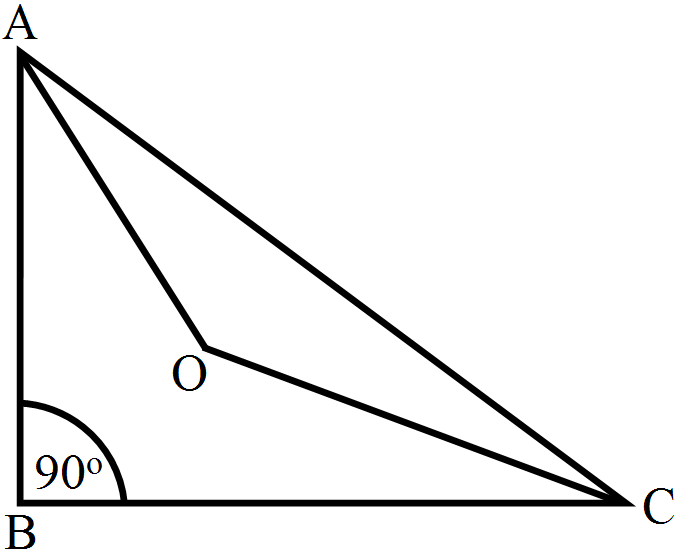
The bisectors of the acute angles of a right triangle meet at O. Find the angle at O between the two bisectors.
Answer

We know that the sum of all three angles of a triangle is 180°
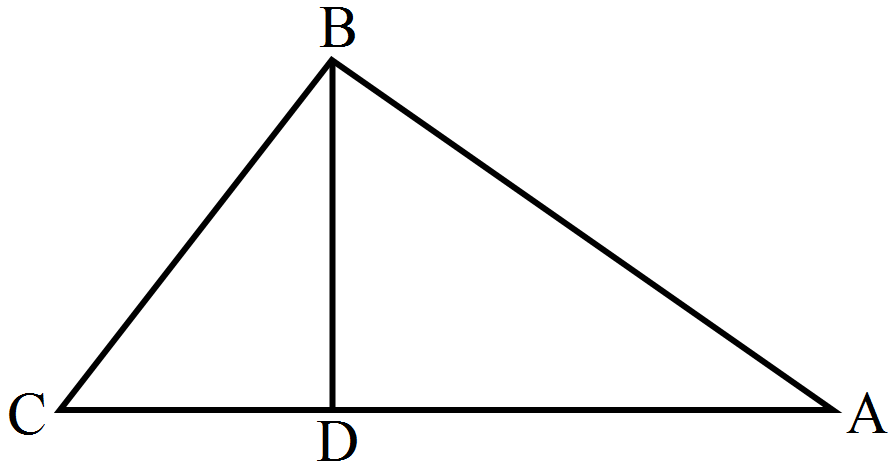
Hence, for $\triangle \text{ABC},$ we can say that:
$\angle \text{A}+\angle \text{B}+\angle \text{C}=180^\circ$
$\angle \text{A}+90^\circ+\angle \text{C}=180^\circ$
$\angle \text{A}+\angle \text{C}=180^\circ-90^\circ$
$\angle \text{A}+\angle \text{C}=90^\circ$
For $\triangle \text{OAC}:$
$\angle \text{OAC}=\angle \text{A}2$ (OA bisects LA)
$\angle \text{OCA}=\angle \text{C}2$ (OC bisects LC)
On applying the above logic to $\triangle \text{OAC},$ we get:
$\angle \text{AOC}+\angle \text{OAC}+\angle \text{OCA}=180^\circ$ $($Sum of angles of $\angle \text{AOC})$
$\angle \text{AOC}+\angle \text{A}2+\angle \text{C}2=180^\circ$
$\angle \text{AOC}+\angle \text{A}+\angle \text{C}2=180^\circ$
$\angle \text{AOC}+\frac{90}{2}=180^\circ$
$\angle \text{AOC}=180^\circ-45^\circ$
$\angle \text{AOC}=135^\circ$
View full question & answer
Question 144 Marks
In $\triangle \text{ABC}, \angle \text{ABC}=100^\circ, \angle \text{BAC}=35^\circ$ and $\text{BD}\bot \text{AC}$ meets side AC in D. If BD = 2cm, find $\angle \text{C},$ and length DC.
Answer

We know that the sum of all angles of a triangle is 180°
Therefore, for the given $\triangle \text{ABC},$ we can say that:
$\angle \text{ABC}+\angle \text{BAC}+\angle \text{ACB}=180^\circ$
$100^\circ+35^\circ+\angle \text{ACB}=180^\circ$
$\angle \text{ACB}=180^\circ-135^\circ$
$\angle \text{ACB}=45^\circ$
$\angle \text{C}=45^\circ$
If we apply the above rule on $\triangle \text{BCD},$ we can say that:
$\angle \text{BCD}+\angle \text{BDC}+\angle \text{CBD}=180^\circ$
$45^\circ+90^\circ+\angle \text{CBD}=180^\circ$ $(\angle \text{ACD}=\angle \text{BCD}$ and BD parallel to AC$)$
$\angle \text{CBD}=180^\circ-135^\circ$
$\angle \text{CBD}=45^\circ$
We know that the sides opposite to equal angles have equal length.
Thus, BD = DC
DC = 2cm
View full question & answer
Question 154 Marks
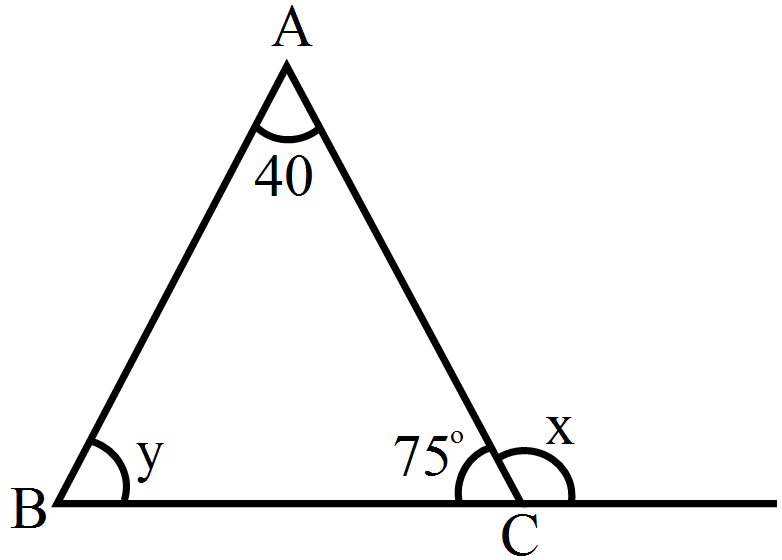
Explain the concept of interior and exterior angle and in the figures given below. Find x and y.
Answer
The interior angles of a triangle are the three angle elements inside the triangle.
The exterior angles are formed by extending the sides of a triangle, and if the side of a triangle is produced, the exterior angle so formed is equal to the sum of the two interior opposite angles.
Using these definitions, we will obtain the values of x and y.
From the given figure, we can see that:
$\angle \text{ACB}+\text{x}=180^\circ$ (Linear pair)'
$75^\circ+\text{x}=180^\circ$
Or,
$\text{x}=105^\circ$
We know that the sum of all angles of a triangle is 180°
Therefore, for $\triangle \text{ABC},$ we can say that:
$\angle \text{BAC}+\angle \text{ABC}+\angle \text{ACB}=180^\circ$
$40^\circ+\text{y}+75^\circ=180^\circ$
Or,
$\text{y}=65^\circ$
View full question & answer
Question 164 Marks
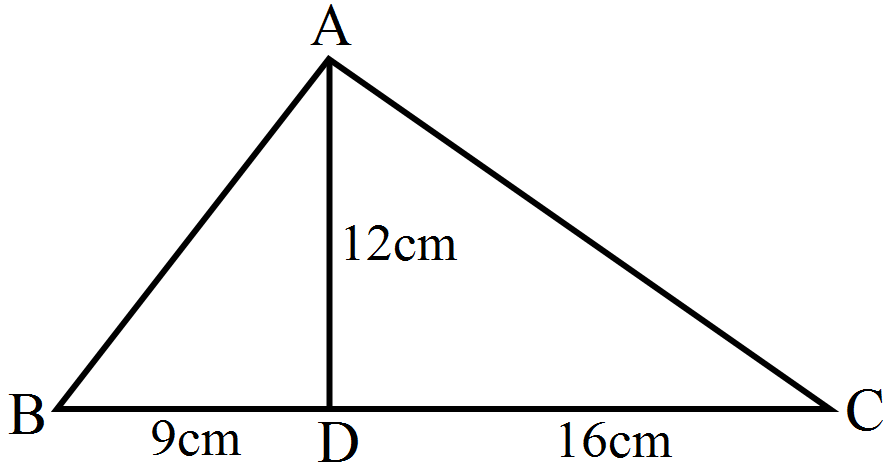
In a $\triangle \text{ABC},$ AD is the altitude from A such that AD = 12cm. BD = 9cm and DC = 16cm. Examine if $\triangle \text{ABC},$ is right angled at A.
Answer

In $\triangle ADC$,
$\angle ADC =90^{\circ}$ ( AD is an altitude on BC )
Using the Pythagoras theorem, we get:
$12^2+16^2=AC^2$
$AC C^2=144+256$
$=400$
$AC=20 cm$
In $\triangle ADB,$
$\angle ADB=90^{\circ}$
( AD is an altitude on BC )
Using the Pythagoras theorem, we get:
$12^2+9^2=A B^2$
$A B^2=144+81$
$=225$
$A B=15 cm$
In $\triangle ABC, $
$BC^2=25^2=625$
$AB^2+AC^2$
$=15^2+20^2$
$=625$
$AB^2+AC^2=BC^2$
Because it satisfies the Pythagoras theorem, we can say that $\triangle ABC$, is right angled at A .
View full question & answer
Question 174 Marks
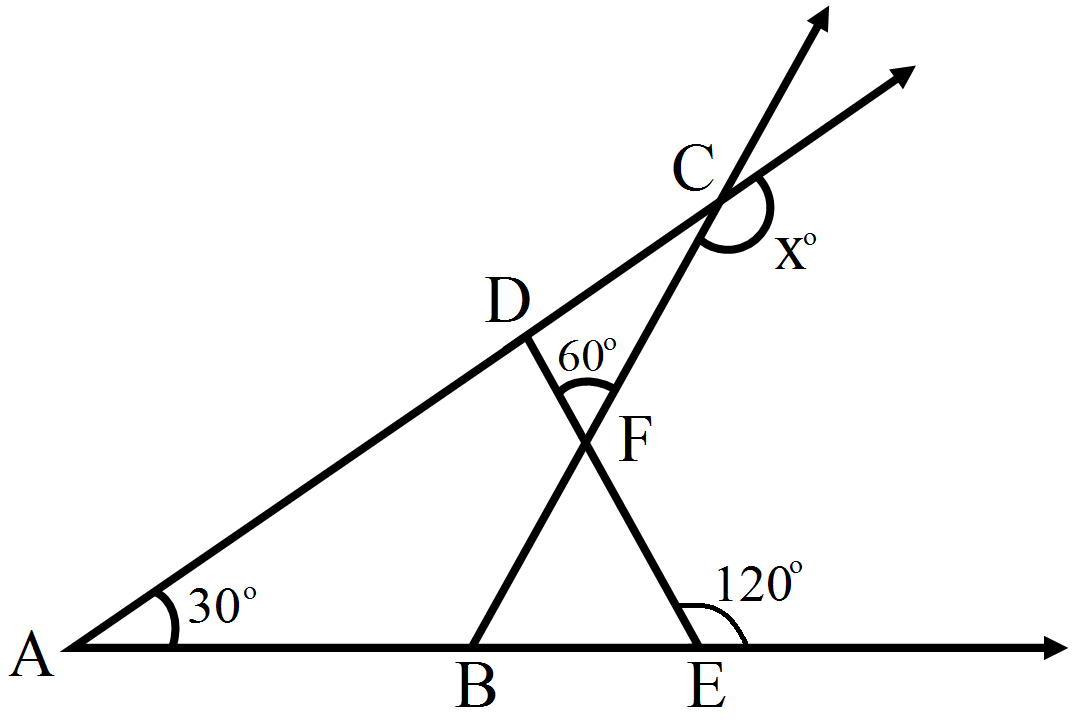
In Figure, measures of some angles are indicated. Find the value of x.
Answer
Here,
$\angle \text{AED}+120^\circ=180^\circ$ (Linear pair)
$\angle \text{AED}=180^\circ-120^\circ$
$=60^\circ$
We know that the sum of all angles of a triangle is 180°
Therefore, for $\triangle \text{ADE},$ we can say that:
$\angle \text{ADE}+\angle \text{AED}+\angle \text{DAE}=180^\circ$
$60^\circ+\angle \text{ADE}+30^\circ=180^\circ$
Or,
$\angle \text{ADE}=180^\circ-60^\circ-30^\circ$
$=90^\circ$
From the given figure, we can also say that:
$\angle \text{FDC}+90^\circ=180^\circ$ (Linear pair)
$\angle \text{FDC}=180^\circ-90^\circ=90^\circ$
Using the above rule for $\triangle \text{CDF},$ we can say that:
$\angle \text{CDF}+\angle \text{DCF}+\angle \text{DFC}=180^\circ$
$90^\circ+\angle \text{DCF}+60^\circ=180^\circ$
$\angle \text{DCF}=180^\circ-60^\circ-90^\circ$
$=30^\circ$
Also,
$\angle \text{DCF}+\text{x}=180^\circ$ (Linear pair)
$30^\circ+\text{x}=180^\circ$
Or,
$\text{x}=180^\circ-30^\circ$
$=150^\circ$
View full question & answer
Question 184 Marks
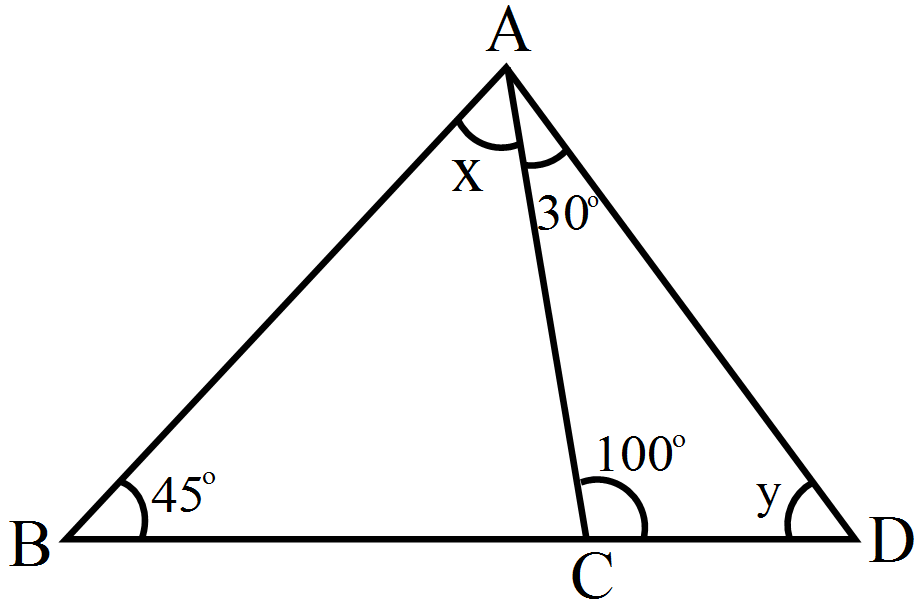
Explain the concept of interior and exterior angle and in the figures given below. Find x and y.
Answer
The interior angles of a triangle are the three angle elements inside the triangle.
The exterior angles are formed by extending the sides of a triangle, and if the side of a triangle is produced, the exterior angle so formed is equal to the sum of the two interior opposite angles.
Using these definitions, we will obtain the values of x and y.
We know that the sum of all angles of a triangle is 180°
Therefore, for $\triangle \text{ACD},$ we can say that:
$30^\circ+100^\circ+\text{y}=180^\circ$
Or,
$\text{y}= 50^\circ$
$\angle \text{ACB}+100^\circ=180^\circ$
$\angle \text{ACB}=80^\circ...(\text{i})$
Using the above rule for $\triangle \text{ACD},$ we can say that:
x + 45º + 80º = 180º
x = 55º
View full question & answer
Question 194 Marks
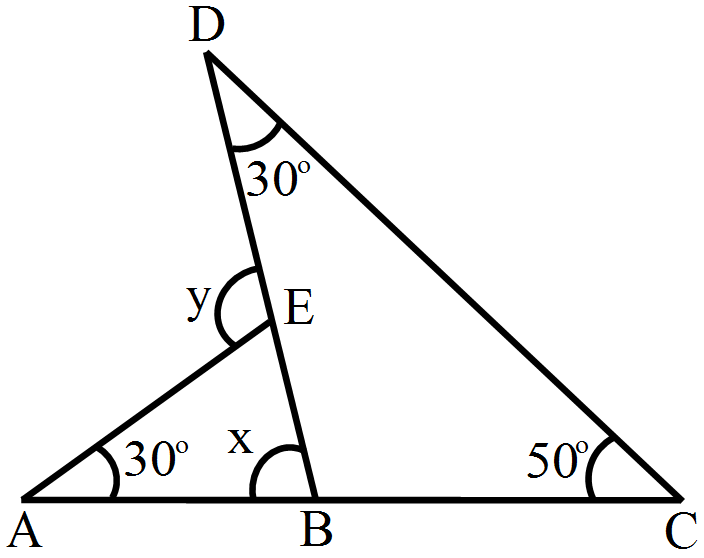
Explain the concept of interior and exterior angle and in the figures given below. Find x and y.
Answer
The interior angles of a triangle are the three angle elements inside the triangle.
The exterior angles are formed by extending the sides of a triangle, and if the side of a triangle is produced, the exterior angle so formed is equal to the sum of the two interior opposite angles.
Using these definitions, we will obtain the values of x and y.
We know that the sum of all angles of a triangle is 180°
Therefore, for $\triangle \text{DBC},$ we can say that:
$30^\circ+50^\circ+\angle \text{DBC}=180^\circ$
$\angle \text{DBC}=100^\circ$
$\text{x}+\angle \text{DBC}=180^\circ$ (Linear pair)
$\text{x}=80^\circ$
And,
y = 30° + 80° (Exterior angle property)
= 110°
View full question & answer