Questions

3 Mark Question

Take a timed test

22 questions · self-marked practice — reveal the answer and mark yourself.

Question 13 Marks
The acute angles of a right triangle are in the ratio 2 : 1. Find the each of these angles.
Answer
In a right triangle
Sum of the two acute angle = 90°
and ratio of these two angles = 2 : 1
Let first angle = 2x
The second angle = x
2x + x = 90°
⇒ 3x = 90°
$\Rightarrow\text{x}=\frac{90}{3}=30^\circ$
$\therefore$ First angle = 2x = 2 × 30° = 60°
and Second angle = x = 30°
View full question & answer
Question 23 Marks
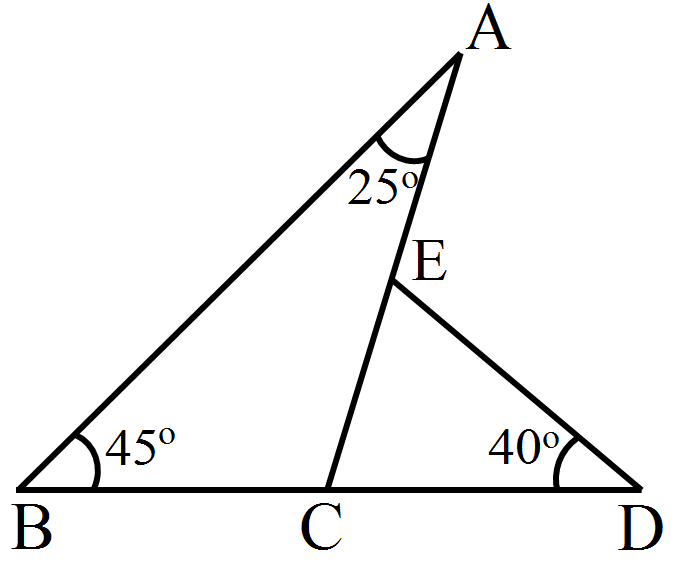
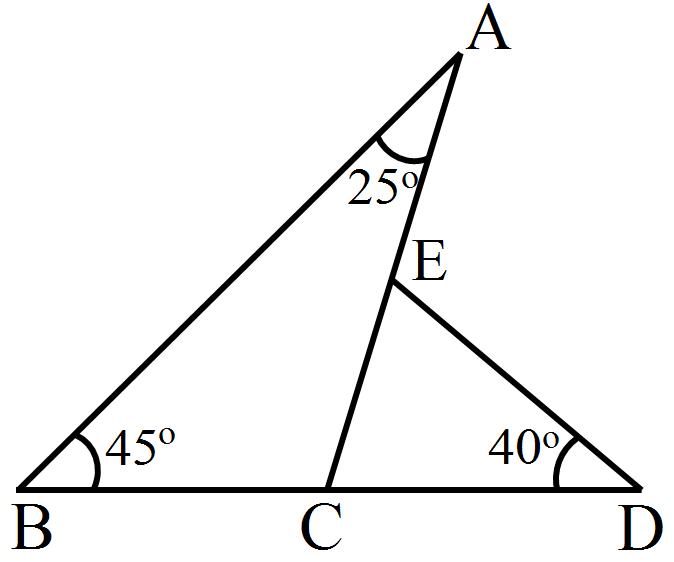
In the figure given alongside, find:
  1. $\angle\text{ACD}$
  2. $\angle\text{AED}$
Answer
In $\triangle\text{ABC},$ side BC is produced to D From D, draw a line meeting AC at E, so that $\angle\text{D}=40^\circ$.
$\angle\text{A}=25^\circ,\angle\text{B}=45^\circ$
  1. In $\triangle\text{ABC},$
Exterior $\angle\text{ACD} = \angle\text{A}+\angle\text{B}=25^\circ+45^\circ=70^\circ$
  1. In $\triangle\text{CDE},$
Exterior $\angle\text{AED} = \angle\text{ECD}+\angle\text{D}= \angle\text{ACD}+\angle\text{D}=70^\circ+40^\circ=7=110^\circ$
Hence, $\angle\text{ACD}=70^\circ$ and $\angle\text{AED}=110^\circ$
View full question & answer
Question 33 Marks
The lengths of the sides of triangles are given below. Which of them are right-angled?
$a=10 cm, b=24 cm, c=26 cm$
Answer
A triangle will be a right angled, if
(longest side) ${ }^2=$ Sum of squares of other two sides
Given,
Here, Ingest side $= C$
$a=10 cm, b=24 cm, c=26 cm$
The triangle $A B C$ will be right angled, if
$c^2=a^2+b^2 \\
(26)^2=(10)^2+(24)^2 \\
676=100+576=676 \\
676=676$
Which is true.
It is a right angled triangle.
View full question & answer
Question 43 Marks
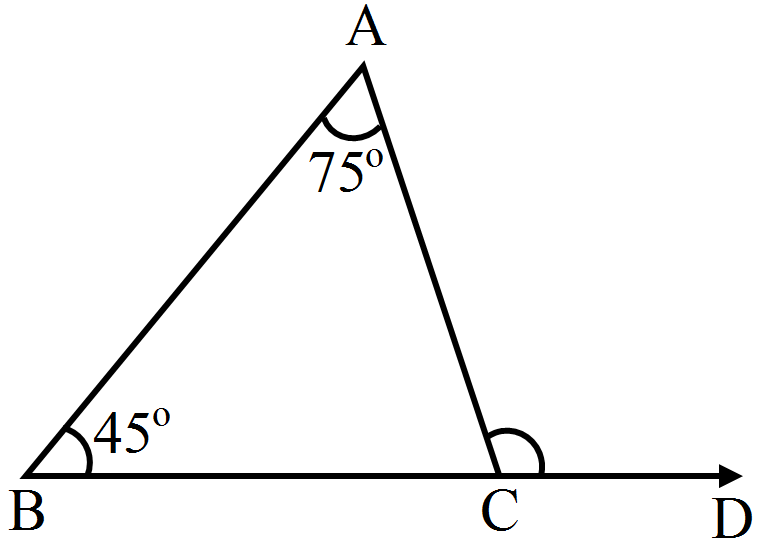
In the figure given alongside, find the measure of $\angle\text{ACD}.$
Answer
In $\triangle\text{ABC},$
$\angle\text{A}=75^\circ,\angle\text{B}=45^\circ$
side BC is produced to D

Forming exterior $\angle\text{ACD}$
Exterior $\angle\text{ACD}=\angle\text{A}+\angle\text{B}$ (Exterior angle is equal to sum of its interior opposite angles)
= 75° + 45° = 120°
View full question & answer
Question 53 Marks
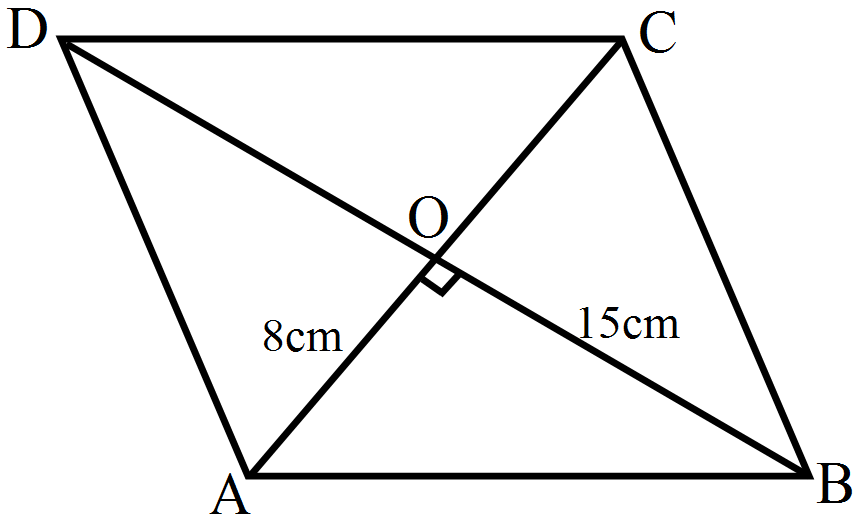
Find the perimeter of a rhombus, the lengths of whose diagonals are 16cm and 30cm.
Answer
Perimeter of rhombus $A B C D=4 \times$ Side
Diagonal $AC =30 cm$ and $BD =16 cm$
The diagonal of rhombus bisect each other at right angles,
$AO=OC=\frac{30}{2}=15 cm$
and $BO = OD =\frac{16}{2}=8 cm$
Now in right $\triangle AOB$,
$A B^2=A O^2+B O^2$
$\Rightarrow A B^2=(15)^2+(8)^2$
$\Rightarrow A B^2=225+64$
$\Rightarrow A B^2=289$
$\Rightarrow A B^2=(17)$
$\Rightarrow A B=17 cm$
Now perimeter $=4 \times$ Side $=4 \times 17=68 cm$
View full question & answer
Question 63 Marks
One of the angles of a triangle is 100° and the other two angles are equal. Find each of these equal angles.
Answer
In a triangle
Measure of one angle = 100°
Sum of the other two angles = 180° - 100° (Sum of angles of a triangles)
But, these two angles are equal.
Measure of each angle $=\frac{80^\circ}{2}=40^\circ$
View full question & answer
Question 73 Marks
One of the acute angles of a right triangle is 36°. Find the other.
Answer
In a right triangle
Sum of the two acute angle = 90°
One angle = 36°
Second angle = 90° - 36° = 54°
View full question & answer
Question 83 Marks
The lengths of the sides of triangles are given below. Which of them are right-angled?
$a=9 cm, b=12 cm, c=16 cm$
Answer
A triangle will be a right angled, if (longest side) ${ }^2=$ Sum of squares of other two sides
Given,
$a=9 cm, b=12 cm, c=16 cm .$
Here, Ingest side $= c$
The triangle $A B C$ will be right angled, if
$c^2=a^2+b^2$
$(16)^2=(9)^2+(12)^2$
$256=81+144=225$
$256=225$
Which is not true.
It is not a right angled triangle
View full question & answer
Question 93 Marks
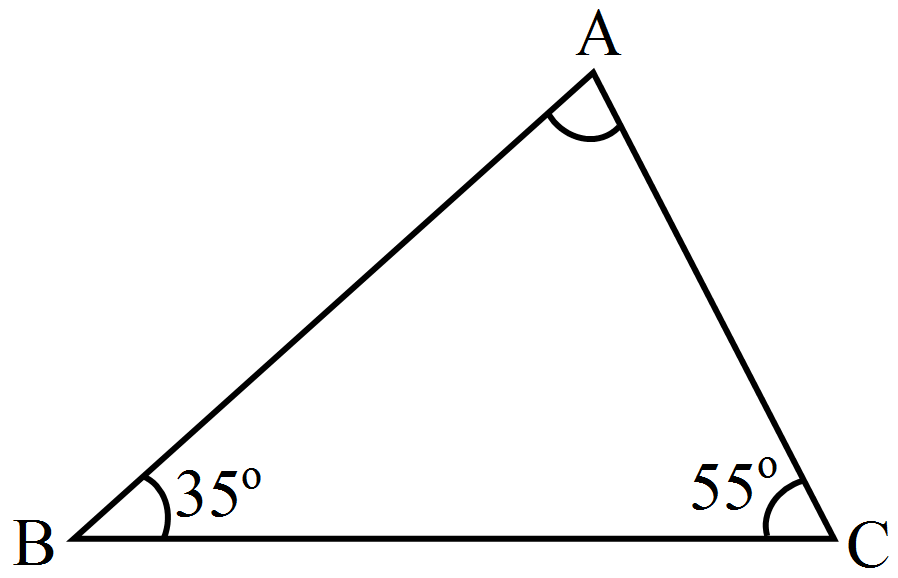
In a $\triangle ABC , \angle B =35^{\circ}$ and $\angle C =55^{\circ}$. Write which of the following is true:
  1. $A C^2=A B^2+B C^2$
  2. $A B^2=B C^2+A C^2$
  3. $B C^2=A B^2+A C^2$
Answer


In $\triangle\text{ABC}, $
$\angle\text{B}= 35^\circ$ and $\angle\text{C}= 55^\circ$
$\Rightarrow\angle\text{A}= 180^\circ-(\angle\text{B} + \angle\text{C})$
$\Rightarrow\angle\text{A}= 180^\circ-(35^\circ + 55^\circ)$
$\Rightarrow\angle\text{A}= 180^\circ-90^\circ$
$\angle\text{A}= 90^\circ$
By Pythagoras Theorem,
$BC^2=AB^2+ AC^2$
(iii) is true.
View full question & answer
Question 103 Marks
The lengths of the sides of triangles are given below. Which of them are right-angled?
$a=15 cm, b=20 cm, c=25 cm$
Answer
A triangle will be a right angled, if
(longest side) ${ }^2=$ Sum of squares of other two sides
Given,
$a=15 cm, b=20 cm, c=25 cm$
Here, longest side $=c$
The triangle will be right angled, if
$c^2=a^2+b^2$
$(25)^2=(15)^2+(20)^2$
$625=225+400=625$
Which is true.
It is a right angled triangle.
View full question & answer
Question 113 Marks
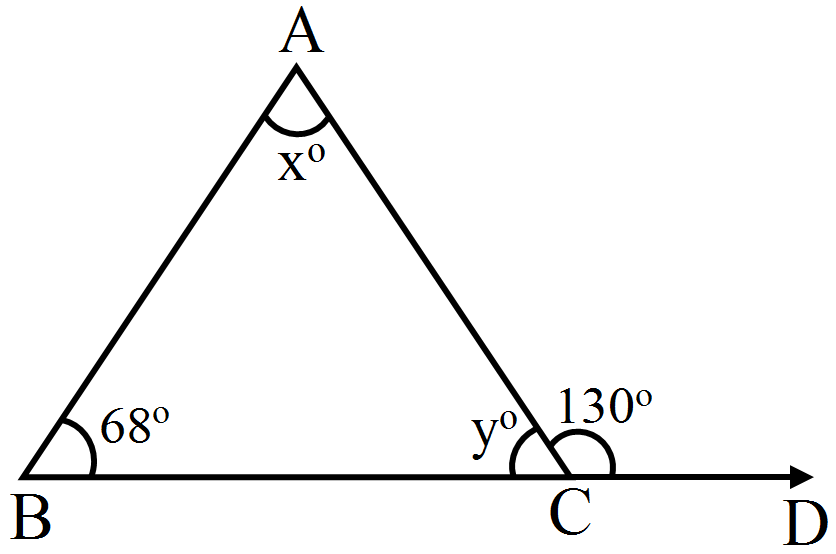
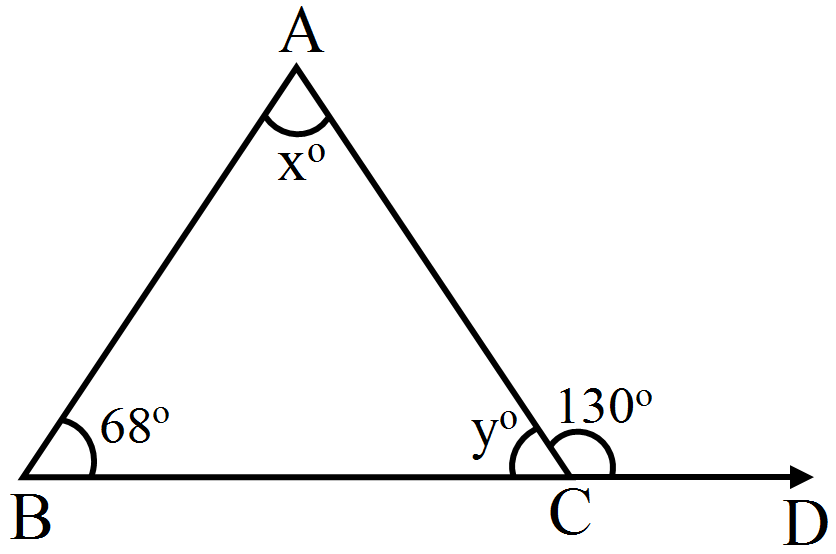
In the figure given alongside, find the values of x and y.
Answer
In $\triangle\text{ABC},$ BC is produced to D forming an exterior angle ACD$\angle\text{B} = 68^\circ,\angle\text{A} = \text{X}^\circ,\angle\text{ACB} = \text{Y}^\circ$ and $\angle\text{ACD} = 130^\circ$
In triangle, Exterior angles is equal to sum of its interior opposite angles. $\angle\text{ACD} = \angle\text{A}+\angle\text{B}$ ⇒ 130° = x + 68° ⇒ x = 130° – 68° = 62° But $\angle\text{ACB}+\angle\text{ACD} = 180^\circ$ (Linear pair) ⇒ y + 130° = 180° ⇒ y = 180° – 130° = 50° Hence, x = 62° and y = 50°
View full question & answer
Question 123 Marks
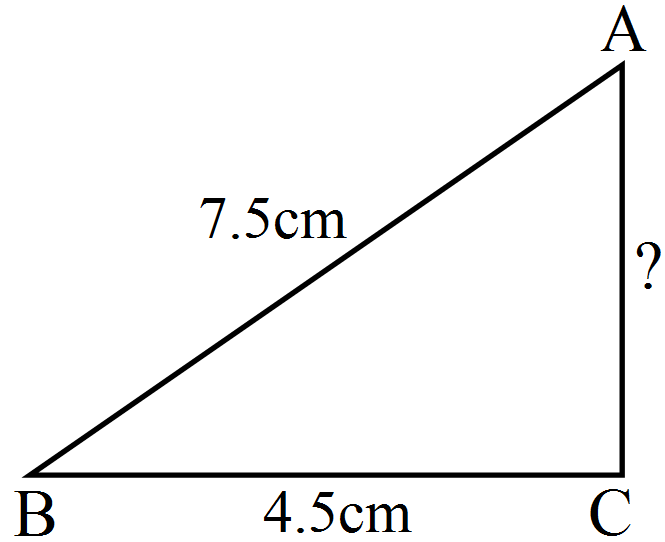
The length of one sides of a right triangle is 4.5cm and the length of its hypotenuse is 7.5cm. Find the length of its third side.
Answer


In right triangle $A B C$,
$\angle C=90^{\circ} AC=7.5 cm, AB=4.5 cm$
By Pythagoras Theorem,
$AB^2=BC^2+AC^2$
$\Rightarrow(7.5)^2=(4.5)^2+AC^2$
$\Rightarrow 56.25=20.25+AC^2$
$\Rightarrow AC C^2=56.25-20.25$
$\Rightarrow AC C^2=36.00$
$AC=\sqrt{36}=6 cm$
View full question & answer
Question 133 Marks
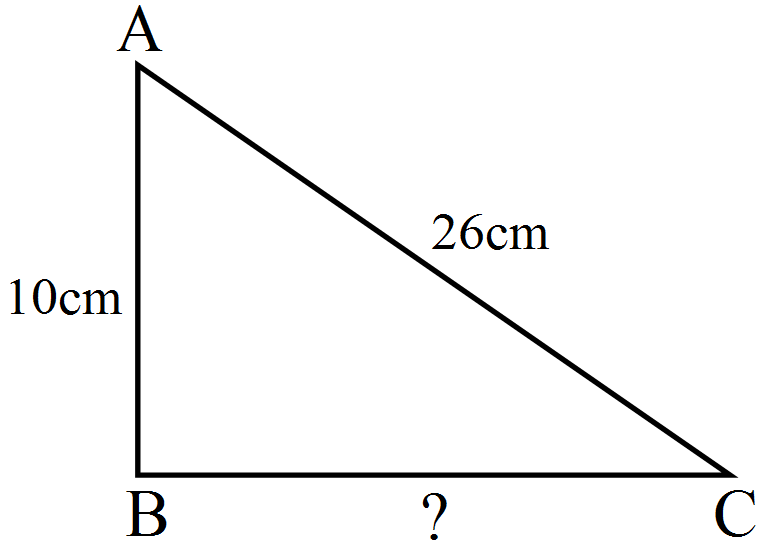
The hypotenuse of a right triangle is 26cm long. If one of the remaining two sides is 10cm long, find the length of the other side.
Answer


In right triangle $A B C$,
$\angle B=90^{\circ} AC=26 cm, AB=10 cm$
By Pythagoras Theorem,
$AC^2=AB B^2+BC^2$
$\Rightarrow(26)^2=(10)^2+BC^2$
$\Rightarrow 676=100+BC^2$
$\Rightarrow BC^2=676-100$
$\Rightarrow B C^2=576$
$BC=\sqrt{576}=24 cm$
View full question & answer
Question 143 Marks
Find the angles of a triangle which are in the ratio 4 : 3 : 2.
Answer
Sum of angles of a triangle = 180° and ratio in the three angles = 4 : 3 : 2
$\therefore\text{First angle}=\frac{180^\circ\times4}{4+3+2}=\frac{180^\circ\times4}{9}=80^\circ$
$\text{Second angle}=\frac{180^\circ\times3}{9}=60^\circ$
$\text{ and third angle}=\frac{180^\circ\times2}{9}=40^\circ$
View full question & answer
Question 153 Marks
Each of the two equal angles of an isosceles triangle is twice the third angle. Find the angles of the triangle.
Answer
Sum of angles of a triangle $=180^\circ$
Let third angle = x
then, each equal angles = 2x
$\text{x} + 2\text{x} + 2\text{x} = 180^\circ$
$\Rightarrow5\text{x} = 180^\circ$
$\Rightarrow\text{x} = \frac{180^\circ}{5}=36^\circ$
Each equal angle $= 2\text{x} = 2 \times36^\circ = 72^\circ$
and third angle $=36^\circ$
View full question & answer
Question 163 Marks
Two sides of a triangle are 5cm and 9cm long. What can be the length of its third side?
Answer
Let the length of the third side be xcm.
Sum of any two sides of a triangle is greater than the third side.
$\therefore$ 5 + 9 > x
⇒ x < 14
Hence, the length of the third side must be less than 14cm.
View full question & answer
Question 173 Marks
The sides of a triangle measure $15 cm, 36 cm$ and 39 cm . Show that it is a right-angled triangle.
Answer
The largest side of the triangle is 39 cm .
$15^2+36^2=225+1296$
$=1521$
Also, $39^2=1521$
$\therefore 15^2+36^2=39^2$
Sum of the square of the two sides is equal to the square of the third side.
Hence, the triangle is right angled.
View full question & answer
Question 183 Marks
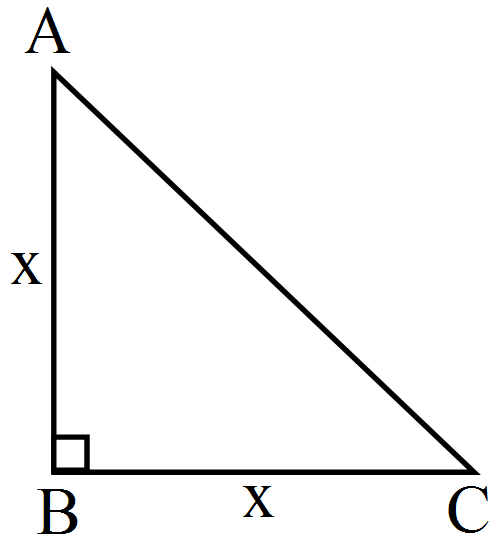
The two legs of a right triangle are equal and the square of its hypotenuse is 50cm. Find the length of each leg.
Answer


In right triangle $A B C$,
$\angle B=90^{\circ}$
Let each leg $= xcm$
By Pythagoras Theorem,
$x^2+x^2=A C^2$
$\Rightarrow 2 x^2=50$
$\Rightarrow x^2=25$
$\Rightarrow x^2=(5)^2$
$\Rightarrow x=5$
Length of each equal leg $=5 cm$.
View full question & answer
Question 193 Marks
In a $\triangle\text{ABC}$, If $​​2\angle\text{A}=3\angle\text{B}=6​\angle\text{C}$, calculate$​​\angle\text{A}$,$​​\angle\text{B}$ and$​​\angle\text{C}$.
Answer
In a $\triangle\text{ABC}$, $​​2\angle\text{A}=3\angle\text{B}=6​\angle\text{C}=1$ (Suppose) $\therefore\angle\text{A}=\frac{1}{2},\angle\text{B}=\frac{1}{3}$ and $\angle\text{C}=\frac{1}{6}$$\therefore\angle\text{A}:\angle\text{B}:\angle\text{C}=\frac{1}{2}:\frac{1}{3}:\frac{1}{6}$
$=\frac{3:2:1}{6}$ But $\angle\text{A}+\angle\text{B}+\angle\text{C}=180^\circ$ (Sum of angles of a triangle) $\therefore\angle\text{A}=\frac{3\times180^\circ}{3+2+1}=\frac{3\times180^\circ}{6}=90^\circ$ $\angle\text{B}=\frac{2\times180^\circ}{6}=60^\circ$ $\angle\text{C}=\frac{1\times180^\circ}{6}=30^\circ$
View full question & answer
Question 203 Marks
If one angle of a triangle is equal to the sum of the other two, show that the triangle is a right angled.
Answer
In a triangle ABC,
Let $\angle\text{A} =\angle\text{B}+\angle\text{C}$
But $\angle\text{A} +\angle\text{B}+\angle\text{C}=180^\circ$ (Sum of angles of a triangle)
$\Rightarrow\angle\text{A} +\angle\text{A}=180^\circ (\angle\text{B} +\angle\text{C} = \angle\text{A})$
$\Rightarrow2\text{A} =180^\circ$
$\Rightarrow\angle\text{A}=\frac{180^\circ}{2}=90^\circ$
$\angle\text{A}=90^\circ$
Hence, triangle ABC is a right triangle.
View full question & answer
Question 213 Marks
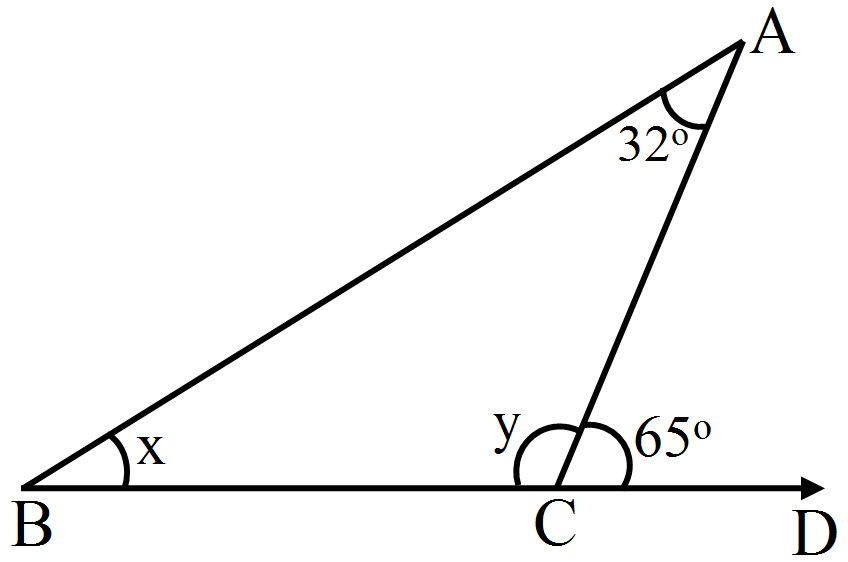
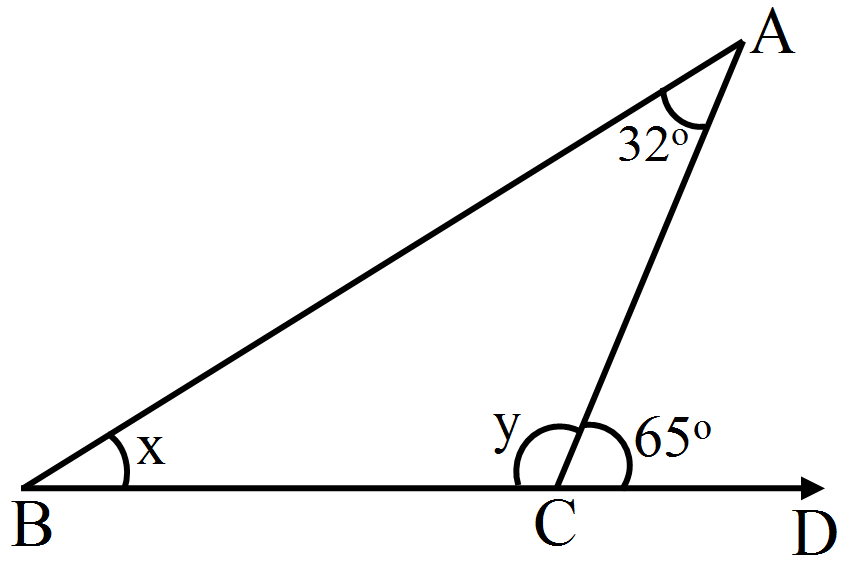
In the figure given alongside, find the values of x and y.
Answer
In $\triangle\text{ABC},$ side BC is produced to D forming exterior angle ACD.$\angle\text{ACD} = 65^\circ,\angle\text{A}=32^\circ$
$\angle\text{B}=\text{x},\angle\text{ACB} = \text{y}$

In triangle, the exterior angles is equal to sum of its interior opposite angles. $\angle\text{ACD} = \angle\text{A}+\angle\text{B}$ ⇒ 65° = 32° + x ⇒ x = 65° – 32° = 33° But $\angle\text{ACB}+\angle\text{ACD} = 180^\circ$ (Linear pair) ⇒ 65° + y = 180° ⇒ y = 180° – 65° = 115° Hence, x = 33° and y = 115°
View full question & answer
Question 223 Marks
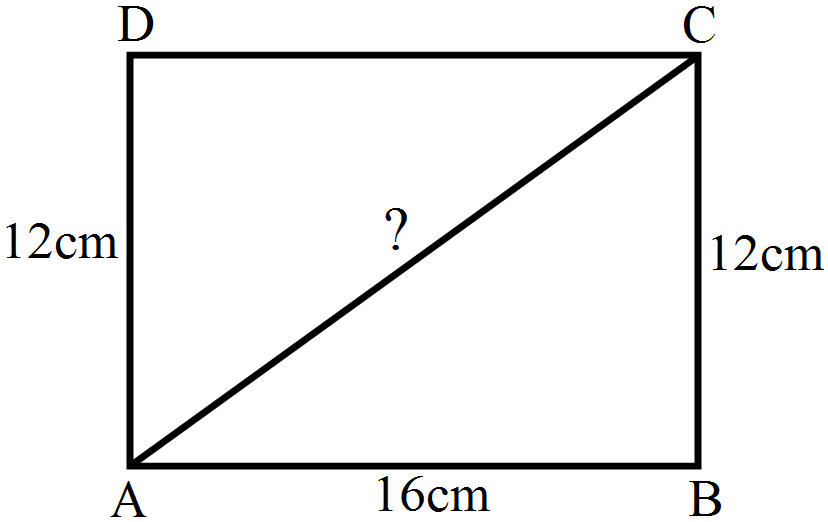
Find the length of diagonal of the rectangle whose sides are 16cm and 12cm.
Answer

Given,
$A B C D$ is a rectangle whose sides, $A B=16 cm$ and $B C=12 cm$.
AC is a diagonal
In right $\triangle ABC$,
$AC ^2=A B^2+ BC ^2$ (By Pythagoras Theorom)
$A C^2=(16)^2+(12)^2$
$\Rightarrow A C^2=256+144$
$\Rightarrow A C^2=400$
$\Rightarrow A B^2=(20)^2$
$AC =20 cm$
Hence length of diagonal $A C=20 cm$.
View full question & answer