Questions

4 Mark Question

Take a timed test

14 questions · self-marked practice — reveal the answer and mark yourself.

Question 14 Marks
A 5m long ladder whan set against the wall of a house reaches a height of 4.8m. How far is the foot of the ladder from the wall?
Answer
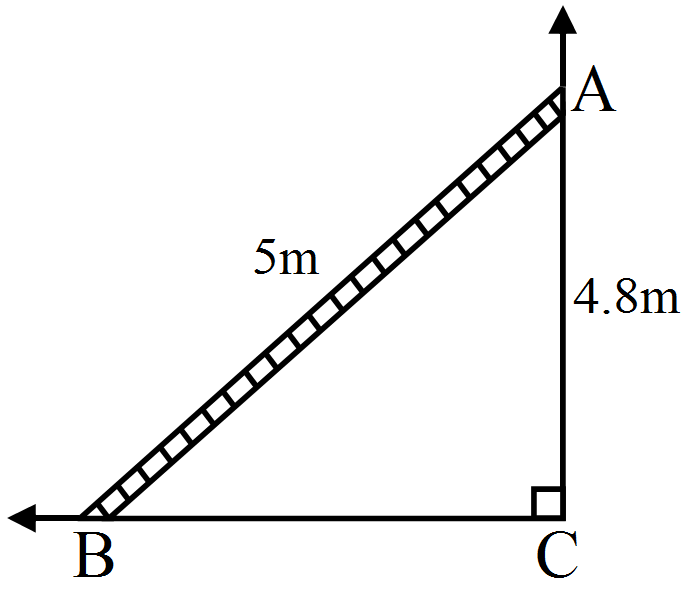

Length of ladder $A B=5 m$
and height $C A=4.8 m$
Let distance of the ladder from the wall $B C=x m$.
Now in right angled $\triangle ABC , \angle C =90^{\circ}$
$A B^2=A C^2+B C^2 \text { (By Pythagoras Theorem) }$
$\Rightarrow(5)^2=(4.8)^2+x^2$
$\Rightarrow 25=23.04+x^2$
$\Rightarrow x^2=25.00-23.04$
$\Rightarrow x^2=1.96$
$\Rightarrow x^2=(1.4)^2$
$x=1.4$
The foot of ladder are 1.4 m away from the wall.
View full question & answer
Question 24 Marks
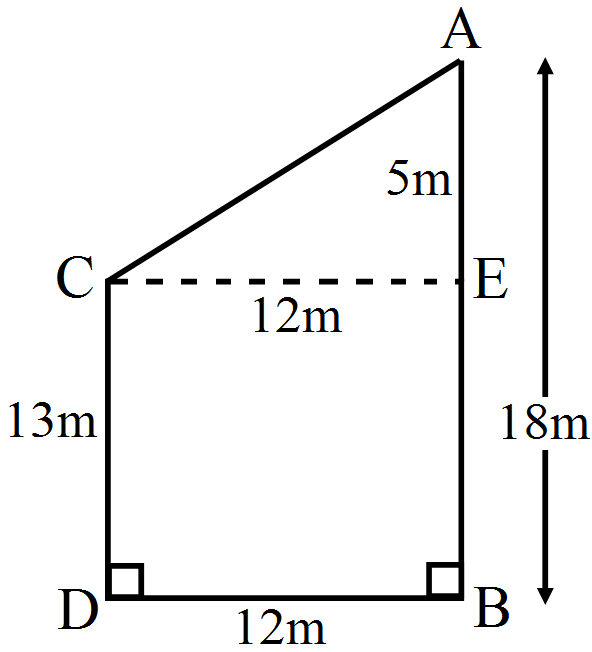
Two poles, 18m and 13m high, stand upright in a playground. If their feet are 12m apart, find the distance between their tops.
Answer

Let $A B$ and $C D$ are two poles and they are 12 m apart.
$AB 18 m, CD =13 m$ and $BD =12 m$
From C, draw CE || BD Then
$CE=BD=12 m$
$\text { and } AE=AB-CD=18-13=5 m$
$\text { Join } AC$
$\text { Now, in right } \triangle ACE,$
$AC^2=CE^2+AE A^2(By \text { Pythagoras Theorom })$
$AC^2=(12)^2+(5)^2$
$\Rightarrow AC^2=144+25$
$\Rightarrow AC^2=169$
$\Rightarrow AC^2=(13)^2$
$AC=13 m$
Distance between their tops $=13 m$.
View full question & answer
Question 34 Marks
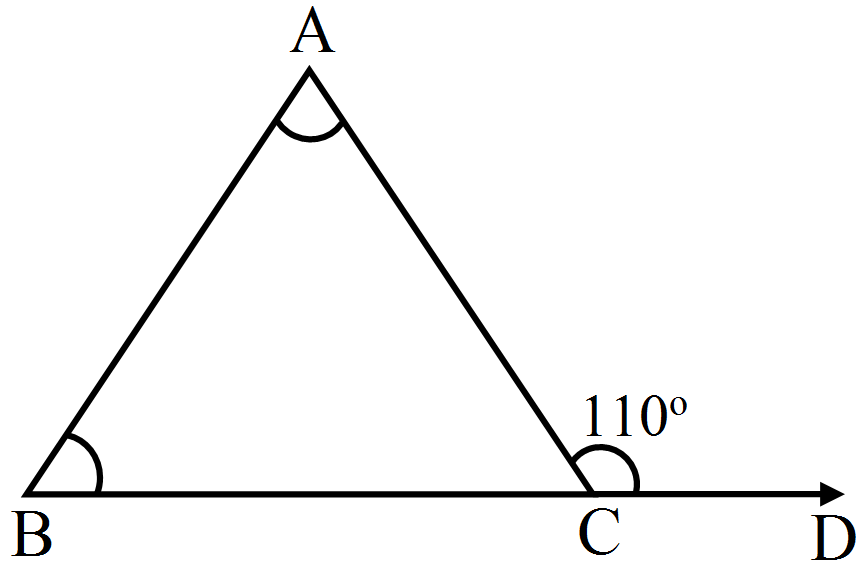
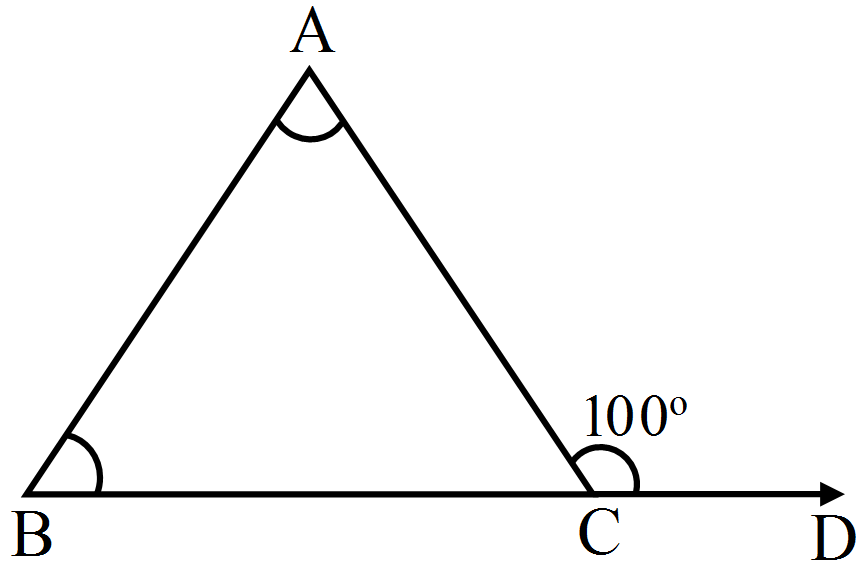
An exterior angle of a triangle measures 110° and its interior opposite angles are in the ratio 2 : 3. Find the angles of the triangle.
Answer
In $\triangle\text{ABC},$ side BC is produced to D forming exterior $\angle\text{ACD}$ $\angle\text{ACD} = 110^\circ,\text{and}\ \angle\text{A}:\angle\text{B}=2:3$
In a triangle, exterior angles is equal to sum of its interior opposite angles. $\Rightarrow\angle\text{ACD} = \angle\text{A}+\angle\text{B}$ $\Rightarrow\angle\text{A}+\angle\text{B}=110^\circ$ But $ \angle\text{A}:\angle\text{B}=2:3$$\therefore\angle\text{A}=\frac{2}{2+3}\times110^\circ$
$=\frac{2}{5}\times110^\circ$
$={2}\times22^\circ=44^\circ$
And $\therefore\angle\text{B}=\frac{3}{2+3}\times110^\circ$ $=\frac{3}{5}\times110^\circ$ $={3}\times22^\circ=66^\circ$ But $\angle\text{A}+\angle\text{B}+\angle\text{C}=180^\circ$ (Sum of angles of a triangle) $\Rightarrow44^\circ+66^\circ+\angle\text{C}=180^\circ$ $\Rightarrow110^\circ+\angle\text{C}=180^\circ$ $\Rightarrow\angle\text{C}=180^\circ-110^\circ=70^\circ$ Hence, $\angle\text{A}=44^\circ,\angle\text{B}=66^\circ$ and $\angle\text{C}=70^\circ$
View full question & answer
Question 44 Marks
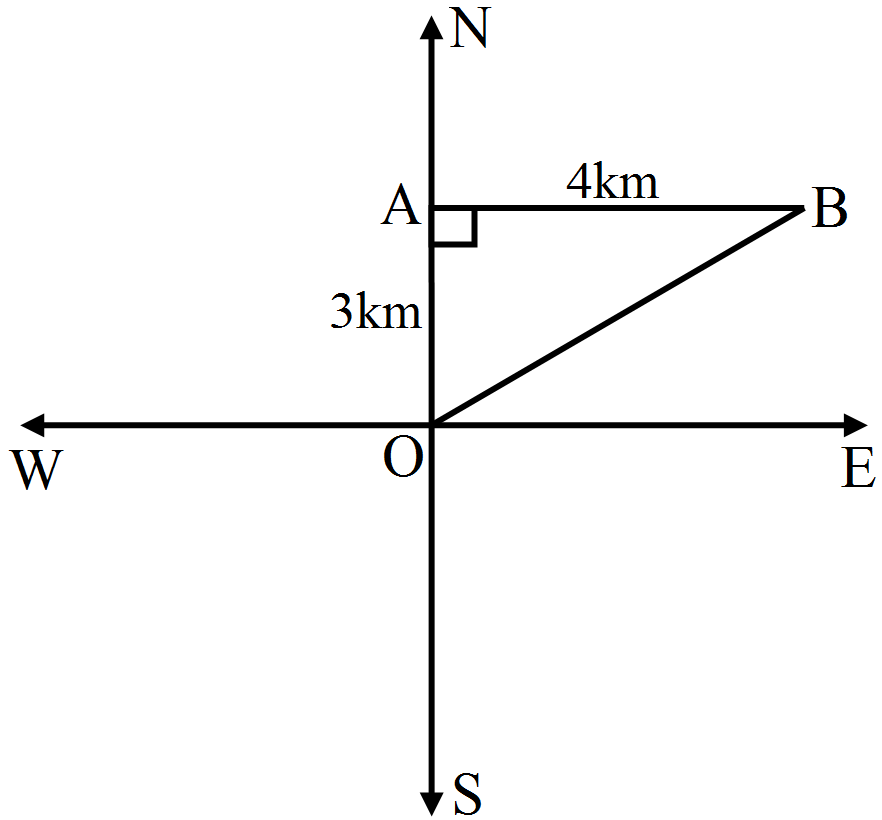
A man goes 3km due north and then 4km due east. How far is he away from his initial position?
Answer


A man goes 3 km due north and then 4 km east.
$\text { In right angled } \triangle OAB$
$OA=3 km, AB=4 km$
$OB^2=OA^2+AB^2 \text { (By Pythagoras Theorom) }$
$OB^2=(3)^2+(4)^2$
$\Rightarrow OB^2=9+16$
$\Rightarrow OB^2=25$
$\Rightarrow OB^2=(5)^2$
$OB=5 km$
Hence he is 5 km away from the initial position.
View full question & answer
Question 54 Marks
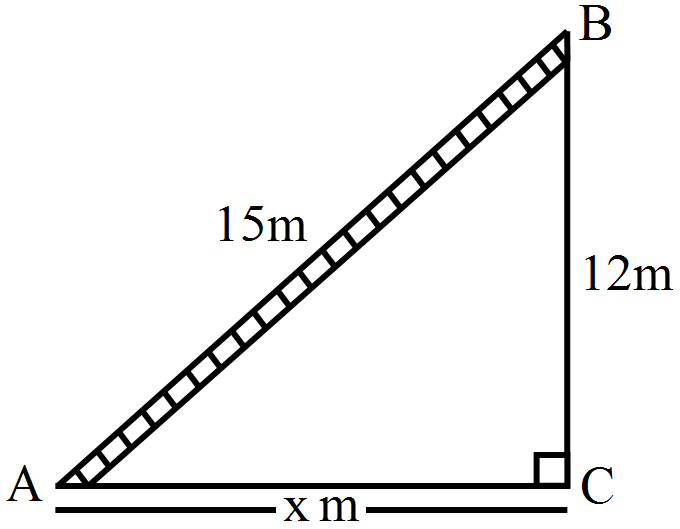
A 15m long ladder is placed against a wall to reach a window 12m high. Find the distance of the foot of the ladder from the wall.
Answer

$A B$ is a ladder and it is 15 m long B is window and $BC =12 m$.
In right $\triangle ABC$,
$AB^2=AC{ }^2+BC^2(\text { By Pythagoras Theorem })$
$\Rightarrow(15)^2=x^2+(12)^2$
$\Rightarrow 225=x^2+144$
$\Rightarrow x^2=81$
$\Rightarrow x^2=(9)^2$
$x=9 m$
Distance of the foot of ladder from the wall $=9 m$.
View full question & answer
Question 64 Marks
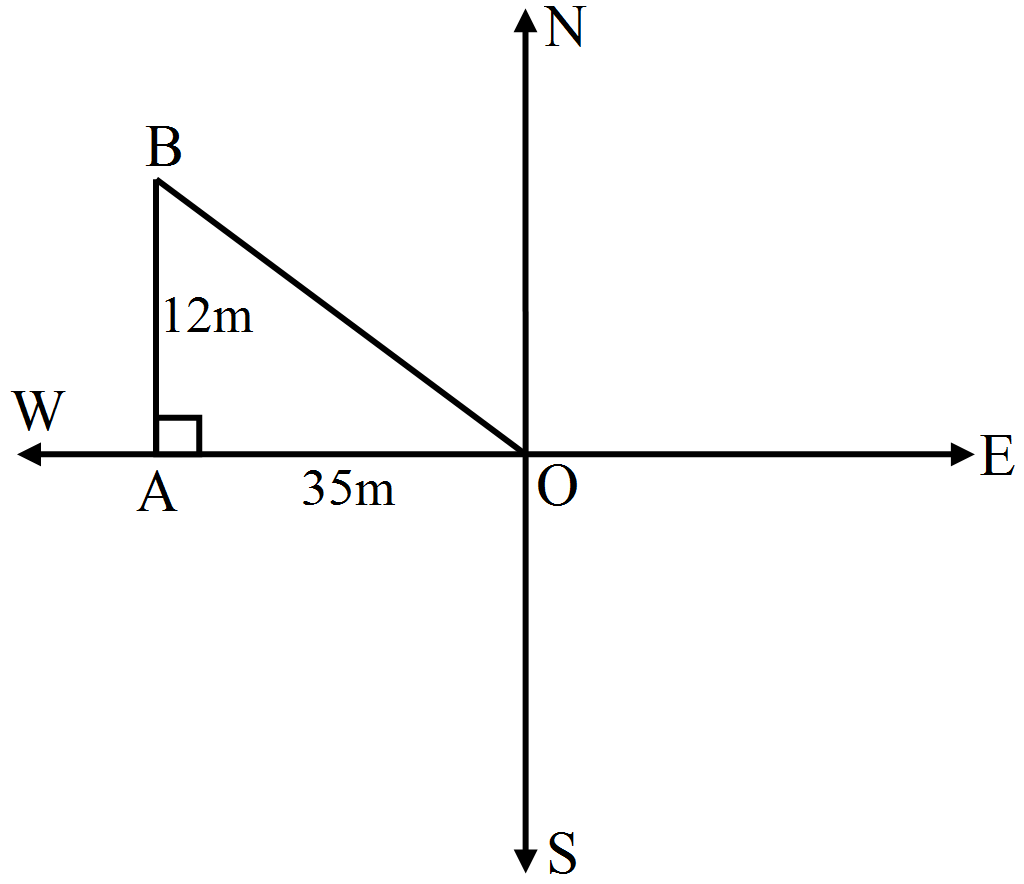
A man goes 35m due west and then 12m due north. How far is he from the starting point?
Answer

A man starts O and goes 35 m due west and then 12 m due north, then In right $\triangle OAB$,
$OA=35 m, AB=12 m$
$OB^2=OA^2+AB \text { (By Pythagoras Theorom) }$
$OB^2=(35)^2+(12)^2$
$\Rightarrow OB^2=1225+144$
$\Rightarrow OB^2=1369$
$\Rightarrow OB^2=(37)^2$
$OB=37 m$
Hence he is 37 m away from the starting point.
View full question & answer
Question 74 Marks
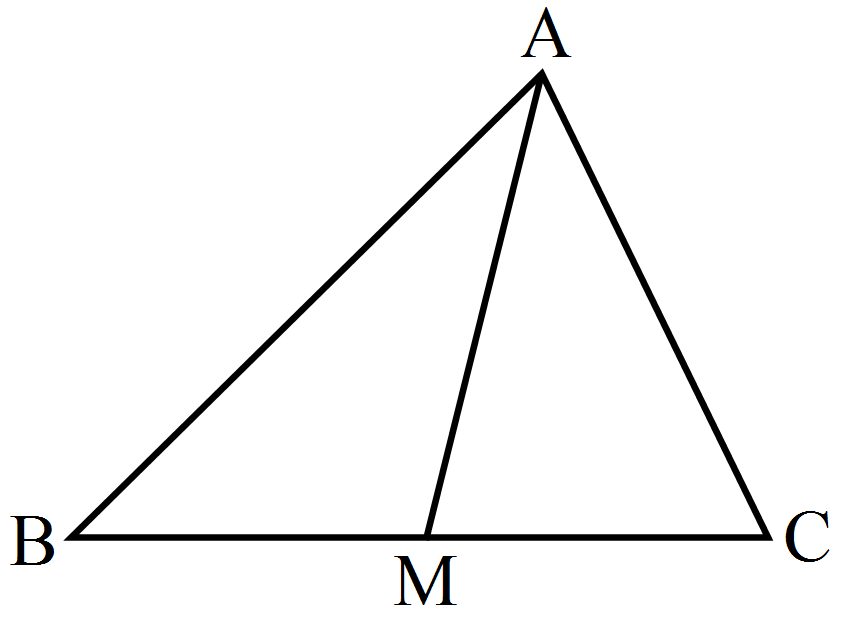
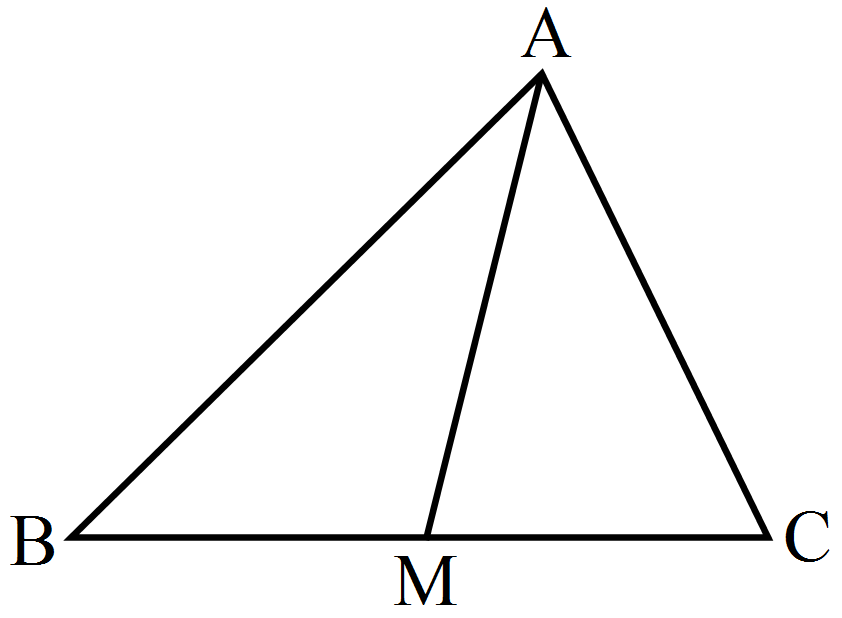
AM is a median of $\triangle\text{ABC}$. Prove that (AB + BC + CA) > 2AM. Hint: (AB + BM) > AM (In $\triangle\text{ABM}$) (AC + MC) > AM (In $\triangle\text{ABM}$)Now, add the two inequalities.
Answer

Proof: AM is the median of $\triangle\text{ABC}$
M is mid-point of BC
In $\triangle\text{ABM},$
AB + BM > AM ...(i)
(Sum of any two sides of a triangle is greater than its third side)
Similarly in $\triangle\text{ACM},$
AC + MC > AM ...(ii)
Adding (i) and (ii)
AB + BM + AC + MC > 2AM
⇒ AB + AC + BM + MC > 2AM
⇒ AB + AC + BC > 2AM
Hence proved.
View full question & answer
Question 84 Marks
An exterior angle of a triangle is 100° and its interior opposite angles are equal to each other. Find the measure of each angle of the triangle.
Answer
In $\triangle\text{ABC},$ side BC is produced to D forming exterior $\angle\text{ACD}$. $\angle\text{ACD} = 100^\circ,\text{and}\ \angle\text{A}=\angle\text{B}$ Exterior angle of a triangle is equal to the sum of its interior opposite angles.
$\angle\text{ACD} = \angle\text{A}+\angle\text{B}$ But $\angle\text{A}=\angle\text{B}$ $\Rightarrow\angle\text{A}+\angle\text{A}=\angle\text{ACD}=100^\circ$ $\Rightarrow2\angle\text{A}=100^\circ$ $\Rightarrow\angle\text{A}=50^\circ$ $\angle\text{B}=\angle\text{A}=50^\circ$ But $ \angle\text{A}+\angle\text{B}+\angle\text{ACB} =180^\circ$ (Sum of angles of a triangle) $\Rightarrow50^\circ+50^\circ+\angle\text{ACB}=180^\circ$ $\Rightarrow100^\circ+\angle\text{ACB}=180^\circ$ $\Rightarrow\angle\text{ACB}=180^\circ-100^\circ=80^\circ$ Hence, $\angle\text{A} = 50^\circ,\text{B} = 50^\circ\text{and}\ \angle\text{C}=80^\circ$
View full question & answer
Question 94 Marks
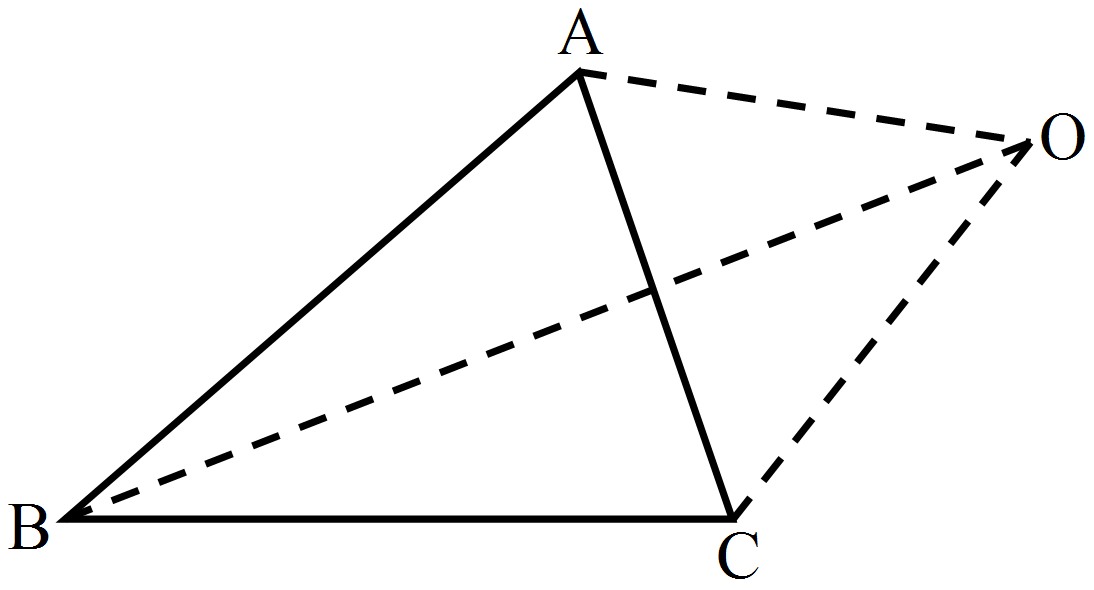
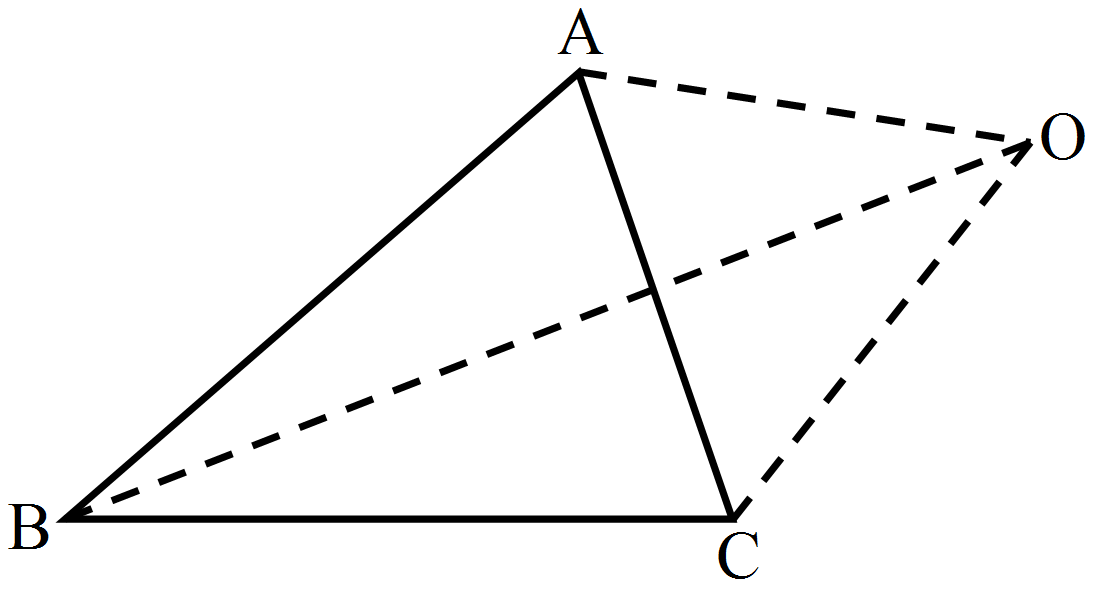
If O is a point in the exterior of $\triangle\text{ABC},$ show that 2(OA + OB + OC) > (AB + BC + CA).Hint: Join OA, OB, OC.
From $\triangle\text{ABC},$ OA + OB > AB. From $\triangle\text{BOC},$ OB + OC > BC. From $\triangle\text{AOC},$ OA + OC > CA.
Answer

Given, O is any point outside of the $\triangle\text{ABC}$
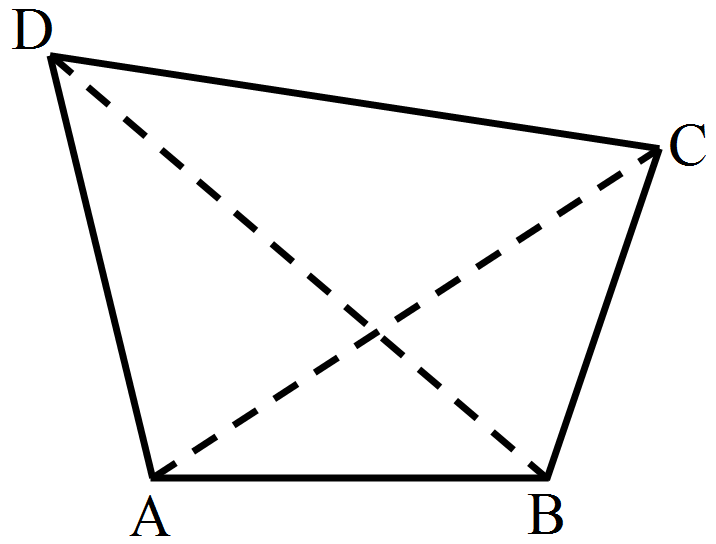
To prove : 2(OA + OB + OC) > (AB + BC + CA)
Construction : join OA, OB and DC.
Proof : In $\triangle\text{AOB},$
OA + OB > AB ...(i)
(Sum of any two sides of a triangle is greater than its third side)
Similarly in $\triangle\text{BOC},$
OB + OC > BC ...(ii)
and in $\triangle\text{COA},$
OC + OA > CA ...(iii)
Adding (i), (ii) and (iii), we get:
OA + OB + OB + OC + OC + OA > AB + BC + CA
2(OA + OB + OC) > (AB + BC + CA)
Hence proved.
View full question & answer
Question 104 Marks
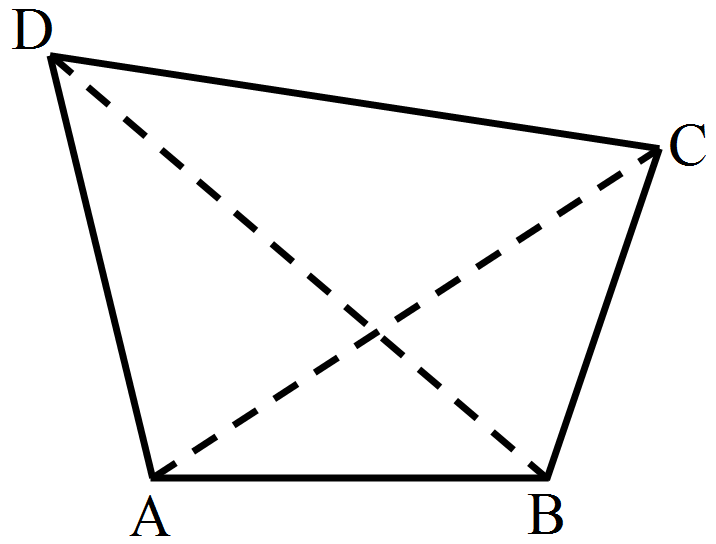
ABCD is quadrilateral.
Prove that (AB + BC + CD + DA) > (AC + BD)
Answer

Given, ABCD is a quadrilateral AC and BD are joined.
Proof : Now in $\triangle\text{ABC},$
AB + BC > AC...(i)
(Sum of any two sides of a triangle is greater than its third side)
Similarly in $\triangle\text{ADC},$
AC + CD > AC...(ii)
In $\triangle\text{ABD},$
AB + AD > BD...(iii)
and in $\triangle\text{BCD},$
BC + CD > BD...(iv)
Adding (i), (ii), (iii) and (iv)
AB + BC + CD + AD + AB + AD + BC + CD > AC + AC + BD + BD
⇒ 2(AB + BC + CD + AD) > 2(AP + BD)
⇒ AB + BC + CD + AD > AC + BD
Hence proved.
View full question & answer
Question 114 Marks
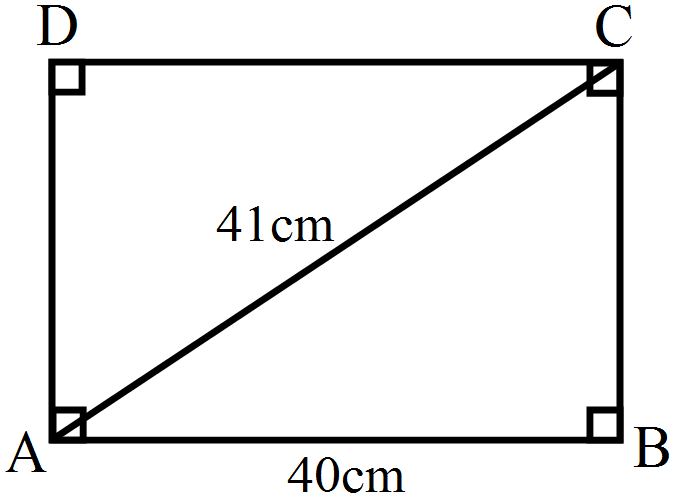
Find the perimeter of the rectangle whose length is 40cm and a diagonal is 41cm.
Answer

Given,
$A B C D$ is a rectangle and $A C$ is its diagonal.
$AB =40 cm$ and $AC =41 cm$
Now in right $\triangle ABC$,
$A C^2=A B^2+B C^2(B y \text { Pythagoras Theorom) } \\
\Rightarrow(41)^2=(40)^2+B C^2 \\
\Rightarrow 1681=1600+B C^2 \\
\Rightarrow B C^2=1681-1600 \\
\Rightarrow B C^2=81 \\
\Rightarrow B C^2=(9)^2 \\
B C=9 cm$
Now perimeter of rectangle $A B C D=2(A B+B C)=2(40+9)=2 \times 49=98 cm$.
View full question & answer
Question 124 Marks
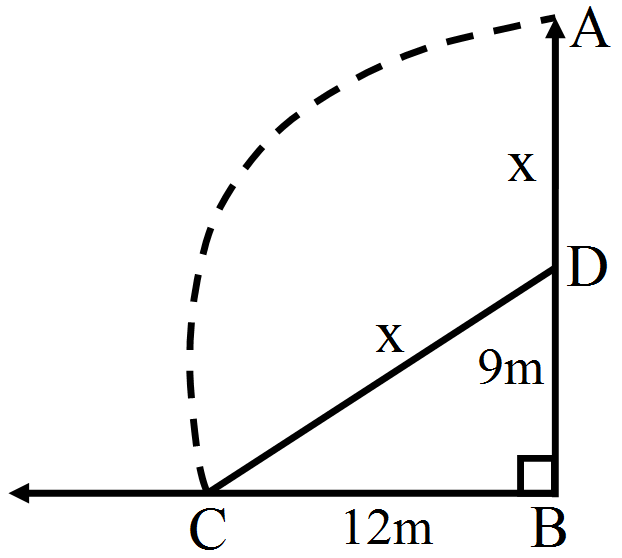
A tree is broken by the wind but does not separate. If the point from where it breaks is 9m above the ground and its top touches the ground at a distance of 12m from its foot, find out the total height of the tree before it broke.
Answer

Let $A B$ be the tree which broke at $D$ and its top $A$ touches the ground at $C$.
Their $B D=5 m$ and $B C=12 m$
Let $A D=x m$, then $C D=x m$
Now, in right $\triangle ABC$,
$C D^2=B D^2+B C^2$ (By Pythagoras Theorom)
$C D^2=(9)^2+(12)^2$
$\Rightarrow C D^2=81+144$
$\Rightarrow C D^2=225$
$\Rightarrow C D^2=(15)^2$
$CD =15 m$
$AD = x =15 m$
Height of the tree $A B=A D+B D=15+9=24 m$.
View full question & answer
Question 134 Marks
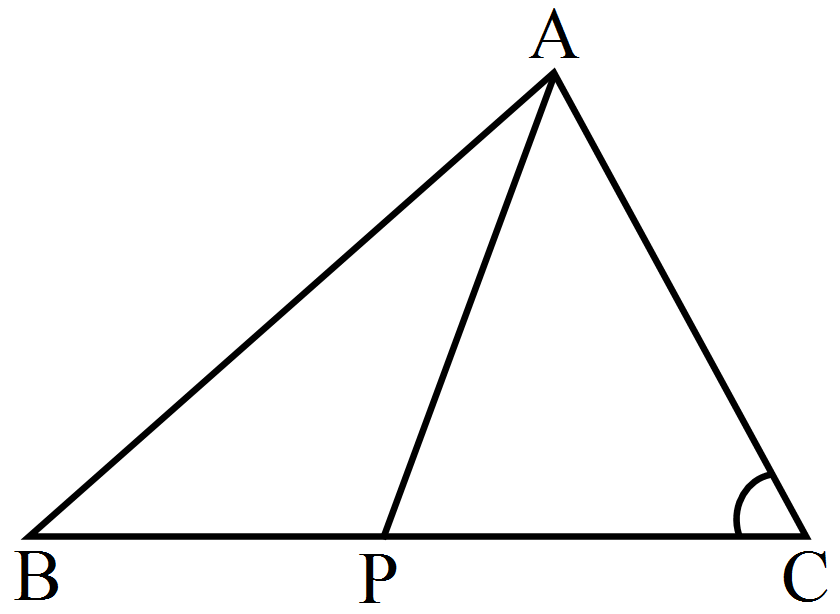
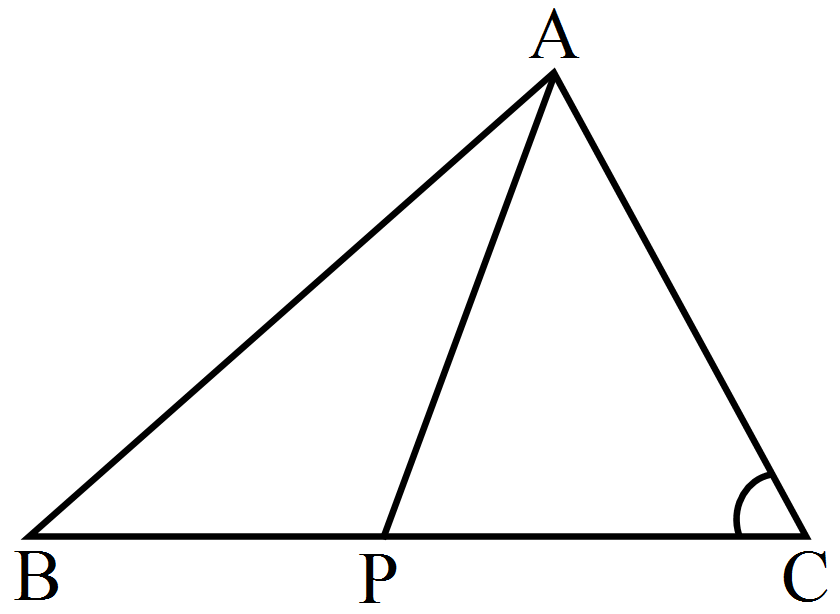
In the given figure, P is a point on the side BC of$\triangle\text{ABC}$. Prove that (AB + BC + AC) > 2AP Hint: (AB + BP) > AP (In $\triangle\text{ABP}$) (PC + AC) > AP (In $\triangle\text{APC}$)Now, add the corresponding sides.
Answer

Given, In $\triangle\text{ABC}$, P is a point on BC. AP is joined.
To Prove: (AB + BC + AC) > 2AP
Proof : In $\triangle\text{ABP},$
AB + BC + AB > AP...(i)
is the median of $\triangle\text{ABC}$
M is mid-point of BC
In $\triangle\text{ABM},$
AB + BM > AM …(i) (Sum of any two sides of a triangle is greater than its third side)
Similarly in $\triangle\text{ACP},$
AC + PC > A...(ii)
Adding (i) and (ii)
AB + BP + AC + PC > AP + AP
⇒ AB + BP + PC + CA > 2AP
⇒ AB + BC + CA > 2AP [$\because$ BC = BP + PC]
Hence proved.
View full question & answer
Question 144 Marks
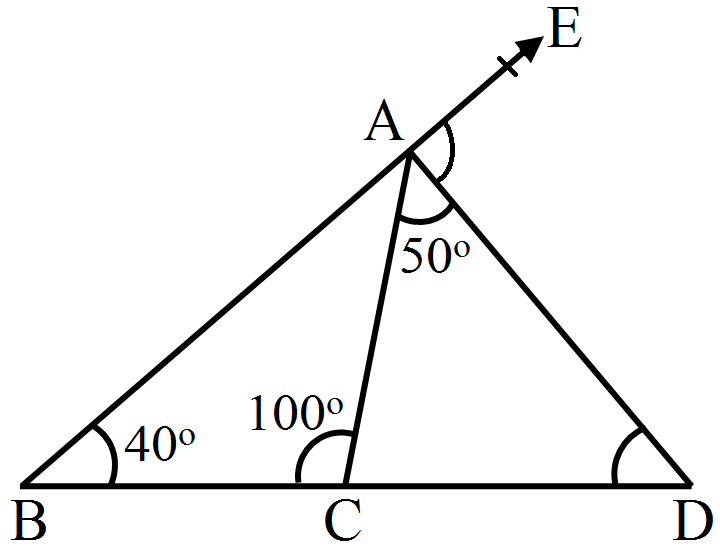
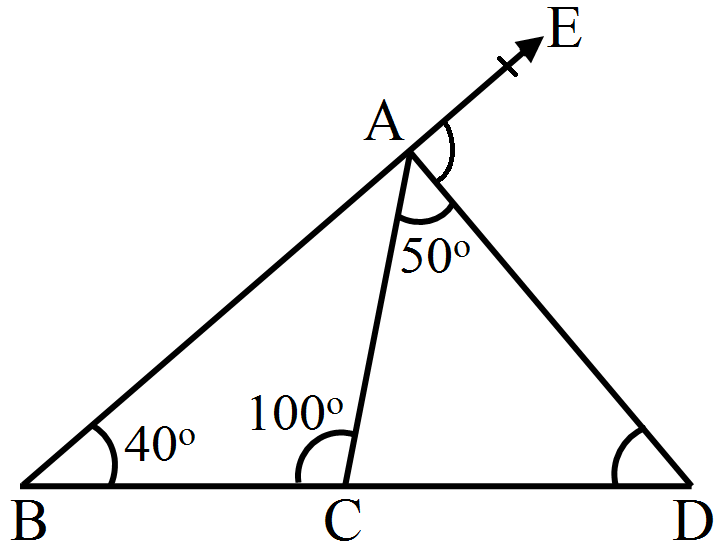
In the figure given alongside, find:
  1. $\angle\text{ACD}$
  2. $\angle\text{ADC}$
  3. $\angle\text{DAE}$
​​​​​​​
Answer
  1. In $\triangle\text{ABC},$ sides BC is produced to D and BA to E.
$\angle\text{CAD} = 50^\circ,\angle\text{B} = 40^\circ$ and $\angle\text{ACB} = 100^\circ$
$\angle\text{ACB} +\angle\text{ACD} = 180^\circ$ (Linear pair)
$\Rightarrow100^\circ+\angle\text{ACD} = 180^\circ$
$\Rightarrow\angle\text{ACD} = 180^\circ-100^\circ=80^\circ$
  1. In $\triangle\text{ABC},$
$\angle\text{CAD} +\angle\text{ACD}++\angle\text{ADC} = 180^\circ$ (sum of angles of a triangle)
$\Rightarrow50^\circ+80^\circ+\angle\text{ADC} = 180^\circ$
$\Rightarrow130^\circ+\angle\text{ADC}=180^\circ$
$\Rightarrow\angle\text{ADC}=180^\circ-130^\circ=50^\circ$
  1. Now, in $\triangle\text{ABD},$ BA is produced to E.
Exterior $\angle\text{DAE} =\angle\text{ACD} +\angle\text{ADC}=80^\circ+50^\circ=130^\circ$
Hence, $\angle\text{ACD}=80^\circ,\angle\text{ADC}=50^\circ$and $\angle\text{DAE}=130^\circ$
View full question & answer