Questions

4 Mark Question

Take a timed test

21 questions · self-marked practice — reveal the answer and mark yourself.

Question 14 Marks
The square of which of the following numbers would be an odd number?
  1. 731
  2. 3456
  3. 5559
  4. 42008
Answer
The square of an odd number is always odd.
  1. 731 is an odd number. Hence, its square will be an odd number.
  2. 3456 is an even number. Hence, its square will not be an odd number.
  3. 5559 is an odd number. Hence, its square will not be an odd number.
  4. 42008 is an even number. Hence, its square will not be an odd number.
Hence, only the squares of 731 and 5559 will be odd numbers.
View full question & answer
Question 24 Marks
By what number should the following numbers be multiplied to get a perfect square in each case? Also, find the number whose square is the new number.
3468
Answer
Factorising number.
3468 = 2 × 2 × 3 × 17 × 17
$\begin{array}{c|c} 2& 3468 \\ \hline 2 & 1734 \\\hline 3&864 \\\hline 17&289 \\\hline 17&17\\\hline &1 \end{array}$
Grouping them into pairs of equal factors,
3468 = (2 × 2) × (17 × 17) × 3
The factor 3 is not paired. For a number to be a perfect square, each prime factor has to be paired. Hence, 3468 must be multiplied by 3 for it to be a perfect square.
The new number would be (2 × 2) × (17 × 17) × (3 × 3)
Furthermore, we have,
(2 × 2) × (17 × 17) × (3 × 3) = (2 × 3 × 17) × (2 × 3 × 17)
Hence, the number whose square is the new number is, 2 × 3 × 17 = 102
View full question & answer
Question 34 Marks
By what number should the following numbers be multiplied to get a perfect square in each case? Also, find the number whose square is the new number.
2880
Answer
Factorising number.
2880 = 2 × 2 × 2 × 2 × 2 × 2 × 3 × 3 × 5
$\begin{array}{c|c} 2& 2880 \\ \hline 2 & 1440 \\\hline 2&720 \\\hline 2&360 \\\hline 2&180 \\\hline 2&90 \\\hline 3&45 \\\hline 3&15 \\\hline 5&5 \\\hline &1 \end{array}$
Grouping them into pairs of equal factors,
2880 = (2 × 2) × (2 × 2) × (2 × 2) × (3 × 3) × 5
There is a 5 as the leftover. For a number to be a perfect square, each prime factor has to be paired. Hence, 2880 must be multiplied by 5 to be a perfect square.
The new number would be (2 × 2) × (2 × 2) × (2 × 2) × (3 × 3) × (5 × 5)
Furthermore, we have,
(2 × 2) × (2 × 2) × (2 × 2) × (3 × 3) × (5 × 5) = (2 × 2 × 2 × 3 × 5) × (2 × 2 × 2 × 3 × 5)
Hence, the number whose square is the new number is, 2 × 2 × 2 × 3 × 5 = 120
View full question & answer
Question 44 Marks
By what numbers should the following be divided to get a perfect square in case? Also, find the number whose square is the new number.
5103
Answer
Factorising number.
5103 = 3 × 3 × 3 × 3 × 3 × 3 × 7
$\begin{array}{c|c} 3& 5103 \\ \hline 3 & 1701 \\\hline 3&567 \\\hline 3 &189 \\\hline 3&63 \\\hline 3&21 \\\hline 7&7\\\hline&1 \end{array}$
Grouping them into pairs of equal factors,
5103 = (3 × 3) × (3 × 3) × (3 × 3) × 7
The factor, 7 is not paired. For a number to be a perfect square, each prime factor has to be paired. Hence, 5103 must be divided by 7 for it to be a perfect square.
The new number would be (3 × 3) × (3 × 3) × (3 × 3)
Furthermore, we have,
(3 × 3) × (3 × 3) × (3 × 3) = (3 × 3 × 3) × (3 × 3 × 3)
Hence, the number whose square is the new number is 3 × 3 × 3 = 27
View full question & answer
Question 54 Marks
The product of two numbers is 1296. If one number is 16 times the other, find the numbers.
Answer
Let the two numbers be a and b.
From the first statement, we have
a × b = 1296
If one number is 196 times the other, then we have
b = 16 × a
Substituting this value in the first equation, we get
a × (16 × a) = 1296
By simplifying both sides, we get
$\text{a}^2=\frac{1296}{16}=81$
Hence, a is the square root of 81, which is 9
To find b, use equartion b = 16 × a
Since a = 9
b = 16 × 9 = 144
So, the two numbers satisfying the question are 9 and 144
View full question & answer
Question 64 Marks
By what number should the following numbers be multiplied to get a perfect square in each case? Also, find the number whose square is the new number.
3675
Answer
Factorising number.
3675 = 3 × 5 × 5 × 7 × 7
$\begin{array}{c|c} 3& 3675 \\ \hline 5 & 1225 \\\hline 5&245 \\\hline 7&49 \\\hline 7 &7 \\\hline &1 \end{array}$
Grouping them into pairs of equal factors,
3675 = (5 × 5) × (7 × 7) × 3
The factor, 3 is not paired. For a number to be a perfect square, each prime factor has to be paired. Hence, 3675 must be multiplied by 3 for it to be a perfect square. The new number would be (5 × 5) × (7 × 7) × (3 × 3)
Furthermore, we have,
(5 × 5) × (7 × 7) × (3 × 3) = (3 × 5 × 7) × (3 × 5 × 7)
Hence, the number whose square is the new number is, 3 × 5 × 7 = 105
View full question & answer
Question 74 Marks
By what numbers should the following be divided to get a perfect square in case? Also, find the number whose square is the new number.1575
Answer
Factorising number.
1575 = 3 × 3 × 5 × 5 × 7
$\begin{array}{c|c} 3& 1575 \\ \hline 3 & 525 \\\hline 5&175 \\\hline 5 &35\\\hline7&7\\\hline&1 \end{array}$
Grouping them into pairs of equal factors,
1575 = (3 × 3) × (5 × 5) × 7
The factor, 7 is not paired. For a number to be a perfect square, each prime factor has to be paired. Hence, 1575 must be divided by 7 for it to be a perfect square.
The new number would be (3 × 3) × (5 × 5)
Furthermore, we have,
(3 × 3) × (5 × 5) = (3 × 5) × (3 × 5)
Hence, the number whose square is the new number is 3 × 5 = 15
View full question & answer
Question 84 Marks
Show that the following numbers are not perfect squares:
  1. 9327
  2. 4058
  3. 22453
  4. 743522
Answer
A number ending with 2, 3, 7 or 8 cannot be a perfect square.
  1. Its last digit is 7. Hence, 9327 is not a perfect square.
  2. Its last digit is 8. Hence, 4058 is not a perfect square.
  3. Its last digit is 3. Hence, 22453 is not a perfect square.
  4. Its last digit is 2. Hence, 743522 is not a perfect square.
View full question & answer
Question 94 Marks
By what numbers should the following be divided to get a perfect square in case? Also, find the number whose square is the new number.
3698
Answer
Factorising number.
3698 = 2 × 43 × 43
$\begin{array}{c|c} 2& 3698 \\ \hline 43 & 1849 \\\hline 43&43 \\\hline &1 \end{array}$
Grouping them into pairs of equal factors,
3698 = 2 × (43 × 43)
The factor, 2 is not paired. For a number to be a perfect square, each prime factor has to be paired. Hence, 3698 must be divided by 2 for it to be a perfect square.
The new number would be (43 × 43). Hence, the number whose square is the new number is 43.
Hence, the number whose square is the new number is 43.
View full question & answer
Question 104 Marks
By what numbers should the following be divided to get a perfect square in case? Also, find the number whose square is the new number.3174
Answer
Factorising number.
3174 = 2 × 3 × 23 × 23
$\begin{array}{c|c} 2& 3174 \\ \hline 3 & 1587 \\\hline 23&529 \\\hline 23 &23\\\hline&1 \end{array}$
Grouping them into pairs of equal factors,
3174 = 2 × 3 × (23 × 23)
The factore, 2 and 3 are not paired. For a number to be perfect square, each prime factor has to be paired. Hence, 3174 must be divided by 6 (2 × 3) for it to be a perfect square.
The new number would be (23 × 23)
Hence, the number whose square is the new number is 23
View full question & answer
Question 114 Marks
Find the least number of six digits which is a perfect square.
Answer
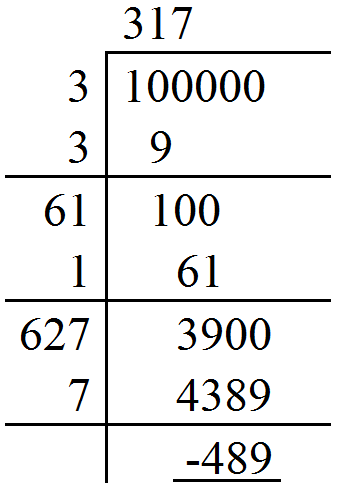
The least number with six digits is 100000. To find the least square number with six digits, we must find the smallest number that must be added to 100000 in order to make a perfect square. For that, we have to find the square root of 100000 by the long division method as follows:

100000 is $489(4389-3900)$ less than $317^2$. Hence, to be a perfect square, 489 should be added to $100000.100000+489=100489$
Hence, the least number of six digits that is a perfect square is 100489.
View full question & answer
Question 124 Marks
Find the smallest number by which 1152 must be divided so that it becomes a perfect square. Also, find the number whose square is the resulting number.
Answer
Prime factorisation of 1152
1152 = 2 × 2 × 2 × 2 × 2 × 2 × 2 × 3 × 3
$\begin{array}{c|c} 2& 1152 \\ \hline 2 & 576 \\\hline 2&288 \\\hline 2 &144\\\hline2&72\\\hline2&36\\\hline2&18\\\hline3&9\\\hline3&3\\\hline&1 \end{array}$
Grouping them into pairs of equal factors,
1152 = (2 × 2) × (2 × 2) × (2 × 2) × (3 × 3) × 2
The factor, 2 at the end is not paired. For a number to be a perfect square, each prime factor has to be paired. Hence, 1152 must be divided by 2 for it to be a perfect square.
The resulting number would be (2 × 2) × (2 × 2) × (2 × 2) × (3 × 3)
Furthermore, we have,
(2 × 2) × (2 × 2) × (2 × 2) × (2 × 2) × (3 × 3) = (2 × 2 × 2 × 3) × (2 × 2 × 2 × 3)
Hence, the number whose square is the resulting number is,
2 × 2 × 2 × 3 = 24
View full question & answer
Question 134 Marks
By what number should the following numbers be multiplied to get a perfect square in each case? Also, find the number whose square is the new number.
8820
Answer
Factorising number.
8820 = 2 × 2 × 3 × 3 × 5 × 7 × 7
$\begin{array}{c|c} 2& 8820 \\ \hline 2 & 4410 \\\hline 3&2205 \\\hline 3&735 \\\hline 5 &245 \\\hline 7&49 \\\hline 7&7 \\\hline &1 \end{array}$
Grouping them into pairs of equal factors,
8820 = (2 × 2) × (3 × 3) × (7 × 7) × 5
The factor, 5 is not paired. For a number to be a perfect square, each prime factor has to be paired. Hence, 8820 must be multiplied by 5 for it to be a perfect square.
The new number would be (2 × 2) x (3 × 3) x (7 × 7) x (5 × 5)
Furthermore, we have,
(2 × 2) × (3 × 3) × (7 × 7) × (5 × 5) = (2 × 3 × 5 × 7) × (2 × 3 × 5 × 7)
Hence, the number whose square is the new number is, 2 × 3 × 5 × 7 = 210
View full question & answer
Question 144 Marks
By what number should the following numbers be multiplied to get a perfect square in each case? Also, find the number whose square is the new number.
4056
Answer
Factorising number.
4056 = 2 × 2 × 2 × 3 × 13 × 13
$\begin{array}{c|c} 2& 4056 \\ \hline 2 & 2028 \\\hline 2&1014 \\\hline 3&507 \\\hline 13&169 \\\hline 13&13 \\\hline &1 \end{array}$
Grouping them into pairs of equal factors,
4056 = (2 × 2) × (13 × 13) × 2 × 3
The factors at the end, 2 and 3 are not paired. For a number to be a perfect square, each prime factor has to be paired. Hence, 4056 must be multiplied by 6 (2 × 3) for it to be a perfect square.
The new number would be (2 × 2) × (2 × 2) × (3 × 3) × (13 × 13)
Furthermore, we have,
(2 × 2) × (2 × 2) × (3 × 3) × (13 × 13) = (2 × 2 × 3 × 13) × (2 × 2 × 3 × 13)
Hence, the number whose square is the new number is, 2 × 2 × 3 × 13 = 156
View full question & answer
Question 154 Marks
The area of a square field is $60025 m^2$. A man cycles along its boundary at $18 km / hr$. In how much time will he return at the starting point?
Answer
Area of the square field $=60025 m^2$
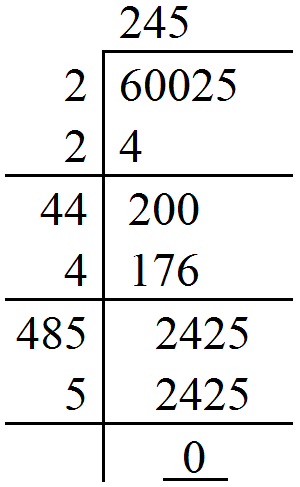
The length of the square field would be the square root of 60025 .
Using the long division method,

Hence, the length of the square field is 245m.
The square has four sides, so the number of boundaries of the field is 4.
The distance s covered by the man = 245m × 4 = 980m = 0.98km
If the velocity v is 18km/hr, the required time t can be calculated using the following formula,
$\text{t}=\frac{\text{s}}{\text{v}}$
$\text{t}=\frac{0.98}{18}=0.054\text{hr}$
$\text{t}=3\text{ minutes},16\text{ seconds}$
So, the man will return to the starting point after 3 minutes and 16 seconds.
View full question & answer
Question 164 Marks
Using square root table, find the square root,
$\frac{101}{169}$
Answer
$\sqrt{\frac{101}{169}}=\frac{\sqrt{101}}{\sqrt{169}}$
The square root of 101 is not listed in the table. This is because the table lists the square roots of all the numbers below 100.
Hence, we have to manipulate the number such that we get the square root of a number less than 100. This can be done in the following manner,
$\sqrt{101}=\sqrt{1.01\times100}=\sqrt{1.01}\times10$
Now, we have to find the square root of 1.01
We have,
$\sqrt{1}=1$ and $\sqrt{2}=1.414$
Their difference of 1 (2 - 1), the difference in the values of the square roots is 0.414
For the difference of 0.01, the difference in the values of the square roots is,
$0.01\times0.414=0.00414$
$\therefore\sqrt{1.01}=1+0.00414=1.00414$
$\sqrt{101}=\sqrt{1.01}\times10=1.00414\times10=10.0414$
Finally, $\sqrt{\frac{101}{169}}=\frac{\sqrt{101}}{1313}=\frac{10.0414}{13}=0.772$
This value is really close to the one from the key answer.
View full question & answer
Question 174 Marks
By what numbers should the following be divided to get a perfect square in case? Also, find the number whose square is the new number.
16562
Answer
Factorising number.
16562 = 2 × 7 × 7 × 13 × 13
$\begin{array}{c|c} 2& 16562 \\ \hline 7 & 8281 \\\hline 7&1183 \\\hline 13 &169 \\\hline 13&13 \\\hline &1 \end{array}$
Grouping them into pairs of equal factors,
16562 = 2 × (7 × 7) × (13 × 13)
The factor, 2 is not paired. For a number to be a perfect square, each prime factor has to be paired. Hence, 16562 must be divided by 2 for it to be a perfect square.
The new number would be (7 × 7) × (13 × 13)
Furthermore, we have,
(7 × 7) × (13 × 13) = (7 × 13) × (7 × 13)
Hence, the number whose square is the new number is, 7 × 13 = 91
View full question & answer
Question 184 Marks
By what number should the following numbers be multiplied to get a perfect square in each case? Also, find the number whose square is the new number.
7776
Answer
Factorising number.
7776 = 2 × 2 × 2 × 2 × 2 × 3 × 3 × 3 × 3 × 3
$\begin{array}{c|c} 2& 7776 \\ \hline 2 & 3888 \\\hline 2&1944 \\\hline 2&972 \\\hline 2&486 \\\hline 3&243 \\\hline 3&81 \\\hline 3&27 \\\hline 3&9 \\\hline 3&3 \\\hline &1 \end{array}$
Grouping them into pairs of equal factors,
7776 = (2 × 2) × (2 × 2) × (3 × 3) × (3 × 3) × 2 × 3
The factors, 2 and 3 at the end are not paired. For a number to be a perfect square, each prime factor has to be paired. Hence, 7776 must be multiplied by 6 (2 × 3) for it to be a perfect square.
The new number would be (2 × 2) × (2 × 2) × (2 × 2) × (3 × 3) x (3 × 3) × (3 × 3)
Furthermore, we have,
(2 × 2) × (2 × 2) × (2 × 2) × (3 × 3) × (3 × 3) × (3 × 3) = (2 × 2 × 2 × 3 × 3 × 3) × (2 × 2 × 2 × 3 × 3 × 3)
Hence, the number whose square is the new number is, 2 × 2 × 2 × 3 × 3 × 3 = 216
View full question & answer
Question 194 Marks
Using square root table, find the square root,
4955
Answer
On prime factorisation,
4955 is equal to 5 × 991, which means that $\sqrt{4955}=\sqrt{5}\times\sqrt{11}$
The square root of 991 is not listed in the table, it lists the square roots of all the numbers below 100
Hence, we have to manipulate the number such that we get the square root of a number less than 100. This can be done in the following manner.
$\sqrt{4955}=\sqrt{49.55\times100}=\sqrt{49.55}\times10$
Now, we have to find the square root of 49.55
We have, $\sqrt{49}=7$ and $\sqrt{50}=7.071$
Their difference is 0.071
Thus, for the difference of 1 (50 - 49), the difference in the values of the square roots is 0.071
For the difference of 0.55, the difference in the values of the square is,
$0.55\times0.0701=0.03905$
$\therefore\sqrt{49.55}=7+0.3905=7.03905$
Finally, we have
$\sqrt{4955}=\sqrt{49.55}\times10$
$=7.03905\times10=70.3905$
View full question & answer
Question 204 Marks
By what number should the following numbers be multiplied to get a perfect square in each case? Also, find the number whose square is the new number.
605
Answer
Factorising number.
605 = 5 × 11 × 11
$\begin{array}{c|c} 5& 605 \\ \hline 11 & 121 \\\hline 11&11 \\\hline &1 \end{array}$
Grouping them into pairs of equal factors,
605 = 5 × (11 × 11)
The factor, 5 is not paired. For a number to be a perfect square, each prime factor has to be paired. Hence, 605 must be multiplied by 5 for it to be a perfect square. The new number would be (5 × 5) × (11 × 11)
Furthermore, we have,
(5 × 5) × (11 × 11) = (5 × 11) × (5 × 11)
Hence, the number whose square is the new number is, 5 × 11 = 55
View full question & answer
Question 214 Marks
Observe the following pattern,
$(1\times2)+(2\times3)=\frac{2\ \times\ 3\ \times\ 4}{3}$
$(1\times2)+(2\times3)+(3\times4)=\frac{3\ \times\ 4\ \times\ 5}{3}$
$(1\times2)+(2\times3)+(3\times4)+(4\times5)=\frac{4\ \times\ 5\ \times\ 6}{3}$
and find the value of,
$(1\times2)+(2\times3)+(3\times4)+(4\times5)$
Answer
The RHS of the three equalities is a fraction whose numerator is the multiplication of three consecutive numbers and whose denominator is 3.
If the biggest number (factor) on the L.H.S is 3, the multiplication of the three numbers on the R.H.S begins with 2.
If the biggest number (factor) on the L.H.S is 4, the multiplication of the three numbers on the R.H.S begins with 3.
If the biggest number (factor) on the L.H.S is 5, the multiplication of the three numbers on the R.H.S begins with 4.
Using this pattern, (1 × 2) + (2 × 3) + (3 × 4) + (4 × 5) + (5 × 6) has 6 as the biggest number. Hence, the multiplication of the three numbers on the R.H.S will begin with 5. Finally, we have,
$1\times2\times+2\times3+3\times4+4\times5+5\times6$
$=\frac{5\ \times\ 6\ \times\ 7}{3}=70$
View full question & answer