Questions · Page 1 of 2

3 Mark Question

🎯

Test yourself on this topic

50 questions · timed · auto-graded

Question 13 Marks
Find the greatest number of three digits which is a perfect square.
Answer
The greatest number with three digits is 999. To find the greatest perfect square with three digits, we must find the smallest number that must be subtracted from 999 in order to get a perfect square. For that, we have to find the square root by the long division method as shown below,
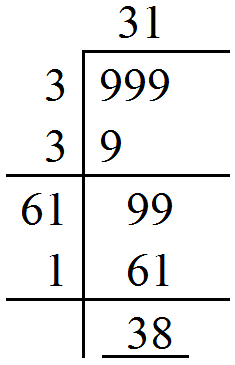
So, 38 must be subtracted from 999 to get a perfect square.
$999-38=961$
$961=31^2$
Hence, the greatest perfect square with three digits is 961 .
View full question & answer
Question 23 Marks
The cost of levelling and turfing a square lawn at Rs. 2.50 per $m ^2$ is Rs 13322.50 . Find the cost of fencing it at Rs. 5 per metre.
Answer
First, we have to find the area of the square lawn, which the total cost divided by the cost of levelling and turfing per square metre,
Area of a square $=\frac{13322.5}{2.5}=5329\text{m}^2$
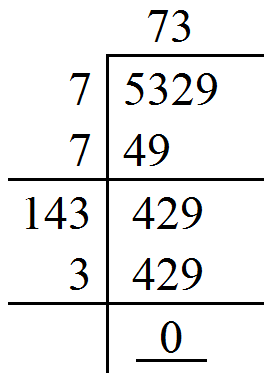
The length of one side of the square is equal to the square root of the area. we will use the long division method to find it as shown below,


$\therefore$ Length of one side of the square $=73 m$
The circumference of the square is $73 \times 4=292 m$
$\therefore$ Total cost of fencing the lawn at Rs. 5 per metre $=292 \times 5=$ Rs. 1460
View full question & answer
Question 33 Marks
The area of a square field is $80\frac{244}{729}$ square metres. Find the length of each side of the field.
Answer
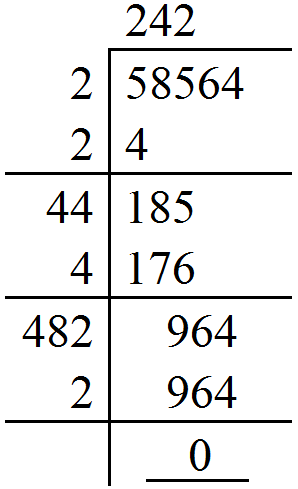
The length of one side of the square root of the area of the field. Hence, we need to calculate the value of $\sqrt{80\frac{244}{729}}$
We have,
$\sqrt{80\frac{244}{729}}=\sqrt{\frac{58564}{729}}=\frac{\sqrt{58564}}{\sqrt{729}}$
Now, to calculate the square root of the numerator and the denominator,

We know that,
$\sqrt{729}=27$
Therefore, length of one side of the field $=\frac{242}{27}=8\frac{26}{27}\text{m}$
View full question & answer
Question 43 Marks
Find the square root of the following by prime factorization.8281
Answer
Resolving 8281 into prime factors,8281 = 7 × 7 × 13 × 13
$\begin{array}{c|c}7& 8281 \\ \hline 7 & 1183 \\\hline 13&169 \\\hline13&13 \\\hline&1\end{array}$
Grouping the factors into pairs of equal factors,
8281 = (7 × 7) × (13 × 13)
Taking one factor for each pair, we get the square root of 705
7 × 13 = 91
View full question & answer
Question 53 Marks
Find the square root of the following correct to three places of decimal:
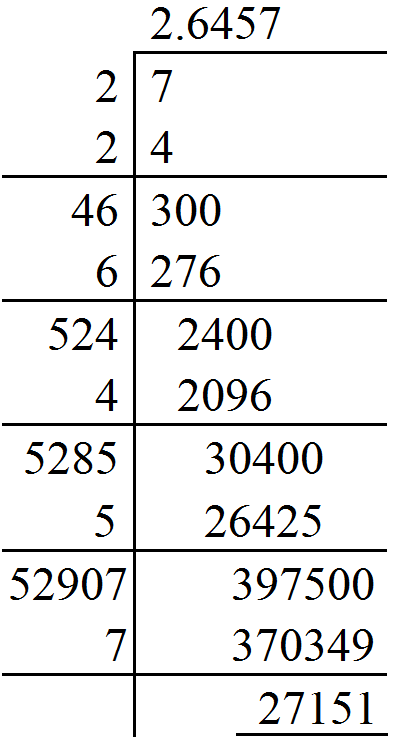
7
Answer
We can find the square root up to three decimal places by using long division until we get four decimal places and then rounding it to three decimal places.

Hence, the square root of 7 up to three decimal places is 2.646.
View full question & answer
Question 63 Marks
Find the square root of the following by prime factorization.47089
Answer
Resolving 47089 into prime factors,
47089 = 7 × 7 × 31 × 31
$\begin{array}{c|c}7& 47089 \\ \hline 7 & 6727 \\\hline 31&961 \\\hline31&31 \\\hline&1\end{array}$
Grouping the factors into pairs of equal factors,
47089 = (7 × 7) × (31 × 31)
Taking one factor for each pair, we get the square root of 47089
7 × 31 = 217
View full question & answer
Question 73 Marks
Find the smallest number by which 147 must be multiplied so that it becomes a perfect square. Also, find the square root of the number so obtained.
Answer
The prime factorisation of 147
147 = 3 × 7 × 7
Grouping the factors into pairs of equal factors, we get,
147 = 3 × (7 × 7)
The factor, 3 does not have a pair. Therefore, we must multiply 147 by 3 to make a perfect square. The new number is,
(3 × 3) × (7 × 7) = 441
Taking one factor from each pair on the L.H.S, the square root of the new number is 3 × 7, which is equal to 21.
View full question & answer
Question 83 Marks
Find the square root of the following correct to three places of decimal:
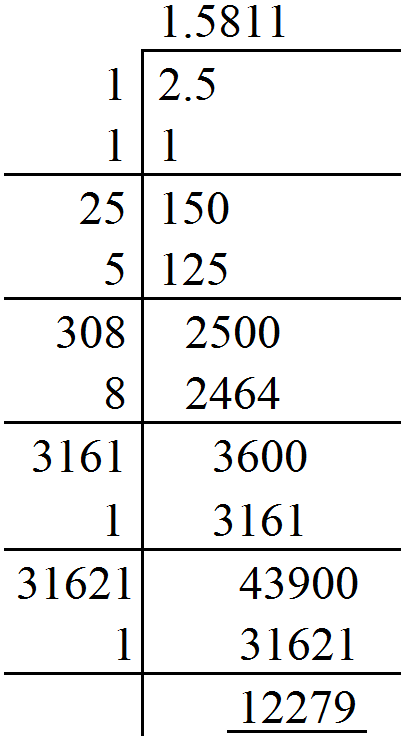
2.5
Answer
We can find the square root up to three decimal places by using long division until we get four decimal places and then rounding it to three decimal places.
Hence, the square root of 2.5 up to three decimal places is 1.581
View full question & answer
Question 93 Marks
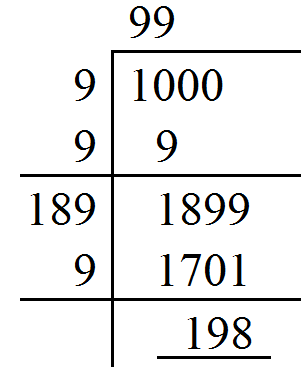
Find the greatest number of 4 digits which is a perfect square.
Answer
The greatest number with four digits is 9999. To find the greatest perfect square with four digits, we must find the smallest number that must be subtracted from 9999 in order to make a perfect square. For that, we have to find the square root of 9999 by the long division method as shown below:

We must subtract 198 from 9999 to make a perfect square,
9999 - 198 = 9801
Hence, the greatest perfect square with four digits is 9801.
View full question & answer
Question 103 Marks
Find the square root of the following correct to three places of decimal:
$287\frac{5}{8}$
Answer
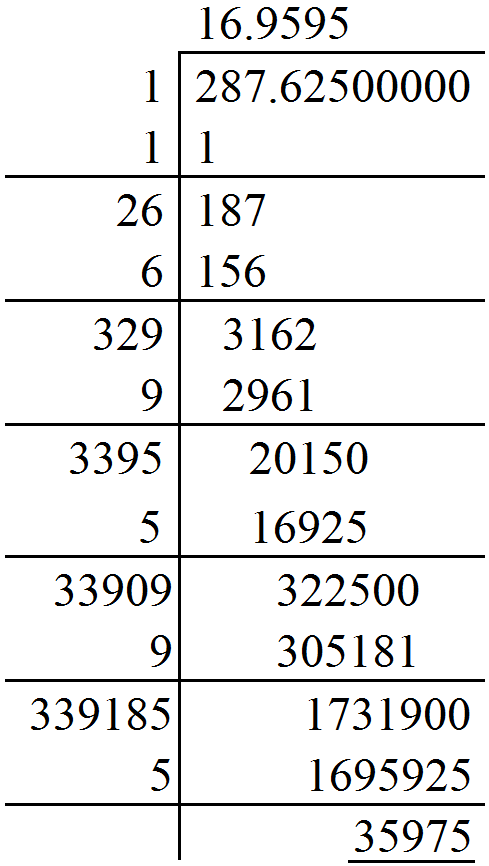
We can find the square root up to four decimal places by expanding $287\frac{5}{8}$ into decimal form up to eight digits to the right of the decimal point as shown below,
$287\frac{5}{8}=287.62500000$
Hence, we have

So, the square root of $287\frac{5}{8}$ up to three decimal places is 16.960
View full question & answer
Question 113 Marks
Find the square root of the following correct to three places of decimal:0.016
Answer
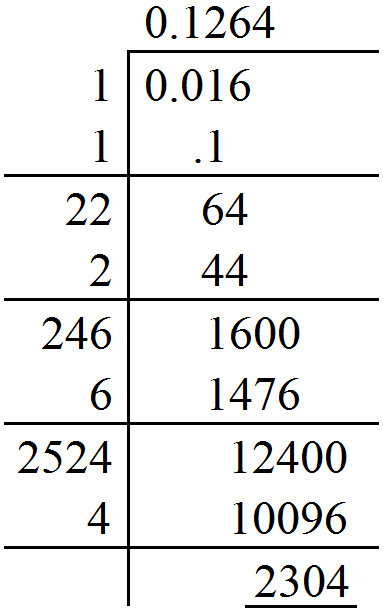
We can find the square root up to three decimal places by using long division until we get four decimal places and then rounding it to three decimal places.
Hence, the square root of 0.016 up to three decimal places is 0.126
View full question & answer
Question 123 Marks
Find the square root of the following by prime factorization.
196
Answer
Resolving 196 into prime factors,
196 = 2 × 2 × 7 × 7
$\begin{array}{c|c}2& 196 \\ \hline 2 & 98 \\\hline 7&49 \\\hline 7&7 \\\hline&1\end{array}$
Grouping the factors into pairs of equal factors,
196 = (2 × 2) × (7 × 7)
Taking one factor for each pair, we get the square root of 196
2 × 7 = 14
View full question & answer
Question 133 Marks
Find the least number of 4 digits which is a perfect square.
Answer
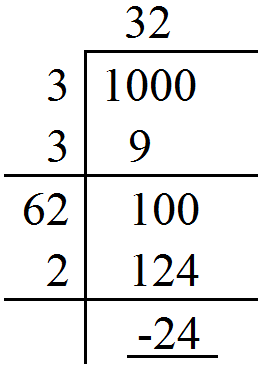
The least number with four digits is 1000. To find the least square number with four digits, we must find the smallest number that must be added to 1000 in order to make a perfect square. For that, we have to find the square root of 1000 by the long division method as shown below:

1000 is $24(124-100)$ less than the nearest square number $32^2$. Thus, 24 must be added to 1000 to be a perfect square.
$1000+24=1024$
Hence, the smallest perfect square number with four digits is 1024.
View full question & answer
Question 143 Marks
Find the square root of the following by prime factorization.3013696
Answer
Resolving 3013696 into prime factors,
3013696 = 2 × 2 × 2 × 2 × 2 × 2 × 7 × 7 × 31 × 31
$\begin{array}{c|c}2&3013696 \\ \hline 2 & 1506848 \\\hline 2&753424\\\hline2&376712 \\\hline2&188356\\\hline2&941781\\\hline7&47089\\\hline7&6727\\\hline31&961\\\hline31&31\\\hline&1\end{array}$
Grouping the factors into pairs of equal factors,
3013696 = (2 × 2) × (2 × 2) × (2 × 2) × (7 × 7) × (31 × 31)
Taking one factor for each pair, we get the square root of 3013696
2 × 2 × 2 × 7 × 31 = 1736
View full question & answer
Question 153 Marks
Find the square root of the following correct to three places of decimal:
23.1
Answer
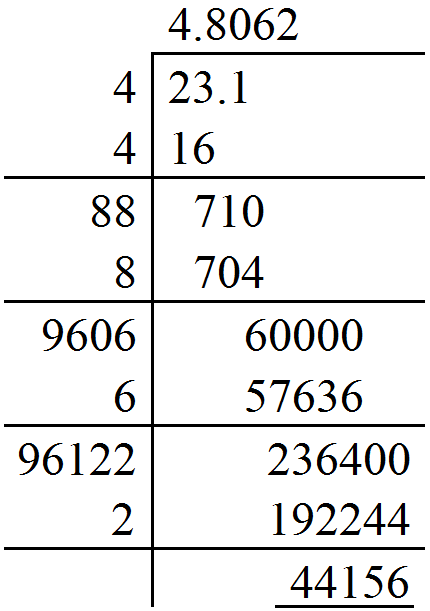
We can find the square root up to three decimal places by using long division until we get four decimal places and then rounding it to three decimal places.

Hence, the square root of 23.1 up to three decimal places is 4.806.
View full question & answer
Question 163 Marks
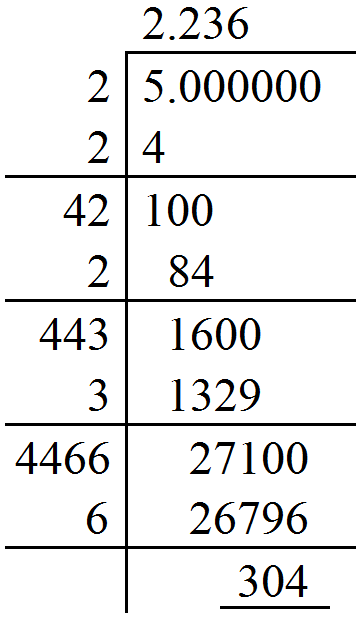
Find the square root of the following correct to three places of decimal:
5
Answer
We can find the square root up to three decimal places by using long division until we get four decimal places and then rounding it to three decimal places.

Hence, the square root of 5 up to three decimal places is 2.236
View full question & answer
Question 173 Marks
Show that the following numbers is a perfect square. Also, find the number whose square is the given number in each case:
$1156$
Answer
In problem, factorise the number into its prime factors.
$1156=2 \times 2 \times 17 \times 17$
Grouping the factors into pairs of equal factors, we obtain,
$1156=(2 \times 2) \times(17 \times 17)$
No factors are left over. Hence, 1156 is a perfect square. Moreover, by grouping 1156 into equal factors,
$1156=(2 \times 17) \times(2 \times 17)$
$1156=(2 \times 17)^2$
Hence, 1156 is the square of 34 , which is equal to $2 \times 17$
View full question & answer
Question 183 Marks
Write the prime factorization of the following numbers and hence find their square roots.
7744
Answer
The prime factorisation of 7744,
7744 = 2 × 2 × 2 × 2 × 2 × 2 × 11 × 11
Grouping them into pairs of equal factors, we get:
7744 = (2 × 2) × (2 × 2) × (2 × 2) × (11 × 11)
Taking one factor from each pair, we get,
$\sqrt{7744}=2\times2\times2\times2\times11=88$
View full question & answer
Question 193 Marks
Find the square root of the following correct to three places of decimal:
20
Answer
We can find the square root up to three decimal places by using long division until we get four decimal places and then rounding it to three decimal places.

Hence, the square root of 20 up to three decimal places is 4.472
View full question & answer
Question 203 Marks
A school collected Rs. 2304 as fees from its students. If each student paid as many paise as there were students in the school, how many students were there in the school?
Answer
Let S be the number of students.
Let $r$ be the money donated by each student.
The total contribution can be expressed by (S)(r) = Rs. 2304
Since each student paid as many paise as the number of students, then $r=S$. Substituting this in the first equation, we get,
$S \times S=2304$
$S^2=2 \times 2 \times 2 \times 2 \times 2 \times 2 \times 2 \times 2 \times 3 \times 3$
$S^2=(2 \times 2) \times(2 \times 2) \times(2 \times 2) \times(2 \times 2) \times(3 \times 3)$
$S=2 \times 2 \times 2 \times 2 \times 3=48$
So, there are 48 students in total in the school.
View full question & answer
Question 213 Marks
Find the smallest number by which the given number must be divided so that the resulting number is a perfect square:
1800
Answer
Factorise number into its prime factors.
1800 = 2 × 2 × 2 × 3 × 3 × 5 × 5
$\begin{array}{c|c} 2 & 1800 \\ \hline 2 & 900 \\\hline 2&450 \\\hline 3&225 \\\hline 3&75 \\\hline 5 &25 \\\hline 5&5 \\\hline &1 \end{array}$
Grouping the factors into pairs,
1800 = (2 × 2) × (3 × 3) × (5 × 5) × 2
Here, the factor 2 does not occur in pairs. To be a perfect square, all the factors have to be in pairs. Hence, the smallest number by which 1800 must be divided for it to be a perfect square is 2.
View full question & answer
Question 223 Marks
Find the least square number, exactly divisible by one of the numbers:
6, 9, 15 and 20
Answer
The smallest number divisible by 6, 9, 15 and 20 is their L.C.M., which is equal to 60.
Factorising 60 into its prime factors,
60 = 2 × 2 × 3 × 5
Grouping them into pairs of equal factors,
60 = (2 × 2) × 3 × 5
The factors 3 and 5 are not paired. To make 60 a perfect square, we have to multiply it by 3 × 5, i.e by 15.
The perfect square is 60 × 15, which is equal to 900.
View full question & answer
Question 233 Marks
Find the smallest number by which 180 must be multiplied so that it becomes a perfect square. Also, find the square root of the perfect square so obtained.
Answer
The prime factorisation of 180
180 = 2 × 2 × 3 × 3 × 5
Grouping the factors into pairs of equal factors, we get,
180 = (2 × 2) × (3 × 3) × 5
The factor, 5 does not have a pair. Therefore, we must multiply 180 by 5 to make a perfect square. The new number is,
(2 × 2) × (3 × 3) × (5 × 5) = 900
Taking one factor from each pair on the LHS, the square root of the new number is 2 × 3 × 5, which is equal to 30.
View full question & answer
Question 243 Marks
Find the square root of the following correct to three places of decimal:
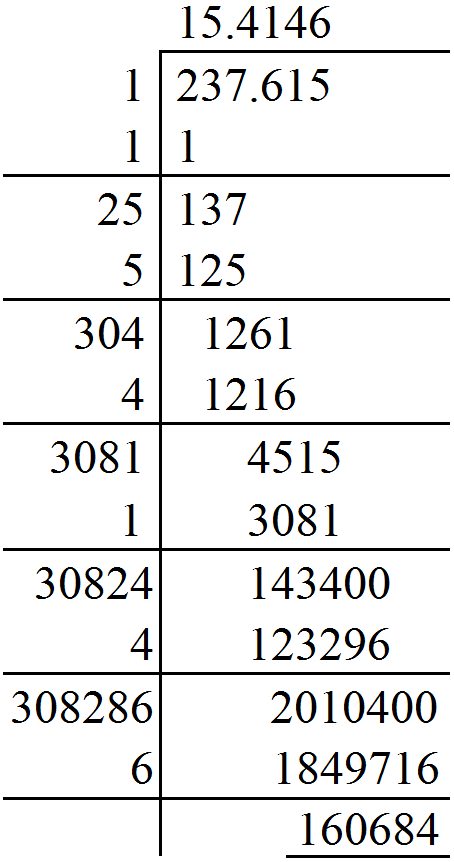
237.615
Answer
We can find the square root up to three decimal places by using long division until we get four decimal places and then rounding it to three decimal places.
Hence, the square root of 237.615 up to three decimal places is 15.415
View full question & answer
Question 253 Marks
Show that the following numbers is a perfect square. Also, find the number whose square is the given number in case:
$14641$
Answer
In problem, factorise the number into its prime factors.
$14641=11 \times 11 \times 11 \times 11$
Grouping the factors into pairs of equal factors, we obtain,
$14641=(11 \times 11) \times(11 \times 11)$
No factors are left over. Hence, 14641 is a perfect square. The above expression is already grouped into equal factors,
$14641=(11 \times 11) \times(11 \times 11)$
$14641=(11 \times 11)^2$
Hence, 14641 is the square of 121 , which is equal to $11 \times 11$
View full question & answer
Question 263 Marks
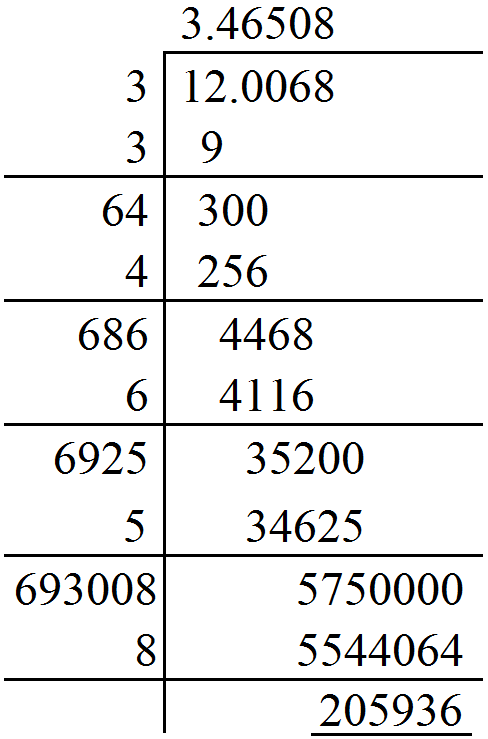
Find the square root of 12.0068 correct to four decimal places.
Answer

$\therefore\ \sqrt{12.0068}=3.46508$
We can round it off to four decimal places i.e., 3.4651
View full question & answer
Question 273 Marks
Find the squares of the following numbers using column method. Verify the result by finding the square using the usual multiplication,
$96$
Answer
$(96)^2$
Here $a=9, b=6$
$\text{a}^2$ $\text{2ab}$ $\text{b}^2$
$\ \ \ \ \ (9)^2\\ \ =81\\+\ \ {11}$ $2\times9\times6\\=108\\ \ +3$ $\ \ \ (6)^2\\=36$
$92$ $111$  
$(96)^2=96 \times 96=9216$
$\therefore(96)^2=9216$
View full question & answer
Question 283 Marks
Find the greatest number of 5 digits which is a perfect square.
Answer
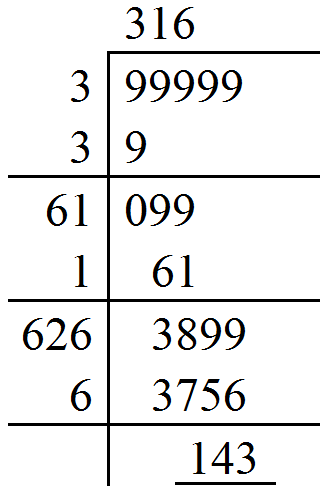
The greatest number with five digits is 99999. To find the greatest square number with five digits, we must find the smallest number that must be subtracted from 99999 in order to make a perfect square. For that, we have to find the square root of 99999 by the long division method as follows:

Hence, we must subtract 143 from 99999 to get a perfect square,
99999 - 143 = 99856
View full question & answer
Question 293 Marks
Find the square root of the following correct to three places of decimal:
66
Answer
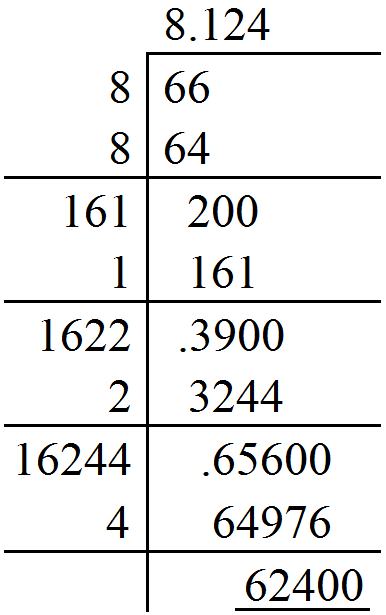
We can find the square root up to three decimal places by using long division until we get four decimal places and then rounding it to three decimal places.

Hence, the square root of 66 up to three decimal places is 8.124
View full question & answer
Question 303 Marks
Evaluate $\sqrt{50625}$ and hence find the value of $\sqrt{506.25}+\sqrt{5.0625}$
Answer
We have,
$\sqrt{50625}=\sqrt{3\times3\times3\times3\times5\times5\times5\times5}$
$=3\times3\times5\times5=225$
Next, we will calculate $\sqrt{506.25}$ and $\sqrt{5.0625}$
$\sqrt{506.25}=\sqrt{\frac{50625}{100}}=\frac{\sqrt{50625}}{\sqrt{100}}=\frac{225}{10}=22.5$
$\sqrt{5.0625}=\sqrt{\frac{50625}{10000}}=\frac{\sqrt{50625}}{\sqrt{10000}}=\frac{225}{100}=2.25$
$\sqrt{506.25}+\sqrt{5.0625}=22.5+2.25=24.75$
View full question & answer
Question 313 Marks
A General arranges his soldiers in rows to form a perfect square. He finds that in doing so, 60 soldiers are left out. If the total number of soldiers be 8160, find the number of soldiers in each row.
Answer
60 soldiers are left out.
Remainaing soldiers = 8160 - 60 = 8100
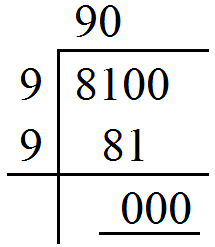
The number of soldiers in each row to form a perfect square would be the square root of 8100. We have to find the square root of 8100 by the long division method as shown below,

Hence, the number of soldiers in each row to from a perfect square is 90
View full question & answer
Question 323 Marks
Find the square root of the following by prime factorization.
529
Answer
Resolving 529 into prime factors,
529 = 23 × 23
$\begin{array}{c|c}23& 529 \\ \hline 23 & 23 \\\hline &1\end{array}$
Grouping the factors into pairs of equal factors,
529 = (23 × 23)
Taking one factor for each pair, we get the square root of 529 as 23
View full question & answer
Question 333 Marks
Find the squares of the following numbers using diagonal method:
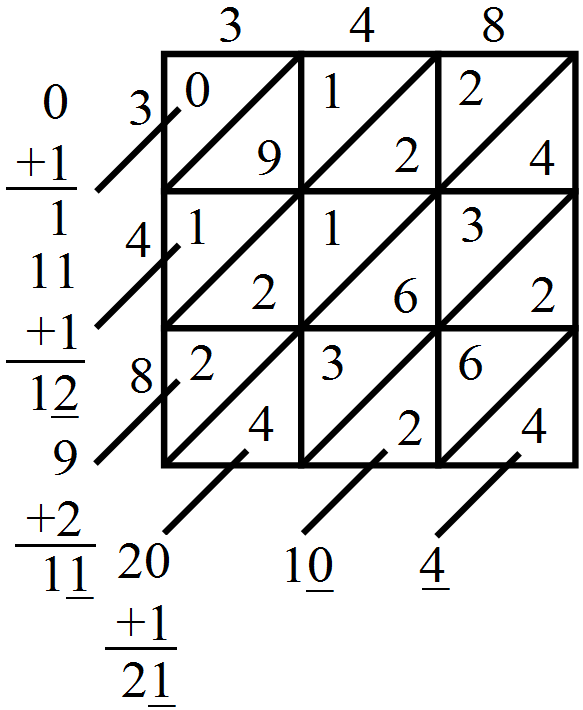
$348$
Answer
$(348)^2$

$\therefore\ (348)^2=121104$
View full question & answer
Question 343 Marks
Find the smallest number by which the given number must bew multiplied so that the product is a perfect square:
12150
Answer
Factorise number into its prime factors.
12150 = 2 × 3 × 3 × 3 × 3 × 3 × 5 × 5
$\begin{array}{c|c} 2 & 12150 \\ \hline 3 & 6075 \\\hline 3&2025 \\\hline 3&675 \\\hline 3&225 \\\hline 3&75 \\\hline5&25\\\hline5&5\\\hline&1\end{array}$
Grouping 12150 into pairs of equal factors,
12150 = (3 × 3 × 3 × 3) × (5 × 5) × 2 × 3
Here, 2 and 3 do not occur in pairs. To be a perfect square, every prime factor has to be in pairs. Hence. the smallest number by which 12150 must be multiplied is 2 × 3, i.e. by 6.
View full question & answer
Question 353 Marks
Find the square root of the following by prime factorization.
441
Answer
Resolving 441 into prime factors,
441 = 3 × 3 × 7 × 7
$\begin{array}{c|c}3& 441 \\ \hline 3 & 147 \\\hline 7&49 \\\hline 7&7 \\\hline&1\end{array}$
Grouping the factors into pairs of equal factors,
441 = (3 × 3) × (7 × 7)
Taking one factor for each pair, we get the square root of 441
3 × 7 = 21
View full question & answer
Question 363 Marks
Find the smallest number by which the given number must bew multiplied so that the product is a perfect square:
23805
Answer
Factorise number into its prime factors.
23805 = 3 × 3 × 5 × 23 × 23
$\begin{array}{c|c} 3 & 23805 \\ \hline 3 & 7935 \\\hline 5&2645 \\\hline 23&529 \\\hline 23&23 \\\hline &1 \end{array}$
Grouping 23805 into pairs of equal factors,
23805 = (3 × 3) × (23 × 23) × 5
Here, the factor 5 does not occur in pairs. To be a perfect square, every prime factor has to be in pairs. Hence, the smallest number by which 23805 must be multiplied is 5.
View full question & answer
Question 373 Marks
Find the smallest number by which the given number must be divided so that the resulting number is a perfect square:
2904
Answer
Factorise number into its prime factors.
2904 = 2 × 2 × 2 × 3 × 11 × 11
$\begin{array}{c|c} 2 & 2904 \\ \hline 2 & 1452 \\\hline 2&726 \\\hline 3&363 \\\hline 11&121 \\\hline 11 &11 \\\hline &1 \end{array}$
Grouping the factors into pairs,
2904 = (2 × 2) × (11 × 11) × 2 × 3
Here, the factors 2 and 3 do not occur in pairs. To be a perfect square, all the factors have to be in pairs. Hence, the smallest number by which 2904 must be divided for it to be a perfect square is 2 × 3, i.e. 6.
View full question & answer
Question 383 Marks
Find the square root of the following by prime factorization.190969
Answer
Resolving 190969 into prime factors,
190969 = 19 × 19 × 23 × 23
$\begin{array}{c|c}19&190969 \\ \hline 19 & 10051 \\\hline 23&529 \\\hline23&23 \\\hline&1\end{array}$
Grouping the factors into pairs of equal factors,
190969 = (19 × 19) × (23 × 23)
Taking one factor for each pair, we get the square root of 190969
19 × 23 = 437
View full question & answer
Question 393 Marks
Find the squares of the following numbers using the identity $(a-b)^2=a^2-2 a b+b^2$ : 
95
Answer
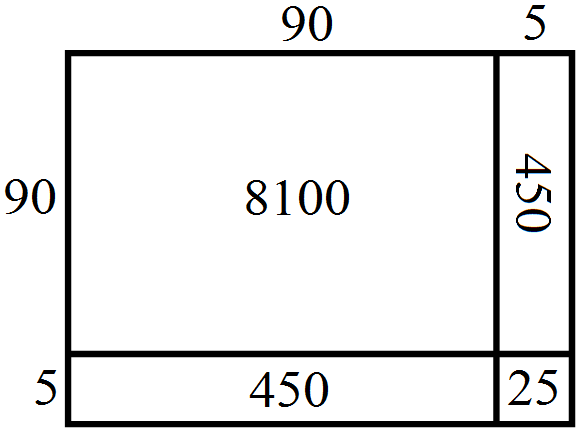
$(a+b)^2=a^2-a b+a b+b^2$
$(95)^2=(90+5)^2$
$=8100+450+450+25$
$=9025$
View full question & answer
Question 403 Marks
Find the squares of the following numbers using diagonal method:
$171$
Answer
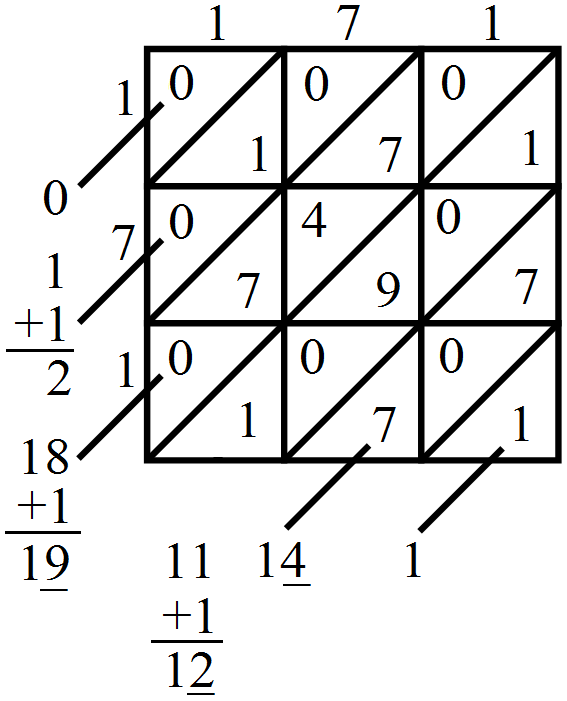
$(171)^2$


$\therefore\ (171)^2=29241$
View full question & answer
Question 413 Marks
Find the square root of the following by prime factorization.27225
Answer
Resolving 27225 into prime factors,
27225 = 3 × 3 × 5 × 5 × 11 × 11
$\begin{array}{c|c}3&27225 \\ \hline 3 & 9075 \\\hline 5&3025\\\hline5&605 \\\hline11&121\\\hline11&11\\\hline&1\end{array}$
Grouping the factors into pairs of equal factors,
27225 = (3 × 3) × (5 × 5) × (11 × 11)
Taking one factor for each pair, we get the square root of 27225
3 × 5 × 11 = 165
View full question & answer
Question 423 Marks
Find the smallest number by which the given number must be divided so that the resulting number is a perfect square:
14283
Answer
Factorise number into its prime factors.
14283 = 3 × 3 × 3 × 23 × 23
$\begin{array}{c|c} 3 & 14283 \\ \hline 3 & 4761 \\\hline 3&1587 \\\hline 23&529 \\\hline 23&23 \\\hline &1 \end{array}$
Grouping the factors into pairs,
14283 = (3 × 3) × (23 × 23) × 3
Here, the factor 3 does not occur in pairs. To be a perfect square, all the factors have to be in pairs. Hence, the smallest number by which 14283 must be divided for it to be a perfect square is 3.
View full question & answer
Question 433 Marks
Find the smallest number by which 4851 must be multiplied so that the product becomes a perfect suqare.
Answer
Prime factorisation of 48514851 = 3 × 3 × 7 × 7 × 11
$\begin{array}{c|c} 3& 4851 \\ \hline 3 & 1617 \\\hline 7&539 \\\hline 7 &77\\\hline11&11\\\hline&1 \end{array}$
Grouping them into pairs of equal factors,
4851 = (3 × 3) × (7 × 7) × 11
The factor, 11 is not paired. The smallest number by which 4851 must be multiplied such that the resulting number is a perfact square is 11
View full question & answer
Question 443 Marks
Write the prime factorization of the following numbers and hence find their square roots.
5929
Answer
The prime factorisation of 9604,
5929 = 7 × 7 × 11 × 11
Grouping them into pairs of equal factors, we get:
5929 = (7 × 7) × (11 × 11)
Taking one factor from each pair, we get,
$\sqrt{5929}=7\times11=77$
View full question & answer
Question 453 Marks
Find the squares of the following numbers using the identity $(a-b)^2=a^2-2 a b+b^2$ : 
99
Answer
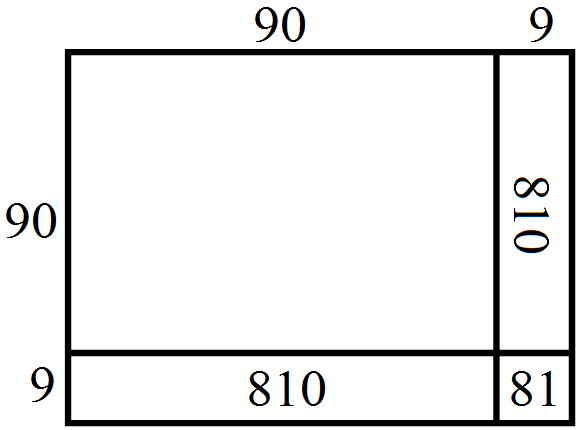
$(a+b)^2=a^2-a b+a b+b^2$
$(99)^2=(90+9)^2$
$=8100+810+810+81$
$=9801$

View full question & answer
Question 463 Marks
Find the smallest number by which the given number must bew multiplied so that the product is a perfect square:
7688
Answer
Factorise number into its prime factors.
7688 = 2 × 2 × 2 × 31 × 31
$\begin{array}{c|c} 2 & 7688 \\ \hline 2 & 3844 \\\hline 2&1922 \\\hline 31&961 \\\hline 31&31 \\\hline &1 \end{array}$
Grouping 7688 into pairs of equal factors,
7688 = (2 × 2) × (31 × 31) × 2
Here, 2 does not occur in pairs. To be a perfect square, every prime factor has to be in pairs. Hence, the smallest number by which 7688 must be multiplied is 2.
View full question & answer
Question 473 Marks
Find the square root of the following correct to three places of decimal:
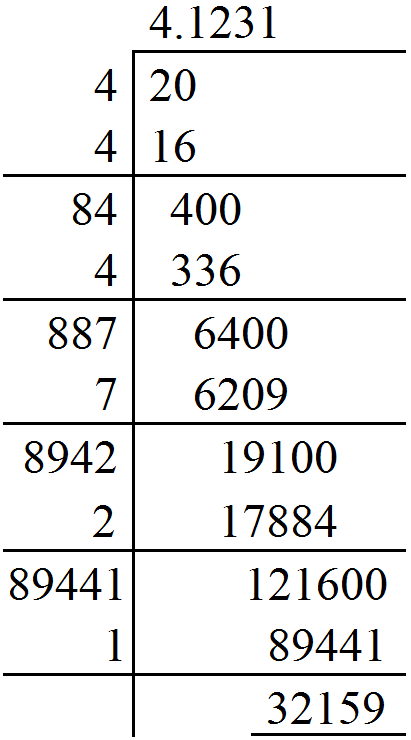
17
Answer
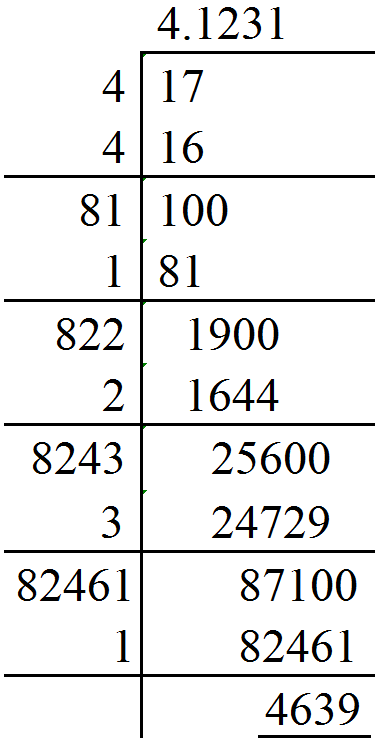
We can find the square root up to three decimal places by using long division until we get four decimal places and then rounding it to three decimal places.

Hence, the square root of 17 up to three decimal places is 4.123
View full question & answer
Question 483 Marks
Find the square root of the following correct to three places of decimal:
1.7
Answer
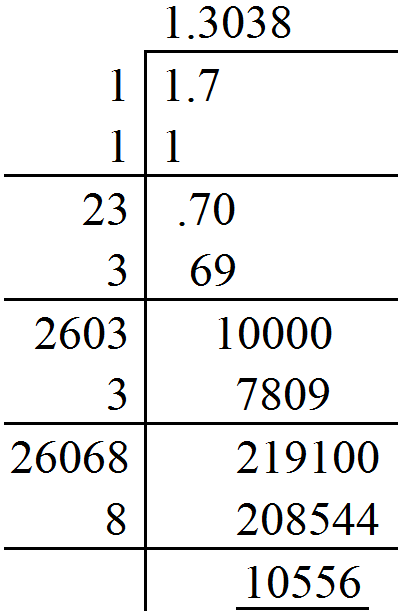
We can find the square root up to three decimal places by using long division until we get four decimal places and then rounding it to three decimal places.

Hence, the square root of 1.7 up to three decimal places is 1.304
View full question & answer
Question 493 Marks
Find the least square number, exactly divisible by one of the numbers:8, 12, 15 and 20
Answer
The smallest number divisible by 8, 12, 15 and 20 is their L.C.M., which is equal to 120.
Factorising 120 into its prime factors,
120 = 2 × 2 × 2 × 3 × 5
Grouping them into pairs of equal factors,
120 = (2 × 2) × 2 × 3 × 5
The factors 2, 3 and 5 are not paired. To make 120 into a perfect square, we have to multiply it by 2 × 3 × 5, i.e. by 30.
The perfect square is 120 × 30, which is equal to 3600.
View full question & answer
Question 503 Marks
Find the length of a side of a sqiare, whose area is equal to the area of a rectangle with sides 240m and 70m.
Answer
The area of the rectangle $=240 m \times 70 m=16800 m^2$
Given that the area of the square is equal to the area of the rectangle.
Hence, the area of the square will also be $16800 m^2$
The length of one side of a square is the square root of its area.
$\therefore \sqrt{16800}=\sqrt{2 \times 2 \times 2 \times 2 \times 2 \times 3 \times 5 \times 5 \times 7}$
$=2 \times 2 \times 5 \sqrt{2 \times 3 \times 7}$
$=20 \sqrt{42} m$
$=129.60 m$
Hence, the length of one side of the square is 129.60 m
View full question & answer