Questions

4 Mark Question

🎯

Test yourself on this topic

25 questions · timed · auto-graded

Question 14 Marks
Find the volume, lateral surface area and the total surface area of the cuboid whose dimensions are:
Length = 24m, breadth = 25cm and height = 6m
Answer
Length of cuboid (l) = 24m
Breadth (b) = 25cm $=\frac{1}{4}\text{m}$
Height (h) = 6m
  1. Volume = lbh $=24\times\frac{1}{4}\times6=36\text{cm}^3$
  2. Lateral surface area = 2[l + b] × h,
$=2\Big(24+\frac{1}{4}\Big)\times6\text{m}^2$

$=2\times\frac{97}{4}\times6=291\text{m}^2$
  1. Total surface area = 2(lb + bh + hb)
$=2\Big(24\times\frac{1}{4}+\frac{1}{4}\times6+6\times24\Big)\text{m}^2$

$=2\Big(6+\frac{3}{2}+144\Big)\text{m}^2$

$=2\Big(\frac{12+3+288}{2}\Big)\text{m}^2$

$=2\times\frac{203}{2}=303\text{m}^2$
View full question & answer
Question 24 Marks
A wooden cylindrical pole is 7m high and its base radius is 10cm. Find its weight if the wood weighs 225kg per cubic metre.
Answer
Radius of the base of pole (r)
$=10\text{dm}$
$=\frac{10}{100}\text{m}$
$=\frac{1}{10}\text{m}$
And height (h) = 7m.
$\therefore$ Volume of wood $=\pi\text{r}^2\text{h}$
$=\frac{22}{7}\times\frac{1}{10}\times\frac{1}{10}\times7\text{m}^3$
$=\frac{22}{100}\text{m}^3$
Weight of 1 cubic metre = 225kg.
$\therefore$ Total weight $=\frac{22}{100}\times225=\frac{4950}{100}$
$=49.5\text{kg.}$
View full question & answer
Question 34 Marks
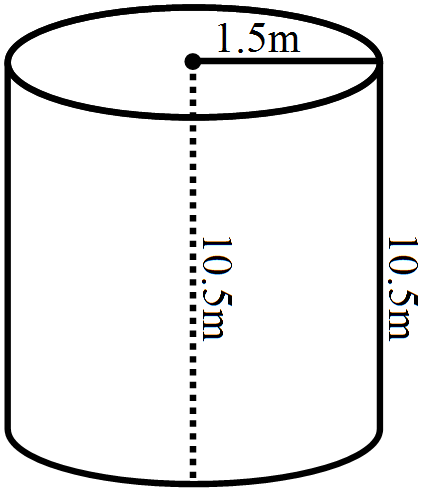
A milk tank is in the form of a cylinder whose radius is 1.5m and height is 10.5m. Find the quantity of milk in litres that can be stored in the tank.
Answer
Radius of cylindrical tank (r) = 1.5m
And height (h) = 10.5m

$\therefore$ Volume of the tank $=\pi\text{r}^2\text{h}$
$=\frac{22}{7}\times1.5\times1.5\times1.5\text{m}^3$
$=\frac{22\times15}{10}\times\frac{15}{100}\times\frac{15}{10}\times\frac{15}{10}=\frac{297}{4}\text{m}^3$
$=74.25\text{m}^3$
$\therefore$ Quantity of milk in litre,
= 74.25 × 1000 litre
= 74250 litre
View full question & answer
Question 44 Marks
Find the volume, curved surface area and total surface area of the cylinders whose dimensions are:
Radius of the base = 14dm and height = 15m
Answer
Radius of the base of a cylinder (r),
= 14dm = 1.4m.
Height (h) = 15m
  1. Volume:
$=\pi\text{r}^2\text{h}=\frac{22}{7}\times(1.4)^2\times15\text{m}^3$

$=\frac{22}{7}\times1.4\times1.4\times15\text{m}^3=92.4\text{m}^3$
  1. Lateral surface area $=2\pi\text{rh}$
$=2\times\frac{22}{7}\times1.4\times15\text{m}^2=132\text{m}^2$
  1. Total surface area $=2\pi\text{r}(\text{h}+\text{r})$
$=2\times\frac{22}{7}\times1.4\times15\text{m}^2=132\text{m}^2$

$=8.8(16.4)\text{m}^2=144.32\text{m}^2$
View full question & answer
Question 54 Marks
Find the volume, lateral surface area and the total surface area of the cuboid whose dimensions are:
Length $=15 m$, breadth $=6 m$ and height $=9 dm$.
Answer
Length of cuboid $( l )=15 m$
Breadth $(b)=6 m$
Height $(h)=9 dm =0.9 m$
a. Volume $= lbh =15 \times 6 \times 0.9=81 m^3$
b. Lateral surface area $=2(l+b) \times h$
$=2(15+6) \times 0.9 m^2$
$=2 \times 21 \times 0.9=37.8 m^2$
c. Total surface area $=2[ lb + bh + hl ]$
$=2(15 \times 6+6 \times 0.9+0.9 \times 15] m ^2$
$=2[90+5.4+13.5] m ^2$
$=2 \times 108.9=217.8 m^2$
View full question & answer
Question 64 Marks
A cylinder is open at both ends and is made of 1.5 cm -thick metal. Its external diameter is 12 cm and height is 84 cm . What is the volume of metal used in making the cylinder? Also, find the weight of the cylinder if $1 cm^3$ of the metal weighs 7.5 g .
Answer
Thickness of the metal $=1.5 cm$.
External diameter $=12 cm$.
$\therefore$ External radius $(R)=\frac{12}{2}=6 cm$.
And then internal radius $( r )=6-1.5$
$=4.5 cm$.
Height $(h)=84 cm$.
$\therefore$ Volume of metal used $=\pi r^2 h-\pi r^2 h$
$=\pi h \left( R ^2- r ^2\right)$
$=\pi h ( R + r )( R - r )$
$=\frac{22}{7} \times 84(6+4.5)(6-4.5) cm ^2$
$=264(10.5)(1.5) cm ^3=4158 cm^3$
Weight of $1 cm^3=7.5 g$
$\therefore$ Total weight $=7.5 \times 4158 g$
$=31185 g=31.185 kg$
View full question & answer
Question 74 Marks
Find the volume of wood used to make a closed box of outer dimensions $60 cm \times 45 cm \times 32 cm$, the thickness of wood being 2.5 cm all around.
Answer
Outer length of wooden box $( L )=60 cm$
Width $(B)=45 cm$
And height $( H )=32 cm$
Thickness of wood used $=2.5 cm$.
Inner length $( l )=60-2 \times 2.5$
$=60-5$
$=55 cm$.
Width $(b)=45-2 \times 2.5=45-5=40 cm$
And height $( h )=32-2 \times 2.5=32-5=27 cm$
Now outer volume $= L \times B \times H =60 \times 45 \times 32 cm^3$
Inner volume $= I \times b \times h =55 \times 40 \times 27$
$\therefore$ Volume of wood $=60 \times 45 \times 32-55 \times 40 \times 27$
$=86400-59400=27000 cm^3$
View full question & answer
Question 84 Marks
The length of a metallic tube is 1 metre, its thickness is 1 cm and its inner diameter is 12 cm . Find the weight of the tube if the density of the metal is 7.7 grams per cubic centimetre.
Answer
Inner diameter of tube $=12 cm$.
Inner radius $( r )=\frac{12}{2}=6 cm$.
Thickness of metal $=1 m$.
$\therefore$ Outer radius $(R)=6+1=7 cm$.
Length of the tube $( h )=1 m=100 cm$.
$\therefore$ Volume of metal used $=\pi R^2-\pi r^2 h$
$=\pi h \left( R ^2- r ^2\right)=\pi h ( R + r )( R - r )$
$=\frac{22}{7} \times 100(7+6)(7-6) cm ^3$
$=\frac{2200}{7} \times 13 \times 1 cm^3=\frac{28600}{7} cm^3$
Weight of $1 cm^3$ metal $=7.7 g$.
$\therefore$ Total weight,
$=\frac{28600}{7} \times 7.7 g=31460 g$
$=31.46 kg$.
View full question & answer
Question 94 Marks
The external dimensions of a closed wooden box are 62cm, 30cm and 18cm. If the box is made of 2cm-thick wood, find the capacity of the box.
Answer
Outer length of box = 62cm.
Outer width = 30cm.
Outer height = 18cm.
Thickness of wood = 2cm.
$\therefore$ Inernal length = 62 - 2 × 2
= 58cm.
Internal width = 30 - 2 × 2
= 26cm.
Inernal height = 18 - 2 × 2
= 14cm.
Capacity of the box = lbh
$=58 \times 26 \times 14 cm^3$
$=21112 cm^3$
View full question & answer
Question 104 Marks
Find the volume, curved surface area and total surface area of the cylinders whose dimensions are:
Radius of the base = 5.6m and height = 1.25m.
Answer
Radius of the base of the cylunder (r),
= 5.6m
Height (h) = 1.25m
  1. $\therefore$ Volume $=\pi\text{r}^2\text{h}$
$=\frac{22}{7}\times(5.6)^2\times1.25\text{cm}^3$

$=\frac{22}{7}\times5.6\times5.6\times1.25\text{m}^3=123.2\text{m}^3$
  1. Lateral surface area $=2\pi\text{rh}$
$=2\times\frac{22}{7}\times5.6\times1.25\text{m}^2=44\text{m}^2$
  1. Total surface area $=2\pi\text{r}(\text{h}+\text{r})$
$=2\times\frac{22}{7}\times5.6(1.25+5.6)$

$=44\times0.8(6.85)\text{m}^2=241.12\text{m}^2$
View full question & answer
Question 114 Marks
Find the volume, curved surface area and total surface area of the cylinders whose dimensions are:
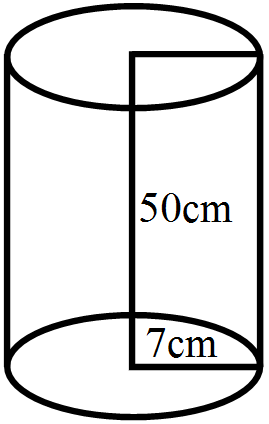
Radius of the base = 7cm and height = 50cm.
Answer
Radius of the base of the cylinder (r) = 7cm.
Height (h) = 50cm.
  1. $\therefore$ Volume $=\pi\text{r}^2\text{h}$

$=\frac{22}{7}\times(7)^2\times50\text{cm}^3$

$=\frac{22}{7}\times7\times7\times50\text{cm}^3=7700\text{cm}^3$
  1. Lateral surface area $=2\pi\text{rh}$
$=2\times\frac{22}{7}\times7\times50=2200\text{cm}^2$
  1. Total surface area $=2\pi\text{r}(\text{h}+\text{r})$
$=2\times\frac{22}{7}\times7(50+7)\text{cm}^2$

$=44\times57=2508\text{cm}^2$
View full question & answer
Question 124 Marks
The volume of a cylinder of height 8 cm is $1232 cm^3$. Find its curved surface area and the total surface area.
Answer
Volume of cylinder $=1232 cm^3$
Height $(h)=8 cm$
Let $r$ be the radius, then
$\pi\text{r}^2\text{h}=1232$
$=\frac{22}{7}\times\text{r}^2\times8=1232$
$\Rightarrow\text{r}^2=\frac{1232\times7}{22\times8}$
$\Rightarrow\text{r}^2=49=(7)^2$
$\Rightarrow\text{r}=7\text{cm}$
$\therefore$ Curved surface area $=2\pi\text{rh}$
$=2\times\frac{22}{7}\times(7+8)\text{cm}^2$
$=44\times15=660\text{cm}^2$
View full question & answer
Question 134 Marks
How many planks of size $2 m \times 25 cm \times 8 cm$ can be prepared from a wooden block 5 m long, 70 cm broad and 32 cm thick, assuming that there is no wastage?
Answer
Length of one plank $=2 m$
$=200 cm$
Breadth $(b)=25 cm$,
Thickesss $( h )=8 cm$
$\therefore$ Volume of plank $= I \times b \times h =200 \times 25 \times 8 cm^3$
$=40000 cm^3$
Length of block $( l )=5 m=500 cm$,
Width (b) $=70 cm$
and thickness $( h )=32 cm$
$\therefore$ Volume of block $=500 \times 70 \times 32 cm^3$
Number of planks $=\frac{\text { Volume of black }}{\text { Volume of plank }}$
$=\frac{500 \times 70 \times 32}{40000}$
$=\frac{1120000}{40000}=28$
View full question & answer
Question 144 Marks
Find the volume of iron required to make an open box whose external dimensions are $36 cm \times 25 cm \times 16.5 cm$, the box being 1.5 cm thick throughout. If $1 cm^3$ of iron weighs 8.5 grams, find the weight of the empty box in kilograms.
Answer
Outer length of open box $=36 cm$
Breadth $=25 cm$
And height $=16.5 cm$
Thickness of iron $=1.5 cm$.
$\therefore \text { Inner length }=36-2 \times 1.5=36-3$
$=33 cm,$
Breadth $=25-2 \times 1.5$
$=25-3$
$=22 cm$
And height $=16.5-1.5$
$=15 cm$
$\therefore$ Volume of iron used in it = Out volume - inner volume
$=36 \times 25 \times 16.5 cm^3-33 \times 22 \times 15 cm^3$
$=14850-10890$
$=3960 cm^3$
Weight of $1 cm^3=8.5$ gram
$\therefore \text { Total weight }=3960 \times 8.5 g$
$=33660 g$
$=33.660 kg$
$=33.66 kg$
View full question & answer
Question 154 Marks
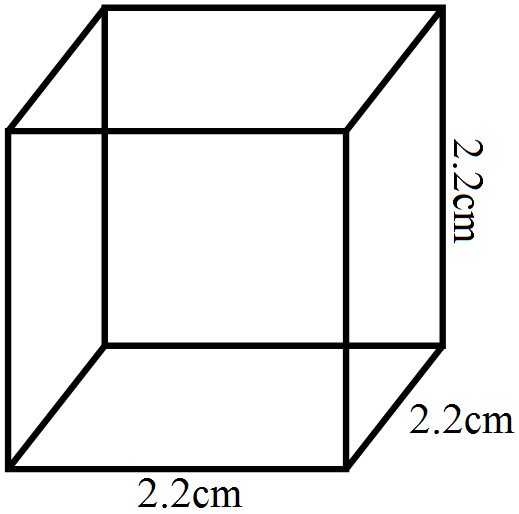
A solid cube of metal each of whose sides measures 2.2cm is melted to form a cylindrical wire of radius 1mm. Find the length of the wire so obtained.
Answer
Side of a solid cube $=2.2 cm$.
Volume $=(\text { side })^3$
$=(2.2)^3$
$=10.648 cm^3$

$\therefore$ Volume of cylinderdrical wire $=10.648 cm^3$
Radius = 1mm $=\frac{1}{10}\text{cm}$
$\therefore\text{Length}=\frac{\text{Volume}}{\pi\text{r}^2}$
$=\frac{10.648\times7\times10\times10}{22\times1\times1}$
$=\frac{10648\times7\times100}{1000\times22}=\frac{484\times7}{10}\text{cm}$
$=\frac{3388}{10}=338.8\text{cm}$
View full question & answer
Question 164 Marks
A wall 15 m long, 30 cm wide and 4 m high is made of bricks, each measuring $22 cm \times 12.5 cm \times 7.5 cm$. If $\frac{1}{12}$ of the total volume of the wall consists of mortar, how many bricks are there in the wall?
Answer
Length of wall (l) = 15m.
Width (b) = 30cm = 0.3m
Height (h) = 4m
$\therefore$ Volume of the wall = lbh
$=15 \times 0.3 \times 4 m^3=18 m^3$
$\therefore \text { Volume of bricks }=18-1.5=16.5 m^3$
Volume of one brick,
$=22 cm . \times 12.5 cm . \times 7.5 cm \text {. }$
$=22 \times 12.5 \times 7.5 cm^3$
$=2062.5\text{cm}^3=\frac{2062.5}{100\times100\times100}\text{m}^3$
$=0.0020625\text{m}^3$
No. of bricks $=\frac{\text{Total volume of bricks}}{\text{Volume of one brick}}$
$=\frac{16.5}{0.0020625}=\frac{165\times10000000}{10\times20625}$
$=8000$
View full question & answer
Question 174 Marks
Find the capacity of a rectangular cistern in litres whose dimensions are $11.2 m \times 6 m \times 5.8 m$. Find the area of the iron sheet required to make the cistern.
Answer
Length of rectangular cistern $( l )=11.2 m$
Breadth $(b)=6 m$
Height $(h)=5.8 m$
a. Volume $= lbh =11.2 \times 6 \times 5.8 m^3$
$=389.76 m^3$
$\therefore$ Capacity in litres,
$=389.76 \times 1000$ litres
$=389760$ litres.
b. Total surface area $=2[ lb + bh + hl ]$
$=2[11.2 \times 6+65.8+5.8 \times 11.2] m ^2$
$=2 \times 166.96=333.92 m^2$.
View full question & answer
Question 184 Marks
Find the volume, lateral surface area and the total surface area of the cuboid whose dimensions are:
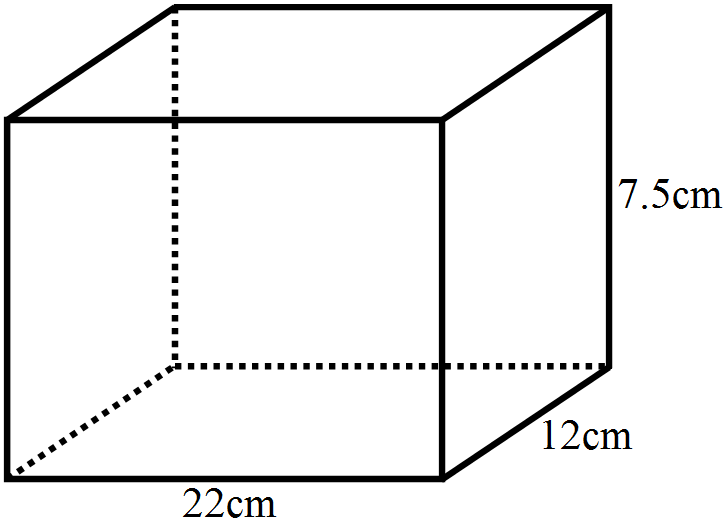
$Length = 22cm, breadth = 12cm and height = 7.5cm.$
Answer

Length of cuboid (l) = 22cm.
Breadth (b) = 12cm
and height (h) = 7.5cm.
  1. Volume $= lbh =22 \times 12 \times 7.5 cm^3$
$= 1980 cm^3$
  1. Lateral surface area = $=2(l+ b ) \times h$
$=2(22+12) \times 7.5 cm^2$

$=2 \times 34 \times 7.5=510 cm^2$
  1. Total surface area = $=2[ lb + bh + hl ]$
$= 2[22 \times 12+12 \times 7.5+7.5 \times 22] cm ^2$

$= 2 \times 34 \times 7.5=510 cm^2$
​​​​​​​
$= 2 \times 519=1038 cm^2$
View full question & answer
Question 194 Marks
The curved surface area of a cylinder is $4400 cm^2$ and the circumference of its base is 110 cm . Find the volume of the cylinder.
Answer
Curved surface area $=4400 cm^3$
Circumference of base $=110 cm$
Let r be the radius,
$\Rightarrow2\pi\text{r}=110$
$\Rightarrow2\times\frac{22}{7}\times\text{r}=110$
$\Rightarrow\text{r}=\frac{110\times7}{2\times22}=\frac{35}{2}\text{cm}$
Now, curved surface area $=2\pi\text{rh}$
$\therefore2\pi\text{rh}=4400$
$\Rightarrow2\times\frac{22}{7}\times\frac{35}{2}\times\text{h}=4400$
$110.\text{h}=4400$
$\Rightarrow\text{h}=\frac{4400}{110}$
$\Rightarrow\text{h}=40\text{cm}$
Hence volume of cylinder $=\pi\text{r}^2\text{h}$
$=\frac{22}{7}\times\frac{35}{2}\times\frac{35}{2}\times40\text{cm}^3$
$=38500\text{cm}^3$
View full question & answer
Question 204 Marks
Find the volume, lateral surface area and the total surface area of the cuboid whose dimensions are:
Length $=48 cm$, breadth $=6 dm$ and height $=1 m$.
Answer
Length of cuboid (l) = 48cm.
Breadth (b) = 6dm = 60cm.
Height (h) = 1m = 100cm.
  1. Volume = lbh = 48 × 60 × 100
$=288000 cm^3$
  1. Lateral surface area = 2(l + b) × h

$=2(48+60) \times 100 cm^2$

$=2 \times 108 \times 100=21600 cm^2$
  1. Total surface area = 2[lb + bh + hl]
$=2[48 \times 60+60 \times 100+100 \times 48] cm^2$

$=2[2880+6000+4800] cm^2$

$=2[13680]=27360 cm^2$
View full question & answer
Question 214 Marks
A piece of ductile metal is in the form of a cylinder of diameter 1cm and length 11cm. It is drawn out into a wire of diameter 1mm. What will be the length of the wire so obtained?
Answer
Diameter of cylindrical metal = 1cm.
Radius (r) $=\frac{1}{2}\text{cm}.$
Length. (A) = 11cm.
Volume $=\pi\text{r}^2\text{h}$
$=\frac{22}{7}\times\Big(\frac{1}{2}\Big)^2\times11\text{cm}^3=\frac{22}{7}\times\frac{1}{4}\times11$
$=\frac{22}{7}\times\frac{11}{4}=\frac{121}{14}\text{cm}^3$
$\therefore$ Volume of wire $=\frac{121}{14}\text{cm}^3$
Diameter of wire = 1mm
$\therefore\text{Radius}=\frac{1}{2}\text{mm}=0.5\text{mm}=0.05\text{cm}.$
Let lenght of wire = h
Then $\pi\text{r}^2\text{h}=\frac{22}{70}\times(0.05)^2\times\text{h}$
$\Rightarrow\frac{22}{7}\times0025\times\text{h}\frac{121}{14}$
$\Rightarrow\text{h}=\frac{121\times7}{14\times22\times0025}$
$=\frac{121\times7\times10000}{14\times22\times25}=1100\text{cm}$
$\therefore$ Length of wire = 11m.
View full question & answer
Question 224 Marks
A closed wooden box 80 cm long, 65 cm wide and 45 cm high, is made of 2.5 cm -thick wood. Find the capacity of the box and its weight if $100 cm^3$ of wood weighs 8 g .
Answer
Outer length $=80 cm$.
Outer width $=65 cm$.
Outer height $=45 cm$.
Total volume $=80 \times 65 \times 45 cm^3$
$=234000 cm^3$
Thickness of wood $=2.5 cm$.
$\therefore$ Inner length $=80-2 \times 2.5=75 cm$.
Inner width $=65-2 \times 2.5=60 cm$.
Inner height $=45-2 \times 2.5=40 cm$.
$\therefore$ Inner capacity (volume)
$=75 \times 60 \times 40 cm^3=180000 cm^3$
Volume of wood $=234000-180000$
$=54000 cm^3$
$\therefore$ Weight of wood $=\frac{54000 \times 8}{100} g$
$=4320 g=4.320 kg$.
View full question & answer
Question 234 Marks
How many cubic metres of earth must be dug out to sink a well which is 20m deep and has a diameter of 7 metres? If the earth so dug out is spread over a rectangular plot 28m by 11m, what is the height of the platform so formed?
Answer
Diameter of a well $=7 m$.
Radius $( r )=\frac{7}{2} m$
Depth $(h)=20 m$
$\therefore$ Volume of earth dug out $=\pi r ^2 h$
$=\frac{22}{7} \times\left(\frac{7}{2}\right)^2 \times 20 m^3 \\
=\frac{22}{7} \times \frac{7}{2} \times \frac{7}{2} \times 20 m^3=770 m^3$
Now volume of platform $=770 m^3$
Length $( l )=28 m$
Breadth (b) $=11 m$
Let height $=h$
$\therefore lbh=770 \Rightarrow 11 \times h=770$
$\Rightarrow h=\frac{770}{28 \times 11}=\frac{5}{2}=2.5 m$
$\therefore$ Height of the platform $=2.5 m$.
View full question & answer
Question 244 Marks
The radius and height of a cylinder are in the ratio $7: 2$. If the volume of the cylinder is $8316 cm^3$, find the total surface area of the cylinder.
Answer
Ratio in radius and height of a cylinder = 7 : 2
Let radius = 7x
Then height = 2x
$\therefore\text{Volume}=\pi\text{r}^2\text{h}=\frac{22}{7}\times7\text{x}\times7\text{x}\times2\text{x}$
$=308\text{x}^3$
$\therefore308\text{x}^3=8316$
$\text{x}^3=\frac{8316}{308}=27=(3)^3$
$\therefore\text{x}=3$
$\therefore$ Radius of cylinder (r) = 7x = 7 × 3 = 21cm,
And height (h) = 2x = 2 × 6cm
Now, total surface area $=2\pi\text{r}(\text{r}+\text{h})$
$=2\times\frac{22}{7}\times21(21+6)\text{cm}^2$
$=132\times27\text{cm}^2$
$=3564\text{cm}^2$
View full question & answer
Question 254 Marks
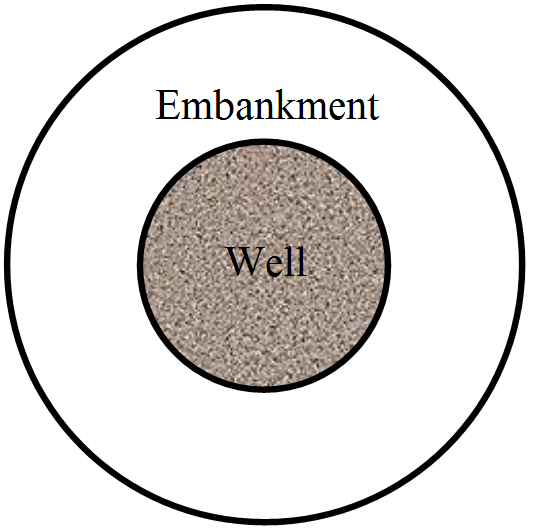
A well of inner diameter 14m is dug to a depth of 12m. Earth taken out of it has been evenly spread all around it to a width of 7m to form an embankment. Find the height of the embankment so formed.
Answer

Inner diameter of well = 14m
Inner radius $=\frac{14}{2}=7\text{m}$
Depth (h) = 12m
$\therefore$ Volume of earth dig out $=\pi\text{r}^2\text{h}$
$=\frac{22}{7}\times(7)^2\times12\text{m}^3$
$=\frac{22}{7}\times7\times7\times12\text{m}^3=1848\text{m}^3$
Width of the embankment of the well
= 7m
$\therefore$ Outer radius (R) = 7 + 7 = 14m.
Let height of the embankment = h
$\therefore$ Volume $\pi\text{r}^2\text{h}-\pi\text{r}^2\text{h}$
$=\pi\text{h}\big(\text{R}^2-\text{r}^2\big)=\frac{22}{7}\text{h}\big(\text{R}^2-\text{r}^2\big)$
$\therefore\frac{22}{7}\text{h}\big(14^2-7^2\big)=1848$
$\Rightarrow\frac {22}{7}\text{h}(14+7)(14-7)=1848$
$\Rightarrow\frac{22}{7}\text{h}\times21\times7=1848$
$\Rightarrow462\text{h}=1848$
$\therefore\text{h}=\frac{1848}{462}=4$
$\therefore$ Height of embankment = 4m.
View full question & answer
4 Mark Question - Maths STD 8 Questions - Vidyadip