$\left(g=9.8 m / s^2, \rho(\text { water })=1000 kg / m^3\right)$
25 questions · self-marked practice — reveal the answer and mark yourself.

Therefore, the ball will start moving upward. As it comes up with part of the ball above the water surface, the volume of the water displaced by the ball becomes less and hence at a certain stage, the buoyant force and the weight balance each other. Then the ball continues to remain in that state, as the net force on the ball becomes zero.
Hence, the volume of the liquid displaced by a floating body is inversely proportional to the density of the liquid. As a result, when a piece of wood floats in kerosine, it displaces greater volume of kerosine compared to the volume of water displaced when the piece of wood floats in water. Hence, it sinks more in kerosine than in water.

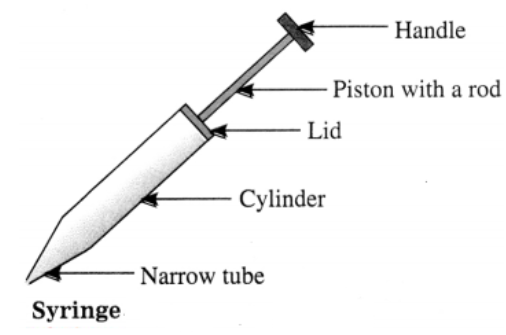
tube. The snugly fitting piston can slide in , and out smoothly. The rod connected to the i piston passes through a hole in the centre of the lid and has a handle at the other end.
When the tip of the narrow tube is dipped in coloured water (or any other liquid) and the piston is pushed towards the tip, up to the bottom, most of the air in the cylinder escapes through the tube, reducing the pressure. When the piston is moved up, the coloured water rises in the part of the cylinder below the piston due to the atmospheric pressure.
Finally, the inner pressure equals the atmospheric pressure and no more coloured water enters in or comes out. To spray the coloured water, the tube is taken out and the piston is moved towards the opening of the tube. As the inner pressure is now greater than the atmospheric pressure, the coloured water gushes out of the narrow opening of the tube.
The tip of a syringe is fitted with a very fine and hollow needle. The required quantity of medicine can be taken in the syringe with the help of the piston. The medicine can then be injected into the body of a patient using the needle and the piston.
tube. The snugly fitting piston can slide in , and out smoothly. The rod connected to the i piston passes through a hole in the centre of the lid and has a handle at the other end. When the tip of the narrow tube is dipped in coloured water (or any other liquid) and the piston is pushed towards the tip, up to the bottom, most of the air in the cylinder escapes through the tube, reducing the pressure.
When the piston is moved up, the coloured water rises in the part of the cylinder below the piston due to the atmospheric pressure. Finally, the inner pressure equals the atmospheric pressure and no more coloured water enters in or comes out.
To spray the coloured water, the tube is taken out and the piston is moved towards the opening of the tube. As the inner pressure is now greater than the atmospheric pressure, the coloured water gushes out of the narrow opening of the tube.

On releasing the bulb, the atmospheric pressure on the ink pushes the ink into the dropper. The dropper is then taken out and its open end is held over the open barrel of the pen. The bulb is then pressed so that the ink in the dropper enters the pen.
As a result, there arises a difference in the internal and external pressures on the walls of the cells and blood capillaries. If the difference is large, it may cause the cell wall and the blood capillaries to burst. Thus, the capillaries in the nose (and ear) may burst causing bleeding.
1.Some people feel their ears popping at the top of a mountain.
2.Some people feel breathless as they climb higher and higher on a mountain.
3.We can enjoy a cold-drink or fruit juice with the help of a straw but can we imagine drinking a cold-drink or fruit juice on the moon using a straw?
4.People are often advised not to carry fountain pens while travelling by air.
2.Atmospheric pressure decreases with altitude. Hence, some people feel breathless as they climb higher and higher on a mountain.
3.When we suck air in the straw, the pressure of the air in the straw becomes less than that of the outside air on the cold drink or fruit juice in the bottle (or the glass). Hence, the cold drink or fruit juice rises in the straw and enters our mouth. We can then drink it. There is no atmosphere on the moon. Hence, it is not possible to enjoy a cold drink or fruituice on the moon by using a straw.
4.The ink in a fountain pen (filled at sea level at atmosphere pressure) may come out through its mouth while travelling by air if the outside pressure becomes less than the pressure in the ink holder of the pen. This can spoil the clothes/purse/bag. Hence, people are often advised not to carry fountain pens while travelling by air.
The pressure exerted by air or the atmosphere surrounding the earth is known as the atmospheric pressure. It is the ratio of the weight of the air to the area of the surface of the earth. It decreases with altitude as the density of air decreases with altitude and also the weight of the air column above a given place.

This shows that pressure varies inversely as the area of the surface on which the force is applied, if the force remains constant. If the same force is applied to surfaces having different areas, the pressure is more on the surface having a smaller area.
Consider a body moving in a straight line, If we apply a force in the direction of motion of the body, the speed of the body increases. On the contrary, if we apply a force in the direction opposite to that of motion of the body, the speed of the body decreases. These ( examples show that force has magnitude as well as direction, i.e., force is a vector quantity.
Make a list of some more examples in which contact and non contact forces are applied. Write the types of force.
1. Some examples in which contact forces are applied:
2. Some examples in which non contact forces are applied: