Questions

Answer the following question.

🎯

Test yourself on this topic

5 questions · timed · auto-graded

Question 15 Marks
Explain the experiment, with0 a neat diagram, to prove the following:
‘Sound needs a material medium for propagation.’
Answer

Image

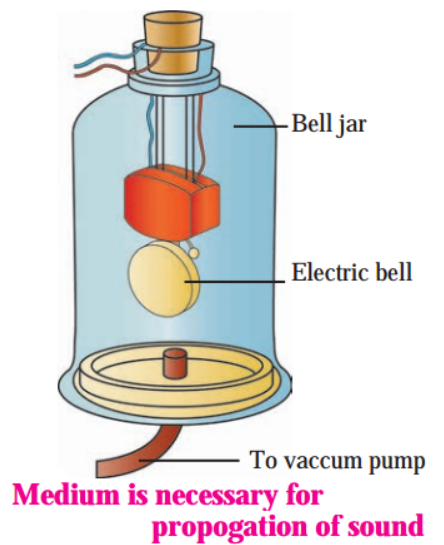
Figure shows part of the set up used in this experiment. What is not shown is the electric circuit in which the electric bell is connected. A vacuum tight bell jar contains an electric bell connected to a power supply through the lid of the jar. The jar is placed on a smooth horizontal surface such as that of glass.

Initially the vacuum pump is off and the jar contains air. The circuit containing the bell is completed using the key or the switch so that the bell starts ringing. This can be heard outside the jar.

Then the vacuum pump is switched on so that it starts removing the air from the jar. We find that the level of ringing sound heard goes on decreasing as the quantity of air in the jar becomes less and less.

When the pump is operated for a sufficiently long time interval, the quantity of air in the jar becomes so less that the level of ringing sound becomes very low; sound is hardly audible. But we can see the striker in the bell hitting the gong. By extrapolation, we conclude that sound generation and propagation needs a medium.
View full question & answer
Question 25 Marks
How is sound produced in the human larynx and a loudspeaker?
Answer
1. Sound production in the human larynx:
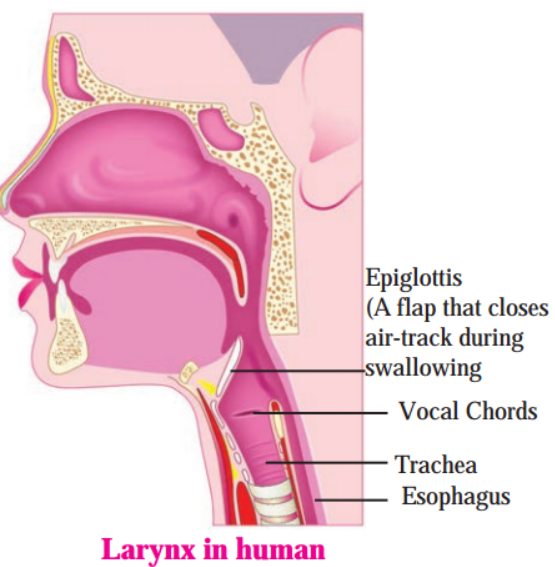
In the humans, sound is produced in the voice box called the larynx. It is located at the upper end of the windpipe. Two vocal cords (chords) are stretched across it with a narrow slit between them for the passage of air (Fig. 15.5). When the lungs force air through the slit, the cords start vibrating.

The frequency of the sound produced depends upon the length and thickness of the cords, and the tension in the chords. The frequency increases with the increase in tension and the more the length or the thickness of the cord, the less is the frequency. Muscles attached to the cords can make the cords tight (more tension) or loose (less tension).

Image

2. Sound produced in a loudspeaker:
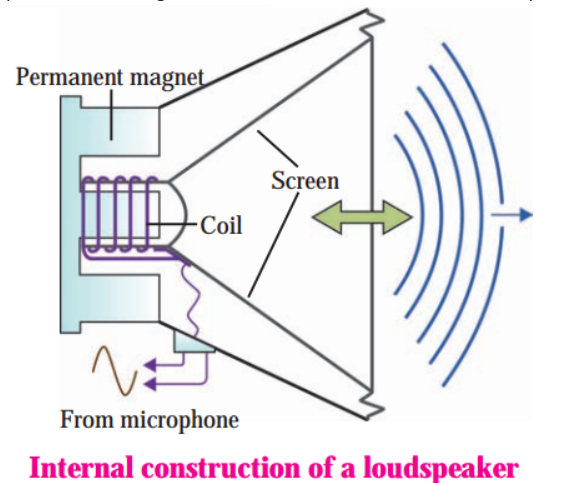
Figure shows the internal construction of a loudspeaker. Here, a coil is wound around a permanent magnet. The conical screen of the loudspeaker is attached to the coil.

Image

When a current is passed through the coil, a magnetic field is produced. Its interaction with the permanent magnet results in the back and forth motion of the coil. The frequency and the amplitude of the motion of the coil depends on the variation in the current through the coil.

As the coil moves, the conical screen also moves back and forth. The vibrations of the screen produce sound waves in air. Very loud sound can be produced by changing the current.

View full question & answer
Question 35 Marks
How are different sound notes generated in musical instruments like guitar, which uses strings for sound generation, and flute, which uses blown air for sound generation?
Answer
1. Guitar: It is a string based, flat- backed instrument. It has usually six strings, the strings are plucked or strummed with the fingers or a small piece of plastic, wood, etc. It has a flat sounding board with a circular sound hole in the centre. Also it has a fretted fingerboard. Its frequency range is more than three octaves. The frequency of vibration of the string is changed by changing the tension in the string or changing the vibrating length of the string. As the tension is increased, the frequency increases. As the vibrating length is increased, the frequency decreases. This is how different sound notes are generated.
[Note: The acoustic guitar has hollow body and six or twelve strings while the electric guitar usually has solid body and six strings. The electric bass guitar has four strings.]

2. Flute: It is a wind instrument where air is blown against the edge or rim of the blowing hole. The frequency of the sound produced depends upon the length of the vibrating air column in the tube. The greater the length of the vibrating air column, the less is the frequency of the sound produced. This is how different sound notes are produced. The flute has six or seven or eight holes to generate sounds of different frequencies. Different notes can be generated also by changing the way of air-blowing.

View full question & answer
Question 45 Marks
NoteFrequency (Hz)
sa256
Re280
Ga312
Ma346
Pa384
Dha426
ni480
Answer
[Note: The diatonic scale:

$
\begin{gathered}
\text { do : } 256 Hz , re : 288 Hz , mi : 320 Hz , \text { fa : } \\
341 \frac{1}{3} Hz , sol : 384 Hz , \text { la }: 426 \frac{2}{3} Hz , ti : 480 Hz \\
\frac{288}{256}=\frac{9}{8}, \frac{320}{256}=\frac{5}{4}, \frac{341 \frac{1}{3}}{256}=\frac{4}{3}, \\
\frac{384}{256}=\frac{3}{2}, \frac{426 \frac{2}{3}}{256}=\frac{5}{3}, \frac{480}{256}=\frac{15}{8}
\end{gathered}
$
(ratio of integers). These ratios are called intervals.

Also, $\frac{320}{288}=\frac{10}{9}, \frac{341 \frac{1}{3}}{320}=\frac{16}{15}, \frac{384}{341 \frac{1}{3}}=\frac{9}{8}$, $\frac{426 \frac{2}{3}}{384}=\frac{10}{9}, \frac{480}{426 \frac{1}{3}}=\frac{9}{8}$ (ratio of integers).
$
\frac{384 Hz }{256 Hz }=\frac{3}{2}
$
Such a simple fraction is pleasing to the ear and is called a musical interval. Frequency ratios 2 : 1, 3 : 2, 4 : 3 are examples of musical interval.

View full question & answer
Question 55 Marks
Explain the production and propagation of sound in air.
Answer
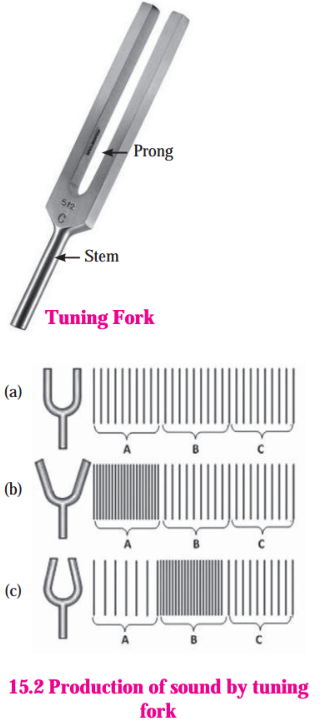
Let us consider production of sound by using a tuning fork. A tuning fork is made of a metal. It has a stem and two prongs (Fig). Figure (a) shows the state of air in the absence of propagation sound through it. Equally spaced vertical lines show that the average distance between the air molecules is the same everywhere. It means average pressure and average density in the regions A, B and C are the same.

Image

Suppose the tuning fork is held vertical, its stem is fixed in a stand (not shown in the figure) and its prongs are struck lightly using a light hammer with a piece of rubber at the top. The prongs then start vibrating.
Figure (b) shows what happens when the prongs move away from each other. The air outside the prongs is compressed (layers in the region A). The pressure and density increase in this region.

Figure (c) shows what happens when the prongs move close to each other. The air molecules near the prongs move away from each other resulting in lower pressure and lower density.

This region is called rarefaction. Meanwhile, the compression produced earlier moves forward, i.e., away from the prongs because the air molecules in this region transfer their energy to the air molecules in the region B producing a compression there. The periodic formation of compression and rarefaction results in propagation of sound waves away from the prongs.

Eventually, these sound waves reach our ears, the ear-drum vibrates, and we get a sense of hearing a sound as the specific signals reach the brain.

View full question & answer
Answer the following question. - Science STD 8 Questions - Vidyadip