Questions

5 Mark Question

Take a timed test

11 questions · self-marked practice — reveal the answer and mark yourself.

Question 15 Marks
Construct ∆NTS where NT = 5.7 cm. TS = 7.5 cm and ∠NTS = 110° and draw incircle and circumcircle of it.
Answer
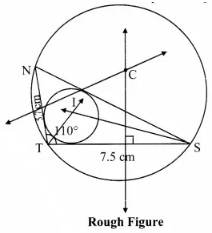
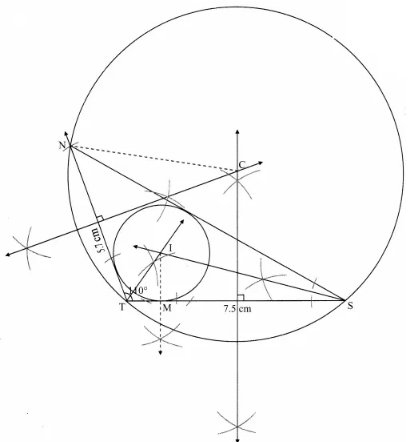
Image

Image
Steps of construction:
For incircle:
i. Construct ∆NTS of the given measurement.
ii. Draw the bisectors of ∠T and ∠S. Let these bisectors intersect at point I.
iii. Draw a perpendicular IM on side TS. Point M is the foot of the perpendicular.
iv. With I as centre and IM as radius, draw a circle which touches all the three sides of the triangle.
For circumcircle:
i. Draw the perpendicular bisectors of side NT and side TS of the triangle.
ii. Name the point of intersection of the perpendicular bisectors as point C.
iii. Join seg CN
iv. With C as centre and CN as radius, draw a circle which passes through the three vertices of the triangle.
View full question & answer
Question 25 Marks
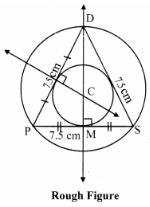
Construct incircle and circumcircle of an equilateral ADSP with side 7.5 cm. Measure the radii of both the circles and find the ratio of radius of circumcircle to the radius of incircle.
Answer

Image


Image

Steps of construction:
i. Construct ∆DPS of the given measurement.
ii. Draw the perpendicular bisectors of side DP and side PS of the triangle.
iii. Name the point of intersection of the perpendicular bisectors as point C.
iv. With C as centre and CM as radius, draw a circle which touches all the three sides of the triangle.
v. With C as centre and CP as radius, draw a circle which passes through the three vertices of the triangle.
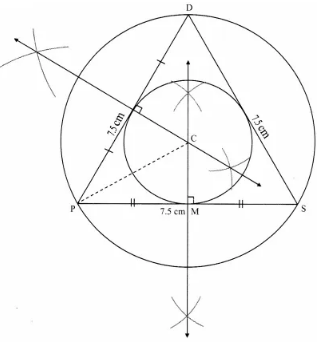
Radius of incircle = 2.2 cm and Radius of circumcircle = 4.4 cm
$\begin{aligned} \therefore \quad \frac{\text { Radius of circumcircle }}{\text { Radius of incircle }} & =\frac{4.4}{2.2} \\ & =\frac{44}{22}=\frac{2}{1} \\ & =2: 1\end{aligned}$

View full question & answer
Question 45 Marks
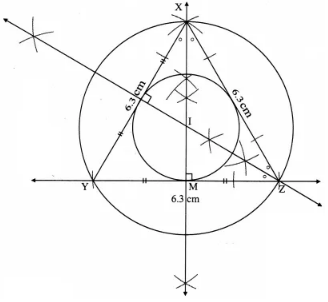
Draw any equilateral triangle. Draw incircle and circumcircle of it. What did you observe while doing this activity? (Textbook pg. no. 85)
i. While drawing incircle and circumcircle, do the angle bisectors and perpendicular bisectors coincide with each other?
ii. Do the incentre and circumcenter coincide with each other? If so, what can be the reason of it?
iii. Measure the radii of incircle and circumcircle and write their ratio.
Answer

Image


Image

Steps of construction:
i. Construct equilateral ∆XYZ of any measurement.
ii. Draw the perpendicular bisectors of side XY and side YZ of the triangle.
iii. Draw the bisectors of ∠X and ∠Z.
iv. Name the point of intersection of the perpendicular bisectors and angle bisectors as point I.
v. With I as centre and IM as radïus, draw a circle which touches all the three sides of the triangle.
vi. With I as centre and IZ as radius, draw a circle which passes through the three vertices of the triangle.
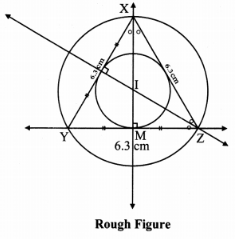
[Note: Here, point of intersection of perpendicular bisector and angle bisector is same.]

i. Yes.
ii. Yes.
The angle bisectors of the angles and the perpendicular bisectors of the sides of an equilateral triangle are coincedent. Hence, its incentre and circumcentre coincide.
iii. Radius of circumcircle = 3.6 cm,
Radius of incircle = 1.8 cm
Ratio $=\frac{\text { Radius of circumcircle }}{\text { Radius of incircle }}=\frac{3.6}{1.8}=\frac{2}{1}=2: 1$

View full question & answer
Question 55 Marks
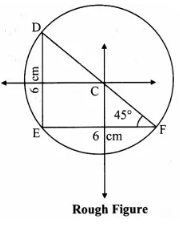
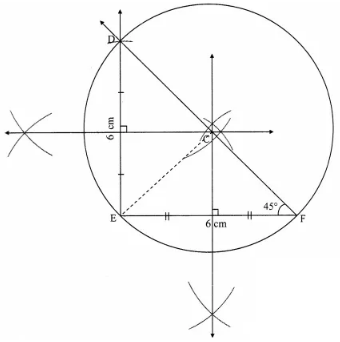
Construct ∆DEF such that DE = EF = 6 cm. ∠F = 45° and construct its circumcircle.
Answer

Image

Image
Steps of construction:
i. Construct ∆DEF of the given measurement.
ii. Draw the perpendicular bisectors of side DE and side EF of the triangle.
iii. Name the point of intersection of perpendicular bisectors as point C.
iv. Join seg CE
v. With C as centre and CE as radius, draw a circle which passes through the three vertices of the triangle.
View full question & answer
Question 65 Marks
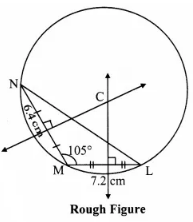
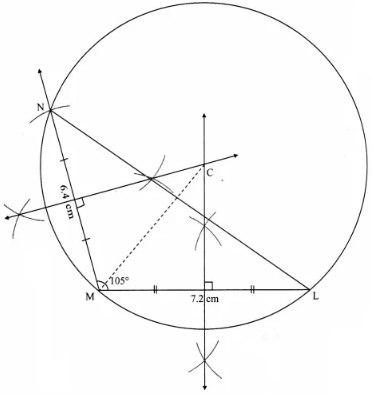
In ∆LMN, LM = 7.2 cm, ∠M = 105°, MN = 6.4 cm, then draw ∆LMN and construct its circumcircle.
Answer

Image

Image
Steps of construction:
i. Construct ∆LMN of the given measurement.
ii. Draw the perpendicular bisectors of side MN and side ML of the triangle.
iii. Name the point of intersection of the perpendicular bisectors as point C.
iv. Join seg CM
v. With C as centre and CM as radius, draw a circle which passes through the three vertices of the triangle.
View full question & answer
Question 75 Marks
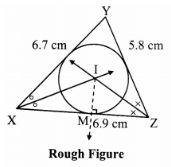
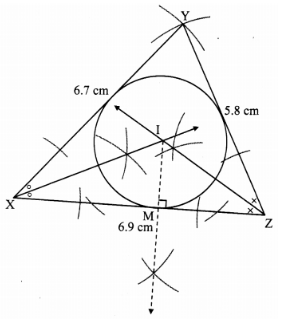
Construct ∆XYZ such that XY = 6.7 cm, YZ = 5.8 cm, XZ = 6.9 cm. Construct its incircle.
Answer

Image

Image
Steps of construction:
i. Construct ∆XYZ of the given measurement
ii. Draw the bisectors of ∠X and ∠Z. Let these bisectors intersect at point I.
iii. Draw a perpendicular IM on side XZ. Point M is the foot of the perpendicular.
iv. With I as centre and IM as radius, draw a circle which touches all the three sides of the triangle.
View full question & answer
Question 85 Marks
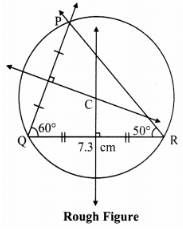
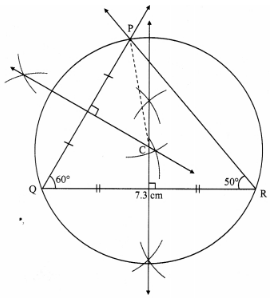
Construct ∆PQR such that ∠P = 70°, ∠R = 50°, QR = 7.3 cm and construct its circumcircle.
Answer
In ∆PQR,
m∠P + m∠Q + m∠R = 180° … [Sum of the measures of the angles of a triangle is 180°]
∴ 70° + m∠Q + 50° = 180°
∴ m∠Q = 180° – 70° + m∠Q + 50° = 180°
∴ m∠Q = 180° – 70° – 50°
∴ m∠Q = 60°

Image

Image
Steps of construction:
i. Construct A PQR of the given measurement.
ii. Draw the perpendicular bisectors of side PQ and side QR of the triangle.
iii. Name the point of intersection of the perpendicular bisectors as point C.
iv. Join seg CP
v. With C as centre and CP as radius, draw a circle which passes through the three vertices of the triangle.
View full question & answer
Question 95 Marks
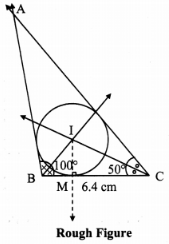
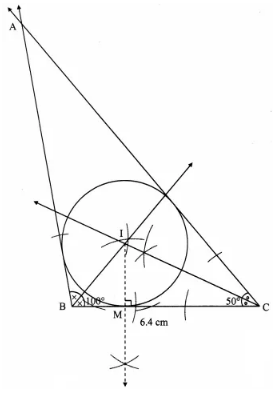
Construct ∆ABC such that ∠B =100°, BC = 6.4 cm, ∠C = 50° and construct its incircle.
Answer

Image

Image
Steps of construction:
i. Construct ∆ABC of the given measurement.
ii. Draw the bisectors of ∠B and ∠C. Let these bisectors intersect at point I.
iii. Draw a perpendicular IM on side BC. Point M is the foot of the perpendicular.
iv. With I as centre and IM as radius, draw a circle which touches all the three sides of the triangle.
View full question & answer
Question 105 Marks
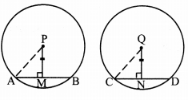
Prove the following two theorems for two congruent circles : Chords of congruent circles which are equidistant from their respective centres are congruent.
Write ‘Given’. ‘To prove’ and the proofs of these theorems.
Answer
Image
Chords of congruent circles which are equidistant from their respective centres are congruent.
Given: Point P and point Q are the centres of congruent circles.
seg PM ⊥ chord AB, A-M-B
seg QN ⊥ chord CD, C-N-D
PM = QN
To prove: chord AB ≅ chord CD
Construction: Draw seg PA and seg QC.
Proof:
In ∆PMA and ∆QNC,
∴ ∠PMA ≅ ∠QNC [Each is of 90°]
seg PM ≅ seg QN [Given]
hypotenuse PA ≅ hypotenuse QC [Radii of the congruent circles]
∴ ∆PMA ≅ ∆QNC [Hypotenuse side test]
∴ seg AM ≅ seg CN [c. s. c. t.]
∴ AM = CN ….(i) [Length of congruent segments]
Now, seg PM ⊥ chord AB, and seg QN ⊥ chord CD
$\therefore A M=\frac{1}{2}( AB ) \ldots \text { (ii) }$
$\therefore C N=\frac{1}{2}(C D) \text {..(iii) [Perpendicular drawn from the centre of the circle to the chord bisects }$
the chord.]
∴ AB = CD [From (i), (ii) and (ii)]
∴ chord AB ≅ chord CD [Segments of equal lengths]
View full question & answer
Question 115 Marks
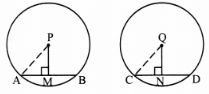
Prove the following two theorems for two congruent circles : Congruent chords in congruent circles are equidistant from their respective centres.
Answer
Congruent chords in congruent circles are equidistant from their respective centres.
Given: Point P and point Q are the centres of congruent circles.
chord AB ≅ chord CD
seg PM ⊥ chord AB, A-M-B
seg QN ⊥ chord CD, C-N-D
To prove: PM = QNImage
Construction: Draw seg PA and seg QC.
Proof:
seg PM ⊥ chord AB, seg QN ⊥ chord CD [Given]
$\therefore A M=\frac{1}{2}(A B)$
$\therefore C N=\frac{1}{2}(C D)$
.(i) [Perpendicular drawn from the centre of the circle to the
(ii) chord bisects the chord.]
But, AB = CD ………(iii) [Given]
∴ AM = CN [From (i), (ii) and (iii)]
i.e., segAM ≅ segCN ….(iv) [Segments of equal lengths]
In ∆PMA and ∆QNC,
∠PMA ≅ ∠QNC [Each is of 90°]
hypotenuse PA ≅ hypotenuse QC [Radii of congruent circles]
seg AM ≅ seg CN [From (iv)]
∴ ∆PMA ≅ ∆QNC [Hypotenuse side test]
∴ segPM ≅ segQN [c. s. c. t.]
∴ PM ≅ QN [Length of congruent segments]
View full question & answer