Question
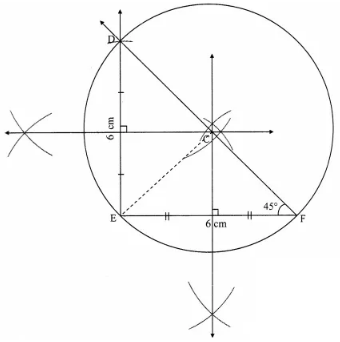
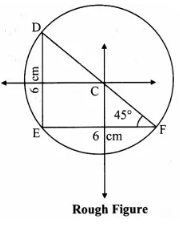
Construct ∆DEF such that DE = EF = 6 cm. ∠F = 45° and construct its circumcircle.

Answer


Image

Image
Steps of construction:
i. Construct ∆DEF of the given measurement.
ii. Draw the perpendicular bisectors of side DE and side EF of the triangle.
iii. Name the point of intersection of perpendicular bisectors as point C.
iv. Join seg CE
v. With C as centre and CE as radius, draw a circle which passes through the three vertices of the triangle.

Need a full question paper?

Generate a complete, print-ready paper with questions like this in minutes — across 16+ boards, with answer keys.

Start Generating Free

Similar questions

The data is given for 62 students in a certain class regarding their mathematics marks out of 100. Take the classes 0 – 10, 10 – 20,… and prepare frequency distribution
table and cumulative frequency table more than or equal to type.
55. 60, 81, 90, 45, 65, 45, 52, 30, 85, 20, 10,
75, 95, 09, 20, 25, 39, 45, 50, 78, 70, 46, 64,
42. 58. 31, 82, 27, 11, 78, 97, 07, 22, 27, 36,
35, 40, 75, 80, 47, 69, 48, 59, 32, 83, 23, 17,
77, 45, 05, 23, 37, 38, 35, 25, 46, 57, 68, 45.
47,49
From the prcparcd table, answer the following questions :
i. How many students obtained marks 40 or above 40?
ii. How many students obtained marks 90 or above 90?
iii. How many students obtained marks 60 or above 60?
iv. What is the cumulative frequency of equal to or more than type of the class 0 – 10?
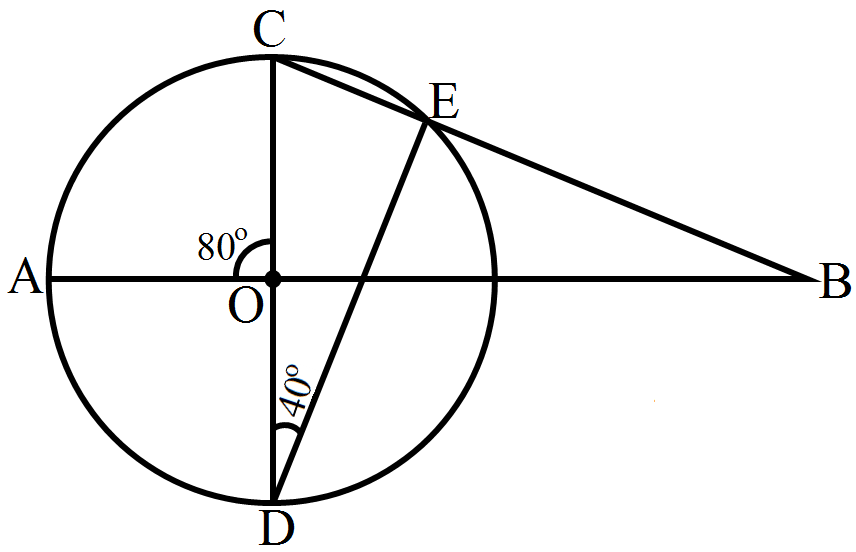
In the given figure, AB and CD are straight lines through the centre O of a circle. If $\angle\text{AOC}=80^\circ$ and $\angle\text{CDE}=40^\circ,$ find
  1. $\angle\text{DCE}$
  2. $\angle\text{ABC}$
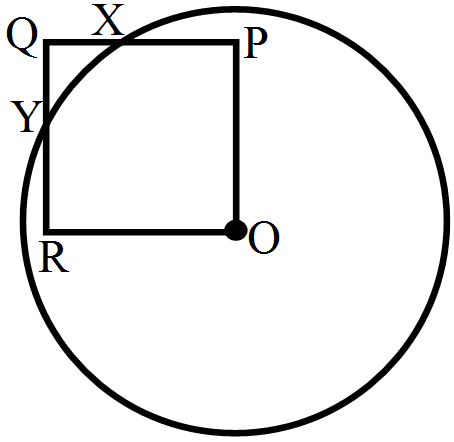
In the adjoining figure, OPQR is a square. A circle drawn with centre O cuts the square at X and Y. Prove that QX = QY.
In the given figure, ABCD is a rectangle with sides AB = 10cm and AD = 5cm. Find the area of $\triangle\text{EFG}.$
The mean of 35 observations is 20, out of which mean of first 18 observations is 15 and mean of last 18 observations is 25. Find the 18th observation.
Divide each of the following polynomials by synthetic division method and also by linear division method. Write the quotient and the remainder : $(2x^4 + 3x^3 + 4x – 2x^2) ÷ (x + 3)$
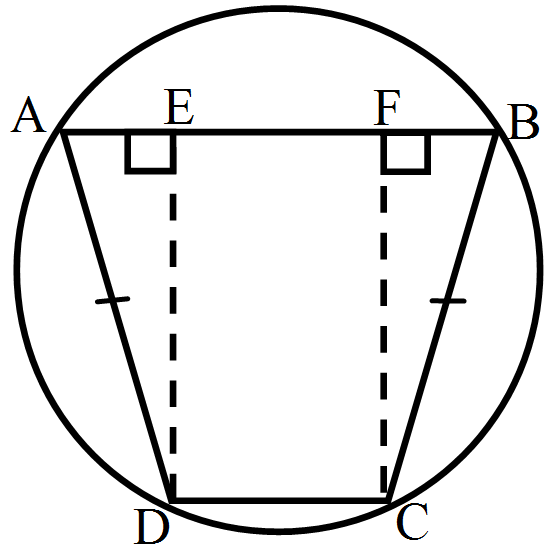
In the given figure, ABCD is a quadrilateral in which AD = BC and $\angle\text{ADC}=\angle\text{BCD}.$ Show that the points A, B, C, D lie on a circle.
The record of marks out of 20 in Mathematics in the first unit test is as follows:
20,6, 14, 10, 13, 15, 12, 14, 17. 17, 18, 1119,
9, 16. 18, 14, 7, 17, 20, 8, 15, 16, 10, 15, 12.
18, 17, 12, 11, 11, 10, 16, 14, 16, 18, 10, 7, 17,
14, 20, 17, 13, 15, 18, 20, 12, 12, 15, 10
Answer the following questions, from the above information.
a. How many students scored 15 marks?
b. How many students scored more than 15 marks?
c. How many students scored less than 15 marks?
d. What is the lowest score of the group?
e. What is the highest score of the group?
If AD is a median of a triangle ABC, then prove that triangles ADB and ADC are equal in area. If G is the mid-point of median AD, prove that $\text{ar}(\triangle\text{BGC})=\text{ar}(\triangle\text{AGC}).$
The midpoints of the sides AB, BC, CD and DA of a quadrilateral ABCD are joined to form a quadrilateral. If AC = BD and $\text{AC}\perp\text{BD}$ then prove that the quadrilateral formed is a square.