By using factor theorem in the following examples, determine whether $q(x)$ is a factor of $p(x)$ or not.
i. $p(x)=x^3-x^2-x-1 ; q(x)=x-1$
ii. $p(x)=2 x^3-x^2-45 ; q(x)=x-3$
Answer
i. $p(x)$ =$ x^3 – x^2 – x – 1$
Divisor =$q(x)$ $= x – 1$
∴ take $x = 1$
Remainder = p(1)
$p(x) = x^3 – x^2 – x – 1$
$\therefore P(1) = (1)^3 – (1)^2 – 1 – 1$
$= 1 – 1 – 1 – 1$
$= -2 \neq 0$
∴ By factor theorem, $x – 1$ is not a factor of$ x^3 – x^2 – x – 1$.ii. $p(x) = 2x^3 – x – 45$
Divisor $= q(x) = x – 3$
take $x = 3$
Remainder =$ p(3)$
$p(x) = 2x^3 – x^2 – 45$
$P(3) = 2(3)^3 – (3)^2 – 45$
$= 2(27) – 9 – 45$
$= 54 – 9 – 45$
$= 0$
$\therefore$ By factor theorem, $x – 3$ is a factor of $2x^3 – x^2 – 45.$
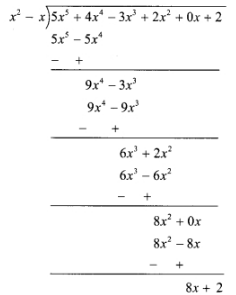
Divide first polynomial by second polynomial and write the answer in the form 'Dividend = Divisor x Quotient + Remainder':
$5 x^5+4 x^4-3 x^3+2 x^2+2 ; x^2-x$
Write the following polynomials in coefficient form.
i. $x^3-2$
ii. $5 y$
iii. $2 m^4-3 m^2+7$
iv. $-\frac{2}{3}$
Answer
i. $x^3-2=x^3+0 x^2+0 x-2$
$\therefore$ Coefficient form of the given polynomial $=(1,0,0,-2)$ ii. $5 y=5 y+0$
$\therefore$ Coefficient form of the given polynomial $=(5,0)$
iii. $2 m^4-3 m^2+7$
$=2 m^4+O m^3-3 m^2+0 m+7$
$\therefore$ Coefficient form of the given polynomial $=(2,0,-3,0,7)$
iv. $-\frac{2}{3}$
$\therefore$ Coefficient form of the given polynomial $=\left(-\frac{2}{3}\right)$