Questions

5 Mark Question

Take a timed test

12 questions · self-marked practice — reveal the answer and mark yourself.

Question 15 Marks
1. Divide $p(x) = 3x^2 + x + 7 by x + 2.$ Find the remainder.
2. Find the value of $p(x) = 3x^2 + x + 7 $ when $x = – 2.$
3. See whether remainder obtained by division is same as the value of $p(-2)$. Take one more example and verify.
Answer
$\text { 1. } x + 2 \div { 3 x ^ { 2 } + x + 7 }$
$3 x^2+6 x$
$\frac{--}{-5 x+7}$
$-5 x-10$
$\frac{+\quad}{17}$
$\therefore \text { Remainder }=17$
2. $p(x)=3 x^2+x+7$
Substituting $x=-2$, we get
$p(-2)=3(2)^2+(-2)+7$
$=12-2+7$
$\therefore p(-2)=17$
3. Yes, remainder $=p(-2)$
Another Example:
If the polynomial $t^3-3 t^2+k t+50$ is divided by $(t-3)$, the remainder is 62 .
Find the value of $k$.
Solution:
When given polynomial is divided by $(t-3)$ the remainder is 62 .
It means the value of the polynomial when $t=3$ is 62.
$p(t)=t^3-3 t^3+k t+50$
By remainder theorem,
$\text { Remainder }=p(3)=33-3^2+k \times 3+50$
$=27-3 \times 9+3 k+50$
$=27-27+3 k+50$
$=3 k+50$
But remainder is 62 .
$\therefore 3 k+50=62$
$\therefore 3 k=62-50$
$\therefore 3 k=12$
$\therefore k=4$
View full question & answer
Question 25 Marks
If $x-2$ and $x-\frac{1}{2}$ both are the factors of the polynomial $n x^2-5 x+m$, then show that $m=$ $n=2$
Answer
$p(x) = nx^2 – 5x + m$
$(x – 2)$ is a factor of $nx^2 – 5x + m.$
\therefore By factor theorem,
$P(2) = 0$
$\therefore p(x) = nx^2 – 5x + m$
$\therefore p(2) = n(2)^2 – 5(2) + m$
$\therefore 0 = n(4) – 10 + m$
$\therefore 4n – 10 + m = 0 …(i)$
Also, $\left(x=\frac{1}{2}\right)$ is a factor of $n x^2-5 x+m$.
$\therefore$ By factor theorem,
$ p \left(\frac{1}{2}\right)=0$
$p ( x )= nx x ^2-5 x + m$
$\therefore p \left(\frac{1}{2}\right)= n \left(\frac{1}{2}\right)^2-5 \frac{1}{2}+ m$
$0=\frac{n}{4}-\frac{5}{2}+ m$
$\therefore 0= n -10+4 m \ldots \text {.. [Multiplying both sides by } 4]$
$\therefore n =10-4 m . . . . \text { (ii) } $
Substituting $n=10-4 m$ in equation (i),
$ 4(10-4 m)-10+m=0$
$\therefore 40-16 m-10+m=0$
$\therefore-15 m+30=0$
$\therefore-15 m=-30$
$\therefore m=2 $
Substituting $m=2$ in equation (ii),
$ n =10-4(2)$
$=10-8$
$\therefore n =2$
$\therefore m = n =2 $
View full question & answer
Question 35 Marks
Find the value of the polynomial $2x – 2x^3 + 7$ using given values for $x$.
i. $x = 3$
ii. $x = -1$
iii. $x = 0$
Answer
i. $p(x)=2 x-2 x^3+7$
Put $x=3$ in the given polynomial.
$\therefore p(3)=2(3)-2(3)^3+7$
$=6-2 \times 27+7$
$=6-54+7$
$\therefore P(3)=-41 \text { ii. } p(x)=2 x-2 x^3+7$
Put $x=-1$ in the given polynomial.
$\therefore p(-1)=2(-1)-2(-1)^3+7$
$=-2-2(-1)+7$
$=-2+2+7$
$\therefore p(-1)=7$
iii. $p(x)=2 x-2 x^3+7$
Put $x=0$ in the given polynomial.
$\therefore p(0)=2(0)-2(0)^3+7$
$=0-0+7$
$\therefore P(0)=7$
View full question & answer
Question 45 Marks
Divide each of the following polynomials by synthetic division method and also by linear division method. Write the quotient and the remainder :
$(y^3 – 3y^2 + 5y – 1) ÷ (y – 1)$
Answer
Synthetic division:
$\left(y^3-3 y^2+5 y-1\right) \div(y-1)$
Dividend $=y^3-3 y^2+5 y-1$
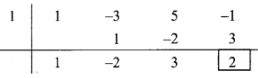
Coefficient form of the dividend $=(1,-3,5,-1)$
Divisor $= y -1$
$\therefore$ Opposite of $-1$ is $1$ .

Image

$\therefore$ Coefficient form of quotient $=(1,-2,3)$
$\therefore$ Quotient $= y ^2-2 y +3$,
Remainder $=2$
Linear division method:
$y^3-3 y^2+5 y-1$
To get the term $y ^3$, multiply $( y -1)$ by $y ^2$ and add $y ^2$
$=y^2(y-1)+y^2-3 y^2+5 y-1$
$=y^2(y-1)-2 y^2+5 y-1$
To get the term $-2 y ^2$, multiply $( y -1$ ) by -2 y and subtract 2 y ,
$=y^2(y-1)-2 y(y-1)-2 y+5 y-1$
$=y^2(y-1)-2 y(y-1)+3 y-1$
To get the term $3 y$, multiply $(y-1)$ by 3 and add 3 ,
$=y^2(y-1)-2 y(y-1)+3(y-1)+3-1$
$=(y-1)\left(y^2-2 y+3\right)+2$
$\therefore \text { Quotient }=y^2-2 y+3$
$\text { Remainder }=2$
View full question & answer
Question 55 Marks
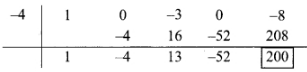
Divide each of the following polynomials by synthetic division method and also by linear division method. Write the quotient and the remainder : $(x^4 – 3x^2 – 8) ÷ (x + 4)$
Answer
$\left(x^4-3 x^2-8\right)+(x+4)$
Dividend $=x^4-3 x^2-8$
$\therefore$ Index form $= x ^4+0 x ^3-3 x ^2+0 x -8$
$\therefore$ Coefficient form of the dividend $=(1,0,-3,0,-8)$
Divisor $=x+4$ 
$\therefore $ Opposite of $+ 4$ is $-4$

Image

$\therefore$ Coefficient form of quotient $=(1,-4,13,-52)$
$\therefore$ Quotient $= x ^3-4 x ^2+13 x -52$,
Remainder $=200$
Linear division method:
$x^4-3 x^2-8$
To get the term $x^4$, multiply $(x+4)$ by $x^3$ and subtract $4 x^3$,
$=x^3(x+4)-4 x^3-3 x^2-8$
To get the term $-4 x^3$, multiply $(x+4)$ by $-4 x^2$ and add $16 x^2$,
$=x^3(x+4)-4 x^2(x+4)+16 x^2-3 x^2-8$
$=x^3(x+4)-4 x^2(x+4)+13 x^2-8$
To get the term $13 x^2$, multiply $(x+4)$ by $13 x$ and subtract $52 x$,
$=x^3(x+4)-4 x^2(x+4)+13 x(x+4)-52 x-8$
To get the term $-52 x$, multiply $(x+4)$ by -52 and add 208 ,
$=x^3(x+4)-4 x^2(x+4)+13 x(x+4)-52(x+4)+208-8$
$=(x+4)\left(x^3-4 x^2+13 x-52\right)+200$
$\therefore \text { Quotient }=x^3-4 x^2+13 x-52$
Remainder $200$
View full question & answer
Question 65 Marks
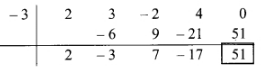
Divide each of the following polynomials by synthetic division method and also by linear division method. Write the quotient and the remainder : $(2x^4 + 3x^3 + 4x – 2x^2) ÷ (x + 3)$
Answer
Synthetic division:
$\left(2 x^4+3 x^3+4 x-2 x^2\right) \div(x+3)$
Dividend $=2 x^4+3 x^3+4 x-2 x^2$
$\therefore$ Index form $=2 x^4+3 x^3-2 x^2+4 x+0$
$\therefore$ Coefficient form of the dividend $=(2,3,-2,4,0)$
Divisor $=x+3$
$\therefore$ Opposite of $+ 3$ is $-3$​​​​​​​ 

Image

Coefficient form of quotient $=(2,-3,7,-17)$
$\therefore$ Quotient $=2 x^3-3 x^2+7 x-17$,
Remainder $=51$
Linear division method:
$2 x^4+3 x^3+4 x-2 x^2=2 x^2+3 x^3-2 x^2+4 x$
To get the term $2 x^4$, multiply $(x+3)$ by $2 x^3$ and subtract $6 x^3$,
$=2 x^3\left(x+31-6 x^3+3 x^3-2 x^2+4 x\right.$
$=2 x^3(x+3)-3 x^3-2 x^2+4 x$
To get the term $-3 x^3$, multiply $(x+3)$ by $-3 x^2$ and add $9 x^2$,
$=2 x^3(x+3)-3 x^2(x+3)+9 x^2-2 x^2+4 x$
$=2 x^3(x+3)-3 x^2(x+3)+7 x^2+4 x$
To get the term $7 x ^2$, multiply $(x+3)$ by 7 x and subtract 21 x ,
$=2 x^3(x+3)-3 x^2(x+3)+7 x(x+3)-21 x+4 x$
$=2 x^3(x+3)-3 x^2(x+3)+7 x(x+3)-17 x$
To get the term $-17 x$, multiply $(x+3)$ by -17 and add 51 ,
$=2 x^3(x+3)-3 x^2(x+3)+7 x(x+3)-17(x+3)+51$
$=(x+3)\left(2 x^3-3 x^2+7 x-17\right)+51$
$\therefore \text { Quotient }=2 x^3-3 x^2+7 x-17$
$\text { Remainder }=51$
View full question & answer
Question 75 Marks
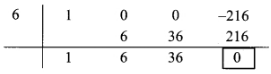
Divide each of the following polynomials by synthetic division method and also by linear division method. Write the quotient and the remainder : $(y^3 – 216) ÷ (y – 6)$
Answer
Synthetic division:
$\left(y^3-216\right) \div(y-6)$
Dividend $=y^3-216$
$\therefore$ Index form $= y ^3+0 y ^3+0 y -216$
$\therefore$ Coefficient form of dividend $=(1,0,0,-216)$
Divisor $=y-6$
$\therefore$ Opposite of $-6$ is $6$ .

Image


Coefficient form of quotient $=(1,6,36)$
$\therefore$ Quotient $= y ^2+6 y +36$,
Remainder $=0$
Linear division method:
$y^3-216$
To get the term $y^3$, multiply $(y-6)$ by $y^2$ and add $6 y^2$,
$=y^2(y-6)+6 y^2-216$
$=y^2(y-6)+6 y \text { sup }>2-216$
To get the, term $6 y ^2$ multiply $(y-6)$ by $6 y$ and add 36 y ,
$=y^2(y-6)+6 y(y-6)+36 y-216$
To get the term 36 y , multiply $( y -6$ ) by 36 and add 216 ,
$=y^2(y-6)+6 y(y-6)+36(y-6)+216-216$
$=(y-6)\left(y^2+6 y+36\right)+0$
Quotient $= y ^2+6 y +36$
Remainder $=0$
View full question & answer
Question 85 Marks
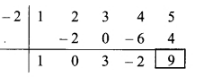
Divide each of the following polynomials by synthetic division method and also by linear division method. Write the quotient and the remainder : $(x^4 + 2x^3 + 3x^2 + 4x + 5) ÷ (x + 2)$
Answer
Synthetic division:
$\left(x^4+2 x^3+3 x^2+4 x+5\right) \div(x+2)$
Dividend $=x^4+2 x^3+3 x^2+4 x+5$
$\therefore$ Coefficient form of dividend $=(1,2,3,4,5)$
Divisor $= x +2$
$\therefore $ Opposite of $+ 2$ is $-2$. 

Image 

Coefficient form of quotient $=(1,0,3,-2)$
$\therefore$ Quotient $= x ^3+3 x -2$,
Remainder $=9$
Linear division method:
$x^4+2 x^3+3 x^2+4 x+5$
To get the term $x^4$, multiply $(x+2)$ by $x^3$ and subtract $2 x^3$,
$=x^3(x+2)-2 x^3+2 x^3+3 x^2+4 x+5$
$=x^3(x+2)+3 x^2+4 x+5$
To get the term $3 x^2$, multiply $(x+2)$ by $3 x$ and subtract $6 x$,
$=x^3(x+2)+3 x(x+2)-6 x+4 x+5$
$=x^3(x+2)+3 x(x+2)-2 x+5$
To get the term $-2 x$, multiply $(x+2)$ by -2 and add 4 ,
$=x^3(x+2)+3 x(x+2)-2(x+2)+4+5$
$=(x+2)(x 3+3 x-2)+9$
$\therefore \text { Quotient }=x^3+3 x-2$
$\text { Remainder }-9$
View full question & answer
Question 95 Marks
Divide each of the following polynomials by synthetic division method and also by linear division method. Write the quotient and the remainder : $(2m^2 – 3m + 10) ÷ (m – 5)$
Answer
Synthetic division:
$\left(2 m^2-3 m+10\right) \div(m-5)$
Dividend $=2 m^2-3 m+10$
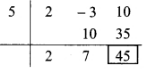
$\therefore$ Coefficient form of dividend $=(2,-3,10)$
Divisor $=m-5$
$\therefore$ Opposite of $-5$ is $5$ .

Image

Coefficient form of quotient $=(2,7)$
$\therefore$ Quotient $=2 m+7$,
Remainder $=45$
Linear division method:
$2 m^2-3 m+10$
To get the term $2 m^2$, multiply $(m-5)$ by $2 m$ and add $10 m$,
$=2 m(m-5)+10 m-3 m+10$
$=2 m(m-5)+7 m+10$
To get the term 7 m , multiply $(m-5)$ by $7$ and add $35$
$=2 m(m-5)+7(m-5)+35+10$
$=(m-5)(2 m+7)+45$
$\therefore \text { Quotient }=2 m+7$
$\text { Remainder }=45$
View full question & answer
Question 105 Marks
Write down the information in the form of algebraic expression and simplify.
There is a rectangular farm with length $\left(2 a^2+3 b^2\right)$ metre and breadth $\left(a^2+b^2\right)$ metre.
The farmer used a square shaped plot of the farm to build a house. The side of the plot was ( $a 2- b 2$ ) metre.
What is the area of the remaining part of the farm?
Answer
Length of the rectangular farm $=\left(2 a^2+3 b^2\right) m$
Breadth of the rectangular farm $=\left(a^2+b^2\right) m$
Area of the farm $=$ length $\times$ breadth $=\left(2 a^2+3 b^2\right) \times\left(a^2+b^2\right)$
$=2 a^2\left(a^2+b^2\right)+3 b^2\left(a^2+b^2\right)$
$=2 a^2+2 a^2 b^2+3 a^2 b^2+3 b^4$
$=\left(2 a^4+5 a^2 b^2+3 b^4\right) \text { sq. } m \ldots$
The farmer used a square shaped plot of the farm to build a house.
Side of the square shaped plot $=\left(a^2-b^2\right) m$
$\therefore \text { Area of the plot }=(\text { side })^2$
$=\left(a^2-b^2\right)^2$
$\left.=\left(a^4-2 a^2 b^2+b^4\right) \text { sq m....(ii) }\right) \therefore \text { Area of the remaining farm }=\text { Area of the farm }- \text { Area of the plot }$
$=\left(2 a^4+5 a^2 b^2+3 b^4\right)-\left(a^4-2 a^2 b^2+b^4\right) \ldots[\text { From (i) and (ii)] }$
$=2 a^4+5 a^2 b^2+3 b^4-a^4+2 a^2 b^2-b^4$
$=2 a^4-a^4+5 a^2 b^2+2 a^2 b^2+3 b^4-b^4$
$=a^4+7 a^2 b^2+2 b^4$
$\therefore$ The area of the remaining farm is $\left(a^4+7 a^2 b^2+2 b^4\right)$ sq. m.
View full question & answer
Question 115 Marks
Use the given letters to write the answer.
i. There are ‘a’ trees in the village Lat. If the number of trees increases every year by ’b‘. then how many trees will there be after ‘x’ years?
ii. For the parade there are y students in each row and x such row are formed. Then, how many students are there for the parade in all ?
iii. The tens and units place of a two digit number is m and n respectively. Write the polynomial which represents the two digit number.
Answer
i. Number of trees in the village Lat = a
Number of trees increasing each year = b
∴ Number of trees after x years = a + bx
∴ There will be a + bx trees in the village Lat after x years.

ii. Total rows = x
Number of students in each row = y
∴ Total students = Total rows × Number of students in each row
= x × y
= xy
∴ There are in all xy students for the parade.

iii. Digit in units place = n
Digit in tens place = m
∴ The two digit number = 10 x digit in tens place + digit in units place
= 10m + n
∴ The polynomial representing the two digit number is 10m + n.

View full question & answer
Question 125 Marks
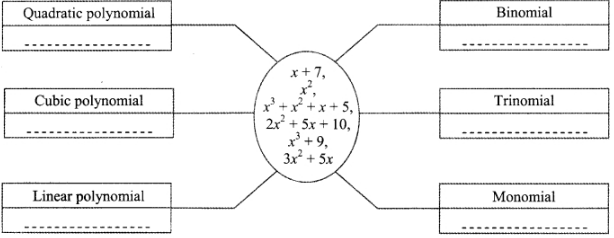
Write the appropriate polynomials in the boxes.

Image
Answer
i. Quadratic polynomial: $x^2 ; 2 x^2+5 x+10 ; 3 x^2+5 x$
ii. Cubic polynomial: $x^3+x^2+x+5 ; x^3+9$
iii. Linear polynomial: $x+7$
iv. Binomial: $x+7 ; x^3+9 ; 3 x^2+5 x$
v. Trinomial: $2 x^2+5 x+10$
vi. Monomial: $x^2$
View full question & answer