Question
Divide each of the following polynomials by synthetic division method and also by linear division method. Write the quotient and the remainder : $(x^4 + 2x^3 + 3x^2 + 4x + 5) ÷ (x + 2)$
Answer

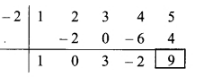
Synthetic division:
$\left(x^4+2 x^3+3 x^2+4 x+5\right) \div(x+2)$
Dividend $=x^4+2 x^3+3 x^2+4 x+5$
$\therefore$ Coefficient form of dividend $=(1,2,3,4,5)$
Divisor $= x +2$
$\therefore $ Opposite of $+ 2$ is $-2$. 

Image 

Coefficient form of quotient $=(1,0,3,-2)$
$\therefore$ Quotient $= x ^3+3 x -2$,
Remainder $=9$
Linear division method:
$x^4+2 x^3+3 x^2+4 x+5$
To get the term $x^4$, multiply $(x+2)$ by $x^3$ and subtract $2 x^3$,
$=x^3(x+2)-2 x^3+2 x^3+3 x^2+4 x+5$
$=x^3(x+2)+3 x^2+4 x+5$
To get the term $3 x^2$, multiply $(x+2)$ by $3 x$ and subtract $6 x$,
$=x^3(x+2)+3 x(x+2)-6 x+4 x+5$
$=x^3(x+2)+3 x(x+2)-2 x+5$
To get the term $-2 x$, multiply $(x+2)$ by -2 and add 4 ,
$=x^3(x+2)+3 x(x+2)-2(x+2)+4+5$
$=(x+2)(x 3+3 x-2)+9$
$\therefore \text { Quotient }=x^3+3 x-2$
$\text { Remainder }-9$

Need a full question paper?

Generate a complete, print-ready paper with questions like this in minutes — across 16+ boards, with answer keys.
Start Generating Free