Question 15 Marks
Solve : $\frac{14 x^2-6 x+8}{10 x^2+4 x+7}=\frac{7 x-3}{5 x+2}$
View full question & answer→Question 25 Marks
If $\frac{y}{b+c-a}=\frac{z}{c+a-b}=\frac{x}{a+b-c}$ then prove that $\frac{a}{z+x}=\frac{b}{x+y}=\frac{c}{y+z}$.
View full question & answer→Question 35 Marks
Find mean proportional of $\frac{x+y}{x-y}, \frac{x^2-y^2}{x^2 y^2}$.
AnswerLet a be the mean proportional of $\frac{x+y}{x-y}$ and $\frac{x^2-y^2}{x^2 y^2}$
$
\begin{aligned}
\therefore \quad a ^2 & =\frac{x+y}{x-y} \times \frac{x^2-y^2}{x^2 y^2} \\
& =\frac{x+y}{x-y} \times \frac{(x+y)(x-y)}{x^2 y^2} \\
& \cdots\left[\because a ^2- b ^2=( a + b )( a - b )\right]
\end{aligned}
$
$
\begin{array}{ll}
\therefore & a ^2=\frac{(x+y)^2}{x^2 y^2} \\
\therefore & a =\frac{x+y}{x y}
\end{array}
$
...[Taking square root of both sides]
$\therefore \quad$ Mean proportional of $\frac{x+y}{x-y}, \frac{x^2-y^2}{x^2 y^2}$ is $\frac{x+y}{x y}$.
View full question & answer→Question 45 Marks
If $\frac{a}{b}=\frac{b}{c}$ and $a, b, c>0$, then show that, : $\frac{a^2+b^2}{a b}=\frac{a+c}{b}$
Answer$ \frac{a^2+b^2}{a b}=\frac{a+c}{b}$
$b = ck ; a = ck ^2$
$\text { L.H.S }=\frac{a^2+b^2}{a b}$
$=\frac{\left( ck ^2\right)^2+( ck )^2}{\left( ck ^2\right)( ck )}$
$=\frac{ c ^2 k ^4+ c ^2 k ^2}{ c ^2 k ^3}$
$=\frac{ c ^2 k ^2\left( k ^2+1\right)}{ c ^2 k ^3}$
$=\frac{ k ^2+1}{ k }$
$\text { R.H.S }=\frac{ a + c }{ b }$
$=\frac{ ck ^2+ c }{ ck }$
$=\frac{ c \left( k ^2+1\right)}{ ck }$
$=\frac{k^2+1}{k}$
$\therefore \quad \text { L.H.S }=\text { R.H.S }$
$\therefore \quad \frac{ a ^2+ b ^2}{ ab }=\frac{ a + c }{ b }$
...[From (i) and (ii)]
View full question & answer→Question 55 Marks
If $\frac{a}{b}=\frac{b}{c}$ and $a, b, c>0$, then show that, : $\left(a^2+b^2\right)\left(b^2+c^2\right)=(a b+b e)^2$
Answer$\text { Let } \frac{a}{b}=\frac{b}{c}=k$
$\therefore b=c k$
$\therefore a=b k=(c k) k$
$\therefore a=c k^2 \ldots \text { (ii) }$
$(a^2 + b^2)(b^2 + c^2) = (ab + bc)^2$^
$b = ck; a = ck^2$
$L.H.S = (a^2 + b^2) (b^2 + c^2)$
$= [(ck^2) + (ck)^2] [(ck)^2 + c^2] … [From (i) and (ii)]$
$= [c^2k^4 + c^2k^2] [c^2k^2 + c^2]$
$= c^2k^2 (k^2 + 1) c^2 (k^2 + 1)$
$= c4k^2 (k^2 + 1)^2$
$R.H.S = (ab + bc)^2$
$= [(ck^2) (ck) + (ck)c]^2 …[From (i) and (ii)]$
$= [c^2k^3 + c^2k]^2$
$= [c^2k (k^2 + 1)]2 = c^4(k^2 + 1)^2$
$\therefore L.H.S = R.H.S$
$\therefore (a^2 + b^2) (b^2 + c^2) = (ab + bc)^2$
View full question & answer→Question 65 Marks
If $\frac{a}{b}=\frac{b}{c}$ and $a, b, c>0$, then show that, : $(a+b+c)(b-c)=a b-c^2$
Answer$\text { Let } \frac{a}{b}=\frac{b}{c}=k$
$\therefore b=c k$
$\therefore a=b k=(c k) k$
$\therefore a=c k^2 \ldots\text { (ii) }$
$(a + b + c)(b – c) = ab – c^2$
$L.H.S = (a + b + c) (b – c)$
$= [ck^2 + ck + c] [ck – c] … $[From (i) and (ii)]
$= c(k^2 + k + 1) c (k – 1)$
$= c^2 (k^2 + k + 1) (k – 1)$
$R.H.S = ab – c^2$
$= (ck^2) (ck) – c^2 …$ [From (i) and (ii)]
$= c^2k^3 – c^2$
$= c^2(k^3 – 1)$
$= c^2 (k – 1) (k^2 + k + 1) … [a^3 – b^3 = (a – b) (a^2 + ab + b^2]$
$\therefore L.H.S = R.H.S$
$\therefore (a + b + c) (b – c) = ab – c^2$
View full question & answer→Question 75 Marks
If $(a + b + c)(a – b + c) = a2 + b2 + c2$, show that $a, b, c$ are in continued proportion.
Answer$(a + b + c)(a – b + c) = a^2 + b^2 + c^2 …$[Given]
$\therefore a(a – b + c) + b(a – b + c) + c(a – b + c) = a2 + b2 + c2$
$\therefore a^2 – ab + ac + ab – b^2 + be + ac – be + c^2 = a^2 + b^2 + c^2$
$\therefore a^2 + 2ac – b^2 + c^2 = a^2 + b^2 + c^2$
$\therefore 2ac – b^2 = b^2$
$\therefore 2ac = 2b^2$
$\therefore ac = b^2$
$\therefore b^2 = ac$
$\therefore a, b, c$ are in continued proportion.
View full question & answer→Question 85 Marks
Three numbers are in continued proportion, whose mean proportional is $12$ and the sum of the remaining two numbers is $26$, then find these numbers.
AnswerLet the first number be $x$.
$\therefore$ Third number $=26-x$
$12$ is the mean proportional of $x$ and ( $26-x$ ).
$\therefore \frac{x}{12}=\frac{12}{26-x}$
$\therefore x(26-x)=12 x 12$
$\therefore 26 x-x^2=144$
$\therefore x^2-26 x+144=0$
$\therefore x^2-18 x-8 x+144=0$
$\therefore x(x-18)-8(x-18)=0$
$\therefore(x-18)(x-8)=0$
$\therefore x=18 \text { or } x=8$
$\therefore$ Third number $=26-x=26-18=8$ or $26-x=26-8=18$
$\therefore$ The numbers are $18,12,8$ or $8,12,18$.
View full question & answer→Question 95 Marks
If $(28 – x)$ is the mean proportional of $(23 – x)$ and $(19 – x),$ then find the value of $x.$
Answer$(28 – x)$ is the mean proportional of $(23 – x)$ and $(19-x). …$ [Given]
$ \therefore \quad \frac{23-x}{28-x}=\frac{28-x}{19-x}$
$\therefore \quad, \frac{(23-x)-(28-x)}{28-x}=\frac{(28-x)-(19-x)}{19-x} $
...[By dividendo]
$\therefore \quad \frac{23-x-28+x}{28-x}=\frac{28-x-19+x}{19-x}$
$\therefore \quad \frac{-5}{28-x}=\frac{9}{19-x}$
$\therefore-5(19-x)=9(28-x)$
$\therefore-95+5 x=252-9 x$
$\therefore 5 x+9 x=252+95$
$\therefore 14 x=347$
$\therefore x=\frac{347}{14}$
View full question & answer→Question 105 Marks
Which number should be subtracted from 12, 16 and 21 so that resultant numbers are in continued proportion?
AnswerLet the number to be subtracted be x.
∴ (12 – x), (16 – x) and (21 – x) are in continued proportion.
$\begin{array}{ll}\therefore & \frac{12-x}{16-x}=\frac{16-x}{21-x} \\ \therefore \quad & \frac{(12-x)-(16-x)}{16-x}=\frac{(16-x)-(21-x)}{21-x} \\ \ldots \text { [By dividendo] } \\ \therefore \quad & \frac{12-x-16+x}{16-x}=\frac{16-x-21+x}{21-x} \\ \therefore \quad & \frac{-4}{16-x}=\frac{-5}{21-x} \\ \therefore \quad & \frac{4}{16-x}=\frac{5}{21-x} \\ \therefore \quad & 4(21-x)=5(16-x)\end{array}$
∴ 84 – 4x = 80 – 5x
∴ 5x – 4x = 80 – 84
∴ x = -4
∴ -4 should be subtracted from 12,16 and 21 so that the resultant numbers in continued proportion.
View full question & answer→Question 115 Marks
Solve : $\frac{5 y^2+40 y-12}{5 y+10 y^2-4}=\frac{y+8}{1+2 y}$
View full question & answer→Question 125 Marks
Solve : $\quad \frac{16 x^2-20 x+9}{8 x^2+12 x+21}=\frac{4 x-5}{2 x+3}$
Answer$\quad \frac{16 x^2-20 x+9}{8 x^2+12 x+21}=\frac{4 x-5}{2 x+3}$
If $x=0$ then
$\begin{aligned}
\text { L.H.S }=\frac{16 x^2-20 x+9}{8 x^2+12 x+21} & =\frac{16(0)^2-20(0)+9}{8(0)^2+12(0)+21} \\
& =\frac{9}{21}=\frac{3}{7}
\end{aligned}$
$\begin{aligned}
\text { R.H.S. }=\frac{4 x-5}{2 x+3} & =\frac{4(0)-5}{2(0)+3} \\
& =\frac{-5}{3}
\end{aligned}$
$\frac{3}{7}=\frac{-5}{3}$, which is a contradiction.
$\therefore \quad x \neq 0 \text {. }$
Let $\frac{16 x^2-20 x+9}{8 x^2+12 x+21}=\frac{4 x-5}{2 x+3}= k$
$\therefore \quad k =\frac{16 x^2-20 x+9}{8 x^2+12 x+21}=\frac{4 x(4 x-5)}{4 x(2 x+3)}$
...[Multiplying numerator and denominator of second ratio by $4 x$ as $x \neq 0]$
$ \therefore \quad k =\frac{16 x^2-20 x+9}{8 x^2+12 x+21}=\frac{16 x^2-20 x}{8 x^2+12 x}$
$=\frac{\left(16 x^2-20 x+9\right)-\left(16 x^2-20 x\right)}{\left(8 x^2+12 x+21\right)-\left(8 x^2+12 x\right)}$
$=\frac{16 x^2-20 x+9-16 x^2+20 x}{8 x^2+12 x+21-8 x^2-12 x}$
$=\frac{9}{21}=\frac{3 \times 3}{3 \times 7}$
$\therefore \quad k =\frac{3}{7}$
$\frac{4 x-5}{2 x+3}= k$
$\therefore \quad \frac{4 x-5}{2 x+3}=\frac{3}{7}$
$\therefore 7(4x – 5)3(2x + 3)$
$\therefore 28x – 35 = 6x + 9$
$\therefore 28x – 6x = 9 + 35$
$\therefore 22x = 44$
$\therefore x = 2$
$\therefore x = 2$ is the solution of the given equation.
View full question & answer→Question 135 Marks
If $\frac{y+z}{a}=\frac{z+x}{b}=\frac{x+y}{c}$, then show that $\frac{x}{b+c-a}=\frac{y}{c+a-b}=\frac{z}{a+b-c}$.
AnswerLet $\frac{y+ z }{ a }=\frac{ z +x}{ b }=\frac{x+y}{ c }= k$
$\therefore \quad k =\frac{ z +x}{ b }=\frac{x+y}{ c }=\frac{y+ z }{ a }$
$\therefore \quad k =\frac{( z +x)+(x+y)-(y+ z )}{ b + c - a }$
... [Theorem on equal ratios]
$ =\frac{ z +x+x+y-y- z }{ b + c - a }$
$\therefore \quad k =\frac{2 x}{ b + c - a }$
$k =\frac{x+y}{ c }=\frac{y+ z }{ a }=\frac{ z +x}{ b }$
$\therefore \quad k =\frac{(x+y)+(y+ z )-( z +x)}{ c + a - b } $
...[From (i)]
...[Theorem on equal ratios]
$=\frac{x+y+y+ z - z -x}{ c + a - b }$
$ \therefore \quad k =\frac{2 y}{ c + a - b }$
$k =\frac{y+ z }{ a }=\frac{ z +x}{ b }=\frac{x+y}{ c } \ldots \text { (iii) }$
$\therefore \quad k =\frac{(y+ z )+( z +x)-(x+y)}{ a + b - c }$
$=\frac{y+ z + z +x-x-y}{ a + b - c }$
$\therefore \quad k =\frac{2 z }{ a + b - c }$
$\therefore \quad \frac{2 x}{ b + c - a }=\frac{2 y}{ c + a - b }=\frac{2 z }{ a + b - c }$
$\therefore \quad \frac{x}{ b + c - a }=\frac{y}{ c + a - b }=\frac{ z }{ a + b - c }$
$\ldots \text { (iv) }$
View full question & answer→Question 145 Marks
If $a(y+z)=b(z+x)=c(x+y)$ and out of $a, b, c$ no two of them are equal, then show that, $\frac{y-z}{a(b-c)}=\frac{z-x}{b(c-a)}=\frac{x-y}{c(a-b)}$.
AnswerHere, no two of a, b and c are equal.
∴ values of (b – c), (c – a) and (a – b) are not zero.
a(y + z) = b(z + x) = c(x + y) … [Given]
$
\therefore \quad \frac{a(y+z)}{a b c}=\frac{b(z+x)}{a b c}=\frac{c(x+y)}{a b c}
$
... [Dividing each term by abc]
$
\therefore \quad \frac{y+z}{ bc }=\frac{z+x}{ ac }=\frac{x+y}{a b}
$
Let $\frac{y+z}{b c}=\frac{z+x}{a c}=\frac{x+y}{a b}= k$
$\ldots[$ From (i) $]$
$
\begin{aligned}
\therefore \quad k & =\frac{(x+y)-( z +x}{ ab - ac } \\
& =\frac{x+y- z -x}{ a ( b - c )}
\end{aligned}
$
... [Theorem on equal ratios]
$
\therefore \quad k =\frac{y- z }{ a ( b - c )}
$
$k =\frac{y+ z }{ bc }=\frac{x+y}{ ab }$ $k =\frac{(y+ z )-(x+y)}{ bc - ab }$
... [Theorem on equal ratios]
$
=\frac{y+ z -x-y}{ b ( c - a )}
$
$
\therefore \quad k =\frac{ z -x}{ b ( c - a )}
$
$
\begin{aligned}
k & =\frac{ z +x}{ ac }=\frac{y+ z }{ bc } \\
\therefore \quad k & =\frac{( z +x)-(y+ z )}{ ac - bc } \\
& =\frac{ z +x-y- z }{ c ( a - b )} \\
\therefore \quad k & =\frac{x-y}{ c ( a - b )} \\
\therefore \quad & \frac{y- F - z }{ a ( b - c )}=\frac{ z - x }{ b ( c - a )}=\frac{ x - y }{ c ( a - b )}
\end{aligned}
$
... [From (ii), (iii) and (iv)]
View full question & answer→Question 155 Marks
Solve the following equations : $\quad \frac{(3 x-4)^3-(x+1)^3}{(3 x-4)^3+(x+1)^3}=\frac{61}{189}$
Answer$\begin{array}{ll}
& \frac{(3 x-4)^3-(x+1)^3}{(3 x-4)^3+(x+1)^3}=\frac{61}{189} \\
\therefore \quad & \frac{(3 x-4)^3+(x+1)^3}{(3 x-4)^3-(x+1)^3}=\frac{189}{61} \quad \ldots[\text { By invertendo] } \\
\therefore \quad & {\left[(3 x-4)^3+(x+1)^3\right]+\left[(3 x-4)^3-(x+1)^3\right]} \\
\therefore & {\left[(3 x-4)^3+(x+1)^3\right]-\left[(3 x-4)^3-(x+1)^3\right]} \\
& =\frac{189+61}{189-61}
\end{array}$
... [By componendo - dividendo]
$\begin{array}{ll}
\therefore \quad & \frac{(3 x-4)^3+(x+1)^3+(3 x-4)^3-(x+1)^3}{(3 x-4)^3+(x+1)^3-(3 x-4)^3+(x+1)^3}=\frac{250}{128} \\
\therefore \quad & \frac{2(3 x-4)^3}{2(x+1)^3}=\frac{2 \times 125}{2 \times 64} \\
\therefore \quad & \frac{(3 x-4)^3}{(x+1)^3}=\frac{125}{64} \\
\therefore \quad & \frac{3 x-4}{x+1}=\frac{5}{4}
\end{array}$
... [Taking cube root of both sides]
∴ 4(3x – 4) = 5(x + 1)
∴ 12x – 16 = 5x + 5
∴ 12x – 5x = 5 + 16
∴ 7x = 21
∴ x = 3
∴ x = 3 ¡s the solution of the given equation.
View full question & answer→Question 165 Marks
Solve the following equations : $\frac{(4 x+1)^2+(2 x+3)^2}{4 x^2+12 x+9}=\frac{61}{36}$
View full question & answer→Question 175 Marks
Solve the following equations : $\frac{\sqrt{4 x+1}+\sqrt{x+3}}{\sqrt{4 x+1}-\sqrt{x+3}}=\frac{4}{1}$
Answer$\begin{array}{ll}\quad \frac{\sqrt{4 x+1}+\sqrt{x+3}}{\sqrt{4 x+1}-\sqrt{x+3}}=\frac{4}{1} \\ \therefore \quad & \frac{(\sqrt{4 x+1}+\sqrt{x+3})+(\sqrt{4 x+1}-\sqrt{x+3})}{(\sqrt{4 x+1}+\sqrt{x+3})-(\sqrt{4 x+1}-\sqrt{x+3})}=\frac{4+1}{4-1}\end{array}$
... [By componendo - dividendo]
$\begin{array}{ll}
\therefore \quad \frac{\sqrt{4 x+1}+\sqrt{x+3}+\sqrt{4 x+1}-\sqrt{x+3}}{\sqrt{4 x+1}+\sqrt{x+3}-\sqrt{4 x+1}+\sqrt{x+3}}=\frac{5}{3} \\ \therefore \quad \frac{2 \sqrt{4 x+1}}{2 \sqrt{x+3}}=\frac{5}{3} \\
\therefore \quad \frac{\sqrt{4 x+1}}{\sqrt{x+3}}=\frac{5}{3} \\
\therefore \quad \frac{4 x+1}{x+3}=\frac{25}{9} \quad \ldots \text { [Squaring both sides] }
\end{array}$
∴ 9(4x + 1) = 25(x + 3)
∴36x + 925x + 75
∴ 36x – 25 = 75 – 9
∴11x = 66
∴ x = 6
∴ x = 6 is the solution of the given equation.
View full question & answer→Question 185 Marks
Solve the following equations : $\frac{(2 x+1)^2+(2 x-1)^2}{(2 x+1)^2-(2 x-1)^2}=\frac{17}{8}$
Answer$\begin{aligned}
& \frac{(2 x+1)^2+(2 x-1)^2}{(2 x+1)^2-(2 x-1)^2}=\frac{17}{8} \\
\therefore \quad & \frac{\left[(2 x+1)^2+(2 x-1)^2\right]+\left[(2 x+1)^2-(2 x-1)^2\right]}{\left[(2 x+1)^2+(2 x-1)^2\right]-\left[(2 x+1)^2-(2 x-1)^2\right]} . \\
& =\frac{17+8}{17-8}
\end{aligned}$
...[By componendo - dividendo]
$\begin{array}{ll}
\therefore \quad & \frac{(2 x+1)^2+(2 x-1)^2+(2 x+1)^2-(2 x-1)^2}{(2 x+1)^2+(2 x-1)^2-(2 x+1)^2+(2 x-1)^2}=\frac{25}{9} \\
\therefore \quad & \frac{2(2 x+1)^2}{2(2 x-1)^2}=\frac{25}{9} \\
\therefore \quad & \frac{(2 x+1)^2}{(2 x-1)^2}=\frac{25}{9} \\
\therefore \quad & \frac{2 x+1}{2 x-1}= \pm \frac{5}{3}
\end{array}$
... [Taking square root of both sides]
$\begin{array}{ll}
\therefore \quad & \frac{2 x+1}{2 x-1}=\frac{5}{3} \text { or } \frac{2 x+1}{2 x-1}=-\frac{5}{3} \\
\therefore \quad 3(2 x+1)=5(2 x-1) \text { or } 3(2 x+1)=-5(2 x-1) \\
\therefore \quad 6 x+3=10 x-5 \text { or } 6 x+3=-10 x+5 \\
\therefore \quad 3+5=10 x-6 x \text { or } 6 x+10 x=5-3 \\
\therefore \quad 8=4 x \text { or } 16 x=2 \\
\therefore \quad x=2 \text { or } x=\frac{2}{16} \quad \therefore \quad x=2 \text { or } x=\frac{1}{8}
\end{array}$
$\therefore x=2$ or $x=\frac{1}{8}$ is the solution of the given equation.
View full question & answer→Question 195 Marks
Solve the following equations : $\frac{10 x^2+15 x+63}{5 x^2-25 x+12}=\frac{2 x+3}{x-5}$
Answer$\frac{10 x^2+15 x+63}{5 x^2-25 x+12}=\frac{2 x+3}{x-5}$
If $x=0$ then
$ \text { L.H.S. }=\frac{10 x^2+15 x+63}{5 x^2-25 x+12}=\frac{10(0)^2+15(0)+63}{5(0)^2-25(0)+12}$
$=\frac{63}{12}=\frac{21}{4}$
$\text { R.H.S. }=\frac{2 x+3}{x-5}=\frac{2(0)+3}{-5}=-\frac{3}{5}$
$\therefore \quad \frac{21}{4}=-\frac{3}{5} \text { which is a contradiction. }$
$\therefore \quad x \neq 0$
$\text { Now, } \frac{10 x^2+15 x+63}{5 x^2-25 x+12}=\frac{2 x+3}{x-5}$
$\therefore \quad \frac{10 x^2+15 x+63}{2 x+3}=\frac{5 x^2-25 x+12}{x-5}$
$\therefore \quad \frac{10 x^2+15 x+63}{5 x(2 x+3)}=\frac{5 x^2-25 x+12}{5 x(x-5)}$
$\text { ? } \quad \ldots\left[\text { Multiplying both sides by } \frac{1}{5 x} \text { as } x \neq 0\right]$
$\therefore \quad \frac{10 x^2+15 x+63}{10 x^2+15 x}=\frac{5 x^2-25 x+12}{5 x^2-25 x}$
$\therefore \quad \frac{\left(10 x^2+15 x+63\right)-\left(10 x^2+15 x\right)}{10 x^2+15 x}$
$=\frac{\left(5 x^2-25 x+12\right)-\left(5 x^2-25 x\right)}{5 x^2-25 x}$
$\therefore \quad \frac{10 x^2+15 x+63-10 x^2-15 x}{10 x^2+15 x}$
$\therefore \quad \frac{63}{10 x^2+15 x}=\frac{12}{5 x^2-25 x}$
$\therefore \quad \frac{63}{5 x(2 x+3)}=\frac{12}{5 x(x-5)}$
$\therefore \quad \frac{21}{2 x+3}=\frac{4}{x-5}$
$\therefore\left[\text { Multiplying both sides by } \frac{5 x}{3} \text { as } x \neq 0\right]$
$\therefore 21(x – 5) = 4(2x + 3)$
$\therefore 21x – 105 = 8x + 12$
$\therefore 21x – 8x = 12 + 105$
$\therefore 13x = 117$
$\therefore x = 9$
$\therefore x = 9$ is the solution of the given equation.
View full question & answer→Question 205 Marks
Solve the following equations : $\frac{x^2+12 x-20}{3 x-5}=\frac{x^2+8 x+12}{2 x+3}$
Answer$ \text { i. } \frac{x^2+12 x-20}{3 x-5}=\frac{x^2+8 x+12}{2 x+3}$
$\therefore \quad \frac{x^2+12 x-20}{4(3 x-5)}=\frac{x^2+8 x+12}{4(2 x+3)}$
$\therefore \quad \quad\left[\text { Multiplying both sides by } \frac{1}{4}\right]$
$\therefore \quad \frac{x^2+12 x-20}{12 x-20}=\frac{x^2+8 x+12}{8 x+12}$
$\therefore \quad \frac{\left(x^2+12 x-20\right)-(12 x-20)}{12 x-20}=\frac{\left(x^2+8 x+12\right)-(8 x+12)}{8 x+12}$
$\therefore \quad \frac{x^2+12 x-20-12 x+20}{12 x-20}=\frac{x^2+8 x+12-8 x-12}{8 x+12}$
$\therefore \quad \frac{x^2}{12 x-20}=\frac{x^2}{8 x+12}$
This equation is true for $x = 0$
$\therefore x = 0$ is one of the solutions.
If $x \neq 0,$ then $x^2 \neq 0$
$\therefore \frac{1}{12 x-20}=\frac{1}{8 x+12} \ldots$ [Dividing both sides by $x ^2$ ]
$\therefore 8x + 12 = 12x – 20$
$\therefore 12 + 20 = 12x – 8x$
$\therefore 32 = 4x$
$\therefore x = 8$
$\therefore x = 0$ or $x = 8$ are the solutions of the given equation.
View full question & answer→Question 215 Marks
If $\frac{3 a+7 b}{3 a-7 b}=\frac{4}{3}$ then find the value of the ratio $\frac{3 a^2-7 b^2}{3 a^2+7 b^2}$.
Answer$\frac{3 a+7 b}{3 a-7 b}=\frac{4}{3}$
$\therefore \quad \frac{3 a+7 b+(3 a-7 b)}{3 a+7 b-(3 a-7 b)}=\frac{4+3}{4-3}$
$\therefore \quad \frac{3 a+7 b+3 a-7 b}{3 a+7 b-3 a+7 b}=\frac{7}{1}$
$\therefore \quad \frac{-6 a }{14 b }=\frac{7}{1}$
$\therefore \quad \frac{ a }{ b }=\frac{7 \times 14}{6}$
$\therefore \quad \frac{ a }{ b }=\frac{49}{3}$
$\therefore \quad\left(\frac{ a }{ b }\right)^2=\left(\frac{49}{3}\right)^2$
$\therefore \quad \frac{ a ^2}{ b ^2}=\frac{2401}{9}$
$\therefore \quad \frac{ a ^2}{ b ^2} \times \frac{3}{7}=\frac{2401}{9} \times \frac{3}{7}$
$\text {... }\left[\text { Multiplying both sides by } \frac{3}{7}\right]$
$\therefore \quad \frac{3 a ^2}{7 b ^2}=\frac{343}{3}$
$\therefore \quad \frac{3 a ^2+7 b ^2}{3 a ^2-7 b ^2}=\frac{343+3}{343-3}$
$\therefore \quad \frac{3 a ^2+7 b ^2}{3 a ^2-7 b ^2}=\frac{346}{340}$
$\therefore \quad \frac{3 a ^2+7 b ^2}{3 a ^2-7 b ^2}=\frac{2 \times 173}{2 \times 170}=\frac{173}{170}$
$\therefore \quad \frac{3 a ^2-7 b ^2}{3 a ^2+7 b ^2}=\frac{170}{173}$
$\therefore \quad \frac{3 a ^2-7 b ^2}{3 a ^2+7 b ^2}=170: 173$
View full question & answer→Question 225 Marks
Solve.
$A B C D$ is a parallelogram. The ratio of $\angle A$ and $\angle B$ of this parallelogram is $5: 4$. FInd the measure of $\angle B$.
AnswerRatio of $\angle A$ and $\angle B$ for given parallelogram is $5: 4$
Let the common multiple be $x$.
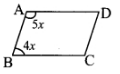
$m \angle A =5 x ^{\circ}$ and $m \angle B=4 x ^{\circ}$
Now $m \angle A + m \angle B =180^{\circ} \ldots$ [Adjacent angles of a parallelogram arc supplementary]
$\therefore 5 x ^{\circ}+4 x ^{\circ}=180^{\circ}$
$\therefore 9 x^{\circ}=180^{\circ}$
$\therefore x ^{\circ}=20^{\circ}$
$\therefore m \angle B=4 x ^{\circ}=4 \times 20^{\circ}=80^{\circ}$
$\therefore$ The measure of $\angle B$ is $800$ .
ii. The ratio of present ages of Albert and Salim is $5: 9$. Five years hence ratio of their ages will be $3: 5$. Find their present ages.
Solution:
The ratio of present ages of Albert and Salim is $5: 9$
Let the common multiple be $x$.
$\therefore$ Present age of Albert $=5 x$ years and
Present age of Salim $=9 x$ years
After $5$ years,
Albert's age $=(5 x+5)$ years and
Salim's age $=(9 x +5)$ years
According to the given condition,
Five years hence ratio of their ages will be $3: 5$
$\frac{5 x+5}{9 x+5}=\frac{3}{5}$
$\therefore 5(5x + 5) = 3(9x + 5)$
$\therefore 25x + 25 = 27x + 15$
$\therefore 25 – 15 = 27 x – 25 x$
$\therefore 10 = 2x$
$\therefore x = 5$
$\therefore$ Present age of Albert $=5 x=5 \times 5=25$ years
Present age of Salim $=9 \times=9 \times 5=45$ years
$\therefore$ The present ages of Albert and Salim are $25$ years and $45$ years respectively.
iii. The ratio of length and breadth of a rectangle is $3: 1$, and its perimeter is $36\ cm$ . Find the length and breadth the rectangle.
Solution:
The ratio of length and breadth of a rectangle is $3: 1$
Let the common multiple be $x$.
Length of the rectangle $( l )=3 xcm$
and Breadth of the rectangle (b) $=x cm$
Given, perimeter of the rectangle $=36 cm$
Since, Perimeter of the rectangle $=2(1+b)$
$\therefore 36=2(3 x+x)$
$\therefore 36=2(4 x)$
$\therefore 36=8 x$
$\therefore x=\frac{36}{8}=\frac{9}{2}=4.5$
Length of the rectangle $=3 x =3 \times 4.5=13.5 cm$
$\therefore$ The length of the rectangle is $13.5\ cm$ and its breadth is $4.5\ cm$ .
iv. The ratio of two numbers is $31: 23$ and their sum is $216$ . Find these numbers.
Solution:
The ratio of two numbers is $31: 23$
Let the common multiple be $x$.
$\therefore$ First number $=31 x$ and
Second number $=23 x$
According to the given condition,
Sum of the numbers is $216$
$\therefore 31 x+23 x=216$
$\therefore 54 x=216$
$\therefore x=4$
$\therefore$ First number $=31 x =31 \times 4=124$
Second number $=23 x =23 \times 4=92$
$\therefore$ The two numbers are $124$ and $92$ .
v . If the product of two numbers is $360$ and their ratio is $10: 9$, then find the numbers.
Solution:
Ratio of two numbers is $10: 9$
Let the common multiple be $x$.
$\therefore $ First number $= 31x $and
Second number $= 23x$
According to the given condition,
Sum of the numbers is $216$
$\therefore 31 x+23 x=216$
$\therefore 54 x=216$
$\therefore x=4$
$\therefore$ First number $=31 x =31 \times 4=124$
Second number $=23 x =23 \times 4=92$
$\therefore$ The two numbers are $124$ and $92$ .
v. If the product of two numbers is $360$ and their ratio is $10: 9$, then find the numbers.
Solution:
Ratio of two numbers is $10: 9$
Let the common multiple be $x$.
$\therefore$ First number $=10 x$ and
Second number $=9 x$
According to the given condition,
Product of two numbers is $360$
$\therefore(10 x)(9 x)=360$
$\therefore 90 x^2=360$
$\therefore x^2=4$
$\therefore x =2$.... [Taking positive square root on both sides]
$\therefore$ First number $=10 x=10 x^2=20$
Second number $=9 x=9 x^2=18$
$\therefore$ The two numbers are $20$ and $18$ . View full question & answer→Question 235 Marks
Using the property $\frac{a}{b}=\frac{a k}{b k}$, fill in the blanks by substituting proper numbers in the following.
i. $\frac{5}{7}=\frac{\ldots .}{28}=\frac{35}{\ldots . .}=\frac{\ldots}{3.5}$
ii. $\quad \frac{9}{14}=\frac{4.5}{\ldots . .}=\frac{\ldots . .}{42}=\frac{\ldots .}{3.5}$
Answer$\text { i. } \quad \frac{5}{7}=\frac{\cdots \cdot}{28}=\frac{5 \times 4}{7 \times 4}=\frac{20}{28}$
$\frac{5}{7}=\frac{35}{\ldots . .}=\frac{5 \times 7}{7 \times 7}=\frac{35}{49}$
$\frac{5}{7}=\frac{\ldots .}{3.5}=\frac{5 \times 0.5}{7 \times 0.5}=\frac{2.5}{3.5}$
$\therefore \quad \frac{5}{7}=\frac{20}{28}=\frac{35}{49}=\frac{2.5}{3.5}$
ii. $ \quad \frac{9}{14} =\frac{4.5}{\ldots}=\frac{9 \times 0.5}{14 \times 0.5}=\frac{4.5}{7}$
$\frac{9}{14} =\frac{\cdots}{42}=\frac{9 \times 3}{14 \times 3}=\frac{27}{42}$
$\frac{9}{14} =\frac{\cdots .}{3.5}=\frac{9 \times 0.25}{14 \times 0.25}=\frac{2.25}{3.5}$
$\therefore \quad \frac{9}{14} =\frac{4.5}{7}=\frac{27}{42}=\frac{2.25}{3.5}$
View full question & answer→Question 245 Marks
Solve.
$A B C D$ is a parallelogram. The ratio of $\angle A$ and $\angle B$ of this parallelogram is $5: 4$. FInd the measure of $\angle B$.
AnswerRatio of $\angle A$ and $\angle B$ for given parallelogram is $5: 4$
Let the common multiple be $x$.
m\angle A = 5x^\circand m\angle B=4x^\circ
$m \angle A=5 x ^{\circ}$ and $m \angle B=4 x ^{\circ}$
Now, $m \angle A+m \angle B=180^{\circ} \ldots$ [Adjacent angles of a parallelogram arc supplementary]
$\therefore 5 x ^{\circ}+4 x ^{\circ}=180^{\circ}$
$\therefore 9 x ^{\circ}=180^{\circ}$
$\therefore x ^{\circ}=20^{\circ}$
$\therefore m \angle B=4 x ^{\circ}=4 \times 20^{\circ}=80^{\circ}$
$\therefore$ The measure of $\angle B$ is 800 .
ii. The ratio of present ages of Albert and Salim is $5: 9$. Five years hence ratio of their ages will be $3: 5$. Find their present ages.
Solution:
The ratio of present ages of Albert and Salim is $5: 9$
Let the common multiple be $x$.
$\therefore$ Present age of Albert $=5 x$ years and
Present age of Salim $=9 x$ years
After 5 years,
Albert's age $=(5 x+5)$ years and
Salim's age $=(9 x+5)$ years
According to the given condition,
Five years hence ratio of their ages will be $3: 5$
$\frac{5 x+5}{9 x+5}=\frac{3}{5}$
$\therefore 5(5 x+5)=3(9 x+5)$
$\therefore 25 x+25=27 x+15$
$\therefore 25-15=27 x-25 x$
$\therefore 10=2 x$
$\therefore x=5$
$\therefore$ Present age of Albert $=5 x =5 \times 5=25$ years
Present age of Salim $=9 x=9 \times 5=45$ years
$\therefore$ The present ages of Albert and Salim are 25 years and 45 years respectively.
iii. The ratio of length and breadth of a rectangle is $3: 1$, and its perimeter is 36 cm . Find the length and breadth of the rectangle.
Solution:
The ratio of length and breadth of a rectangle is $3: 1$
Let the common multiple be $x$.
Length of the rectangle $( l )=3 xcm$
and Breadth of the rectangle (b) $=x cm$
Given, perimeter of the rectangle $=36 cm$
Since, Perimeter of the rectangle $=2(1+b)$
$\therefore 36=2(3 x+x)$
$\therefore 36=2(4 x)$
$\therefore 36=8 x$
$\therefore x=\frac{36}{8}=\frac{9}{2}=4.5$
Length of the rectangle $=3 x =3 \times 4.5=13.5 cm$
$\therefore$ The length of the rectangle is 13.5 cm and its breadth is 4.5 cm .
iv. The ratio of two numbers is $31: 23$ and their sum is 216 . Find these numbers.
Solution:
The ratio of two numbers is $31: 23$
Let the common multiple be $x$.
$\therefore$ First number $=31 x$ and
Second number $=23 x$
According to the given condition,
Sum of the numbers is 216
$\therefore 31 x+23 x=216$
$\therefore 54 x=216$
$\therefore x=4$
$\therefore$ First number $=31 x =31 \times 4=124$
Second number $=23 x =23 \times 4=92$
$\therefore$ The two numbers are 124 and 92 .
v. If the product of two numbers is 360 and their ratio is $10: 9$, then find the numbers.
Solution:
Ratio of two numbers is $10: 9$
Let the common multiple be $x$.
$\therefore$ First number $=10 x$ and
Second number $=9 x$
According to the given condition,
Product of two numbers is 360
$\therefore(10 x)(9 x)=360$
$\therefore 90 x^2=360$
$\therefore x^2=4$
$\therefore x =2$.... [Taking positive square root on both sides]
$\therefore$ First number $=10 x =10 x ^2=20$
Second number $=9 x=9 x^2=18$
$\therefore$ The two numbers are 20 and 18 . View full question & answer→Question 255 Marks
Using the property $\frac{a}{b}=\frac{a k}{b k}$, fill in the blanks by substituting proper numbers in the following.
i. $\frac{5}{7}=\frac{\ldots .}{28}=\frac{35}{\ldots . .}=\frac{\ldots}{3.5}$
ii. $\quad \frac{9}{14}=\frac{4.5}{\ldots . .}=\frac{\ldots . .}{42}=\frac{\ldots .}{3.5}$
Answer$\text { i. } \quad \frac{5}{7}=\frac{\cdots \cdot}{28}=\frac{5 \times 4}{7 \times 4}=\frac{20}{28}$
$\frac{5}{7}=\frac{35}{\ldots . .}=\frac{5 \times 7}{7 \times 7}=\frac{35}{49}$
$\frac{5}{7}=\frac{\ldots .}{3.5}=\frac{5 \times 0.5}{7 \times 0.5}=\frac{2.5}{3.5}$
$\therefore \quad \frac{5}{7}=\frac{20}{28}=\frac{35}{49}=\frac{2.5}{3.5}$
ii. $ \quad \frac{9}{14} =\frac{4.5}{\ldots}=\frac{9 \times 0.5}{14 \times 0.5}=\frac{4.5}{7}$
$\frac{9}{14} =\frac{\cdots}{42}=\frac{9 \times 3}{14 \times 3}=\frac{27}{42}$
$\frac{9}{14} =\frac{\cdots .}{3.5}=\frac{9 \times 0.25}{14 \times 0.25}=\frac{2.25}{3.5}$
$\therefore \quad \frac{9}{14} =\frac{4.5}{7}=\frac{27}{42}=\frac{2.25}{3.5}$
View full question & answer→