Question 12 Marks
To find the approximate value of π, take the wire of length 11 cm, 22 cm and 33 cm each. Make a circle from the wire. Measure the diameter and complete the following table.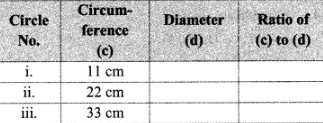
Verify that the ratio of circumference to the diameter of a circle is approximately $\sqrt[22]{7}$.
Answeri. $3.5, \sqrt[22]{7}$
ii. $7, \sqrt[22]{7}$
iii. $10.5, \sqrt[22]{7}$
$\therefore$ The ratio of circumference to the diameter of each circle is $\sqrt[22]{7}$.
View full question & answer→Question 22 Marks
Draw three or four circles of different radii on a card board. Cut these circles. Take a thread and measure the length of circumference and diameter of each of the circles. Note down the readings in the given table.
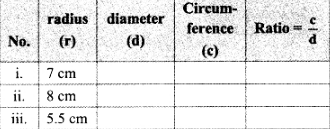
Answeri. 14,44,3.1
ii. 16,50.3,3.1
iii. 11,34.6,3.1
From table, we observe that the ratio $\sqrt[c]{d}$ is nearly 3.1 which is constant. This ratio is denoted by $\pi$ (pi).
View full question & answer→Question 32 Marks
Show that 5 + √7 is an irrational number.
AnswerLet us assume that 5 + √7 is a rational number. So, we can find co-prime integers ‘a’ and ‘b’ (b ≠ 0) such that
$\begin{array}{r}5+\sqrt{7}=\frac{a}{b} \\ \therefore \quad \sqrt{7}=\frac{a}{b}-5\end{array}$
Since, ' $a$ ' and 'b' are integers, $\sqrt[a]{b}-5$ is a rational number and so $\sqrt{ } 7$ is a rational number. $\therefore$ But this contradicts the fact that $\sqrt{ } 7$ is an irrational number. Our assumption that $5+\sqrt{ } 7$ is a rational number is wrong.
$\therefore 5+\sqrt{7}$ is an irrational number.
View full question & answer→Question 42 Marks
Write the following numbers in its decimal form. : $\frac{29}{8}$
Answer$\frac{29}{8}$
$\begin{aligned} & 8 \longdiv { 2 9 . 0 0 0 } \\ & \frac{24}{50} \\ & -\frac{48}{20} \\ & -\frac{16}{40} \\ & -\frac{40}{0} \\ \therefore \quad \frac{29}{8} & = 3 . 6 2 5 \end{aligned}$
View full question & answer→Question 52 Marks
Write the following numbers in its decimal form. : $\frac{121}{13}$
Answer$\frac{121}{13}$
$\frac{9.307692 \ldots}{1 3 \div { 1 2 1 . 0 0 0 0 0 0 }}$
$-117$
$40$
$-\frac{39}{10}$
$-\frac{0}{100}$
$-\frac{91}{90}$
$-\frac{78}{120}$
$-\frac{117}{30}$
$-\frac{26}{4}$
$\therefore \quad \frac{121}{13}=9 . \overline{307692}$
View full question & answer→Question 62 Marks
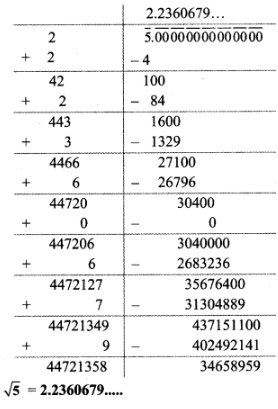
Write the following numbers in its decimal form. : $\sqrt{5}$
Answer$\sqrt{ } 5$
View full question & answer→Question 72 Marks
Write the following numbers in its decimal form. : $\frac{9}{11}$
Answer$\frac{9}{11}$
$\begin{array}{c}0.81 \ldots . . \\ 1 1 \longdiv { 9 . 0 0 } \\ -\frac{0}{90} \\ -\frac{88}{20} \\ -\frac{11}{9} \\ \frac{9}{11}=0 . \overline{81}\end{array}$
View full question & answer→Question 82 Marks
Write the following numbers in its decimal form. : $\frac{-5}{7}$
Answer$\frac{-5}{7}$
$\frac{0.714285 \ldots}{5.000000}$
$\frac{-0}{50}$
$-49$
$10$
$-\frac{7}{30}$
$-\frac{28}{20}$
$-\frac{14}{60}$
$-\frac{56}{40}$
$-\frac{35}{5}$
$\frac{-5}{7}=-0 . \overline{714285}$
View full question & answer→Question 92 Marks
Write the following numbers in $\frac{p}{q}$ form. : $30 . \overline{219}$
AnswerLet $x=30 . \overline{219} \ldots$ (i)
$\therefore x =30.219219$
Since, three numbers i.e. 2, 1 and 9 are repeating after the decimal point.
Thus, multiplying both sides by 1000 ,
$1000 x =30219.219219 \ldots$
$\therefore 1000 x =30219 . \overline{219}$...(ii)
Subtracting (i) from (ii),
$1000 x-x=30219 . \overline{219}-30 . \overline{219}$
$\therefore 999 x=30189$
$\therefore \quad x=\frac{30189}{999}=\frac{3 \times 10063}{3 \times 333}$
$\therefore \quad 30 . \overline{219}=\frac{10063}{333}$
View full question & answer→Question 102 Marks
Write the following numbers in $\frac{p}{q}$ form. : $357.417417 \ldots .$.
AnswerLet $x=357.417417 \ldots=357 . \overline{417} \ldots$ (i)
Since, three numbers i.e. $4,1$ and $7$ are repeating after the decimal point.
Thus, multiplying both sides by $1000 ,$
$ 1000 x=357417.417417 \ldots$
$\therefore 1000 x=357417.417 \ldots \text { (ii) }$
$\text { Subtracting (i) from (ii), }$
$1000 x-x=357417 . \overline{417}-357 . \overline{417}$
$\therefore 999 x=357060$
$\therefore \quad x=\frac{357060}{999}=\frac{3 \times 119020}{3 \times 333}$
$\therefore \quad 3 5 7 . 4 1 7 4 1 7 \ldots =\frac{119020}{333} $
View full question & answer→Question 112 Marks
Write the following numbers in $\frac{p}{q}$ form. : $9.315315 \ldots .$.
AnswerLet $x=9.315315 \ldots=9 . \overline{315} \ldots$ (i)
Since, three numbers i.e. $3,1$ and $5$ are repeating after the decimal point.
Thus, multiplying both sides by $1000 ,$
$1000 x =9315.315315 \ldots$
$\therefore 1000 x =9315 . \overline{315} \ldots \text { (ii) }$
$\text { Subtracting (i) from (ii), }$
$1000 x - x =9315 . \overline{315}-9 . \overline{315}$
$\therefore 999 x =9306$
$\therefore \quad x=\frac{9306}{999}=\frac{9 \times 1034}{9 \times 111}=\frac{1034}{111}$
$\therefore \quad 9.315315 \ldots=\frac{1034}{111} $
View full question & answer→Question 122 Marks
Write the following numbers in $\frac{p}{q}$ form. : $29 . \overline{568}$
AnswerLet $x=29 . \overline{568}...(i)$
$x=29.568568 \ldots$
Since, three numbers i.e. $5, 6$ and $8$ are repeating after the decimal point.
Thus, multiplying both sides by $1000 ,$
$ 1000 x=29568.568568 \ldots$
$1000 x=29568 . \overline{568} \ldots \text { (ii) } $
Subtracting $(i)$ from $(ii),$
$ 1000 x - x =29568 . \overline{568}-29 . \overline{568}$
$\therefore 999 x =29539$
$\therefore \quad x=\frac{29539}{999}$
$\therefore \quad 2 9 . \overline { 5 6 8 } =\frac{ 2 9 5 3 9 }{ 9 9 9 }$
View full question & answer→Question 132 Marks
Write the following numbers in $\frac{p}{q}$ form. : 0.555
Answer$\begin{aligned} 0.555=\frac{0.555 \times 1000}{1 \times 1000}=\frac{555}{1000} & =\frac{5 \times 111}{5 \times 200} \\ & =\frac{111}{200}\end{aligned}$
View full question & answer→Question 142 Marks
Multiply : $(\sqrt{3}-\sqrt{2})(2 \sqrt{3}-3 \sqrt{2})$
View full question & answer→Question 152 Marks
Convert into Decimal form the rational numbers And Write is either terminating or non-terminating recurring type :$\frac{56}{37}$
Answer$\frac{56}{37}=1.513513513 \ldots=1.\overline{513}$ Non terminating recurring type
View full question & answer→Question 162 Marks
Convert into Decimal form the rational numbers And Write is either terminating or non-terminating recurring type :$\frac{33}{26}$
Answer$\frac{33}{26}=1.2692307692307 \ldots=1.2 \overline{692307}$ Non terminating recurring type
View full question & answer→Question 172 Marks
Convert into Decimal form the rational numbers And Write is either terminating or non-terminating recurring type :$\frac{17}{36}$
Answer$\frac{17}{36}=0.472222 \ldots=0.47\overline{2}$ Non terminating recurring type
View full question & answer→Question 182 Marks
Convert into Decimal form the rational numbers And Write is either terminating or non-terminating recurring type :$\frac{101}{8}$
Answer$\frac{101}{8}=12.625$ Terminating type
View full question & answer→Question 192 Marks
Convert into Decimal form the rational numbers And Write is either terminating or non-terminating recurring type :$-\frac{7}{64}$
Answer$-\frac{7}{64}=-0.109375$ Terminating type
View full question & answer→Question 202 Marks
Convert into Decimal form the rational numbers And Write is either terminating or non-terminating recurring type :$\frac{2}{5}$
Answer$\frac{2}{5}=0.4$ Terminating type
View full question & answer→Question 212 Marks
Rationalize the denominator $\frac{1}{\sqrt{5}-\sqrt{3}}$.
AnswerThe conjugate pair of $\sqrt{5}-\sqrt{3}$ is $\sqrt{5}+\sqrt{3}$.
$
\frac{1}{\sqrt{5}-\sqrt{3}}=\frac{1}{\sqrt{5}-\sqrt{3}} \times \frac{\sqrt{5}+\sqrt{3}}{\sqrt{5}+\sqrt{3}}=\frac{\sqrt{5}+\sqrt{3}}{(\sqrt{5})^2-(\sqrt{3})^2}=\frac{\sqrt{5}+\sqrt{3}}{5-3}=\frac{\sqrt{5}+\sqrt{3}}{2}
$
View full question & answer→Question 222 Marks
Rationalize the denominator of $\frac{3}{2 \sqrt{7}}$
Answer$\frac{3}{2 \sqrt{7}}=\frac{3}{2 \sqrt{7}} \times \frac{\sqrt{7}}{\sqrt{7}}=\frac{3 \sqrt{7}}{2 \times 7}=\frac{3 \sqrt{7}}{14}$
...(multiply $2 \sqrt{7}$ by $\sqrt{7}$ is sufficient to rationalize.)
View full question & answer→Question 232 Marks
Rationalize the denominator of $\frac{1}{\sqrt{5}}$
Answer$\frac{1}{\sqrt{5}}=\frac{1}{\sqrt{5}} \times \frac{\sqrt{5}}{\sqrt{5}}=\frac{\sqrt{5}}{5}$
(multiply numerator and denominator by $\sqrt{5}$.)
View full question & answer→Question 242 Marks
Solve : $\left|5+\frac{x}{4}\right|=5$
Answer$\left|5+\frac{x}{4}\right|=5$
$\begin{array}{llll}
\therefore & 5+\frac{x}{4}=5 & \text { or } & 5+\frac{x}{4}=-5 \\
\therefore & \frac{x}{4}=5-5 & \text { or } & \frac{x}{4}=-5-5 \\
\therefore & \frac{x}{4}=0 & \text { or } & \frac{x}{4}=-10 \\
\therefore & x=0 & \text { or } & x=-40
\end{array}$
...[Multiplying both the sides by 4 ]
View full question & answer→Question 252 Marks
Solve : $\left|\frac{8-x}{2}\right|=5$
Answer$\left|\frac{8-x}{2}\right|=5$
$\therefore \quad \frac{8-x}{2}=5 \quad$ or $\quad \frac{8-x}{2}=-5$
$\therefore 8-x=10$ or $8-x=-10$. [Multiplying both the sides by 2 ]
$\therefore 8-10=x$ or $8+10=x$
$\therefore x=-2$ or $x=18$
View full question & answer→Question 262 Marks
Solve : $|7-2 x|=5$
Answer$|7-2 x|=5$
$ \therefore 7-2 x=5 \text { or } 7-2 x=-5$
$\therefore 7-5=2 x \text { or } 7+5=2 x$
$\therefore 2 x=2 \text { or } 2 x=12$
$\therefore x=\frac{2}{2} \text { or } x=\frac{12}{2}$
$\therefore x=1 \text { or } x=6 $
View full question & answer→Question 272 Marks
Solve : $|3 x-5|=1$
Answer$|3 x-5|=1$
$\therefore 3 x-5=1 \text { or } 3 x-5=-1$
$\therefore 3 x=1+5 \text { or } 3 x=-1+5$
$\therefore 3 x=6 \text { or } 3 x=4$
$\therefore \quad x=\frac{6}{3} \quad \text { or } \quad x=\frac{4}{3}$
$\therefore \quad x=2 \quad \text { or } \quad x=\frac{4}{3}$
View full question & answer→Question 282 Marks
Multiply : $(3 \sqrt{2}-\sqrt{3})(4 \sqrt{3}-\sqrt{2})$
Answer$\begin{aligned} & (3 \sqrt{2}-\sqrt{3})(4 \sqrt{3}-\sqrt{2}) \\ = & 3 \sqrt{2}(4 \sqrt{3}-\sqrt{2})-\sqrt{3}(4 \sqrt{3}-\sqrt{2}) \\ = & 3 \sqrt{2} \times 4 \sqrt{3}-3 \sqrt{2} \times \sqrt{2} \\ & \quad-\sqrt{3} \times 4 \sqrt{3}+\sqrt{3} \times \sqrt{2} \\ = & 12 \sqrt{2 \times 3}-3 \sqrt{2 \times 2}-4 \sqrt{3 \times 3}+\sqrt{3 \times 2} \\ = & 12 \sqrt{6}-(3 \times 2)-(4 \times 3)+\sqrt{6} \\ = & 12 \sqrt{6}-6-12+\sqrt{6} \\ = & (12+1) \sqrt{6}-6-12 \\ = & 13 \sqrt{6}-18 \\ \therefore \quad & (3 \sqrt{2}-\sqrt{3})(4 \sqrt{3}-\sqrt{2})=13 \sqrt{6}-18\end{aligned}$
View full question & answer→Question 292 Marks
Multiply : $(\sqrt{5}-\sqrt{7}) \sqrt{2}$
Answer$\begin{aligned}(\sqrt{5}-\sqrt{7}) \sqrt{2} & =\sqrt{5} \times \sqrt{2}-\sqrt{7} \times \sqrt{2} \\ & =\sqrt{5 \times 2}-\sqrt{7 \times 2} \\ \therefore \quad(\sqrt{5}-\sqrt{7}) \sqrt{2} & =\sqrt{10}-\sqrt{14}\end{aligned}$
View full question & answer→Question 302 Marks
Multiply : $\quad \sqrt{3}(\sqrt{7}-\sqrt{3})$
Answer$\quad \begin{aligned} \sqrt{3}(\sqrt{7}-\sqrt{3}) & =\sqrt{3} \times \sqrt{7}-\sqrt{3} \times \sqrt{3} \\ & =\sqrt{3 \times 7}-\sqrt{3 \times 3} \\ \therefore \quad \sqrt{3}(\sqrt{7}-\sqrt{3}) & =\sqrt{21}-3\end{aligned}$
View full question & answer→Question 312 Marks
There are some real numbers written on a card sheet. Use these numbers and construct two examples each of addition, subtraction, multiplication and division. Solve these examples.
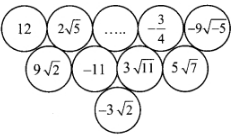
Answeri. $\quad 9 \sqrt{2}+(-3 \sqrt{2})=9 \sqrt{2}-3 \sqrt{2}=6 \sqrt{2}$
ii. $12-2 \sqrt{5}=2(6-\sqrt{5})$
iii. $2 \sqrt{5} \times 3 \sqrt{11}=6 \sqrt{55}$
iv. $\frac{2 \sqrt{5}}{9 \sqrt{2}}=\frac{2 \sqrt{5}}{9 \sqrt{2}} \times \frac{\sqrt{2}}{\sqrt{2}}=\frac{2 \sqrt{10}}{9 \times 2}=\frac{\sqrt{10}}{9}$
View full question & answer→Question 322 Marks
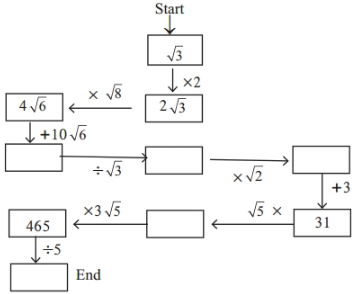
Follow the arrows and complete the chart by doing the operations given.
Question 332 Marks
$\sqrt{100+36} ? \sqrt{100}+\sqrt{36}$
Answer$
\begin{aligned}
& \sqrt{100+36}=\sqrt{136}=2 \sqrt{34} \\
& \sqrt{100}+\sqrt{36}=10+6=16 \\
\therefore \quad & \sqrt{100+36} \neq \sqrt{100}+\sqrt{36}
\end{aligned}
$
From the above examples,
$
\sqrt{a+b} \neq \sqrt{a}+\sqrt{b}
$
View full question & answer→Question 342 Marks
$\sqrt{9+16} ?+\sqrt{9}+\sqrt{16}$
Answer$\begin{aligned} & \sqrt{9+16}=\sqrt{25}=5 \\ & \sqrt{9}+\sqrt{16}=3+4=7 \\ \therefore \quad & \sqrt{9+16} \neq \sqrt{9}+\sqrt{16}\end{aligned}$
View full question & answer→Question 352 Marks
Classify the decimal form of the given rational numbers into terminating and non-terminating recurring type. : $\frac{11}{6}$
AnswerDenominator = 6
= 2 x 3
Since, the denominator is other than prime factors 2 or 5.
$\therefore$ the decimal form of the rational number $\frac{11}{6}$ will be non-terminating recurring type.
View full question & answer→Question 362 Marks
Classify the decimal form of the given rational numbers into terminating and non-terminating recurring type. : $\frac{17}{125}$
AnswerDenominator = 125
= 5 x 5 x 5
Since, 5 is the only prime factor in the denominator.
the decimal form of the rational number $\frac{17}{125}$ will be terminating type.
View full question & answer→Question 372 Marks
Classify the decimal form of the given rational numbers into terminating and non-terminating recurring type. : $\frac{29}{16}$
AnswerDenominator = 16
= 2 x 2 x 2 x 2
Since, 2 is the only prime factor in the denominator.
$\therefore$ the decimal form of the rational number $\frac{29}{16}$ will be terminating type.
View full question & answer→Question 382 Marks
Classify the decimal form of the given rational numbers into terminating and non-terminating recurring type. : $\frac{2}{11}$
AnswerDenominator = 11 = 1 x 11
Since, the denominator is other than prime factors 2 or 5.
$\therefore$ the decimal form of the rational number $\frac{2}{11}$ will be non-terminating recurring type.
View full question & answer→Question 392 Marks
Classify the decimal form of the given rational numbers into terminating and non-terminating recurring type. : $\frac{13}{5}$
AnswerDenominator = 5 = 1 x 5
Since, 5 is the only prime factor denominator.
the decimal form of the rational number $\frac{13}{5}$ will be terminating type.
View full question & answer→