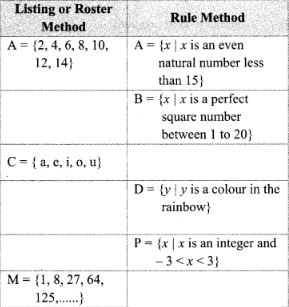
Questions

5 Mark Question

Take a timed test

16 questions · self-marked practice — reveal the answer and mark yourself.

Question 15 Marks
Represent the union of two sets by Venn diagram for each of the following.
i. A = {3, 4, 5, 7},B = {1, 4, 8} l Marks
ii. P {a, b, c, e, f, Q = {l, m, n, e, b) I Markj
iii. X = {x x is a prime number between 80 and 100}
Y = { y | y is an odd number between 90 and 100}
Answer
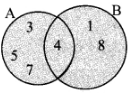
i. A = {3, 4, 5, 7}, B = {1, 4, 8}
Image
ii. P = {a, b, c, e, f}, Q = {l, m, n, e, b}
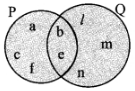
Image
iii. X = {x | x is a prime number between 80 and 100}
∴ X = {83, 89, 97}
Y = {y | y is an odd number between 90 and 100}
∴ Y = {91, 93, 95, 97, 99}
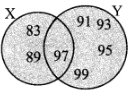
Image

View full question & answer
Question 25 Marks
Out of 100 persons in a group, 72 persons speak English and 43 persons speak French. Each one out of 100 persons speak at least one language. Then how many speak only English? How many speak only French ? How many of them speak English and French both?
Answer
i. Let U be the set of all the persons,
E be the set of persons who speak English and
F be the set of persons who speak French.
∴ n(E) = 72, n(F) = 43
Since, each one out of 100 persons speak at least one language
∴ n(U) = n(E ∪ F)= 100,

ii. n (E ∪ F) = n (E) + n (F) – n(E ∩ F)
100 = 72 + 43 – n (E ∩ F)
n (E ∩ F) = 72 + 43 – 100
∴ n(E ∩ F) = 15
Number of people who speak English and French = 15

iii. Number of people who speak only English = n(E) – n(E ∩ F)
= 72 – 15 = 57

iv. Number of
people who speak only French = n(F) – n(E ∩ F)
= 43 – 15 = 28

Alternate Method:
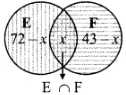
Let U be the set of all the persons,
E be the set of persons who speak English,
F be the set of persons who speak French and x people speak both the languages.

Image
Since, each one out of 100 persons speak at least one language.
∴ n(U) = n(E ∪ F) = 100
∴ 72 – x + x + 43 – x = 100
∴ 115 – x= 100
∴ x = 115 – 100= 15.
Number of people who speak English and French = 15
Number of people who speak only English = 72 – x = 72 – 15 = 57
Number of people who speak only French = 43 – x = 43 – 15 = 28

View full question & answer
Question 45 Marks
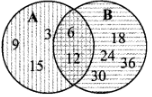
Verify the above rule for the given Venn diagram.
Image
Answer
n(A) = 5 , n(B) = 6
n(A ∪ B) = 9 , n(A ∩ B) = 2
Now, n(A ∪ B) = 9 …(i)
n(A) + n(B) – n(A ∩ B) = 5 + 6 – 2 = 9 …(ii)
∴ n(A ∪ B) = n(A) + n(B) – n(A ∩ B). …[From (i) and (ii)]
View full question & answer
Question 55 Marks
A = {1,2,3, 5, 7,9,11,13}
B = {1,2,4, 6, 8,12,13}
Verify the above rule for the given set A and set B.
Answer
A = {1, 2, 3, 5, 7, 9, 11, 13}
B = {1, 2, 4, 6, 8, 12, 13}
A ∪ B = {1, 2, 3, 4, 5, 6, 7, 8, 9, 11, 12, 13}
A ∩ B= {1, 2, 13}
n(A) = 8, n(B) = 7,
n(A ∪ B) = 12, n(A ∩ B) = 3
n(A ∩ B) = 12 …(i)
n(A) + n(B) – n(A ∩ B) = 8 + 7 – 3 = 12 …(ii)
∴ n(A ∪ B) = n(A) + n(B) – n(A ∩ B) … [From (i) and (ii)]
View full question & answer
Question 65 Marks
Take different examples of sets and verify the above mentioned properties.
Answer
i. Let A = {3, 5}, B= {3, 5, 8, 9, 10}
A ∩ B = B ∩ A = {3, 5}

ii. Let A = {3, 5}, B = {3, 5, 8, 9, 10}
Since, all elements of set A are present in set B.
∴ A ⊆ B
Also, A ∩ B = {3, 5} = A
∴ If A ⊆ B, then A ∩B = A.

iii. Let A = {2, 3, 8, 10}, B = {3,8}
A ∩ B = {3, 8} = B
Also, all the elements of set B are present in set A
∴ B ⊆ A
∴ If A ∩ B = B, then B ⊆ A.

iv. Let A = {2, 3, 8, 10}, B = {3, 8}, A ∩B = {3, 8}
Since, all the elements of set A n B are present in set A and B
A ∩ B ⊆ A and A ∩B ⊆B

v. Let U= {3, 4, 6, 8}, A = {6, 4}
∴ A’ = {3, 8}
∴ A ∩ A’= { } = φ

vi. A ∩ φ = { } = φ

vii. Let A = {6, 4}
∴ A ∩ A = {6, 4}
∴ A ∩ A = A

View full question & answer
Question 75 Marks
A survey was conducted to know the hobby of 220 students of class IX. Out of which 130 students informed about their hobby as ’rock climbing and 180 students informed about their hobby as sky watching. There are 110 students who follow both the hobbies. Then how many students do not have any of the two hobbies? How many of them follow the hobby of rock climbing only? How many students follow the hobby of sky watching only?
Answer
i. Let U be the set of students of class IX,
R be the set of students who follow the hobby of rock climbing and
S be the set of students who follow the hobby of sky watching.
∴ n (U) = 220, n (R) = 130, n (S) = 180,
110 students follow both the hobbies
∴ n (R ∩ S) = 110

ii. n(R ∪ S)=n (R) + n (S) – n (R ∩ S)
= 130 + 180 – 110
∴n (R ∪ S) = 200
∴ 200 students follow the hobby of rock climbing or sky watching.

iii. Total number of students = 220.
Number of students who do not follow the hobby of rock climbing or sky watching
= n (U) – n (R ∪ S)
= 220 – 200
= 20

iv. Number of students who follow the hobby of rock climbing only
= n (R) – n(R ∩ S)
= 130 – 110
= 20

v. Number of students who follow the hobby of sky watching only
= n (S) – n (R ∩ S)
= 180 – 110
= 70

Alternate Method:
Let U be the set of students of class IX,
R be the set of students who follow the hobby of rock climbing and
S be the set of students who follow the hobby of sky watching.
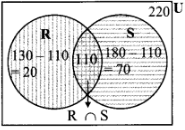
Image

From the Venn diagram
i. Students who follow the hobby of rock climbing or sky watching
= n(R ∪ S)
= 20 + 110 + 70
= 200

ii. Number of students who do not follow the hobby of rock climbing or sky watching
= n (U) – n(R ∪S)
= 220 – 200
= 20

iii. Number of students who follow the hobby of rock climbing only
= n (R) – n(R ∩S)
= 130 – 110
= 20

iv. Number of students who follow the hobby of sky watching only
= n (S) – n (R ∩ S)
= 180 – 110
= 70

View full question & answer
Question 85 Marks
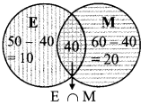
In a competitive exam 50 students passed in English, 60 students passed in Mathematics and 40 students passed in both the subjects. None of them failed in both the subjects. Find the number of students who passed at least in one of the subjects ?
Answer
Let U be the set of students who appeared for the exam,
E be the set of students who passed in English and
M be the set of students who passed in Maths.
∴ n(E) = 50, n(M) = 60,
40 students passed in both the subjects
∴ n(M ∩ E) = 40
Since, none of the students failed in both subjects
∴ Total students = n(E ∪M)
= n(E) + n(M) – n(E ∩ M)
= 50 + 60 – 40
= 70
∴ The number of students who passed at least in one of the subjects is 70.

Alternate Method:
Let U be the set of students who appeared for the exam,
E be the set of students who passed in English and M be the set of students who passed in Maths.
Image
Since, none of the students failed in both subjects
∴ Total student = n(E ∪M)
= 10 + 40 + 20
= 70
∴ The number of students who passed at least in one of the subjects is 70.

View full question & answer
Question 95 Marks
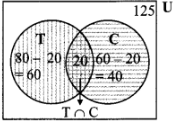
In a hostel there are 125 students, out of which 80 drink tea, 60 drink coffee and 20 drink tea and coffee both. Find the number of students who do not drink tea or coffee.
Answer
i. Let U be the set of students in the hostel, T be the set of students who drink tea and C be the set of students who drink coffee.
n(U) = 125, n(T) = 80, n(C) = 60,
number of students who drink Tea and Coffee = n(T ∩ C) = 20

ii. n(T ∪ C) = n(T) + n(C) – n(T ∩ C)
= 80 + 60 – 20
∴ n(T ∪ C) = 120
∴ 120 students drink tea or coffee
Also, there are 125 students in the hostel.

iii. Number of students who do not drink tea or coffee = n(U) – n(T ∪ C)
= 125 – 120
= 5
∴ 5 students do not drink tea or coffee.

Alternate Method:
Let U be the set of students in the hostel, T be the set of students who drink tea and C be the set of students who drink coffee.
Image
From Venn diagram,
Student who drinks tea or coffee = n(T ∪ C) = 60 + 20 + 40 = 120
∴ The number of students who do not drink tea or coffee = n(U) – n(T ∪ C)
= 125 – 120 = 5
∴ 5 students do not drink tea or coffee.

View full question & answer
Question 105 Marks
Which set of numbers could be the universal set for the sets given below?
i. A = set of multiples of $5$,
B = set of multiples of $7$,
C = set of multiples of $12ii$. P = set of integers which are multiples of $4$.
T = set of all even square numbers.
Answer
$\text { i. } A=\text { set of multiples of } 5$
$\therefore A=\{5,10,15, \ldots\}$
$B=\text { set of multiples of } 7$
$\therefore B=\{7,14,21, \ldots\}$
$C=\text { set of multiples of } 12$
$\therefore C=\{12,24,36, \ldots\}$
Now, set of natural numbers, whole numbers, integers, rational numbers are as follows:
$N=\{1,2,3, \ldots\}, W=\{0,1,2,3, \ldots\}$
$I=\{\ldots,-3,-2,-1,0,1,2,3, \ldots\}$
$Q=\left\{\left.\frac{p}{q} \right\rvert\, p, q \in I, q \neq 0\right\}$
Since, set $A, B$ and $C$ are the subsets of sets $N, W, I$ and $Q$.
$\therefore$ For set $A , B$ and C we can take any one of the set from $N , W , I$ or Q as universal set.ii. $P =$ set of integers which are multiples of 4 .
$P=\{4,8,12, \ldots\}$
$T=$ set of all even square numbers $T=\left\{2^2, 4^2, 6^2, \ldots\right\}$
Since, set $P$ and $T$ are the subsets of sets $N, W, I$ and $Q$.
$\therefore$ For set P and T we can take any one of the set from $N , W , I$ or Q as universal set.
View full question & answer
Question 115 Marks
i. Write the subset relation between the sets.
P is the set of all residents in Pune.
M is the set of all residents in Madhya Pradesh.
I is the set of all residents in Indore.
B is the set of all residents in India.
H is the set of all residents in Maharashtra.

ii. Which set can be the universal set for above sets ?

Answer
i.
a. The residents of Pune are residents of India.
∴ P ⊆ B
b. The residents of Pune are residents of Maharashtra.
∴ P ⊆ H
c. The residents of Madhya Pradesh are residents of India.
∴ M ⊆ B
d. The residents of Indore are residents of India.
∴ I ⊆ B
e. The residents of Indore are residents of Madhya Pradesh.
∴ I ⊆ M
f. The residents of Maharashtra are residents of India.
∴ H ⊆B

ii. The residents of Pune, Madhya Pradesh, Indore and Maharashtra are all residents of India.
∴ B can be the Universal set for the above sets.

View full question & answer
Question 125 Marks
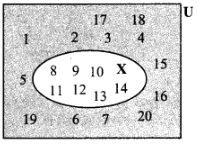
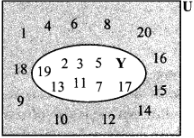
Take the set of natural numbers from 1 to 20 as universal set and show set X and Y using Venn diagram. [2 Marks each]
i. X= {x |x ∈ N, and 7 < x < 15}
ii. Y = { y | y ∈ N, y is a prime number from 1 to 20}
Answer
U = {1, 2, 3, 4, …….., 18, 19, 20}
x = {x | x ∈ N, and 7 < x < 15}
∴ x = {8, 9, 10, 11, 12, 13, 14}
Image

U = {1, 2, 3, 4, …… ,18, 19, 20}
Y = { y | y ∈ N, y is a prime number from 1 to 20}
∴ Y = {2, 3, 5, 7, 11, 13, 17, 19}
Image

View full question & answer
Question 135 Marks
If A = {a, b, c, d, e}, B = {c, d, e, f}, C = {b, d}, D = {a, e}, then which of the following statements are true and which are false?
i. C ⊆ 3
ii. A ⊆ D
iii. D ⊆ B
iv. D ⊆ A
V. B ⊆ A
vi. C ⊆ A
Answer
i. C = {b, d}, B = {c, d, e ,f}
C ⊆ B
False
Since, all the elements of C are not present in B.

ii. A = {a, b, c, d, e}, D = {a, e}
A ⊆ D
False
Since, all the elements of A are not present in D.

iii. D = {a, e}, B = {c, d, e, f}
D ⊆ B
False
Since, all the elements of D are not present in B.

iv. D = {a, e}, A = {a, b, c, d, e}
D ⊆ A
True
Since, all the elements of D are present in A.

v. B = {c, d, e, f}, A = {a, b, c, d, e}
B ⊆ A
False
Since, all the elements of B are not present in A.

vi. C = {b, d}, A= {a, b, c, d, e}
C ⊆A
True
Since, all the elements of C are present in A.

View full question & answer
Question 145 Marks
Decide which of the following are equal sets and which are not ? Justify your answer.
$A= \{x | 3x – 1 = 2\}$
$B = \{x | x$ is a natural number but $x$ is neither prime nor composite$\}$
$C = \{x | x\  e\  N, x < 2\}$
Answer
$A =\{a| a$ is a natural number smaller than zero$\}$
Natural numbers begin from $1.$
$∴ A =\{ \}$
$∴ A$ is an empty set.$B = \{x | x^2 = 0\}$
Here, $x^2 = 0$
$∴ x = 0 …$  [Taking square root on both sides]
$∴ B = {0}$
$∴B$ is not an empty set.
$C=\{x \mid 5 x-2=0, x \in N\}$
Here, $5 x-2=0$
$ \therefore 5 x=2$
$\therefore x=\frac{2}{5}$
Given, $x \in N$
But, $x=\frac{2}{5}$ is not a natural number.
$\therefore C=\{\}$
$\therefore C$ is an empty set.
View full question & answer
Question 155 Marks
Decide which of the following are equal sets and which are not ? Justify your answer.
A= {x | 3x – 1 = 2}
B = {x | x is a natural number but x is neither prime nor composite}
C = {x | x e N, x < 2}
Answer
A= {x | 3x – 1 = 2}
Here, 3x – 1 = 2
∴ 3x = 3
∴ x = 1
∴ A = {1} …(i)

B = {x | x is a natural number but x is neither prime nor composite}
1 is the only number which is neither prime nor composite,
∴ x = 1
∴ B = {1} …(ii)

C = {x | x G N, x < 2}
1 is the only natural number less than 2.
∴ x = 1
∴ C = {1} …(iii)
∴ The element in sets A, B and C is identical. … [From (i), (ii) and (iii)]
∴ A, B and C are equal sets.

View full question & answer