Question
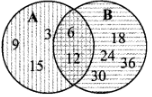
Verify the above rule for the given Venn diagram.
Image

Answer

n(A) = 5 , n(B) = 6
n(A ∪ B) = 9 , n(A ∩ B) = 2
Now, n(A ∪ B) = 9 …(i)
n(A) + n(B) – n(A ∩ B) = 5 + 6 – 2 = 9 …(ii)
∴ n(A ∪ B) = n(A) + n(B) – n(A ∩ B). …[From (i) and (ii)]

Need a full question paper?

Generate a complete, print-ready paper with questions like this in minutes — across 16+ boards, with answer keys.
Start Generating Free

Similar questions

Solve the following equations : $\frac{(2 x+1)^2+(2 x-1)^2}{(2 x+1)^2-(2 x-1)^2}=\frac{17}{8}$
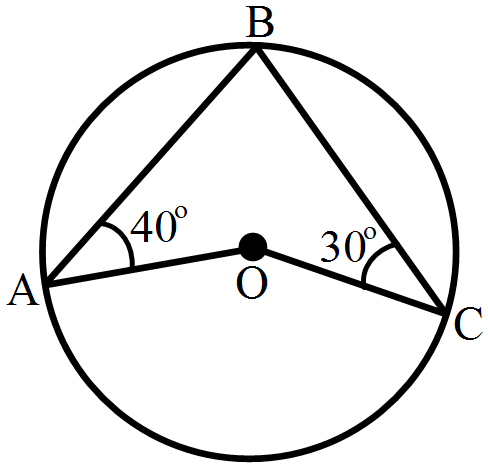
  1. In Figure (1), O is the centre of the circle. If $\angle\text{OAB}=40^\circ$ and $\angle\text{OCB}=30^\circ,$ find $\angle\text{AOC}.$
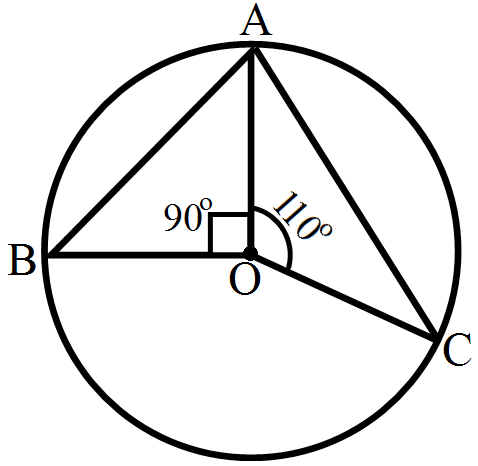
  2. In Figure (2), A, B and C are three points on the circle with centre O such that $\angle\text{AOB}=90^\circ$ and $\angle\text{AOC}=110^\circ.$ Find $\angle\text{BAC}.$


In figure, ABC and ABD are two triangles on the base AB. If line segment CD is bisected by AB at O, show that $\text{ar}(\triangle\text{ABC})=\text{ar}(\triangle\text{ABD}).$
If the length of a rectangle is reduced by 5 units and its breadth is increased by 3 units, then the area of the rectangle is reduced by 9 square units. If length is reduced by 3 units and breadth is increased by 2 units, then the area of rectangle will increase by 67 square units. Then find the length and breadth of the rectangle.
Show that $4\sqrt{2}$ is an irrational number.
Find the distances with the help of the number line given below.

Image
i. d(B, E)
ii. d (J, J)
iii. d(P, C)
iv. d(J, H)
v. d(K, O)
vi. d(O, E)
vii. d(P, J)
viii. d(Q, B)

Construct ∆DEF such that DE = EF = 6 cm. ∠F = 45° and construct its circumcircle.
If $(28 – x)$ is the mean proportional of $(23 – x)$ and $(19 – x),$ then find the value of $x.$
Three coins are tossed simultaneously 100 times with the following frequencies of different outcomes:
Outcome
No head
One head
Two head
Three head
Frequency
14
38
36
12
If the three coins are tossed simultaneously again, compute the probability of:
  1. 2 heads coming up.
  2. 3 heads coming up.
  3. At least one Head coming up.
  4. Getting more Tails than Heads.
  5. Getting more heads than tails.
In each of the examples given below, a pair of triangles is shown. Equal parts of triangles in each pair are marked with the same signs. Observe the figures and state the test by which the triangles in each pair are congruent.
