Question 15 Marks
In a $\triangle\text{ABC},$ the internal bisectors of $\angle\text{B}$ and $\angle\text{E}$ meet at P and the external bisectors of $\angle\text{B}$ and $\angle\text{C}$ meet at Q. Prove that $\angle\text{BPC}+\angle\text{BQC}=180^\circ.$
Answer
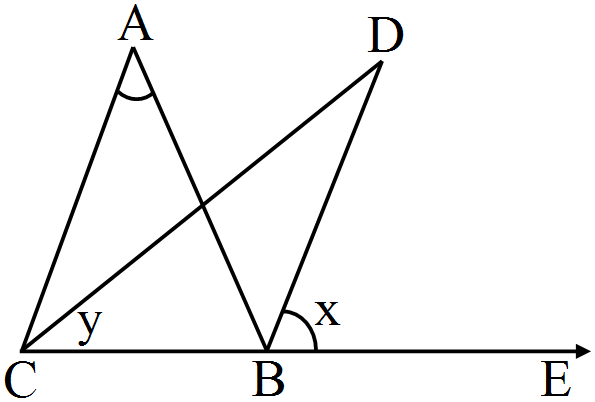
View full question & answer→Let $\angle\text{ABC}=2\text{x}$ and $\angle\text{ACE}=2\text{y}$ 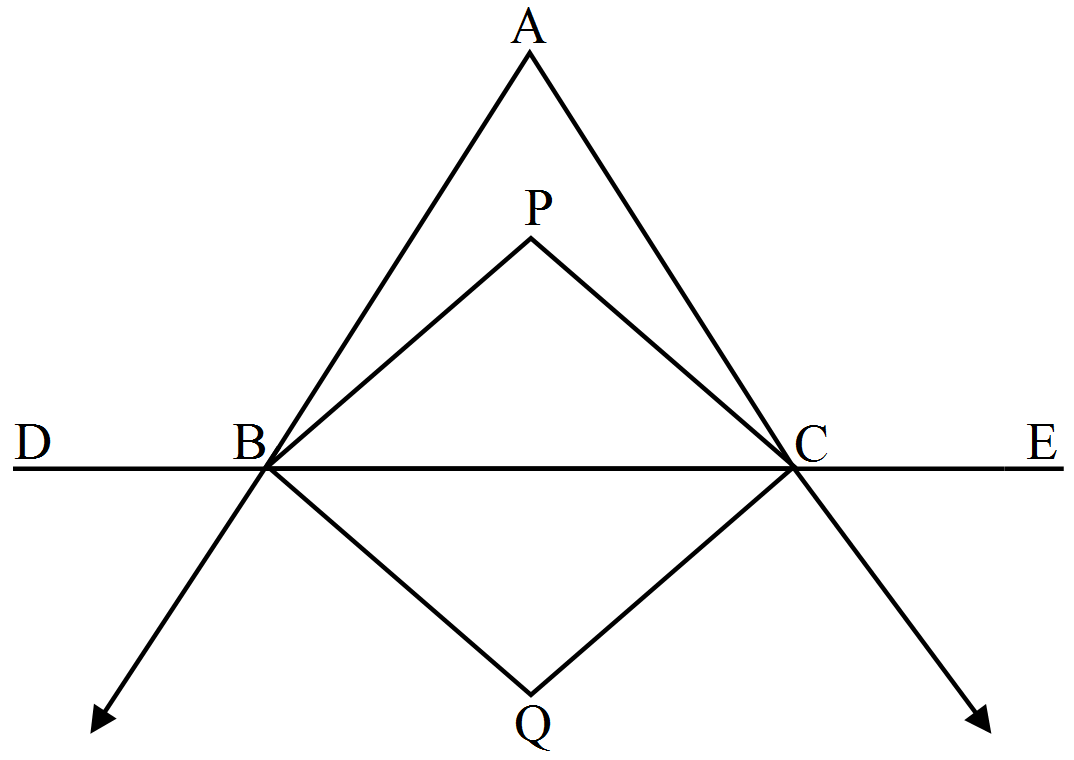 $\angle\text{ABC}=180^\circ-2\text{x}$ [Linera pair]
$\angle\text{ACB}=180^\circ-2\text{y}$ [Linera pair]
$\angle\text{A}+\angle\text{ABC}+\angle\text{ACB}=180^\circ$ [Sum of all angles of a triangle]
$\Rightarrow\angle\text{A}+180^\circ-2\text{x}+180^\circ-2\text{y}=180^\circ$
$\Rightarrow-\angle\text{A}+2\text{x}+2\text{y}=180^\circ$
$\Rightarrow\text{x}+\text{y}=90^\circ+\frac{1}{2}\angle\text{A}$
Now in $\triangle\text{BQC}$$\text{x}+\text{y}+\angle\text{BQC}=180^\circ$ [Sum of all angles of a triangle]
$\Rightarrow90^\circ+\frac{1}{2}\angle\text{A}+\angle\text{BQC}=180^\circ$
$\Rightarrow\angle\text{BQC}=90^\circ-\frac{1}{2}\angle\text{A}\dots(\text{i})$
and we know that $\Rightarrow\angle\text{BPC}=90^\circ+\frac{1}{2}\angle\text{A}\dots(\text{ii})$ Adding (i) and (ii) we get $\angle\text{BPC}+\angle\text{BQC}=180^\circ$ Hence proved.
$\angle\text{ABC}=180^\circ-2\text{x}$ [Linera pair]$\angle\text{ACB}=180^\circ-2\text{y}$ [Linera pair]
$\angle\text{A}+\angle\text{ABC}+\angle\text{ACB}=180^\circ$ [Sum of all angles of a triangle]
$\Rightarrow\angle\text{A}+180^\circ-2\text{x}+180^\circ-2\text{y}=180^\circ$
$\Rightarrow-\angle\text{A}+2\text{x}+2\text{y}=180^\circ$
$\Rightarrow\text{x}+\text{y}=90^\circ+\frac{1}{2}\angle\text{A}$
Now in $\triangle\text{BQC}$$\text{x}+\text{y}+\angle\text{BQC}=180^\circ$ [Sum of all angles of a triangle]
$\Rightarrow90^\circ+\frac{1}{2}\angle\text{A}+\angle\text{BQC}=180^\circ$
$\Rightarrow\angle\text{BQC}=90^\circ-\frac{1}{2}\angle\text{A}\dots(\text{i})$
and we know that $\Rightarrow\angle\text{BPC}=90^\circ+\frac{1}{2}\angle\text{A}\dots(\text{ii})$ Adding (i) and (ii) we get $\angle\text{BPC}+\angle\text{BQC}=180^\circ$ Hence proved.
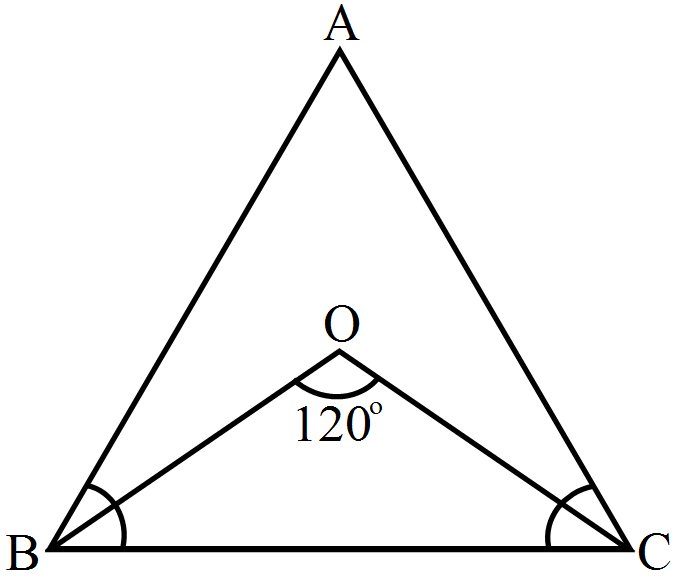 So here, using the corollary, "if the bisectors of $\angle\text{ABC}$ and $\angle\text{ACB}$ of a $\triangle\text{ABC},$meet at a point O, Then $\angle\text{BOC}=90^\circ+\frac{1}{2}\angle\text{A}"$ Thus, in $\triangle\text{ABC},$$\angle\text{BOC}=90^\circ+\frac{1}{2}\angle\text{A}$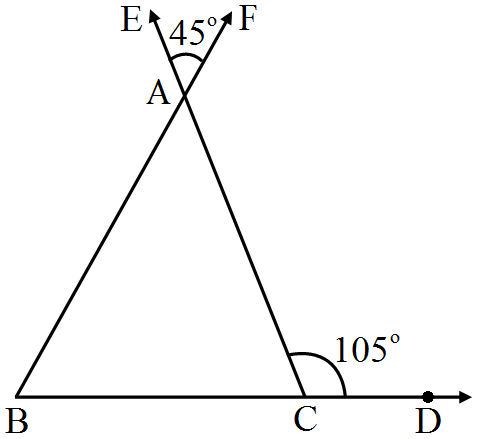
 $\angle\text{BAC}=\angle\text{EAF}=45^\circ$ [Vertically opposite angles]
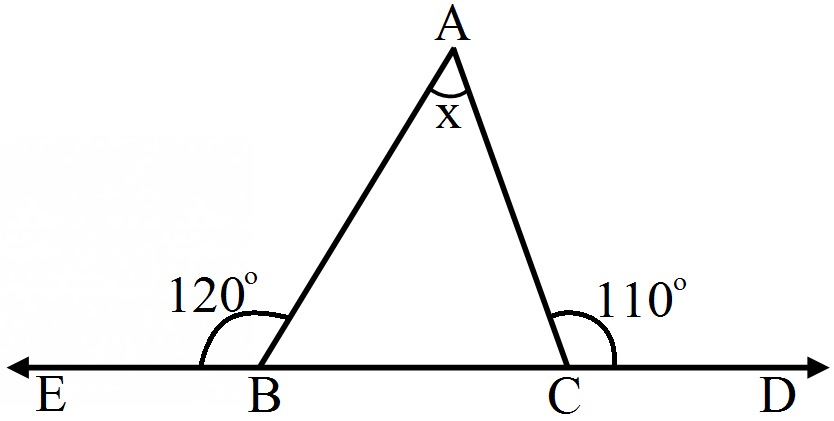
 $\angle\text{ABC}=180^\circ-2\text{x}$ [Linear pair]
 Now, using angle sum property of the triangle In $\triangle\text{AEB}$$\angle\text{BAE}+\angle\text{AEB}+\angle\text{EBA}=180^\circ$
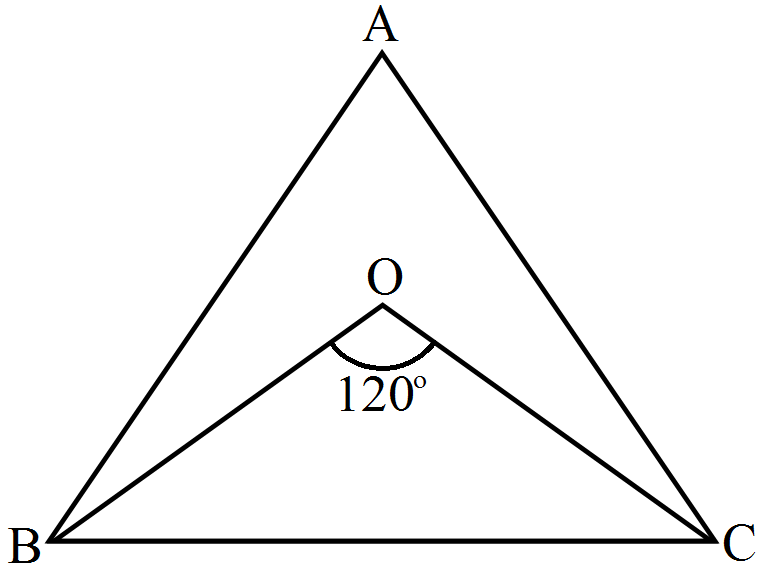 In $\triangle\text{ABC},$$\angle\text{ABC}=\angle\text{ACB}$