Question
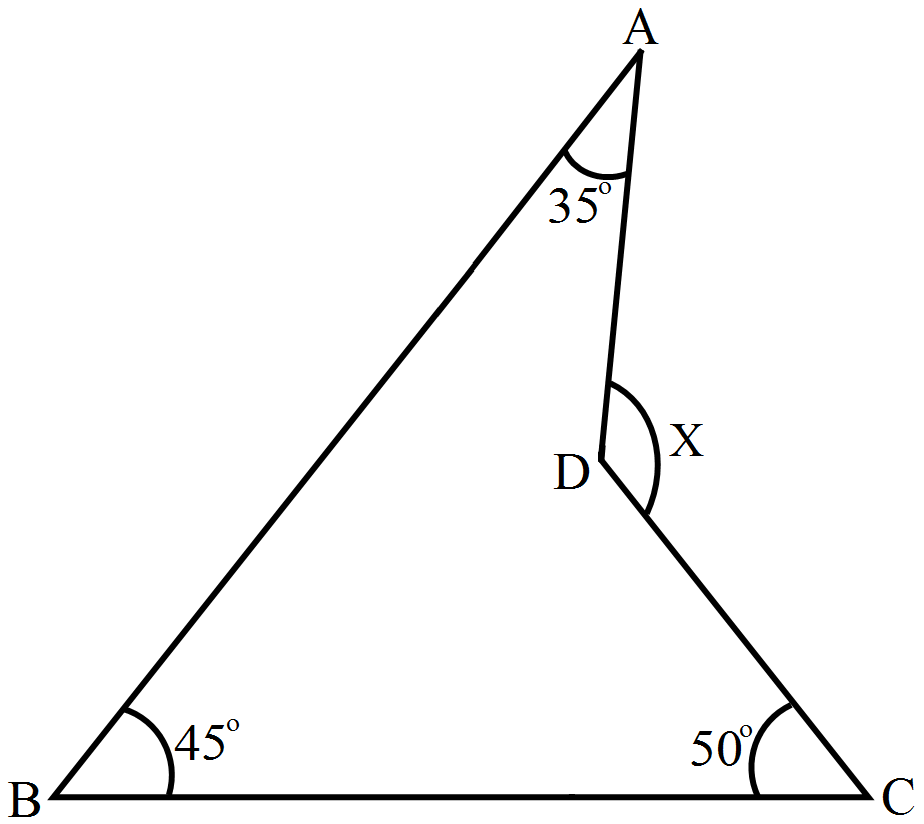
In the given figure, compute the value of x.
Answer

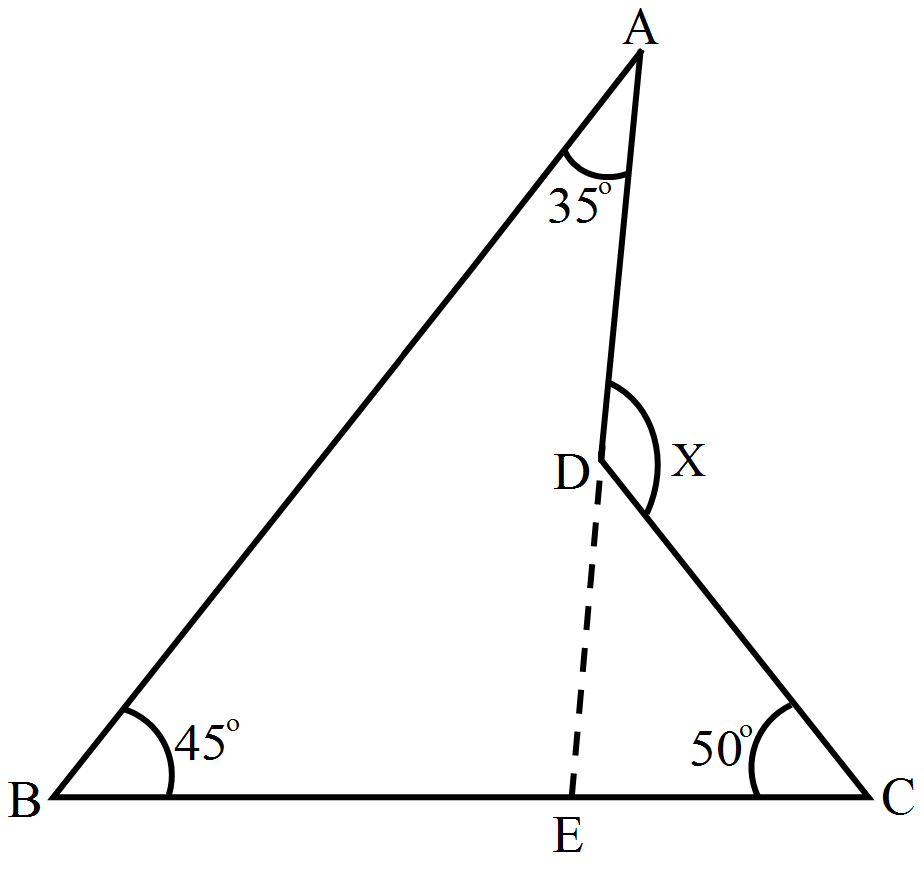
In the given figure, $\angle\text{DCB}=45^\circ,\angle\text{CBA}=35^\circ$ and $\angle\text{BAD}=35^\circ$ Here, we will produce AD to meet BC at E Now, using angle sum property of the triangle In $\triangle\text{AEB}$$\angle\text{BAE}+\angle\text{AEB}+\angle\text{EBA}=180^\circ$
$\angle\text{AEB}+35^\circ+45^\circ=180^\circ$
$\angle\text{AEB}+180^\circ=180^\circ$
$\angle\text{AEB}=180^\circ-80^\circ$
$\angle\text{AEB}=100^\circ$
Eurther, BEC is a straight line. So, using the property, "the angles forming a linear pair are supplementary", we get$\angle\text{AEB}+\angle\text{AEC}=180^\circ$
$100^\circ+\angle\text{AEC}=180^\circ$
$\angle\text{AEC}=180^\circ-100^\circ$
$\angle\text{AEC}=80^\circ$
Also, using the property, " an exterior angle of a triangle is equal to the sum of its two opposite interior angles" In $\triangle\text{DEC},\text{x}$ is its exterior angle Thus,$\angle\text{x}=\angle\text{DCE}+\angle\text{DEC}$
$=50^\circ+80^\circ$
$=130^\circ$
Therefore, $\text{x}=130^\circ.$

Need a full question paper?

Generate a complete, print-ready paper with questions like this in minutes — across 16+ boards, with answer keys.

Start Generating Free

Similar questions

Explain, by taking a suitable example, how the arithmetic mean alters by:
  1. Adding a constant k to each term.
  2. Subtracting a constant k from each term.
  3. Multiplying each term by a constant k.
  4. Dividing each term by non-zero constant k.
Construct ∆XYZ, such that YZ = 7.4 cm, ∠XYZ = 45° and XY – XZ = 2.7 cm.
Construct ∆XYZ, such that XY + XZ = 10.3 cm, YZ = 4.9 cm, ∠XYZ = 45°.
Construct ∆XYZ such that XY = 6.7 cm, YZ = 5.8 cm, XZ = 6.9 cm. Construct its incircle.
The investments (in ten crores of rupees) of Life Insurance Corporation of India in different sectors is given below:
Sectors
Investment (in ten crores of rupess)
Central government securities
45
State government securities
11
Securities guaranteed by the government
23
Private sectors
18
Socially oriented sectors (plan)
46
Socially oriented sectors (Non–plan)
11
Represent the above data with the help of a bar graph.
On a graph paper, plot the points A(2, 3), B(6, -1) and C(0, 5). If these points are collinear, then draw the line which includes them. Write the co-ordinates of the points at which the line intersects the X-axis and the Y-axis.
Find the measure of each angle of a parallelogram, if one of its angles is 30° less than twice the smallest angle.
Solve the following equations : $\frac{x^2+12 x-20}{3 x-5}=\frac{x^2+8 x+12}{2 x+3}$
A chord of length $30\ cm$ is drawn at a distance of $8\ cm$ from the centre of a circle.
Find out the radius of the circle.
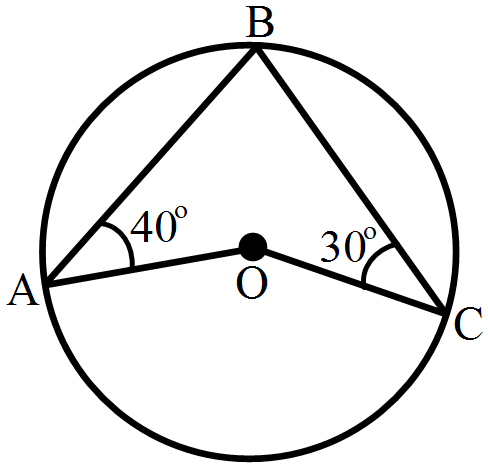
  1. In Figure (1), O is the centre of the circle. If $\angle\text{OAB}=40^\circ$ and $\angle\text{OCB}=30^\circ,$ find $\angle\text{AOC}.$
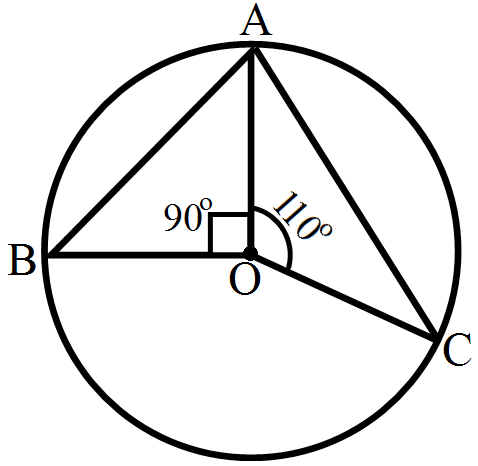
  2. In Figure (2), A, B and C are three points on the circle with centre O such that $\angle\text{AOB}=90^\circ$ and $\angle\text{AOC}=110^\circ.$ Find $\angle\text{BAC}.$