Questions

MCQ(1M)

Take a timed test

30 questions · auto-graded multiple-choice test.

MCQ 11 Mark
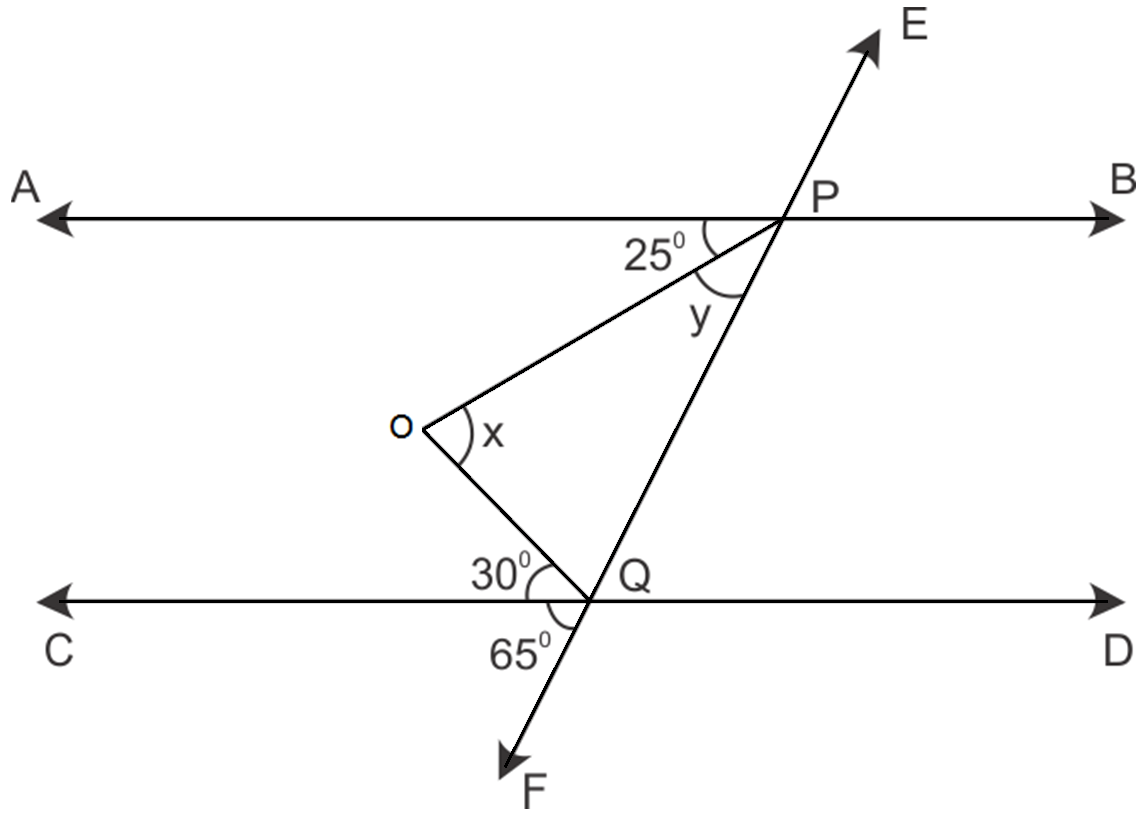
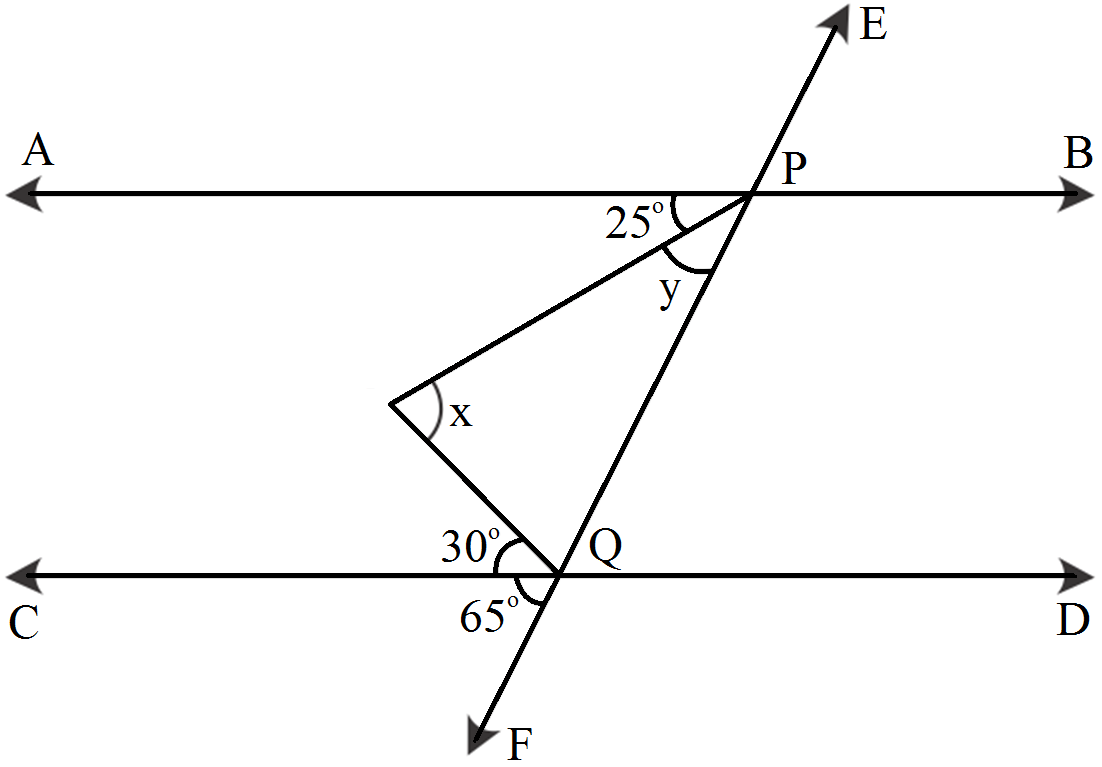
In Fig. $AB$ and $CD$ are parallel lines and transversal $EF$ intersect them at $P$ and $Q$ respectively. If $\angle\text{APR}=25^\circ,\angle\text{RQC}=30^\circ$ and $\angle\text{CQF}=65^\circ,$ then:
  • $x = 55^\circ , y = 40^\circ$
  • B
    $x = 50^\circ , y = 45^\circ$
  • C
    $x = 60^\circ , y = 35^\circ$
  • D
    $x = 35^\circ , y = 60^\circ$
Answer
Correct option: A.
$x = 55^\circ , y = 40^\circ$

$\angle\text{OQP}=180^\circ-\angle\text{OQF}$
$=180^\circ-(30^\circ+65^\circ)$
$\Rightarrow\angle\text{OQP}=85^\circ\dots(1)$
$\angle\text{APQ}=\angle\text{CQF} \ ($Corresponding angles$)$
$\Rightarrow25^\circ+\text{y}^\circ=65^\circ$
$\Rightarrow\text{y}^\circ=65^\circ-25^\circ$
$\Rightarrow\text{y}^\circ=40^\circ$
Now in $\triangle\text{OPQ}$
$\angle\text{O}+\angle\text{OPQ}+\angle\text{PQO}=180^\circ$
$\Rightarrow\text{x}^\circ+40^\circ+85^\circ=180^\circ$
$\text{x}^\circ=180^\circ-85^\circ-40^\circ=55^\circ$
$\Rightarrow\text{x}^\circ=55^\circ,\text{y}=40^\circ$
View full question & answer
MCQ 21 Mark
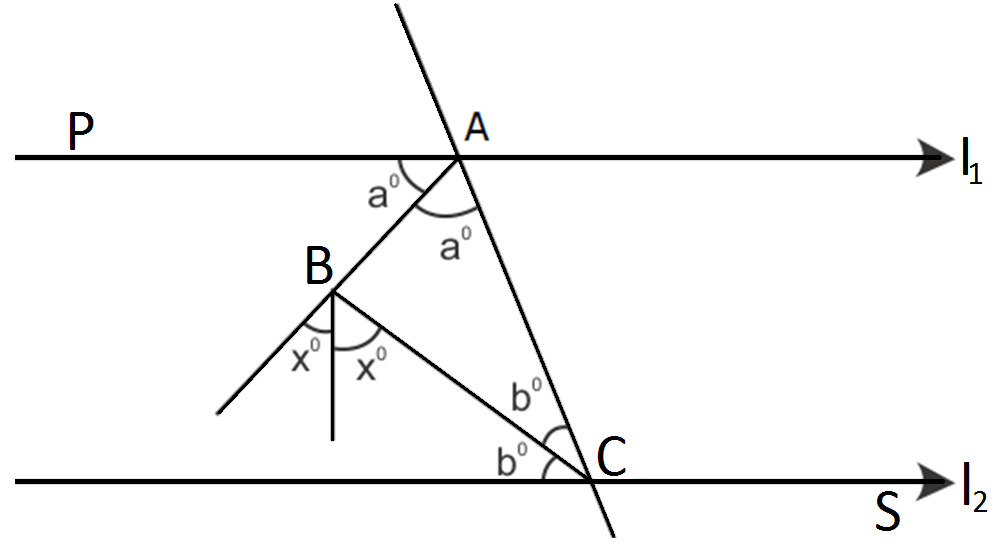
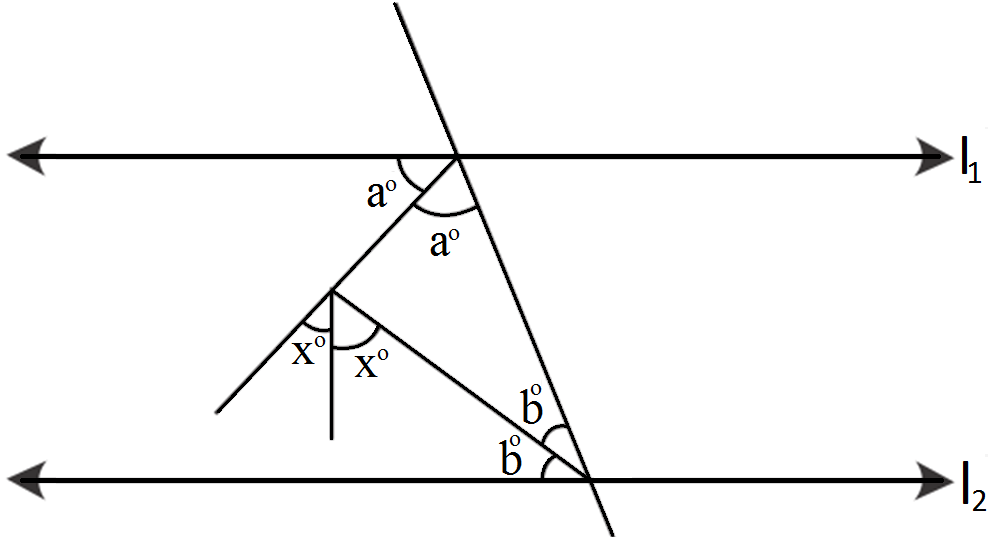
In Fig. if $l_1 \| l_2$, the value of $x$ is:

  • A
    $22\frac{1}{2}$
  • B
    $30$
  • $45$
  • D
    $60$
Answer
Correct option: C.
$45$

From figure,
$\angle\text{ACS}=180^\circ-2\text{b}^\circ$
also $\angle\text{ACS}=\angle\text{PAC}=2\text{a}^\circ ($alternate angles$)$
$\Rightarrow2\text{a}^\circ=180^\circ-2\text{b}^\circ$
$\Rightarrow\text{a}^\circ+\text{b}^\circ=90^\circ$
Now, in $\triangle\text{ABC}$
$\text{a}^\circ+\text{b}^\circ+\angle\text{ABC}=180^\circ$
$\angle\text{ABC}=180^\circ-2\text{x}^\circ$
$\Rightarrow\text{a}^\circ+\text{b}^\circ+180^\circ-2\text{x}^\circ=180^\circ$
$\Rightarrow2\text{x}^\circ=\text{a}^\circ+\text{b}^\circ=90^\circ$
$\Rightarrow\text{x}^\circ=45^\circ$
View full question & answer
MCQ 31 Mark
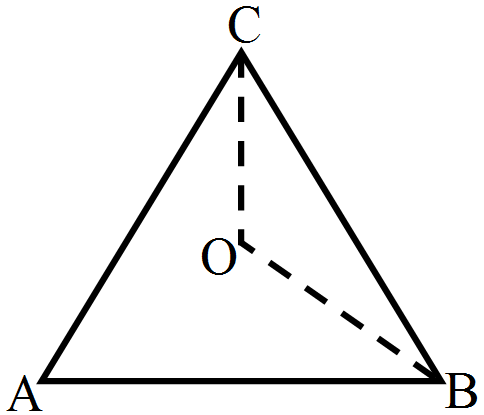
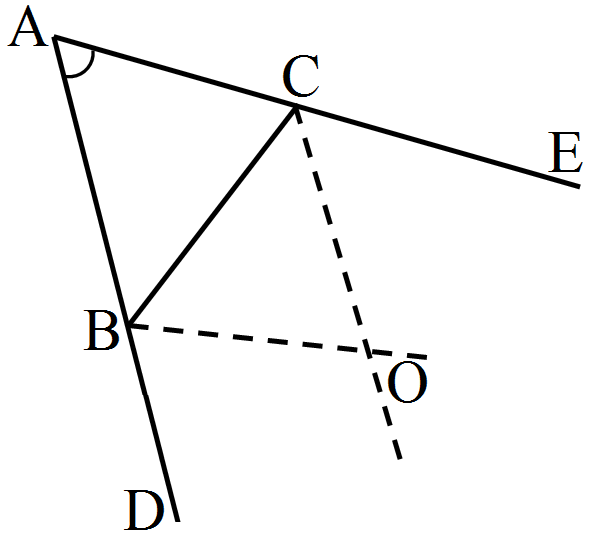
In a $\triangle\text{ABC},$ if $\angle\text{A}=60^\circ,\angle\text{B}=80^\circ$ and the bisectors of $\angle\text{B}$ and $\angle\text{C}$ meet at $O,$ then $\angle\text{BOC}=$
  • A
    $60^\circ$
  • $120^\circ$
  • C
    $150^\circ$
  • D
    $30^\circ$
Answer
Correct option: B.
$120^\circ$

$O$ is point where bisectors of $\angle\text{C }\ \angle\text{B}$ meets.
$\angle\text{A}+\angle\text{B}+\angle\text{C}=180^\circ$
$60^\circ+80^\circ+\angle\text{C}=108^\circ$
$\angle\text{C}=40^\circ$
$\frac{\angle\text{C}}{2}=20^\circ$
$\frac{\angle\text{C}}{2}=20^\circ=\angle\text{BCO}\dots(1)$
$\frac{\angle\text{B}}{2}=\frac{80^\circ}{2}=40^\circ=\angle\text{OBC}\dots(2)$
In $\triangle\text{BOC}$
$\angle\text{BCO}+\angle\text{OBC}+\angle\text{BOC}=180^\circ$
from $(1)$ and $(2)$
$20^\circ+40^\circ+\angle\text{BOC}=180^\circ$
$\Rightarrow\angle\text{BOC}=180^\circ-60^\circ=120^\circ$
View full question & answer
MCQ 41 Mark
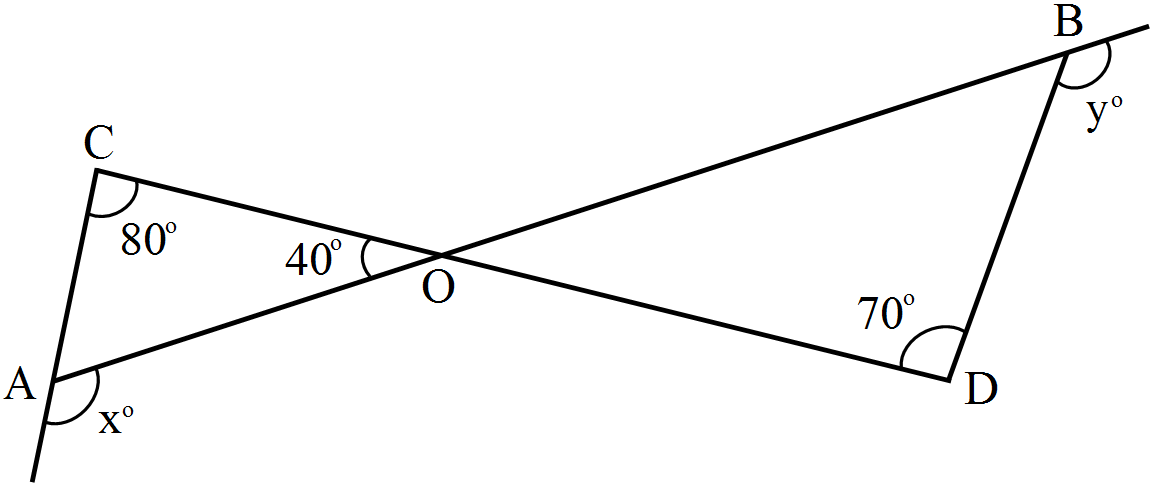
In Fig. $x + y =$
  • A
    $270^\circ$
  • $230^\circ$
  • C
    $210^\circ$
  • D
    $190^\circ$
Answer
Correct option: B.
$230^\circ$
$\triangle\text{ACO}$
$\angle\text{ACO}+\angle\text{COA}+\angle\text{COA}=180^\circ$
Now, $\angle\text{OAC}=180^\circ-\text{x}^\circ$
$\Rightarrow80^\circ+40^\circ+180^\circ-\text{x}^\circ=180^\circ$
$\Rightarrow\text{x}^\circ=120^\circ$
$\angle\text{BOD}=\angle\text{COA}=40^\circ \ ($Opposite angles$)$
$\angle\text{BDO}=70^\circ$
In $\triangle\text{OBD},$
$\angle\text{OBD}=180^\circ-40^\circ-70^\circ=70^\circ$
Also, $\text{y}^\circ=180^\circ-\angle\text{OBD}=180^\circ-70^\circ=110^\circ$
$\Rightarrow\text{x}^\circ+\text{y}^\circ=120^\circ+110^\circ=230^\circ$
View full question & answer
MCQ 51 Mark
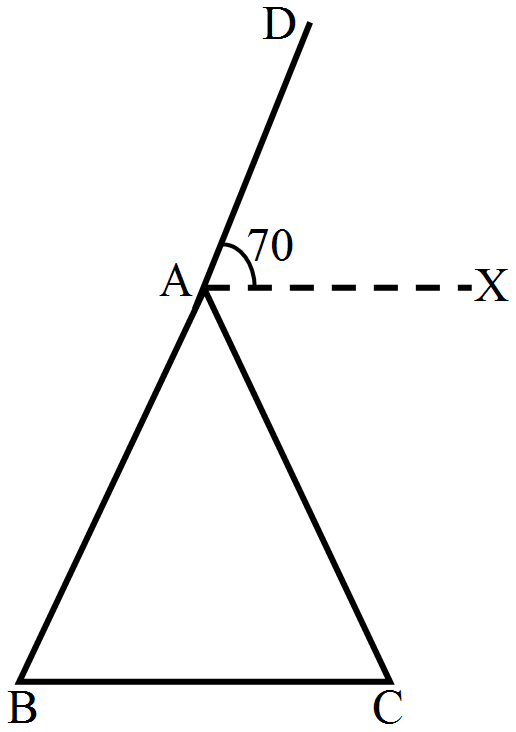
In $\triangle\text{ABC},\angle\text{B}=\angle\text{C}$ and ray $AX$ bisects the exterior angle $\angle\text{DAC}.$ If $\angle\text{DAX}=70^\circ$ then $\angle\text{ACB}=$
  • A
    $35^\circ$
  • B
    $90^\circ$
  • $70^\circ$
  • D
    $55^\circ$
Answer
Correct option: C.
$70^\circ$

$AX$ is bisector of $\angle\text{DAC}.$
$\Rightarrow\angle\text{DAX}=\angle\text{XAC}=70^\circ$
$\Rightarrow\angle\text{DAC}=2\times70^\circ=140^\circ$
Now, $\angle\text{A}=180^\circ-\angle\text{DAC}=180^\circ-140^\circ=40^\circ$
In $\triangle\text{ABC},$
$\angle\text{A}+\angle\text{B}+\angle\text{C}=180^\circ$
$\Rightarrow40^\circ+\angle\text{B}+\angle\text{C}=180^\circ$
$\Rightarrow40^\circ+\angle\text{C}+\angle\text{C}=180^\circ\dots(\angle\text{B}=\angle\text{C})$
$\Rightarrow2\angle\text{C}=140^\circ$
$\Rightarrow\angle\text{C}=70^\circ$
$\text{i.e}\angle\text{ACB}=70^\circ$
View full question & answer
MCQ 61 Mark
The side $BC$ of $\triangle\text{ABC}$ is produced to a poin $D$. The bisector of $\angle\text{A}$ meet side $BC$ in $L$. If $\angle\text{ABC}=30^\circ$ and $\angle\text{ACD}=115^\circ,$ then $\angle\text{ALC}=$
  • A
    $85^\circ$
  • B
    $72\frac{1}{2}^\circ$
  • C
    $145^\circ$
  • $\text{None of these}$
Answer
Correct option: D.
$\text{None of these}$
View full question & answer
MCQ 71 Mark
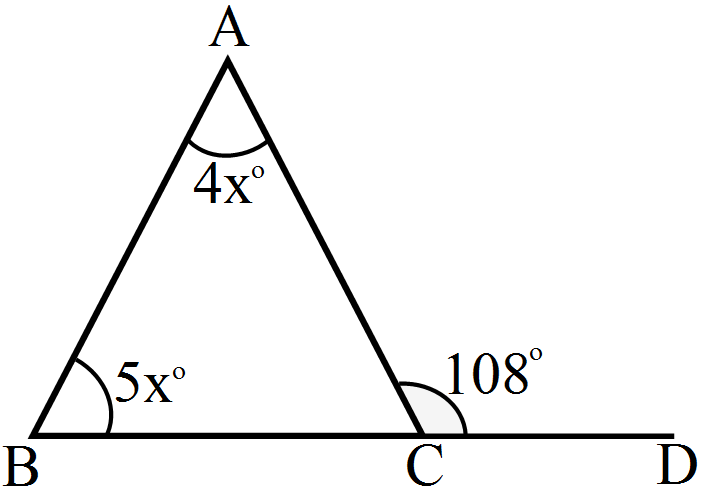
An exterior angle of a triangle is $108^\circ$ and its interior opposite angles are in the ratio $4 : 5$ The angles of the triangle are:
  • $48^\circ , 60^\circ , 72^\circ$
  • B
    $50^\circ , 60^\circ , 70^\circ$
  • C
    $52^\circ , 56^\circ , 72^\circ$
  • D
    $42^\circ , 60^\circ , 76^\circ$
Answer
Correct option: A.
$48^\circ , 60^\circ , 72^\circ$

From figure, we have
$\angle\text{A}+\angle\text{B}=\angle\text{ACD}$
$\Rightarrow4\text{x}^\circ+5\text{x}^\circ=108^\circ$
$\Rightarrow9\text{x}^\circ=108^\circ$
$\Rightarrow\text{x}=12^\circ$
So, $\angle\text{A}=48^\circ,\angle\text{B}=60^\circ$
$\Rightarrow\angle\text{C}=180^\circ-48^\circ-60^\circ=72^\circ$
View full question & answer
MCQ 81 Mark
If one angle of a triangle is equal to the sum of the other two angles, then the triangle is:
  • An isosceles triangle
  • B
    An obtuse triangle
  • C
    An equilateral triangle
  • D
    A right triangle
Answer
Correct option: A.
An isosceles triangle
Let the three angles of a triangle be $A, B$ and $C$.
Now, $A + B + C = 180^\circ$
If $A = B + C$
Then $A + (A) = 180^\circ$
i.e. $2A = 180^\circ$
i.e. $A = 90^\circ$
Since, one of the angle is $90^\circ ,$ the triangle is a Right triangle.
View full question & answer
MCQ 91 Mark
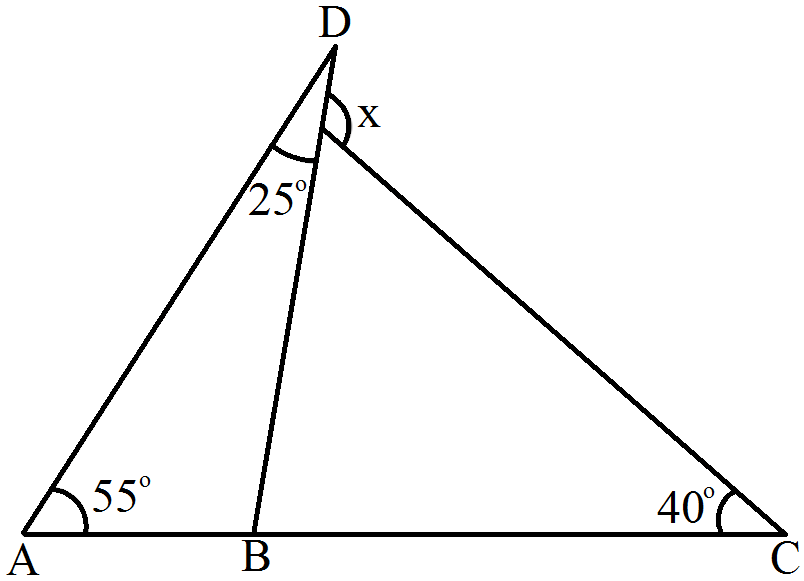
In Fig the value of $x$ is:
  • A
    $65^\circ$
  • B
    $80^\circ$
  • C
    $95^\circ$
  • $120^\circ$
Answer
Correct option: D.
$120^\circ$

In $\triangle\text{ABD}$
$\angle\text{A}+\angle\text{B}+\angle\text{D}=180^\circ$
$\Rightarrow55^\circ+\angle\text{DBA}+25^\circ=180^\circ$
$\Rightarrow\angle\text{DBA}=180^\circ-55^\circ-25^\circ$
$=180^\circ-80^\circ$
$\Rightarrow\angle\text{DBA}=100^\circ$
So, $\angle\text{DBC}=180^\circ-\angle\text{DBA}$
$=180^\circ-100^\circ$
$\Rightarrow\angle\text{DBC}=80^\circ$
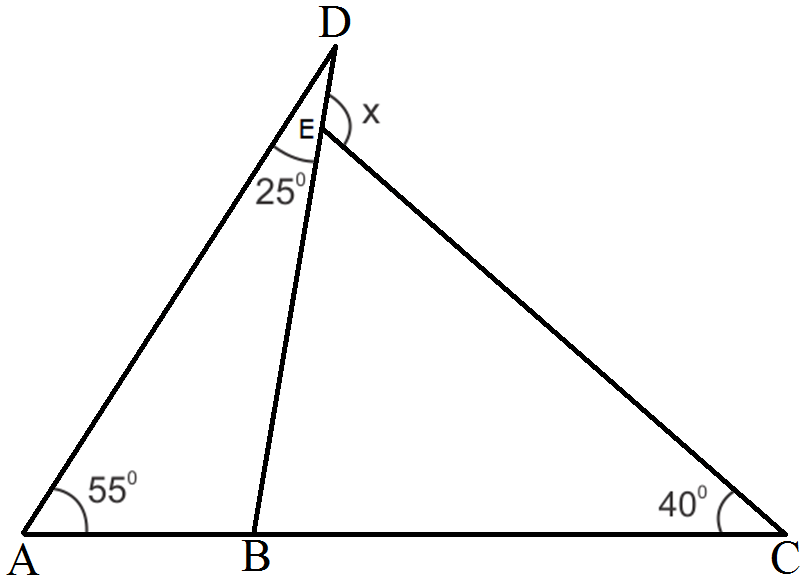
Now, in $\triangle\text{EBC}$
$\angle\text{E}+\angle\text{EBC}+\angle\text{C}=180^\circ$
$\Rightarrow\angle\text{E}+80^\circ+40^\circ=180^\circ$
$\big(\angle\text{DBC}=\angle\text{EBC}\big)$
$\Rightarrow\angle\text{E}=180^\circ-120^\circ=60^\circ$
Also, $\text{x}=180^\circ-\angle\text{E}=180^\circ-60^\circ$
$\Rightarrow\text{x}=120^\circ$
View full question & answer
MCQ 101 Mark
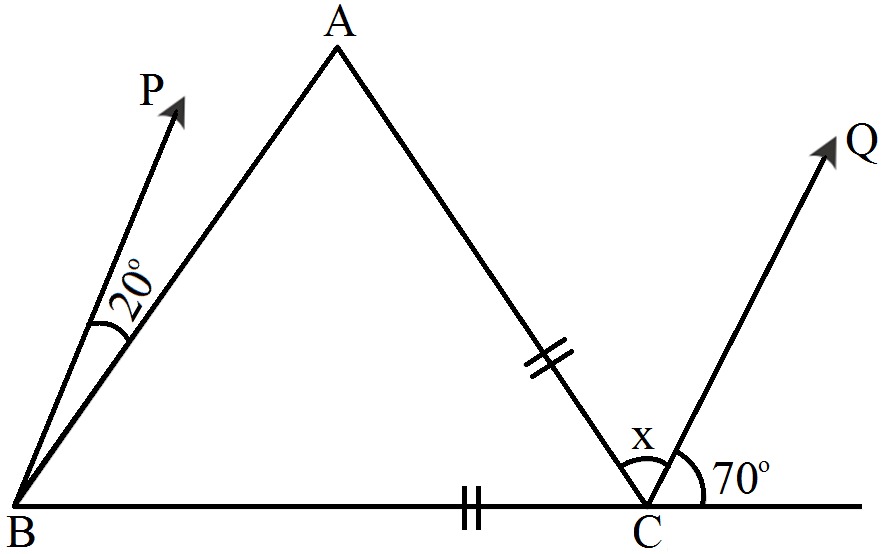
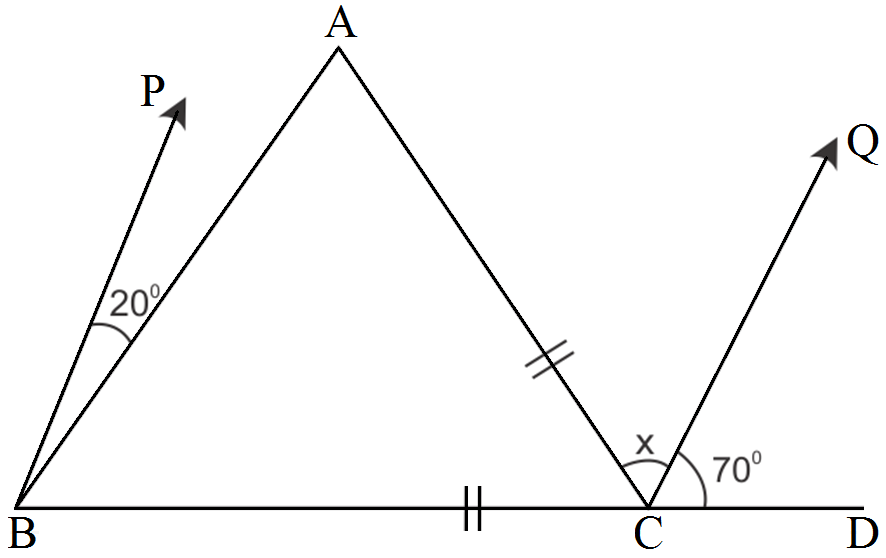
In Fig. if $BP \| CQ$ and $AC = BC,$ then the measure of $x$ is:
  • A
    $20^\circ$
  • B
    $25^\circ$
  • $30^\circ$
  • D
    $35^\circ$
Answer
Correct option: C.
$30^\circ$

$\angle\text{PBC}=\angle\text{QCD} ($Corresponding angles, $OP \| CQ$ and $BC$ is transverse$)$
$\Rightarrow\angle\text{PBC}=70^\circ$
Now, $\angle\text{PBA}+\angle\text{ABC}+\angle\text{PBC}$
$\Rightarrow20^\circ+\angle\text{ABC}=70^\circ$
$\Rightarrow\angle\text{ABC}=50^\circ$
In $\triangle\text{ABC},$
$\angle\text{ABC}+\angle\text{BAC}+\angle\text{ACB}=180^\circ\dots(1)$
Now, $\angle\text{ABC}=\angle\text{BAC}=50^\circ$
$($isosceles $\triangle)$
And, $\angle\text{ACB}=180^\circ-(70^\circ+\text{x})$
From $(1)$
$50^\circ+50^\circ+180^\circ-(70^\circ+\text{x})=180^\circ$
$\Rightarrow\text{x}=30^\circ$
View full question & answer
MCQ 111 Mark
If the measure of angles of a triangle are in the ratio of $3 : 4 : 5,$ what is the measure of the smallest angle of the triangle?
  • A
    $25^\circ$
  • B
    $30^\circ$
  • $45^\circ$
  • D
    $60^\circ$
Answer
Correct option: C.
$45^\circ$
The measures of angles of a triangle are in ratio $3 : 4 : 5.$
Let the angles be $3x, 4x,$ and $5x$.
in any triangle, sum of all angles $= 180^\circ$
$\Rightarrow 3x + 4x + 5x = 180^\circ$
$\Rightarrow 12x = 180^\circ$
$\Rightarrow x = 15^\circ$
So, smallest angle $= 3 \times 15^\circ = 45^\circ$
View full question & answer
MCQ 121 Mark
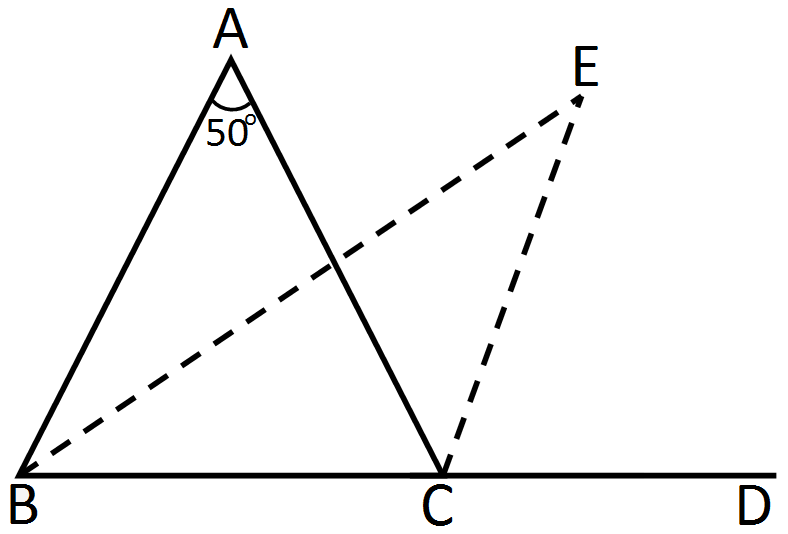
In a $\triangle\text{ABC},\angle\text{A}=50^\circ$ and $BC$ is produced to a point $D$. If the bisectors of $\angle\text{ABC}$ and $\angle\text{ACD}$ meet at $E,$ then $\angle\text{E}=$
  • $25^\circ$
  • B
    $50^\circ$
  • C
    $100^\circ$
  • D
    $75^\circ$
Answer
Correct option: A.
$25^\circ$

$BE$ and $CE$ are bisectors of $\angle\text{B}$ and $\angle\text{ACD}.$
In $\triangle\text{ABC},$
$\angle\text{A}+\angle\text{B}+\angle\text{C}=180^\circ$
$\Rightarrow\angle\text{B}+\angle\text{C}=180^\circ-50^\circ=130^\circ\dots(1)$
Now, in $\triangle\text{BEC}$
$\angle\text{CBE}+\angle\text{BEC}+\angle\text{ECB}=180^\circ\dots(2)$
$\angle\text{CBE}=\frac{\angle\text{B}}{2},\angle\text{BEC}=\angle\text{E},\angle\text{ECB}=\angle\text{C}+\angle\text{ACE}$
Now, $\angle\text{ACD}=180^\circ-\angle\text{C}$
$\angle\text{ACE}=\frac{\angle\text{ACD}}{2}=\frac{180^\circ-\angle\text{C}}{2}=90^\circ-\frac{\angle\text{C}}{2}$
So, $\angle\text{ECB}=\angle\text{C}+90^\circ-\frac{\angle\text{C}}{2}$
$\Rightarrow\angle\text{ECB}=90^\circ+\frac{\angle\text{C}}{2}$
Now putting all value in eq $(2)$
$\frac{\angle\text{B}}{2}+\angle\text{E}+90^\circ+\frac{\angle\text{C}}{2}=180^\circ$
$\Rightarrow\angle\text{E}=180^\circ-90^\circ-\Big(\frac{\angle\text{B}+\angle\text{C}}{2}\Big)$
$=90^\circ-\Big(\frac{\angle\text{B}+\angle\text{C}}{2}\Big)$
$=90^\circ-\frac{130^\circ}{2}\ [$From eq $(1)]$
$\Rightarrow\angle\text{E}=25^\circ$
View full question & answer
MCQ 131 Mark
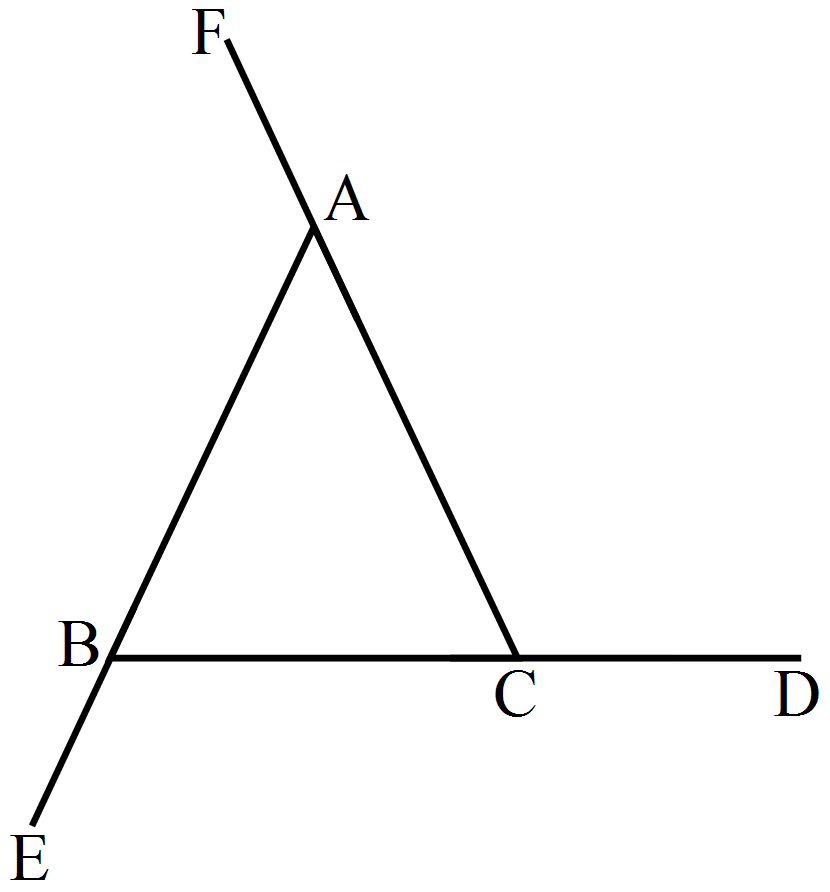
If the sides of a triangle are produced in order, then the sum of the three exterior angles so formed is:
  • A
    $90^\circ$
  • B
    $180^\circ$
  • C
    $270^\circ$
  • $360^\circ$
Answer
Correct option: D.
$360^\circ$

In $\triangle\text{ABC},$
$\angle\text{A}+\angle\text{B}+\angle\text{C}=180^\circ$
Now, $\angle\text{FAB}=180^\circ-\angle\text{A}\dots(1)$
$\angle\text{DCA}=180^\circ-\angle\text{C}\dots(2)$
$\angle\text{EBC}=180^\circ-\angle\text{B}\dots(3)$
Adding equation $(1), (2)$ and $(3) \angle\text{FAB}+\angle\text{DCA}+\angle\text{EBC}$
$=180^\circ-\angle\text{A}+180^\circ-\angle\text{C}+180^\circ-\angle\text{B}$
$=540^\circ-(\angle\text{A}+\angle\text{B}+\angle\text{C})$
$=540^\circ-180^\circ$
$\Rightarrow$ Sum of all exterior angles $= 360^\circ$
View full question & answer
MCQ 141 Mark
The bisects of exterior angles at $B$ and $C$ of $\triangle\text{ABC}$ meet at $O$. If $\angle\text{A}=\text{x}^\circ,$ then $\angle\text{BOC}=$
  • A
    $90^\circ+\frac{\text{x}^\circ}{2}$
  • $90^\circ-\frac{\text{x}^\circ}{2}$
  • C
    $180^\circ+\frac{\text{x}^\circ}{2}$
  • D
    $180^\circ-\frac{\text{x}^\circ}{2}$
Answer
Correct option: B.
$90^\circ-\frac{\text{x}^\circ}{2}$

In $\triangle\text{ABC},$
$\angle\text{A}+\angle\text{B}+\angle\text{C}=180^\circ$
$\Rightarrow\angle\text{B}+\angle\text{C}=180^\circ-\text{x}^\circ\dots(1)$
$\Rightarrow\angle\text{CBD}=180^\circ-\angle\text{B}\dots(2)$
$\Rightarrow\angle\text{ECB}=180^\circ-\angle\text{C}\dots(3)$
$\Rightarrow\frac{\angle\text{CBD}}{2}=\angle\text{OBC}=90^\circ-\frac{\angle\text{B}}{2}\dots(4)\ [$frpom eq $(2)]$
$\frac{\angle\text{ECB}}{2}=\angle\text{OCB}=90^\circ-\frac{\angle\text{C}}{2}\dots(5)$
Now, in $\triangle\text{BOC}$
$\angle\text{OBC}+\angle\text{OCB}+\angle\text{BOC}=180^\circ$
$\Rightarrow\angle\text{BOC}=180^\circ-(\angle\text{OBC}+\angle\text{OCB})$
From eq $(4)$ and $(5),$
$\angle\text{BOC}=180^\circ-\Big(90^\circ-\frac{\angle\text{B}}{2}+90^\circ-\frac{\angle\text{C}}{2}\Big)$
$=180^\circ-\Big(180^\circ-\frac{\angle\text{B}}{2}-\frac{\angle\text{C}}{2}\Big)$
$=\Big(\frac{\angle\text{B}+\angle\text{C}}{2}\Big)\ [$from eq $(1)]$
$=\frac{180^\circ-\text{x}^\circ}{2}$
$\Rightarrow\angle\text{BOC}=90^\circ-\frac{\text{x}^\circ}{2}$
View full question & answer
MCQ 151 Mark
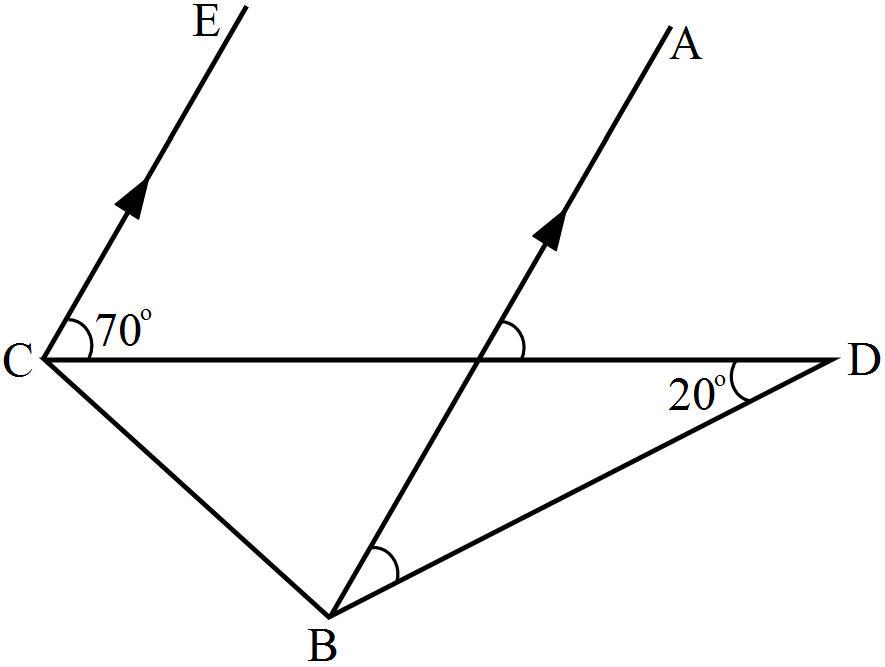
In Fig. if $\text{EC }\|\text{ AB},\angle\text{ECD}=70^\circ$ and $\angle\text{ECD}=70^\circ$ and $\angle\text{BDO}=20^\circ,$ then $\angle\text{OBD}$ is:
  • A
    $20^\circ$
  • $50^\circ$
  • C
    $60^\circ$
  • D
    $70^\circ$
Answer
Correct option: B.
$50^\circ$
$EC \| AB$ And, $CD$ is transverse to it.
Now $\angle\text{ECD}=\angle\text{AOD}=70^\circ\ ($Corresponding angles$)$
In $\triangle\text{OBD}$
$\angle\text{OBD}+\angle\text{BOD}+\angle\text{ODB}=180^\circ$
$\angle\text{BOD}=180^\circ-\angle\text{AOD}=180^\circ-70^\circ=110^\circ$
So $\angle\text{OBD}=180^\circ-\angle\text{BOD}-\angle\text{ODB}$
$=180^\circ-110^\circ-20^\circ$
$=50^\circ$
View full question & answer
MCQ 161 Mark
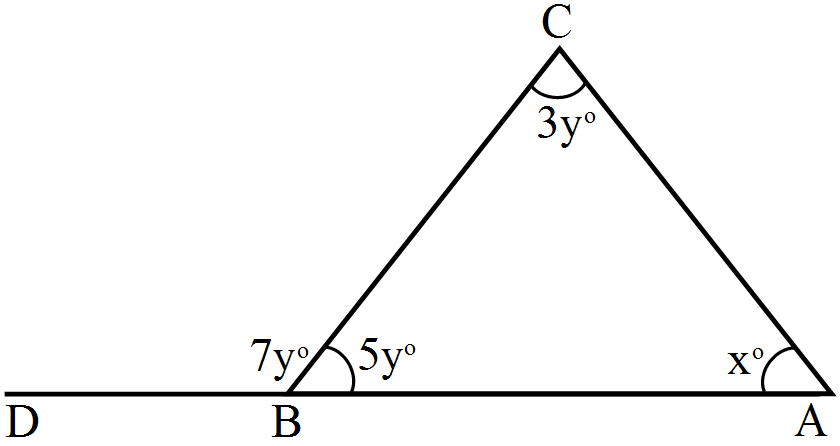
In Fig. what is the value of $x$?
  • A
    $35^\circ$
  • B
    $45^\circ$
  • C
    $50^\circ$
  • $60^\circ$
Answer
Correct option: D.
$60^\circ$
In $\triangle\text{ABC},$
$\angle\text{BCA}+\angle\text{CAB}+\angle\text{ABC}=180^\circ$
$\Rightarrow3\text{y}^\circ+\text{x}^\circ+5\text{y}^\circ=180^\circ$
$\Rightarrow8\text{y}^\circ+\text{x}^\circ=180^\circ\dots(1)$
Also, $5\text{y}^\circ=180^\circ-7\text{y}^\circ$
$\Rightarrow12\text{y}^\circ=180^\circ$
$\Rightarrow\text{y}^\circ=15^\circ$
From $(1), \text{x}^\circ=180^\circ-8\text{y}^\circ$
$\Rightarrow\text{x}^\circ=180^\circ-8\times15^\circ$
$\Rightarrow\text{x}^\circ=60^\circ$
View full question & answer
MCQ 171 Mark
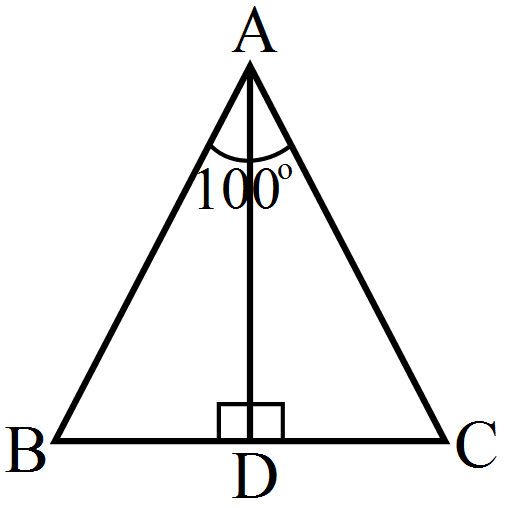
In $\triangle\text{ABC},$ if $\angle\text{A}=100^\circ,\text{AD}$ bisects $\angle\text{A}$ and $\text{AD}\perp\text{BC}.$ Then, $\angle\text{B}=$
  • A
    $50^\circ$
  • B
    $90^\circ$
  • $40^\circ$
  • D
    $100^\circ$
Answer
Correct option: C.
$40^\circ$

$\text{AD}\perp\text{BC}$ and $AD$ bisects $\angle\text{A}.$
$\Rightarrow\angle\text{BAD}=\angle\text{CAD}=50^\circ$
In Right $\triangle\text{ADB}$
$\angle\text{BAD}=50^\circ,\angle\text{ADB}=90^\circ$
Also sum of all interior angles $= 180^\circ$
$\Rightarrow\angle\text{BAD}+\angle\text{ADB}+\angle\text{B}=180^\circ$
$\Rightarrow\angle\text{B}=180^\circ-50^\circ-90^\circ$
$\Rightarrow\angle\text{B}=40^\circ$
View full question & answer
MCQ 181 Mark
In a triangle, an exterior angle at a vertex is $95^\circ$ and its one of the interior opposite angle is $55^\circ ,$ then the measure of the other interior angle is:
  • A
    $55^\circ$
  • B
    $85^\circ$
  • $40^\circ$
  • D
    $9.0^\circ$
Answer
Correct option: C.
$40^\circ$
Let the other interior opposite angle be $x^\circ .$
Then, we have
$x^\circ + 55^\circ = 95^\circ$
$\Rightarrow x^\circ = 95^\circ - 55^\circ = 40^\circ$
View full question & answer
MCQ 191 Mark
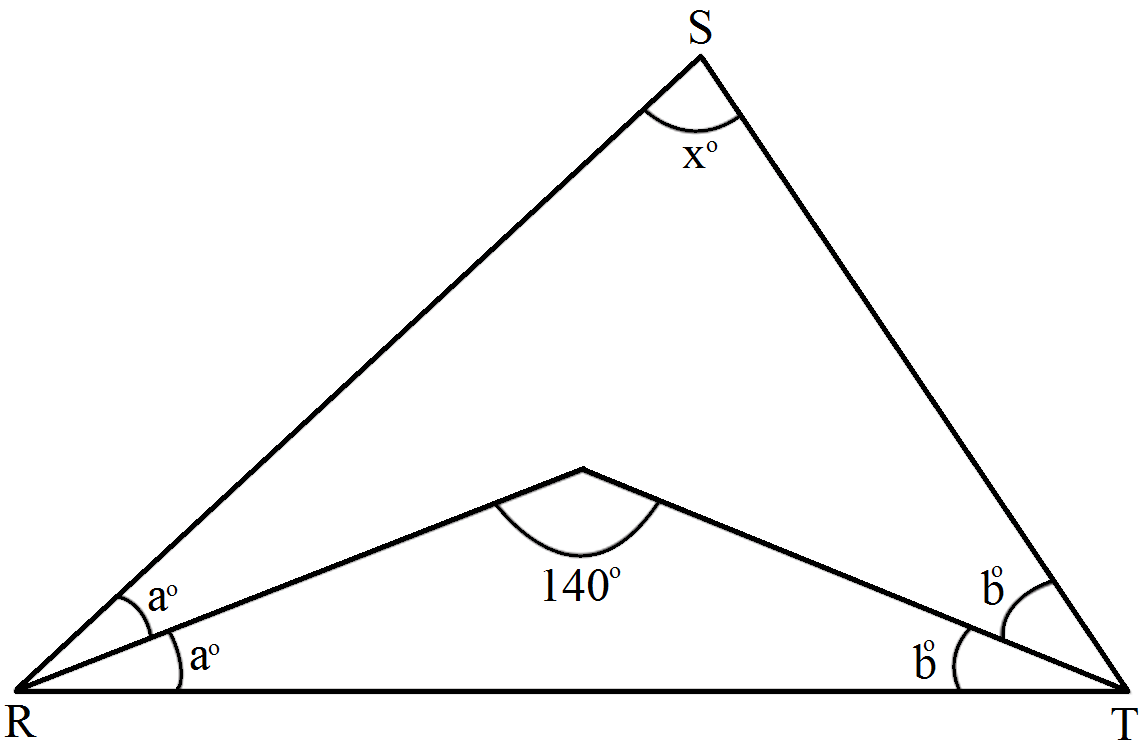
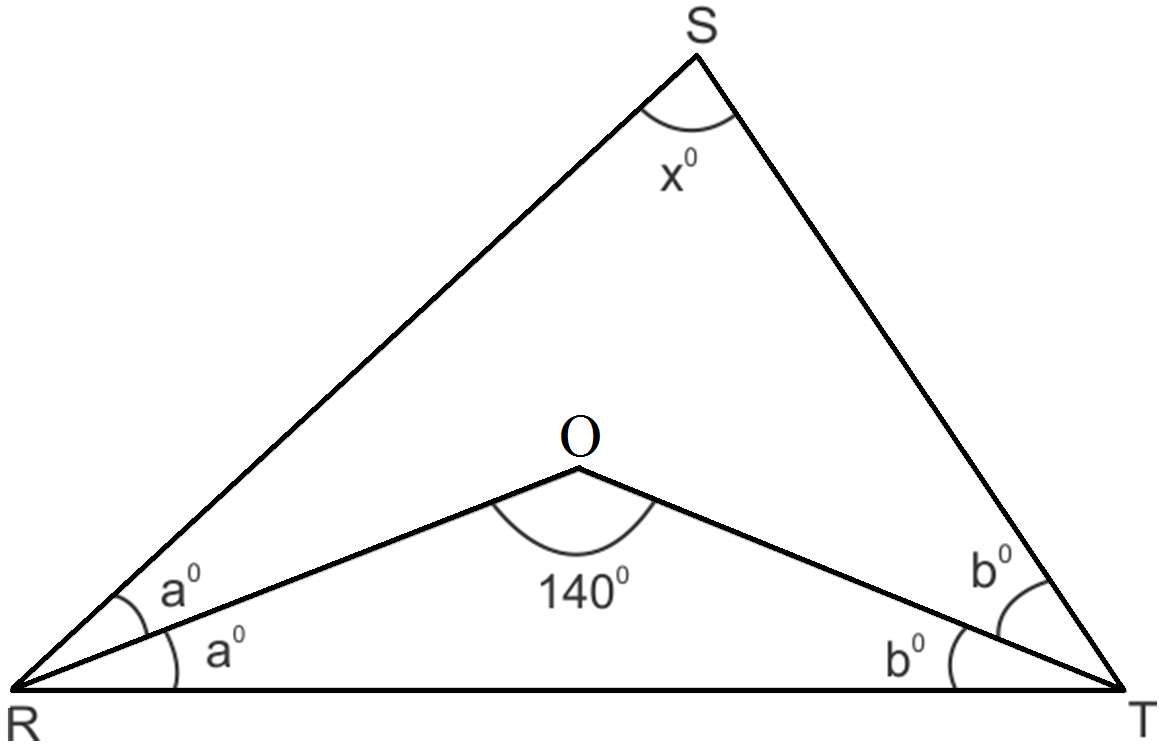
In $\triangle\text{RST}$ what is the value of $x$ ?
  • A
    $40^\circ$
  • B
    $90^\circ$
  • C
    $80^\circ$
  • $100^\circ$
Answer
Correct option: D.
$100^\circ$

In $\triangle\text{RST}$
$\angle\text{R}+\angle\text{S}+\angle\text{T}=180^\circ$
$\Rightarrow2\text{a}^\circ+\text{x}^\circ+2\text{b}^\circ=180^\circ$
$\Rightarrow\text{x}^\circ=180^\circ-2(\text{a}+\text{b})^\circ\dots(1)$
Now in $\triangle\text{ROT}$
$\angle\text{ORT}+\angle\text{ROT}+\angle\text{OTR}=180^\circ$
$\Rightarrow\text{a}^\circ+140^\circ+\text{b}^\circ=180^\circ$
$\Rightarrow(\text{a}+\text{b})^\circ=180^\circ-140^\circ=40^\circ\dots(2)$
From $(1)$ and $(2)$
$\text{x}^\circ=180^\circ-2(40^\circ)$
$\Rightarrow\text{x}=100^\circ$
View full question & answer
MCQ 201 Mark
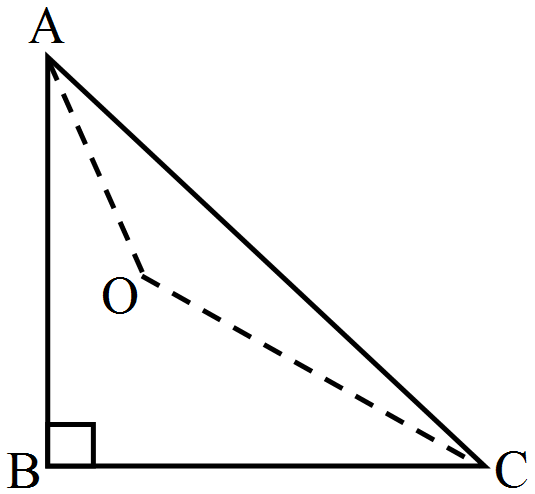
If the bisectors of the acute angles of a right triangle meet at $O,$ then the angle at $O$ between the two bisectors is:
  • A
    $45^\circ$
  • B
    $95^\circ$
  • $135^\circ$
  • D
    $90^\circ$
Answer
Correct option: C.
$135^\circ$

In $\triangle\text{ABC},$
$\angle\text{A}+\angle\text{B}+\angle\text{C}=180^\circ$
$\Rightarrow\angle\text{A}+90^\circ+\angle\text{C}=180^\circ$
$\Rightarrow\angle\text{A}+\angle\text{C}=90^\circ\dots(1)$
Now, in $\triangle\text{AOC},$
$\angle\text{COA}+\angle\text{OAC}+\angle\text{OCA}=180^\circ$
$\Rightarrow\angle\text{COA}+\frac{\angle\text{A}}{2}+\frac{\angle\text{C}}{2}=180^\circ [AO$ and $CO$ bisects angle $\angle\text{A}$ and $\angle\text{C}]$
$\Rightarrow\angle\text{COA}=180-\Big(\frac{\angle\text{A}+\angle\text{C}}{2}\Big)$
$=180^\circ-\Big(\frac{90^\circ}{2}\Big) [$From $(1)]$
$=100^\circ-45^\circ$
$=135^\circ$
View full question & answer
MCQ 211 Mark
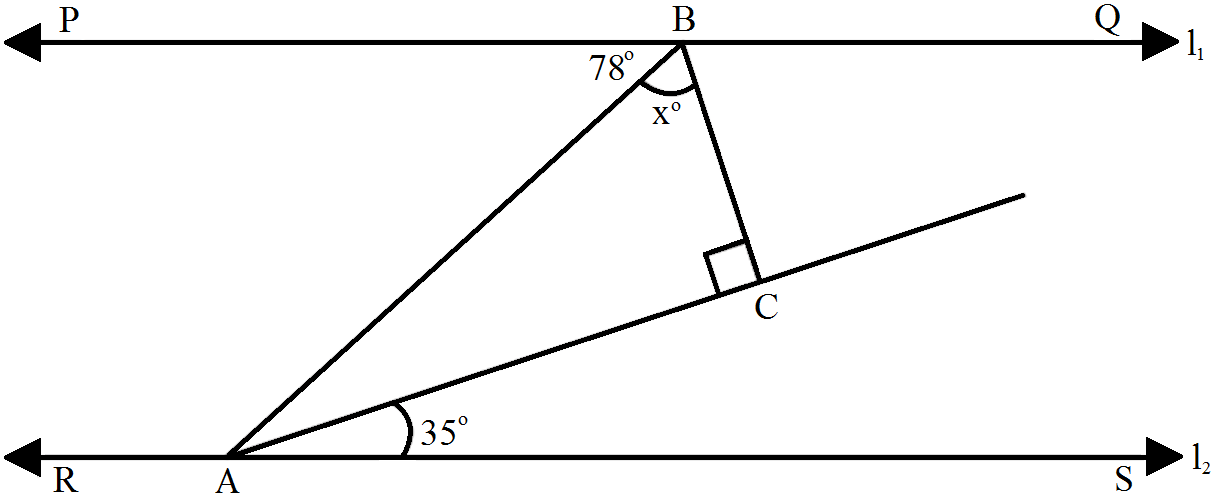
In Fig. for which value of $x$ is $l_1 \| l_2$?
  • A
    $37^{\circ}$
  • B
    $43^{\circ}$
  • C
    $45^{\circ}$
  • $47^{\circ}$
Answer
Correct option: D.
$47^{\circ}$
Let if $l_1 \| l_2$ and $AB$ is tranverse to it.Then,
$\angle\text{PBA}$ should be equal $\angle\text{BAS} ($Alternate angles$)$
So if $l_1 \| l_2$, then $\angle\text{BAS}=70^\circ$
$\Rightarrow\angle\text{BAC}=78^\circ-35^\circ=43^\circ\dots(1)$
Now, in $\triangle\text{ABC}$
$\text{x}^\circ+\angle\text{C}+\angle\text{BAC}=180^\circ$
$\Rightarrow\text{x}^\circ+90^\circ+43^\circ=180^\circ$
$\Rightarrow\text{x}^\circ=180^\circ-90^\circ-43^\circ=47^\circ$
$\Rightarrow\text{x}^\circ=47^\circ$
So if $x^{\circ}=47^{\circ}$ then $I_1 \| I_2$
View full question & answer
MCQ 221 Mark
An exterior angle of a triangle is equal to $100^\circ$ and two interrior opposite angles are equal. Each of these angles is equal to:
  • A
    $75^\circ$
  • B
    $80^\circ$
  • C
    $40^\circ$
  • $50^\circ$
Answer
Correct option: D.
$50^\circ$
Let the two interior opposite angles be $x^\circ$ each.
Now, the exterior angle is equal to the sum of the two interior opposite angles.
$x^\circ + x^\circ = 180^\circ$
$\Rightarrow 2x^\circ = 100^\circ$
$\Rightarrow x^\circ = 50^\circ$
View full question & answer
MCQ 231 Mark
Side $BC$ of a triangle $\text{ABC}$ has been produced to a point $D$ such that $\angle\text{ACD}=120^\circ.$ If $\angle\text{B}=\frac{1}{2}\angle\text{A},$ then $\angle\text{A}$ is equal to :
  • $80^\circ$
  • B
    $75^\circ$
  • C
    $60^\circ$
  • D
    $90^\circ$
Answer
Correct option: A.
$80^\circ$
$\angle\text{B}=\frac{1}{2}\ \angle\text{A}$
$\angle\text{ACD}$ is an exterior angle.
$\Rightarrow\angle\text{A}+\angle\text{B}=\angle\text{ACD}$
$\Rightarrow\angle\text{A}=\frac{1}{2}\angle\text{A}=120^\circ$
$\Rightarrow\frac{3\angle\text{A}}{2}=120^\circ$
$\Rightarrow3\angle\text{A}=240^\circ$
$\Rightarrow\angle\text{A}=80^\circ$
View full question & answer
MCQ 241 Mark
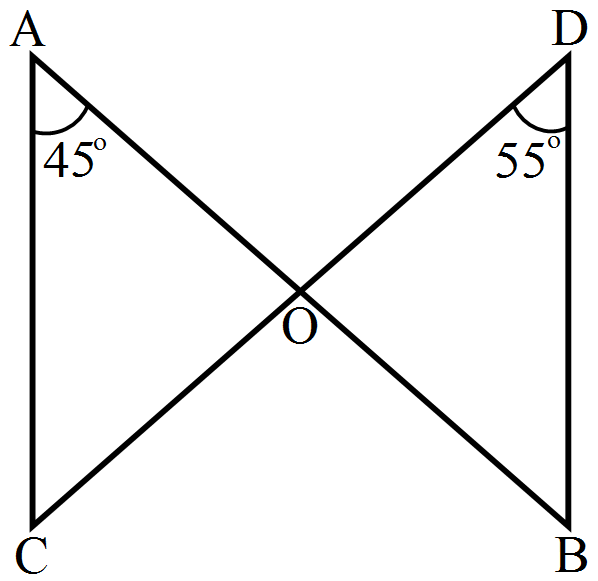
Line segments $AB$ and $CD$ intersect at $O$ such that $AC \| DB$. If $\angle\text{CAB}=45^\circ$ and $\angle\text{CDB}=55^\circ,$ then $\angle\text{BOD}=$
  • A
    $100^\circ$
  • $80^\circ$
  • C
    $90^\circ$
  • D
    $135^\circ$
Answer
Correct option: B.
$80^\circ$

$AC \| BD$
And, $AB$ is transverse to these parallal lines
So $\angle\text{CAB}=\angle\text{ABD} \ ($Alternate angles$)$
$\Rightarrow\angle\text{ABD}=45^\circ$
Now In $\triangle\text{BOD}$
$\angle\text{BOD}+\angle\text{ODB}+\angle\text{DBA}=180^\circ$
$\angle\text{DBA}=\angle\text{ABD}=45^\circ,\angle\text{ODB}=55^\circ$
So $\angle\text{BOD}=180^\circ-45^\circ-55^\circ$
$=80^\circ$
View full question & answer
MCQ 251 Mark
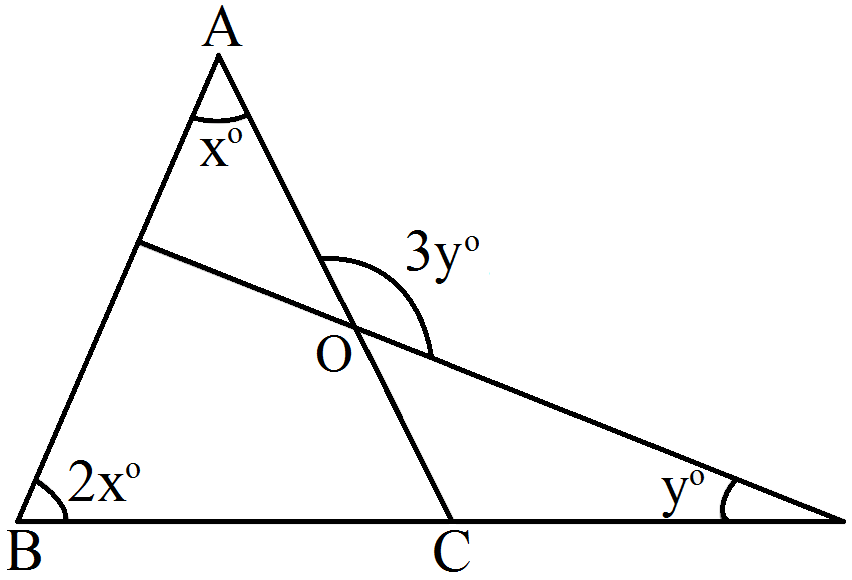
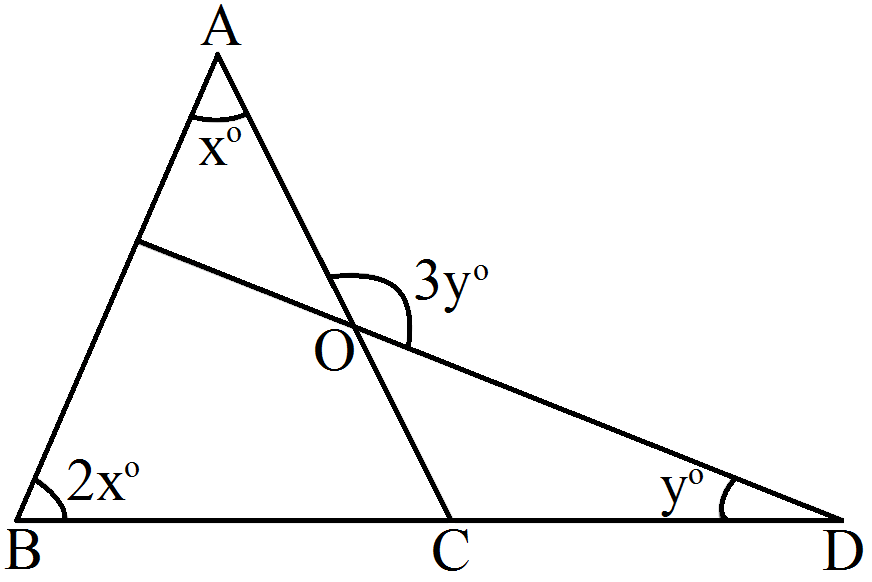
In Fig. what is $y$ in terms of $x$?
  • $\frac{3}{2}\text{x}^\circ$
  • B
    $\frac{4}{3}\text{x}^\circ$
  • C
    $\text{x}^\circ$
  • D
    $\frac{3}{4}\text{x}^\circ$
Answer
Correct option: A.
$\frac{3}{2}\text{x}^\circ$

From figure,
$\angle\text{DOC}=180^\circ-\angle\text{AOD} \ ($Both are Supplementary$)$
$\Rightarrow\angle\text{DOC}=180^\circ-3\text{y}^\circ$
Also, $\angle\text{ACB}=180^\circ-\angle\text{A}-\angle\text{B}$
$\Rightarrow\angle\text{ACB}=180^\circ-\text{x}^\circ-2\text{x}^\circ=180^\circ-3\text{x}^\circ$
And $\angle\text{ACD}=180^\circ-\angle\text{ACB}$
$=180^\circ-(180^\circ-3\text{x}^\circ)$
$\Rightarrow\angle\text{ACD}=3\text{x}^\circ$
Now, in $\triangle\text{OCD}$
$\angle\text{DOC}+\angle\text{OCD}+\angle\text{D}=180^\circ$
$180^\circ-3\text{y}^\circ+3\text{x}^\circ+\text{y}^\circ=180^\circ$
$\big[\angle\text{OCD}=\angle\text{ACD}\big]$
$\Rightarrow2\text{y}^\circ=3\text{x}^\circ$
$\Rightarrow\text{y}=\frac{3}{2}\text{x}^\circ$
View full question & answer
MCQ 261 Mark
If all the three angles of a triangle are equal, then each one of them is equal to:
  • A
    $90^\circ$
  • B
    $45^\circ$
  • $60^\circ$
  • D
    $30^\circ$
Answer
Correct option: C.
$60^\circ$
Let the measure of each angle be $ x^\circ .$
Now, the sum of all angles of any triangle is $180^\circ .$
Thus $, x^\circ + x^\circ + x^\circ = 180^\circ$
i.e. $3x^\circ = 180^\circ$
i.e. $ x^\circ = 60^\circ$
View full question & answer
MCQ 271 Mark
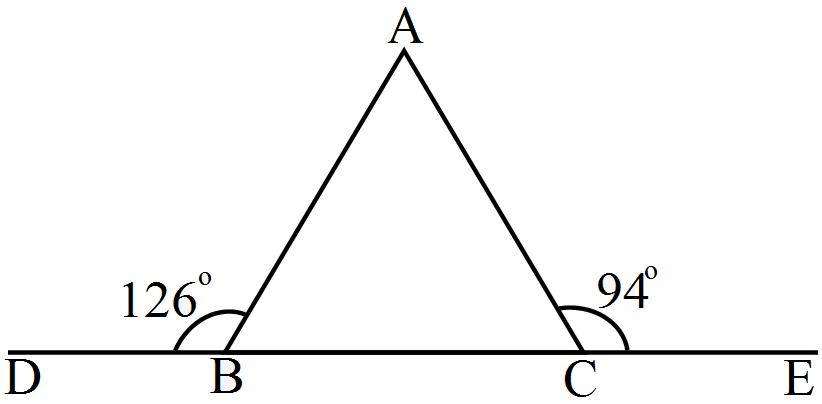
The base $BC$ of triangle $\text{ABC}$ is produced both ways and the measure of exterior angles formed are $94^\circ$ and $126^\circ$ . Then, $\angle\text{BAC}=$
  • A
    $94^\circ$
  • B
    $54^\circ$
  • $40^\circ$
  • D
    $44^\circ$
Answer
Correct option: C.
$40^\circ$

$\angle\text{ABC}=180^\circ-126^\circ=54^\circ$
$\angle\text{ACB}=180^\circ-94^\circ=86^\circ$
Now, in $\triangle\text{ABC}$
$\angle\text{BAC}+\angle\text{ABC}+\angle\text{ACB}=180^\circ$
$\Rightarrow\angle\text{BAC}=180^\circ-\angle\text{ABC}-\angle\text{ACB}$
$=180^\circ-54^\circ-86^\circ$
$\Rightarrow\text{BAC}=40^\circ$
View full question & answer
MCQ 281 Mark
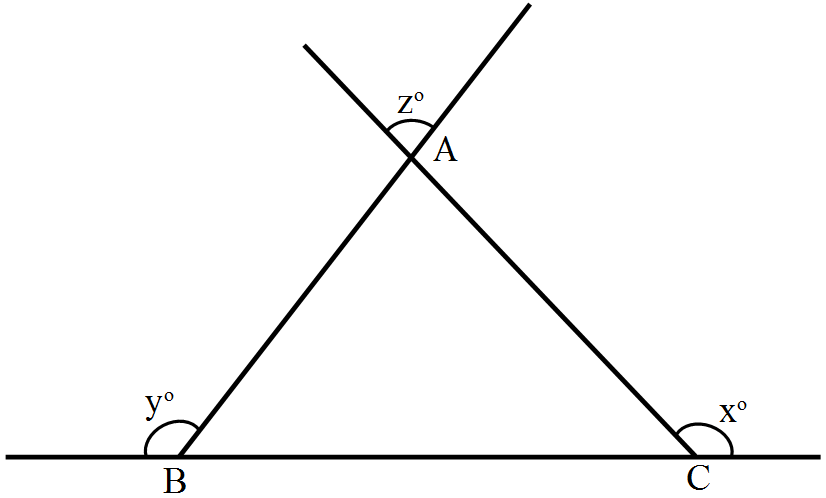
In Fig. what is $z$ in terms of $ x$ and $y$ ?
  • A
    $x + y + 180^\circ$
  • $x + y - 180^\circ$
  • C
    $180^\circ - (x + y)$
  • D
    $x + y + 360^\circ$
Answer
Correct option: B.
$x + y - 180^\circ$
From figure
$\angle\text{A}=\text{z}^\circ$
$\angle\text{ACB}=180^\circ-\text{x}^\circ$
$\angle\text{ABC}=180^\circ-\text{y}^\circ$
Now, in $\triangle\text{ABC}$
$\angle\text{A}+\angle\text{B}+\angle\text{C}=180^\circ$
$\Rightarrow\text{z}^\circ+180^\circ-\text{y}^\circ+180^\circ-\text{x}^\circ=180^\circ$
$\Rightarrow\text{z}^\circ=\text{x}^\circ+\text{y}^\circ-180^\circ$
View full question & answer
MCQ 291 Mark
If two acute angles of a right triangle are equal, then each acute is equal to:
  • A
    $30^\circ$
  • $45^\circ$
  • C
    $60^\circ$
  • D
    $90^\circ$
Answer
Correct option: B.
$45^\circ$
Let the measure of each acute angle of a triangle be $x^\circ$ .
Then, we have
$x^\circ + x^\circ + 90^\circ = 180^\circ$
i.e. $2x^\circ = 90^\circ$
i.e. $ x^\circ = 45^\circ$
View full question & answer
MCQ 301 Mark
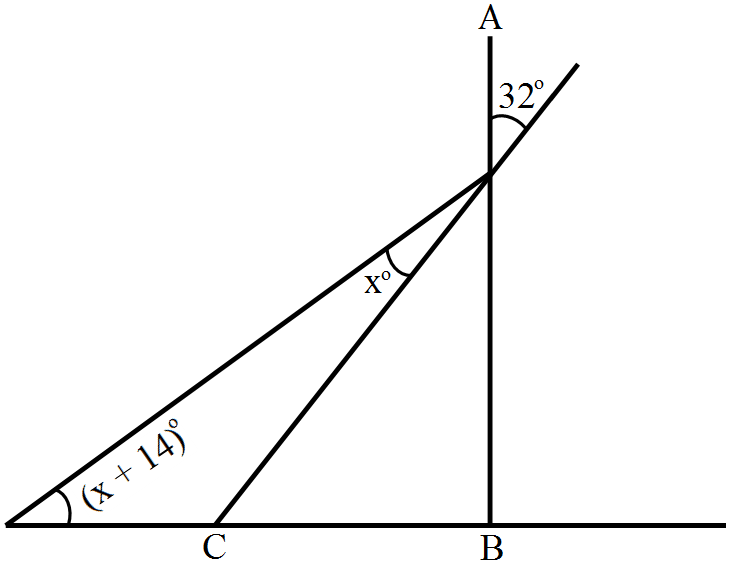
In Fig. if $\text{AB}\perp\text{BC},$ then $x =$
  • A
    $18^\circ$
  • $22^\circ$
  • C
    $25^\circ$
  • D
    $32^\circ$
Answer
Correct option: B.
$22^\circ$
$\text{AB}\perp\text{BC}$
$\Rightarrow\angle\text{ABC}=90^\circ$
$\angle\text{CAB}=32^\circ\ ($Opposite angles$)$
Now, in $\triangle\text{ABD}$
$\angle\text{DAB}=\text{x}^\circ+32^\circ$
$\angle\text{ABD}=90^\circ$
$\angle\text{BDA}=\text{x}^\circ+14^\circ$
In a $\triangle,$ sum of all angles $= 180^\circ$
$\Rightarrow\angle\text{DAB}+\angle\text{ABD}+\angle\text{BDA}=180^\circ$
$\Rightarrow\text{x}^\circ+32^\circ+90^\circ+\text{x}^\circ+14^\circ=180^\circ$
$\Rightarrow2\text{x}^\circ=180^\circ-136^\circ$
$\Rightarrow2\text{x}^\circ=44^\circ$
$\Rightarrow\text{x}^\circ=22^\circ$
View full question & answer