Question 11 Mark
On a card-sheet, draw a triangle of sides 4 cm, 3 cm and 2 cm. Cut it out. Make 13 more copies of the triangle and cut them out from the card sheet. Note that all these triangular pieces are congruent. Arrange them as shown in the following figure and make three triangles out of them.
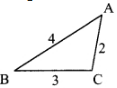
Number of triangle: 1
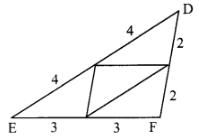
Number of triangles: 4
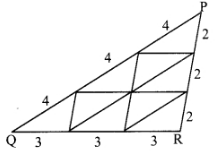
Number of triangles: 9
∆ABC and ∆DEF are similar in the correspondence ABC ↔ DEF.
∠A ≅ ∠D, ∠B ≅ ∠E, ∠C ≅ ∠F
and $\frac{ AB }{ DE }=\frac{4}{8}=\frac{1}{2} ; \frac{ BC }{ EF }=\frac{3}{6}=\frac{1}{2} ; \frac{ AC }{ DF }=\frac{2}{4}=\frac{1}{2} \ldots$ the corresponding sides are inproportion.
Similarly, consider ∆DEF and ∆PQR. Are their angles congruent and sides proportional in the correspondence DEF ↔ PQR?
Answer
View full question & answer→Yes.
∠D ≅ ∠P, ∠E ≅ ∠Q, ∠F ≅ ∠R
$\frac{ DE }{ PQ }=\frac{8}{12}=\frac{2}{3} ; \frac{ EF }{ QR }=\frac{6}{9}=\frac{2}{3} ; \frac{ DF }{ PR }=\frac{4}{6}=\frac{2}{3}$
∠D ≅ ∠P, ∠E ≅ ∠Q, ∠F ≅ ∠R
$\frac{ DE }{ PQ }=\frac{8}{12}=\frac{2}{3} ; \frac{ EF }{ QR }=\frac{6}{9}=\frac{2}{3} ; \frac{ DF }{ PR }=\frac{4}{6}=\frac{2}{3}$