Questions

4 Mark Question

Take a timed test

4 questions · self-marked practice — reveal the answer and mark yourself.

Question 14 Marks
Verify that the equation $‘sin2 \theta + cos2 \theta = 1’$ is true when $\theta = 0^\circ$ or $\theta = 90^\circ.$
Answer
$sin^2 \theta + cos^2 \theta = 1$
i. lf $\theta = 0^\circ,$
LH.S. $= sin^2 \theta + cos^2 \theta$
$= sin^2 0^\circ + cos^2 0^\circ$
$= 0 + 1 …[\because sin 0^\circ = 0, cos 0^\circ = 1]$
$= R.H.S.$
$\therefore sin^2 \theta + cos^2 \theta = 1ii. If \theta = 90^\circ,$
L.H.S.=$ sin^2 \theta +cos^2 \theta$
$= sin^2 90^\circ + cos^2 90^\circ$
$= 1 + 0 … [ \because sin 90^\circ = 1, cos 90^\circ = 0]$
$= 1$
= R.H.S.
$\therefore sin^2 \theta + cos^2 \theta = 1$
View full question & answer
Question 24 Marks
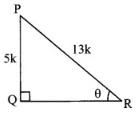
In right angled $\triangle P Q R, \angle Q=90^{\circ}, \angle R=\theta$ and if $\sin \theta=\frac{5}{13}$, then find $\cos \theta$ and $\tan \theta$,
Answer
Take the given trigonometric ratio as 13 k equation (i).
$\sin \theta=\frac{5}{13} \ldots \text { i) [Given] }$
By using the definition write the trigonometric ratio of $\sin O$ and take it as equation (ii).
In right angled $\triangle P Q R, \angle R=\theta$
Image
$\sin \theta=\frac{\text { Opposite side of } \theta}{\text { Hypotenuse }}$
$\therefore  \sin \theta=\frac{P Q}{P R}$
$\therefore  \frac{P Q}{P R}=\frac{5}{13}$
...[From (i) and (ii)]
Let the common multiple be $k$.
$\therefore P Q=5 k \text { and } P R=13 k$
Find $Q R$ by using Pythagoras theorem.
$PR ^2= PQ ^2+ QR ^2 \ldots$ [Pythagoras theorem]
$\therefore(13 k)^2=(5 k)^2+Q R^2$
$\therefore 169 k^2=25 k^2+Q R^2$
$\therefore Q R^2=169 k^2-25 k^2$
$=144 k^2$
$\therefore Q R=\sqrt{144 k^2} \ldots$ [Taking square root of both sides]
$=12 k$
$\therefore \quad \cos \theta=\frac{\text { Adjacent side of } \theta}{\text { Hypotenuse }}=\frac{Q R}{P R}=\frac{12 k}{13 k}=\frac{12}{13}$
$\tan \theta=\frac{\text { Opposite side of } \theta}{\text { Adjacent side of } \theta}=\frac{P Q}{Q R}=\frac{5 k}{12 k}=\frac{5}{12}$
View full question & answer
Question 34 Marks
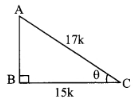
If $\cos \theta=\frac{15}{17}$, then find $\sin \theta$.
Answer
$\cos \theta=\frac{15}{17} \ldots \text {.. (i) [Given] }$
$\text { In right angled } \triangle ABC \text {, }$
$\angle C=\theta .$
Image
$\cos \theta=\frac{\text { Adjacent side of } \theta}{\text { Hypotenuse }}$
$\therefore \quad \cos \theta=\frac{ BC }{ AC } \ldots \text { (ii) }$
$\therefore \quad \frac{ BC }{ AC }=\frac{15}{17}$
Let the common multiple be k.
$\therefore B C=15 k \text { and } A C=17 k$
Now, $AC ^2= AB ^2+ BC ^2 \ldots$ [Pythagoras theorem]
$\therefore(17 k)^2=A B^2+(15 K)^2$
$\therefore 289 k^2=A B^2+225^2$
$\therefore AB^2=289 k^2-225 k^2$
$=64 k^2$
$\therefore AB =\sqrt{64 k^2} \ldots[\text { Taking square root of both sides] }$
$=8 k$
$\therefore \quad \sin \theta=\frac{\text { Opposite side of } \theta}{\text { Hypotenuse }}=\frac{ AB }{ AC }=\frac{8 k }{17 k }=\frac{8}{17}$
View full question & answer
Question 44 Marks
If $\sin \theta=\frac{4}{5}$, then find $\cos \theta$.
Answer
$\sin \theta=\frac{4}{5} \ldots$. (i) [Given]
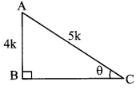
In right angled $\triangle ABC$,
$\angle C=\theta \text {. }$
Image
$\sin \theta=\frac{\text { Opposite side of } \theta}{\text { Hypotenuse }}$
$\therefore \quad \sin \theta=\frac{ AB }{ AC } \ldots \text { (ii) }$
$\therefore \quad \frac{ AB }{ AC }=\frac{4}{5}$
Let the common multiple be k.
$\therefore AB = 4k$ and $AC = 5k$
Now, $AC^2 = AB^2 + BC^2$ … [Pythagoras theorem]
$\therefore (5 k)^2 = (4k)^2 + BC^2$
$\therefore 25k^2 = 16k^2 + BC^2$
$\therefore BC^2 = 25k^2 – 16k^2 = 9k^2$
$\therefore  BC =\sqrt{9 k^2} . \text {.[Taking square root of both sides] }$
$=  3 k$
$ \therefore \quad \cos \theta=\frac{\text { Adjacent side of } \theta}{\text { Hypotenuse }}=\frac{ BC }{ AC }=\frac{3 k }{5 k }=\frac{3}{5}$
View full question & answer