Question
Verify that the equation $‘sin2 \theta + cos2 \theta = 1’$ is true when $\theta = 0^\circ$ or $\theta = 90^\circ.$

Answer

$sin^2 \theta + cos^2 \theta = 1$
i. lf $\theta = 0^\circ,$
LH.S. $= sin^2 \theta + cos^2 \theta$
$= sin^2 0^\circ + cos^2 0^\circ$
$= 0 + 1 …[\because sin 0^\circ = 0, cos 0^\circ = 1]$
$= R.H.S.$
$\therefore sin^2 \theta + cos^2 \theta = 1ii. If \theta = 90^\circ,$
L.H.S.=$ sin^2 \theta +cos^2 \theta$
$= sin^2 90^\circ + cos^2 90^\circ$
$= 1 + 0 … [ \because sin 90^\circ = 1, cos 90^\circ = 0]$
$= 1$
= R.H.S.
$\therefore sin^2 \theta + cos^2 \theta = 1$

Need a full question paper?

Generate a complete, print-ready paper with questions like this in minutes — across 16+ boards, with answer keys.
Start Generating Free

Similar questions

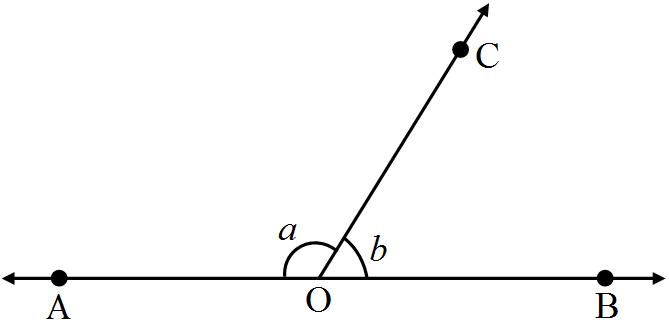
In figure, $\angle\text{AOC}$ and $\angle\text{BOC}$ from a linear pair. If a - 2b = 30°, find a and b.
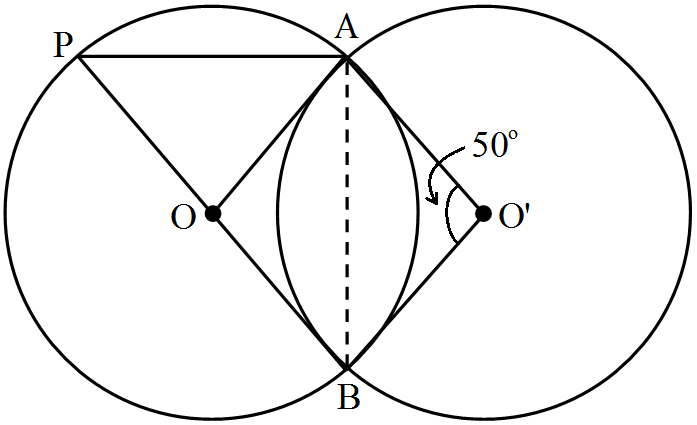
In the given figure, two congruent circles with centres O and O' intersect at A and B. If $\angle\text{AOB} = 50^\circ,$ then find $\angle\text{APB.}$
The income and expenditure for 5 years of a family is given in the following data:
Years
1995–96
1996–97
1997–98
1998–99
1999–2000
Income (Rs. In thousands)
100
140
150
170
210
Expenditure (Rs. in thousands)
80
130
145
160
190
Represent the above data by a bar graph.
Solve. $\frac{\sqrt{x+7}+\sqrt{x-2}}{\sqrt{x+7}-\sqrt{x-2}}=\frac{5}{1}$
Prove that the medians of an equilateral triangle are equal.
Find the cube of the following binomial expressions:$\frac{1}{\text{x}}+\frac{\text{y}}{3}$
The following data gives the amount of loans (in crores of rupees) disbursed by a bank during some years:
Year
1992
1993
1994
1995
1996
Loan (in corers of rupees)
28
33
55
55
80
  1. Represent the above data with the help of a bar graph.
  2. With the help of the bar graph, indicate the year in which amount of loan is not increased over that of the preceding year.
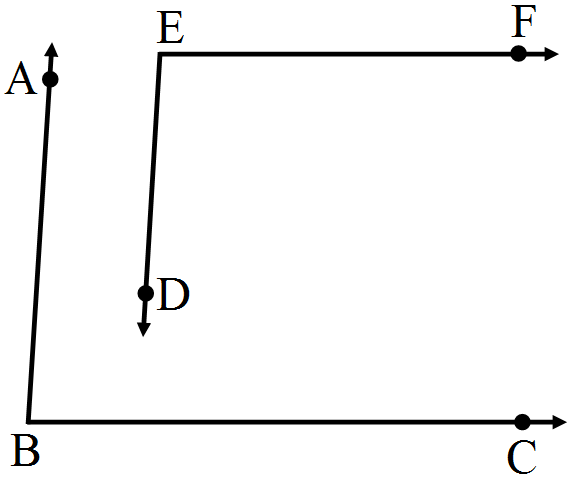
In the given figure, BA || ED and BC || EF. Show that $\angle\text{ABC}+\angle\text{DEF}=180^\circ.$
Following data gives the number of children in 40 families:
1, 2, 6, 5, 1, 5, 1, 3, 2, 6, 2, 3, 4, 2, 0, 0, 4, 4, 3, 2, 2, 0, 0, 1, 2, 2, 4, 3, 2, 1, 0, 5, 1, 2, 4, 3, 4, 1, 6, 2, 2.
Represent it in the form of a frequency distribution.
Show that, the line segments joining the mid-points of opposite sides of a quadrilateral bisects each other.