Question types

Matter in Our Surroundings question types

198 questions across 7 question groups — pick any mix to generate a Science paper with step-by-step answer keys.

198
Questions
7
Question groups
5
Question types
Sample Questions

Matter in Our Surroundings questions

One sample from each question group in this chapter. Select any group above to see the full set with answer keys.

Fill in the following blanks with suitable words:
The arrangement of particles is less ordered in the ________ State. However, there is no order in the ________ State.
View full solution
Fill in the following blanks with suitable words:
At room temperature, the forces of attraction between the particles of solid substances are ____________ than those which exist in the gaseous state.
View full solution
Q 6MCQ1 Mark
During summer days, water kept in an earthen pot $($pitcher$)$ becomes cool because of the phenomenon of:
  • A
    Diffusion
  • B
    Transpiration.
  • C
    Osmosis.
  • Evaporation.

Answer: D.

View full solution
Q 7MCQ1 Mark
When a crystal of potassium permanganate is placed at the bottom of water in a beaker, the water in the whole beaker turns purple on its own, even without stirring. This is an example of:
  • A
    Distribution.
  • B
    Intrusion.
  • Diffusion.
  • D
    Effusion.

Answer: C.

View full solution
Q 8MCQ1 Mark
The conversion of a solid into vapours without passing through the liquid state is called:
  • A
    Vaporization.
  • B
    Fusion.
  • Sublimation.
  • D
    Freezing.

Answer: C.

View full solution
Q 9MCQ1 Mark
Which of the following represent the suitable condition for the liquefaction of gases?
  • A
    Low temperature, low pressure.
  • B
    High temperature, low pressure.
  • Low temperature, high pressure.
  • D
    High temperature, high pressure.

Answer: C.

View full solution
Q 10MCQ1 Mark
Which one of the following set of phenomena would increase on raising the temperature?
  • A
    Diffusion, evaporation, compression of gases.
  • B
    Evaporation, compression of gases, solubility.
  • Evaporation, diffusion, expansion of gases.
  • D
    Evaporation, solubility, diffusion, compression of gases.

Answer: C.

View full solution
Q 11true or false1 Mark
State whether the following statement is true or false:
Red brown bromine vapour diffuse into air in a gas jar but the colourless air molecules do not diffuse into bromine vapour.
View full solution
When water is heated to a temperature x, it gets converted into steam at temperature x by a process called R. And when steam at temperature x is cooled, it gets reconverted in to water at the same temperature x by a process called S.
  1. How much is the value of x in Kelvin?
  2. What is the process R called?
  3. What is the name of the energy absorbed during the process R?
  4. What is process S known as?
  5. What is the name of energy released during the process S known as?
View full solution
The substance X normally exists in a physical state which can flow easily but does not fill its vessel completely. It also turns anhydrous copper sulphate blue. When substance X is cooled excessively, it changes into a substance Y which has a fixed shape as well as a fixed volume. If, however, the substance X is heated strongly, it changes into a substance Z which has neither a fixed shape nor a fixed volume.
  1. Name the substances (i) X (ii) Y and (iii) Z.
  2. What is the process of conversion of X into Y known as?
  3. At which temperature X gets converted into Y?
  4. What is the process of conversion of X into Z known as?
  5. At which temperature X gets converted into Z?
View full solution
The scientists now say that there are actually five states of matter A, B, C, D and E. The state A has a fixed volume but no fixed shape. The state B can be compressed very easily by applying pressure and state C has a fixed shape as well as a fixed volume. The state D is mixture of free electrons and ions whereas state E is named after an Indian scientist and a famous physicist.
  1. Name the physical states (i) A (ii) B (iii) C (iv) D, and (v) E.
  2. Name one substance belonging to state C which can directly change into vapours on heating. What is this process known as?
  3. Name one substance which normally belongs to state B but whose solid form changes directly into gaseous state.
  4. Name the most common substance belonging to state A.
  5. Which state of matter makes the sum and other stars to glow.
View full solution
When a beam of sunlight enters a room through a window, we can see tiny particles X suspended in a gas (or rather a mixture of gases) Y which are moving rapidly in a very haphazard manner.
  1. What could particles X be?
  2. Name the gas (or mixture of gases) Y.
  3. What is the phenomenon exhibited by particles X known as?
  4. What is causing the movement of particles X?
  5. What conclusion does the existence of this phenomenon give us about the nature of matter?
View full solution
There are four substances W, X, Y and Z. The substance W is a dark violet solid having diatomic molecules. A solution of W in alcohol is used as a common antiseptic C. The substance X is a white solid which is usually recovered from sea water on a large scale. The substance Y is a white solid which is insoluble in water and used in the form of small balls for the safe storage of woollen clothes. The substance Z is a yet another white solid which is used in making commonly used dry cells.
  1. Name (i) W (ii) X (iii) Y and (iv) Z.
  2. Out of W, X, Y and Z, which substance/ substances can undergo sublimation?
  3. Which substances organic in nature?
  4. What is the name of substance C?
  5. Which substance belongs to the halogen family?
View full solution
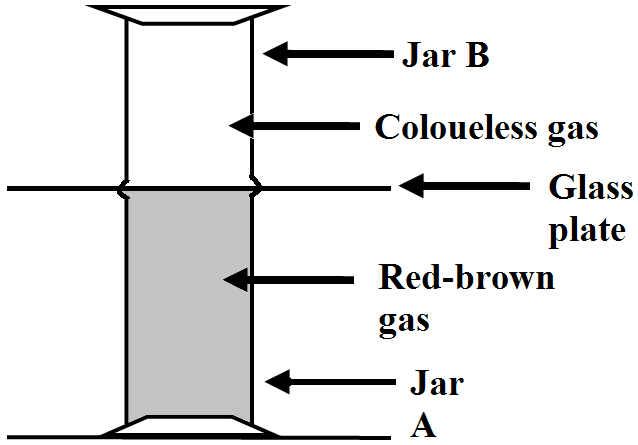
Look at the diagram on the right side. Jar A contains are d-brown gas whereas Jar B contains a colourless gas. The two gas jars are separated by a glass plate placed between them:
  1. What will happen when the glass plate between the two jars is pulled away?
  2. What name is given to the phenomenon which takes place?
  3. Name the brown gas which could be in jar A.
  4. Which is the colorless gas most likely to be present in jar B?
  5. Name one coloured solid and one colourless liquid which can show the same phenomenon.
View full solution

Generate a Matter in Our Surroundings paper free

Pick question groups from the list above, set marks and difficulty, and export a branded PDF with step-by-step answer keys. First 3 chapters free — no signup.

Download App