Questions · Page 1 of 2

Question Answer (2 Marks)

Take a timed test

50 questions · self-marked practice — reveal the answer and mark yourself.

Question 12 Marks
Why does a gas exert pressure?
Answer
Because of high energy and negligible forces of attraction, the particles of a gas move with high speed in all directions. Thus, the pressure exerted by a gas is due to the constant collisions of the fast moving gas particles against the walls of the container.
View full question & answer
Question 22 Marks
When water is heated to a temperature x, it gets converted into steam at temperature x by a process called R. And when steam at temperature x is cooled, it gets reconverted in to water at the same temperature x by a process called S.
  1. How much is the value of x in Kelvin?
  2. What is the process R called?
  3. What is the name of the energy absorbed during the process R?
  4. What is process S known as?
  5. What is the name of energy released during the process S known as?
Answer
  1. The value of ‘x’ in Kelvin is 373K.
  2. Vaporisation or boiling.
  3. Latent heat of vaporisation.
  4. Condensation.
  5. Latent heat of condensation.
View full question & answer
Question 32 Marks
Give one example of the diffusion of a solid in another solid.
Answer
If two metal blocks are bound together tightly and kept undistributed for a few years, then the particles of one metal are found to have diffused into the other metal.
View full question & answer
Question 42 Marks
Why is a liquid (the hydraulic fluid) used to operate the brakes in a car?
Answer
A liquid is always used to operate the brakes in a car. This is because the particles in brake oil can move freely without being compressed much and thus can transmit the applied force into pressure, which is applied on the brakes efficiently.
View full question & answer
Question 52 Marks
Give two reasons to justify that:
Water is a liquid at room temperature.
Answer
Water is a liquid at room temperature because:
  1. Water has a fixed volume (which does not change on changing its container).
  2. Water has no fixed shape (it takes the shape of the container in which it is kept).
View full question & answer
Question 62 Marks
Define the term ‘latent heat of fusion’ of a solid. How much is the latent heat of fusion of ice?
Answer
The latent heat of fusion of a solid is the quantity of heat in joules required to convert 1Kg of the solid (at its melting point) to liquid, without any change in temperature. The latent heat of fusion of ice is 3.34 × 10⁵J/ Kg.
View full question & answer
Question 72 Marks
Explain why, there is no rise in temperature of a substance when it undergoes a change of state though heat is supplied continuously.
Answer
The temperature of a substance remains constant during the change of state though heat is supplied continuously because the heat gets used up in changing the state by overcoming the forces of attraction between the particles.
View full question & answer
Question 82 Marks
Why do gases have neither a fixed shape nor a fixed volume?
Answer
A gas does not have a fixed shape or fixed volume because the particles of gases do not have fixed positions or fixed spaces between them.
View full question & answer
Question 92 Marks
Explain why, naphthalene balls kept in stored clothes in our homes disappear over a period of time.
Answer
This happens because naphthalene balls undergo sublimation. The naphthalene balls keep on forming naphthalene vapours slowly which disappear into the air.
View full question & answer
Question 102 Marks
Why does the temperature of a substance remain constant during the change of state?
Answer
The temperature of a substance remains constant during the change of state because the heat gets used up in changing the state by overcoming the forces of attraction between the particles.
View full question & answer
Question 112 Marks
State two characteristics of matter demonstrated by:
Diffusion.
Answer
Diffusion:
  1. Matter is made up of tiny particles.
  2. The particles of matter are constantly moving.
View full question & answer
Question 122 Marks
When water is cooled to a temperature x, it gets converted into ice at temperature x by a process called P. And when ice at temperature x is warmed, it gets reconverted into water at the same temperature x in a process called Q.
  1. What is the value of temperature x in Kelvin?
  2. What is the process P known as?
  3. What is the name of energy released during process P?
  4. What is the process Q known as?
  5. What is the name of energy absorbed during process Q?
Answer
  1. 273K.
  2. The name of the process is freezing.
  3. Latent heat of freezing.
  4. Melting.
  5. Latent heat of fusion.
View full question & answer
Question 142 Marks
How does applying pressure (or compression) help in the liquefaction of a gas?
Answer
There is a lot of space between the particles of a gas. If enough pressure is applied to the gas, it gets highly compressed. The particles of gas get so close together that they start attracting each other sufficiently to form a liquid. And we say that the gas has liquefied.
View full question & answer
Question 152 Marks
State two characteristics of matter demonstrated by:
Brownian motion.
Answer
Brownian motion:
  1. The particles of matter are very, very small.
  2. The particles of matter are constantly moving.
View full question & answer
Question 162 Marks
Define the term ‘latent heat of vaporization’ of liquid. What is the value of the of the latent heat of vaporization of water?
Answer
The latent heat of vaporization of a liquid is the quantity of heat in joules required to convert 1Kg of the liquid (at its boiling point) to vapour or gas without any change in temperature. The latent heat of vaporization of water is 22.5 × 10⁵J/ Kg.
View full question & answer
Question 172 Marks
Which produces more severe burns: boiling water or steam? Why?
Answer
Steam causes more severe burns than boiling water because the steam contains more heat, in the form of latent heat, than boiling water. Hence, when steam falls on our skin and condenses to produce water it gives out 22.5 × 10⁵ joules per kilogram more heat than boiling water.
View full question & answer
Question 182 Marks
Whish of the following diffuses fastest and which the slowest?
Solid, Liquid, Gas
Give reasons for your answer.
Answer
Solids diffuse the slowest as the particles in solids do not move from their fixed positions. Gases diffuse the fastest as the particles in gases move very quickly in all directions.
View full question & answer
Question 192 Marks
Which contains more heat, 1kg of ice at 0°C or 1kg of water at 0°C? Give reason for your answer.
Answer
The latent heat of fusion of ice is 3.34 × 10⁵J/ Kg. It means that 3.34 × 10⁵ joules of heat is required to change 1Kg of ice at its melting point of 0°C into water at the same temperature (of 0°C). This means that 1Kg of ice at 0°C has 3.34 × 10⁵ joules of less heat than 1kg of water at the same temperature of 0°C.
View full question & answer
Question 202 Marks
  1. Compare the properties of solids, liquids and gases in tabular form.
  2. Give two reasons for saying that wood is a solid.

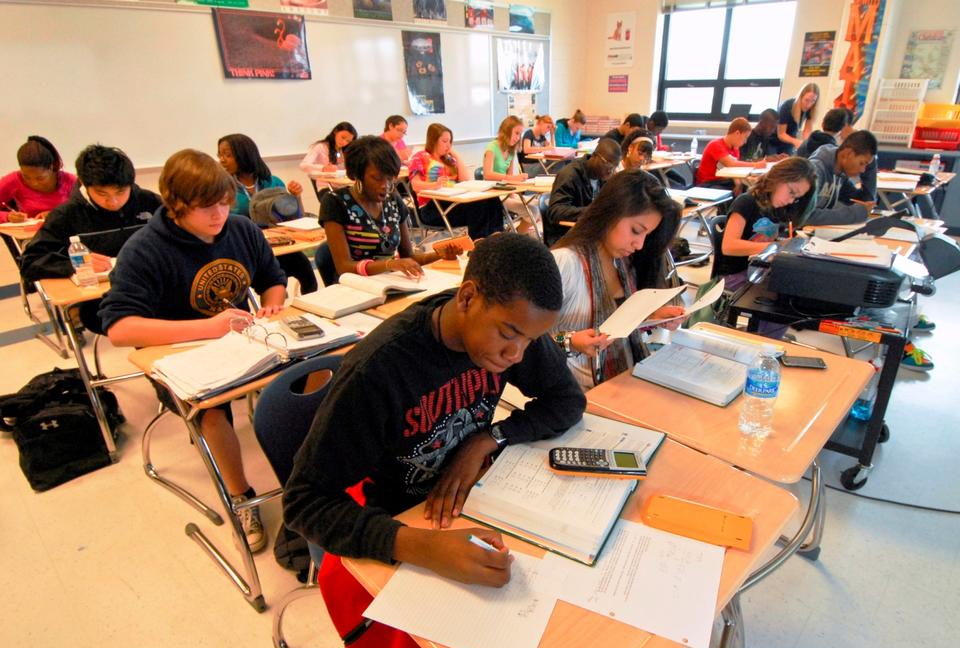
During class, the students resemble molecules in a solid (because they are very close to one another)

While going from one classroom to another the students resemble molecules in a liquid (because they are a little more father apart from one another)
Answer
  1.  
 
Solids
Liquids
Gases
i
Solids have a fixed shape and a fixed volume.
Liquids have a fixed volume but no fixed shape.
Gases have neither a fixed volume nor a fixed shape.
ii
Solids cannot be compresses much.
Liquids cannot be compresses much.
Gases can be compressed easily.
iii
Solides have high densities.
Liquids have moderate to high densities.
Gases have very low densities.
iv
Solids do not fill their container completely.
Liquids do not fill their container completely.
Gases fill their container completely.
v
Solids do not flow.
Liquids generally flow easily.
Gases flow easily.
  1.  
  1. Wood is a rigid object which has a tendency to maintain its shape when subjected to outside force.
  2. It has a definite shape and definite volume.
View full question & answer
Question 212 Marks
What does the diffusion of gases tell us about their particles?
Answer
Diffusion in gases shows that their particles move very quickly in all directions and the rate of diffusion of a gas depends on its density. Light gases diffuse faster than heavy gases.
View full question & answer
Question 222 Marks
Give two reasons to justify that:
An iron almirah is a solid.
Answer
An iron almirah is a solid because:
  1. It has a fixed shape (which cannot be changed by pressing it with hands).
  2. It has a fixed volume (which depends on the dimensions according to which it is made).
View full question & answer
Question 232 Marks
Explain why, diffusion occurs more quickly in a gas than in al iquid.
Answer
Diffusion occurs more quickly in gases than in a liquid because the particles in gases move very quickly in all directions whereas the particles in liquids move slowly as compared to the gas particles.
View full question & answer
Question 242 Marks
How do solids, liquids and gases differ in shape and volume?
Answer
  1. Solids: They have a fixed shape and a fixed volume.
  2. Liquids: They have a fixed volume but no fixed shape.
  3. Gases: They neither have a fixed shape nor a fixed volume.
View full question & answer
Question 252 Marks
What is meant by ‘diffusion’? Give one example of diffusion in gases.
Answer
The spreading out and mixing of a substance due to the motion of its particles is called diffusion.
For example: Smell of food being cooked in the kitchen reaches us even from a considerable distance.
View full question & answer
Question 262 Marks
Give reason for the following observation:
The smell of hot sizzling food reaches us even from a considerable distance but to get the smell form cold food, we have to go close to it.
Answer
The smell of hot sizzling food reaches us quickly as compared to cold food because the rate of diffusion of hot gases (released by hot sizzling food) into air is faster than that of cold gases released by cold food.
View full question & answer
Question 272 Marks
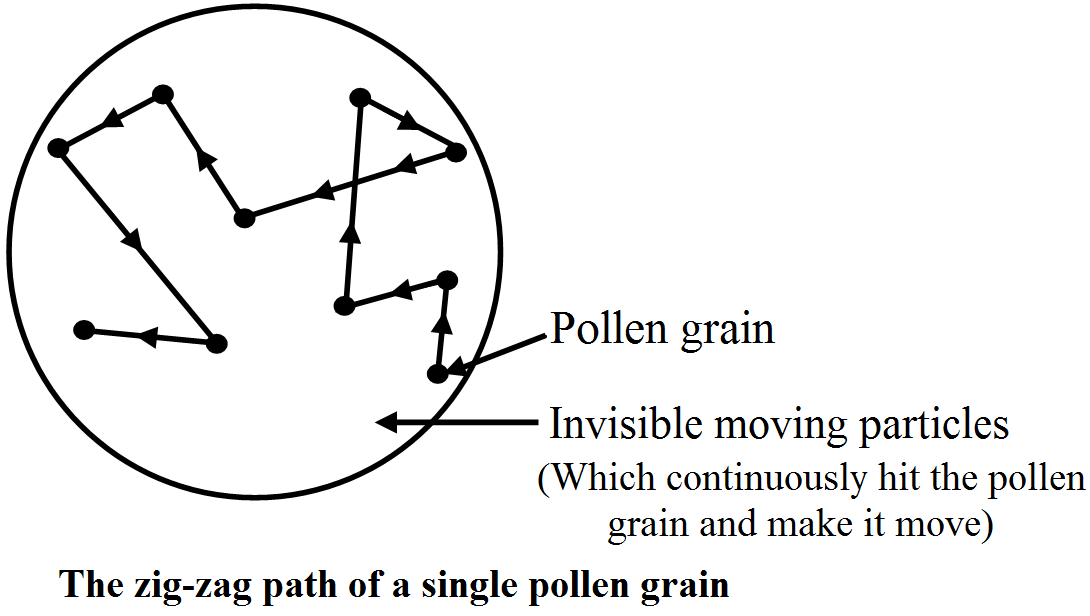
What is Brownian motion? Draw a diagram to show the movement of a particle (like a pollen grain) during Brownian motion.
Answer
The zig-zag movement of small particles suspended in a liquid (or gas) is called Brownian motion. Brownian motion increases on increasing the temperature.
View full question & answer
Question 282 Marks
A student placed a gas jar containing air in the upside down position over a gas jar full of red-brown bromine vapours. He observed that the red brown colour spread upwards into the jar containing air. Based on this observation, the student concluded that it is only the bromine vapour which moves up and diffuses into air in the upper jar, the air from the upper jar does not move down by diffusion into the lower jar containing bromine vapours. Do you agree with this conclusion of the student? Give reason for your answer.
Answer
No, the conclusion made by the student is wrong because the air from the upper gas jar also diffuses down into the lower gas jar containing bromine vapour. Since, air is colourless it cannot be noticed by the student.
View full question & answer
Question 292 Marks
Explain why, steam at 100°C is better for heating purposes than boiling water at 100°C.
Answer
It is because of the fact that steam at 100°C contains more heat, in the form of latent heat, than boiling water at 100°C. Hence, steam would give out 22.5 × 10⁵ joules per kilogram more heat than boiling water.
View full question & answer
Question 302 Marks
Why does a gas fill a vessel completely?
Answer
The particles of a gas have high kinetic energy and negligible forces of attraction amongst them. Due to this, the particles of a gas are constantly moving with high speeds in all the directions and the gas completely fills the vessel in which it is kept.
View full question & answer
Question 312 Marks
What is sublimation? Name two substances (other than ammonium chloride) which undergo sublimation.
Answer
The changing of a solid directly into vapours on heating and of vapours into solid on cooling is known as sublimation. The common substances which undergo sublimation are Camphor and Naphthalene.
View full question & answer
Question 332 Marks
What is evaporation? State the various factors which affect evaporation.
Answer
The process of a liquid changing into vapour (or gas) even below its boiling point is called evaporation. The factors affecting rate of evaporation are:
  1. Temperature.
  2. Surface area.
  3. Humidity.
  4. Wind speed.
View full question & answer
Question 342 Marks
Why does all the water of the earth not get evaporated during hot summer days?
Answer
All water on earth does not get evaporated on hot summer days because of the high value of latent heat of vaporization of water.
View full question & answer
Question 352 Marks
How can the evaporation of a liquid be made faster?
Answer
The rate of evaporation of a liquid can be made faster by
  1. Increasing the temperature.
  2. Increasing the surface area of the liquid.
  3. Lowering humidity.
  4. Increasing wind speed.
View full question & answer
Question 362 Marks
An inflated balloon full of air goes down slowly (becomes smaller and smallers lowly) even though the knot at the mouth of the balloon is air tight. And after a week all the air has escaped from the balloon. Explain how the air particles got out of the balloon.
Answer
The fast moving molecules of air trapped in the inflated balloon exert continuous pressure on the thin, stretched rubber sheet of balloon and keep on diffusing out through it gradually. Therefore, the air escapes out of the balloon after some time.
View full question & answer
Question 372 Marks
How does perspiration or sweating help keep our body cool on a hot day?
Answer
On a hot day, when our body temperature tends to rise too much, our sweat glands give out moisture (sweat) on our skin. When this sweat evaporates, it takes the latent heat of vaporization from our body hence making our body cool.
View full question & answer
Question 382 Marks
Explain the following:
When an incense stick is lighted in the corner of room, its fragrance spreads quickly in the entire room.
Answer
The particles of gases produced by the burning of incense sticks move rapidly in all directions. They collide with the particles of air present in the room, mix with air and reach every part of the room quickly.
View full question & answer
Question 392 Marks
Honey is more viscous than water. Can you suggest why?
Answer
The force of attraction between the particles of honey is much more than the force of attraction between the particles of water.
View full question & answer
Question 402 Marks
How is ammonia gas liquefied?
Answer
Ammonia gas is liquefied by applying high pressure and lowering the temperature of the gas. Lowering the temperature is done by continuously pouring water over the coils carrying the compressed gas.
View full question & answer
Question 412 Marks
Define ‘melting point’ of a substance? What is the melting point of ice?
Answer
The temperature, at which a solid substance melts and changes into a liquid at atmospheric pressure, is called melting point of the substance. The melting point of ice is 0°C.
View full question & answer
Question 422 Marks
Name two gases of air which dissolve in water by diffusion. What is the importance of this process in nature?
Answer
Carbon dioxide and Oxygen gas dissolve in water by diffusion. This process is important as these gases are essential for the survival of aquatic plants and animals. The aquatic plants use the dissolved carbon dioxide for preparing food by photosynthesis and aquatic animals use the dissolved oxygen in water for breathing.
View full question & answer
Question 432 Marks
Would you cool a bucket of water more quickly by placing it on ice or by placing ice in it? Give reasons for your answer.
Answer
We would place ice in the water to cool it more quickly because the ice takes its latent heat from the water and hence cools it more effectively. On the other hand, if we keep the water on ice then the latent heat would be taken from the surrounding air hence releasing its coolness to the surrounding and not the water.
View full question & answer
Question 442 Marks
Describe in your own words, what happens to the particles when salt dissolves in water.
Answer
When salt is added to water and stirred, the tiny salt particles break off from each solid salt granule and fill up the spaces available between the particles of water and mix with them.
View full question & answer
Question 452 Marks
Which contains more heat, 1kg of water at 100°C or 1kg of steam at 100°C? Give reason for your answer.
Answer
1Kg of steam at 100°C has more heat than water at the same temperature because when water changes into steam, it absorbs latent heat, but when steam condenses to form water, an equal amount of latent heat is given out.
View full question & answer
Question 462 Marks
Why does evaporation cool a liquid?
Answer
Evaporation causes cooling because when a liquid evaporates, it draws or takes the latent heat of vaporisation from ‘anything’ which it touches and hence the substances or surroundings lose heat and get cooled.
View full question & answer
Question 472 Marks
Why are gases so easily compressible whereas it is almost impossible to compress a solid or a liquid?
Answer
Gases can be compressed easily because its particles are far apart and there are large spaces between them (which can be reduced by compression).
View full question & answer
Question 482 Marks
Name the three states of matter. Give one example of each.
Answer
Three states of matter are:
  1. The solid state: Ice.
  2. The liquid state: Water.
  3. The gas state: Air.
View full question & answer
Question 492 Marks
Explain briefly, how gases can be liquefied.
Answer
Gases can be liquefied by applying pressure and lowering temperature. The temperature needs to be lowered because when the gas is compressed too much, then heat is produced due to compression. Cooling lowers the temperature of the compressed gas and helps in liquefying it.
View full question & answer
Question 502 Marks
Why does steam cause more severe burns than boiling water?
Answer
Steam causes more severe burns than boiling water because the steam contains more heat, in the form of latent heat, than boiling water. Hence, when steam falls on our skin and condenses to produce water, it gives out 22.5 × 10⁵ Joules per kilogram more heat than boiling water.
View full question & answer
Question Answer (2 Marks) - Science STD 9 Questions - Vidyadip