Questions

Answer the following question.

Take a timed test

9 questions · self-marked practice — reveal the answer and mark yourself.

Question 13 Marks
What is the purpose of launching X-Ray telescope Chandra?
Answer
Chandra was launched to study X-rays coming from heavenly objects. Special mirrors which . can reflect X-rays were used in this telescope.
View full question & answer
Question 23 Marks
What are the two types of reflecting telescopes?
Answer
  • The reflecting telescopes are mainly of two types: Newtonian and Cassegrain.
  • The newtonian telescope uses a plane mirror and a concave mirror.
  • The Cassegrain telescope uses a convex and a concave mirror.
View full question & answer
Question 33 Marks
How does a radio telescope work?
Answer
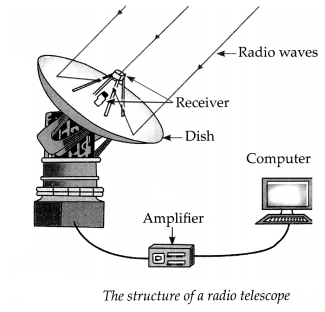
  • A radio telescope is made from one or more dishes of a particular parabolic shape.
  • The incident radio waves are reflected by these dishes and converge at a focus.
  • A radio receiver is placed at focal point.
  • The information gathered by this receiver is then passed onto a computer which analyses and constructs the image of the source.
View full question & answer
Question 43 Marks
What are the difficulties in using refracting telescopes?
Answer
  • We require a large objective lens which is very difficult to make. Also large lenses are heavy and tend to get distorted.
  • As the objective and eyepiece lens are placed on the opposite sides of the telescope, the length of the telescope also increases with increase in the size of the lenses. This makes it difficult to manage a large telescope.
  • The images formed by lenses have errors of colours. This is called chromatic aberration.
View full question & answer
Question 53 Marks
How do refracting telescopes work?
Answer
  • Most refracting telescopes are made with two or more lenses.
  • The two lenses are called objective lens and an eyepiece lens.
  • The objective lens should be large so that maximum light can be collected from the source.
  • Using the light collected, the eyepiece lens which is small in size, produces a large image of the source.
View full question & answer
Question 63 Marks
Why can an X-ray telescope not be based on the earth?
Answer
  • X-rays are emitted from distant heavenly bodies.
  • The rays coming towards the earth will be absorbed by the earth’s atmosphere and will go undetected.
  • Hence, X-ray telescopes are placed in an orbit outside the earth’s atmosphere and not on the earth.
View full question & answer
Question 73 Marks
Why are optical telescopes located in uninhabited places on mountains?
Answer
  • The visible light coming from a heavenly body has to pass through the earth’s atmosphere to reach the earth’s surface.
  • During this journey, some of the light is absorbed by the atmosphere and the intensity of the light reaching the earth’s surface decreases.
  • A second problem is caused by the changes in atmospheric pressure and temperature.
  • These changes cause turbulence in the atmosphere which in turn cause the light rays to change their path slightly and thereby shake the position of the image.
  • We cannot use optical telescope during the day. because of sunlight also.
  • During the night too, city lights and cloudy weather can cause difficulties in observing the heavenly bodies.
  • Hence, optical telescopes are located in uninhabited places on mountains.
View full question & answer
Question 83 Marks
Explain the construction of a radio telescope.
Answer
  • The radio telescope is made from one or more dishes of a particular parabolic shape.
  • As in optical telescope, the incident radio waves are reflected by these dishes and converge at the focus.

Image

  • A radio receiver is placed at the focal point.
  • The information gathered by this receiver is passed on to a computer which analyses it and constructs an image of the source.
View full question & answer
Question 93 Marks
Explain the construction of Galileo’s telescope.
Answer
  • The Galileo’s telescope is made up of two or more convex lenses.
  • The lens facing the object is called the objective lens which is made as large as possible to collect the maximum amount of light coming from a heavenly object.
  • The lens closer to the eye is called the eyepiece which uses the light collected by the objective lens and produces a large image of the source.
  • Such a telescope is also called a refracting telescope.
View full question & answer