Radio telescope is made up of one or more dishes of shape.
- Aspherical
- Bhyperbolic
- ✓parabolic
- Dhexagonal
Answer: C.
View full solution →40 questions across 8 question groups — pick any mix to generate a Science paper with step-by-step answer keys.
Write the Correct Alternative.
9 Q→02Answer the following in one sentece.
5 Q→03Answer the following questions in detail.
2 Q→04Answer the following question.
9 Q→05Answer the following question.
6 Q→06Fill In The Blanks.
5 Q→07Match The Columns/pair.
3 Q→08Observe The Picture And Explain.
1 Q→One sample from each question group in this chapter. Select any group above to see the full set with answer keys.
Answer: C.
View full solution →Answer: B.
View full solution →Answer: A.
View full solution →Answer: C.
View full solution →Answer: C.
View full solution →| Column ‘A’ | Column ‘B’ |
| (1) Micro waves | (a) 800 nm – 0.3mm |
| (2) Infrared waves | (b) 360 pm – 400 nm |
| (3) Visible light rays | (c) 3 pm – 300 pm |
| (4) Ultraviolet rays | (d) 400 nm – 800nm |
| (5) X-rays | (e) 0.3 mm -20cm |
| Column ‘A’ | Column ‘B’ |
| (1) X-rays | (a) GMRT |
| (2) Optical telescope | (b) ISRO |
| (3) Indian radio telescope | (c) Hubble |
| (4) Launching artificial satellite | (d) Chandra |
| (5) Radio waves | (e) telecommunication |
| (6) INSAT and GSAT | (f) longer than 20cm |
| Column ‘A’ | Column ‘B’ |
| (1) X-rays | (a) GMRT |
| (2) Optical telescope | (b) ISRO |
| (3) Indian radio telescope | (c) Hubble |
| (4) Launching artificial-satellite | (d) Chandra |
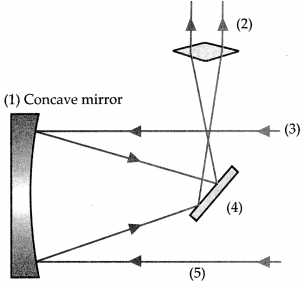
a. What type of telescope is shown in the figure?
b. Label the main parts of the telescope.
c. Which type of mirror does the telescope use?
d. What other type of telescope uses a curved mirror?
e. Explain the working of the above telescope.
Pick question groups from the list above, set marks and difficulty, and export a branded PDF with step-by-step answer keys. First 3 chapters free — no signup.