Questions

2 Mark Question

Take a timed test

9 questions · self-marked practice — reveal the answer and mark yourself.

Question 12 Marks
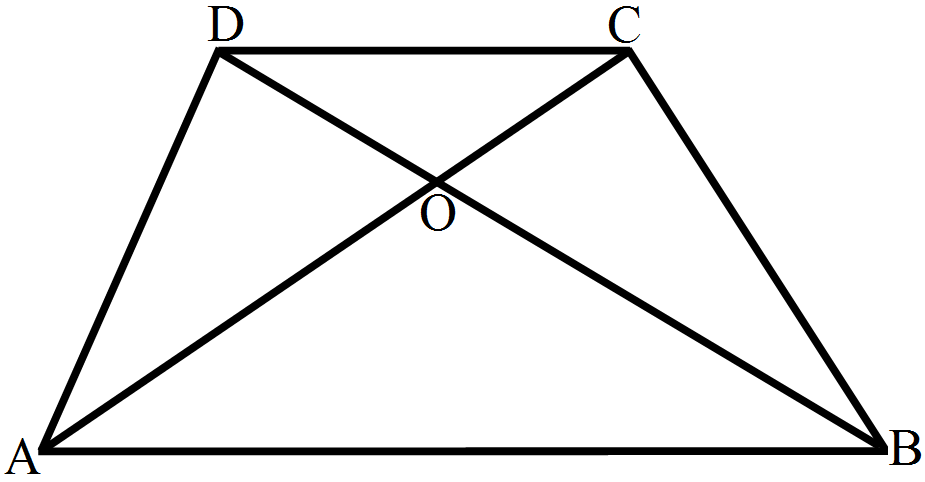
In the adjoining figure, ABCD is a trapezium in which AB || DC and its diagonals AC and BD intersect at O.
Prove that $\text{ar}(\triangle\text{AOD})=\text{ar}\triangle\text{BOC}.$
Answer
$\triangle\text{CDA}$ and $\triangle\text{CBD}$ lies on the same base and between the same parallel lines.So,
$\text{ar}(\triangle\text{CDA})=\text{ar}(\triangle\text{CDB})\dots(1)$
Subtracting $\text{ar}(\triangle\text{OCD})$ from both sides of equation (1), we get:
$\text{ar}(\triangle\text{CDA})-\text{ar}(\triangle\text{OCD})=\text{ar}(\triangle\text{CDB})-\text{ar}(\triangle\text{OCD})$
$\Rightarrow\ \text{ar}(\triangle\text{AOD})=\text{ar}\triangle\text{BOC}.$
View full question & answer
Question 22 Marks
Find the area of a figure formed by joining the midpoints of the adjacent sides of a rhombus with diagonals 12cm and 16cm.
Answer
Area of rhombus $=\frac{1}{2}\times\text{Product of diagonal}$$=\frac{1}{2}\times12\times16$
$=96\text{cm}^2$
Area of figure formed by joining the mid-points of rhombus $=\frac{1}{2}\times\text{Area of rhombus}$$=\frac{1}{2}\times96$
$=48\text{cm}^2$
View full question & answer
Question 32 Marks
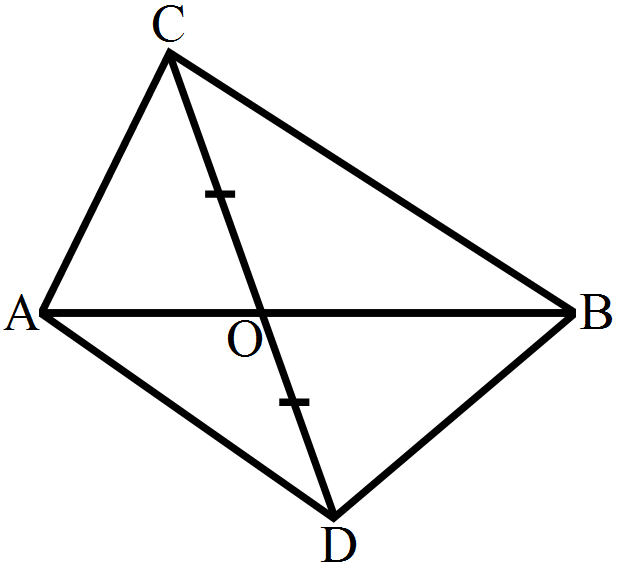
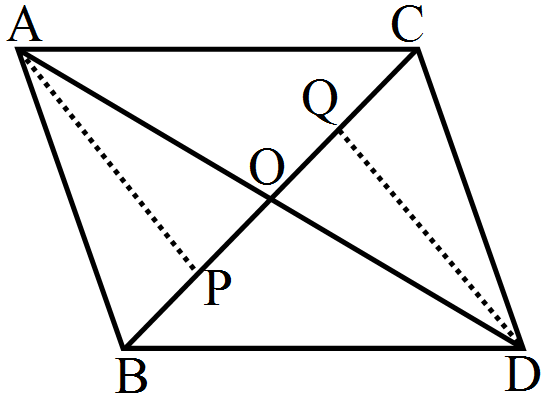
In the adjoining figure, ABC and ABD are two triangles on the same base AB. If line segment CD is
bisected by AB at O, show that $\text{ar}(\triangle\text{ABC})=\text{ar}(\triangle\text{ABD}).$
Answer
We know that median of a triangle divides it into two triangles of equal area. Now, AO is the median of $\triangle\text{ACD}.$$\Rightarrow\ \text{A}(\triangle\text{COA})=\text{A}(\triangle\text{DOA})\dots(1)$
And, Bo is the median of $\triangle\text{BCD}.$$\Rightarrow\ \text{A}(\triangle\text{COB})=\text{A}(\triangle\text{DOB})\dots(2)$
Adding (1) and (2), we get:$\text{A}(\triangle\text{COA})+\text{A}(\triangle\text{COB})=\text{A}(\triangle\text{DOA})+\text{A}(\triangle\text{DOB})$
$\Rightarrow\ \text{A}(\triangle\text{ABC})=\text{A}(\triangle\text{ABD})$
View full question & answer
Question 42 Marks
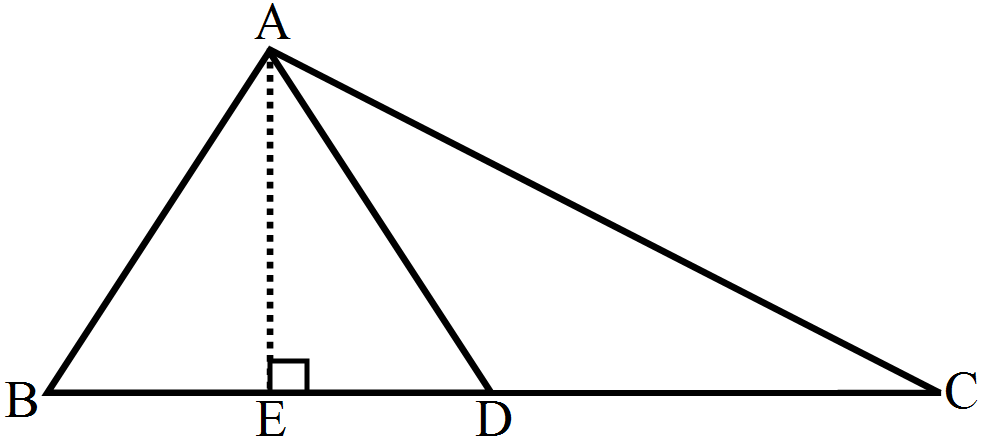
Prove that a median divides a triangle into two triangles of equal area.
Answer
Given: ABC is a triangle in which AD is the median. To prove:$\text{ar}(\triangle\text{ABD})=\text{ar}(\triangle\text{ACD})$
Construction:
Draw $\text{AE}\perp\text{BC}$
View full question & answer
Question 52 Marks
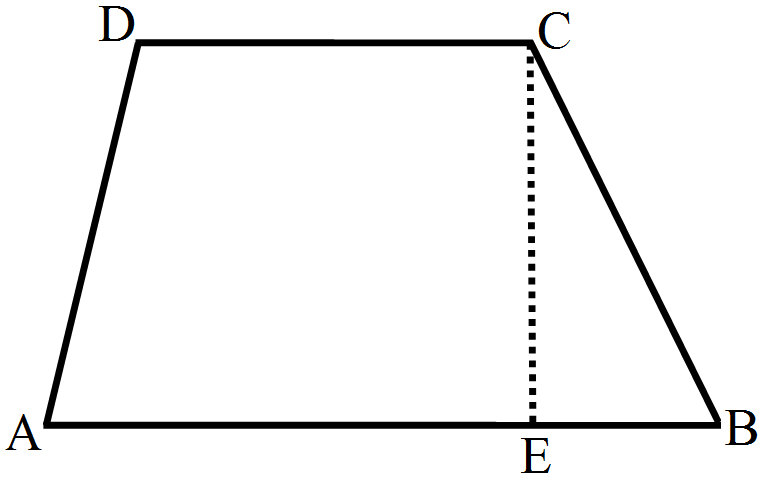
Find the area of a trapezium whose parallel sides are 9cm and 6cm respectively and the distance between these sides is 8cm.
Answer
ABCD is a trapezium in which, AB || CD. AB = 9cm and CD = 6cm. CE is a perpendicular drawn to AB through C and CE = 8cm.
Area of trapezium $=\frac{1}{2}(\text{Sum of parallel sides})\times\text{Distance between them}$
$=\Big[\frac{1}{2}(9+6)\times8\Big]\text{cm}^2$
$=\Big(\frac{1}{2}\times15\times8\Big)\text{cm}^2$
$=60\text{cm}^2$
$\therefore$ Area of trapezium = $60cm^2.$
View full question & answer
Question 62 Marks
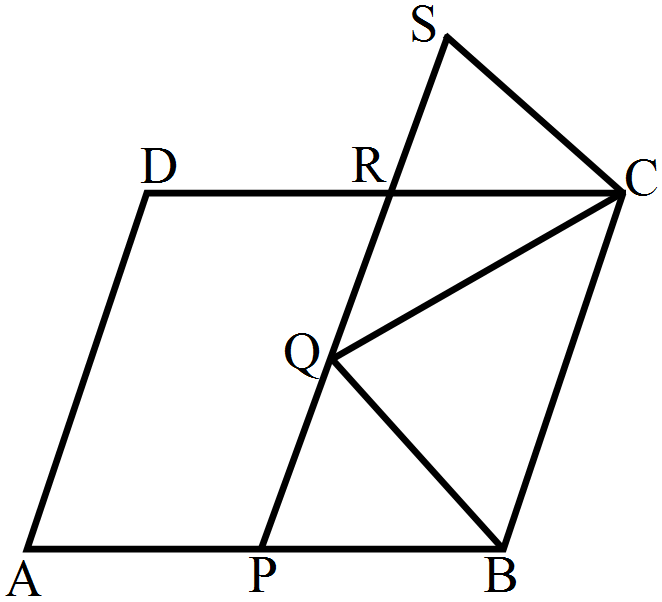
In the adjoining figure, ABCD and BQSC are two parallelograms. Prove that $\text{ar}(\triangle\text{RSC})=\text{ar}(\triangle\text{PQB}).$
Answer
In $\triangle\text{RSC}$ and $\triangle\text{PQB},$$\angle\text{CRS}=\angle\text{BPQ}$ [RC || PB, corresponding angles]
$\angle\text{RSC}=\angle\text{PQB}$ [RC || PB, corresponding angles]
$\text{SC}=\text{QB}$ [Opposite sides of a parallelogram BQSC]
$\therefore\ \triangle\text{RSC}\cong\triangle\text{PQB}$ [by AAS congruence criterion]
$\Rightarrow\ \text{ar}(\triangle\text{RSC})=\text{ar}(\triangle\text{PQB})$
View full question & answer
Question 72 Marks
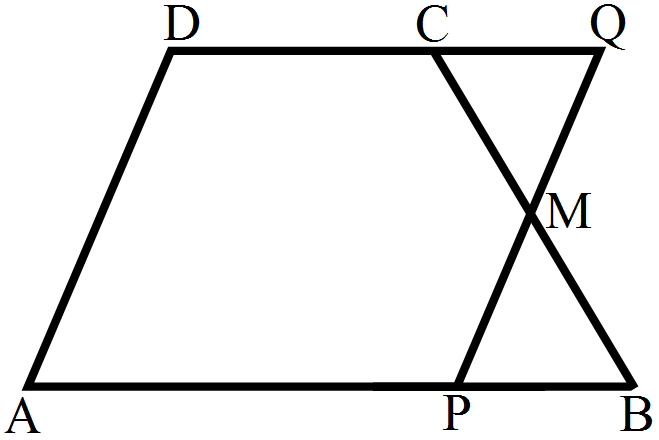
In a trapezium ABCD, AB || DC and M is the midpoint of BC. Through M, a line PQ || AD has been drawn which meets AB in P and DC produced in Q, as shown in the adjoining figure.
Prove that $\text{A}\text{(ABCD)}=\text{A}(\text{APQD}).$
Answer
In $\triangle\text{MCQ}$ and $\triangle\text{MPB},$$\angle\text{QCM}=\angle\text{PBM}$ [alternate angles]
CM = BM [M is the mid-point of BC]$\angle\text{CMQ}=\angle\text{PMB}$ [vertically opposite angles]
$\therefore\ \triangle\text{MCQ}\cong\triangle\text{MPB}$
$\Rightarrow\ \text{A}(\triangle\text{MCQ})=\text{A}(\triangle\text{MPB})$
Now,$\text{A}(\text{ABCD})=\text{A}(\text{APQD})+\text{A}(\text{DMPB})-\text{A}(\triangle\text{MCQ})$
$\Rightarrow\ \text{A}\text{(ABCD)}=\text{A}(\text{APQD})$
View full question & answer
Question 82 Marks
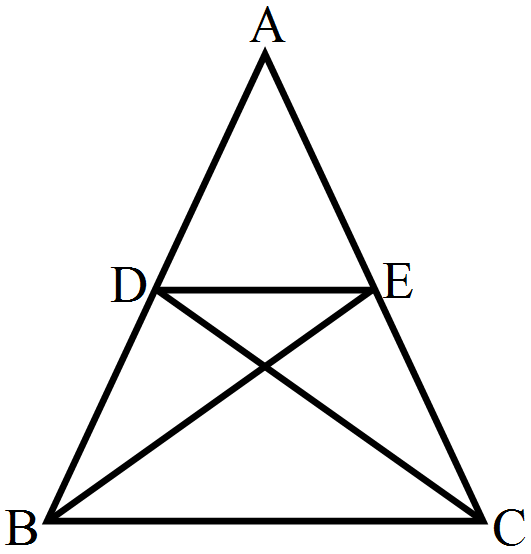
D and E are points on sides AB and AC respectively of $\triangle\text{ABC}$ such that$\text{ar}(\triangle\text{BCD})=\text{ar}(\triangle\text{BCE}).$ Prove that DE || BC.
Answer
Since $\triangle\text{BCD}$ and $\triangle\text{BCE}$ are equal in area and have a same base BC. Therefore, Altitude from D of $\triangle\text{BCD}$ = Altitude from E of $\triangle\text{BCE}.$$\Rightarrow\ \triangle\text{BCD}$ and $\triangle\text{BCE}.$ are between the same parallel lines.
⇒ DE || BC.
View full question & answer
Question 92 Marks
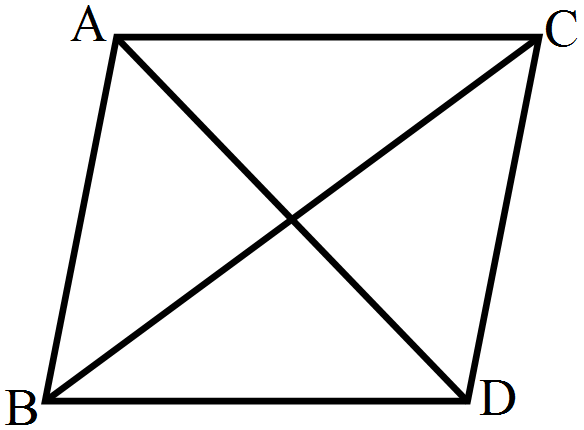
In the adjoining figure, $\triangle\text{ABC}$ and $\triangle\text{DBC}$ are on the same base BC with A and D on opposite sides of BC such that $\text{ar}(\triangle\text{ABC})=\text{ar}(\triangle\text{DBC}).$
Show that BC bisects AD.
Answer
Given:
Two triangle, $\text{i.e.}\triangle\text{ABC}$ and $\triangle\text{DBC}$ which have same base BC and point A
and D lie on opposite sides of BC and $\text{ar}(\triangle\text{ABC})=\text{ar}(\triangle\text{DBC}).$
View full question & answer