Question 15 Marks
The radius of a circle is $8\ cm$ and the length of one of its chords is $12\ cm$. Find the distance of the chord from the centre.
Answer
View full question & answer→Given that,
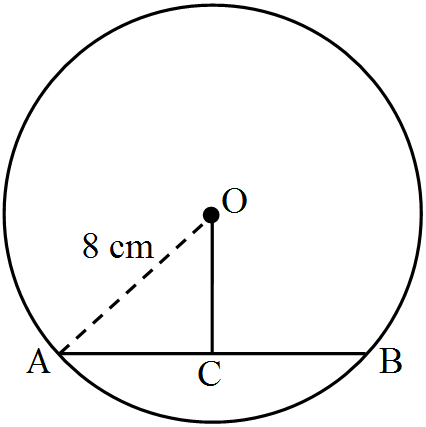
Radius of circle $(OA) = 8\ cm$
Chord $(AB) = 12\ cm Draw$
$\text{OC}\perp\text{AB}$
We know that, The perpendicular from centre to chord bisects the chord
$\therefore\text{AC}=\text{BC}=\frac{12}{2}=6$
Now in $\triangle\text{OCA,}$ by Pythagoras theorem $AC^2+ OC^2= OA^2$
$\Rightarrow 6^2 + OC^2 = 8^2$
$\Rightarrow 36 + OC^2 = 64$
$\Rightarrow OC^2 = 64 - 36$
$\Rightarrow OC^2 = 28$
$\Rightarrow\text{OC}=\sqrt{28}$
$\Rightarrow OC = 5.291\ cm$
Radius of circle $(OA) = 8\ cm$
Chord $(AB) = 12\ cm Draw$
$\text{OC}\perp\text{AB}$
We know that, The perpendicular from centre to chord bisects the chord
$\therefore\text{AC}=\text{BC}=\frac{12}{2}=6$
Now in $\triangle\text{OCA,}$ by Pythagoras theorem $AC^2+ OC^2= OA^2$
$\Rightarrow 6^2 + OC^2 = 8^2$
$\Rightarrow 36 + OC^2 = 64$
$\Rightarrow OC^2 = 64 - 36$
$\Rightarrow OC^2 = 28$
$\Rightarrow\text{OC}=\sqrt{28}$
$\Rightarrow OC = 5.291\ cm$
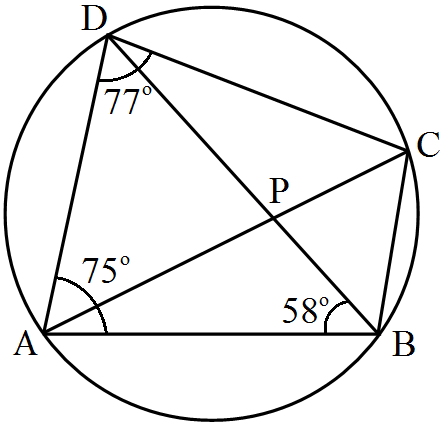
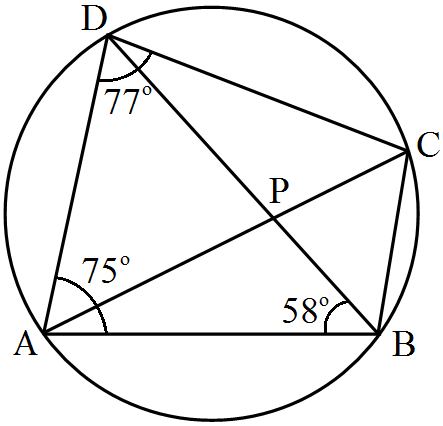 Since in a cyclic quadrilateral the opposite angles are supplementary, here$\angle\text{ADC}+\angle\text{ABD}+\angle\text{CBD}=180^\circ$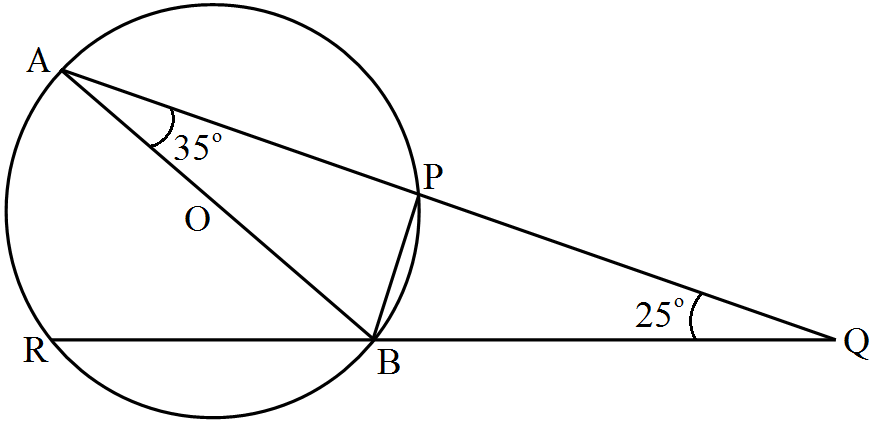
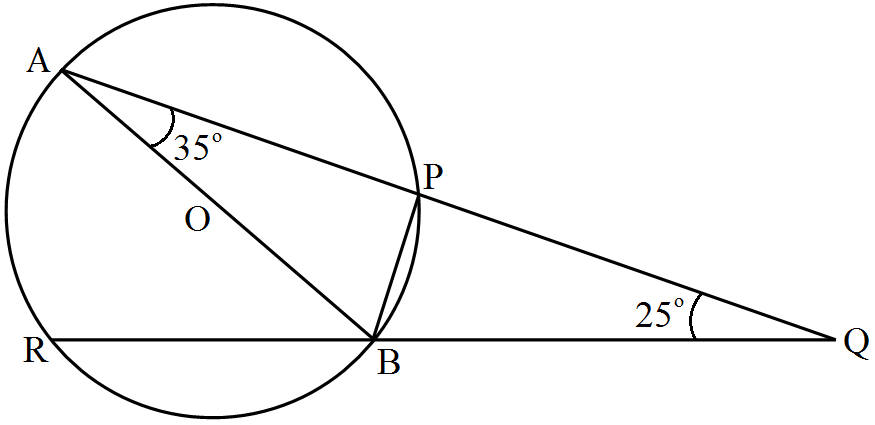 It is known that in a triangle the sum of all the interior angles add up to 180°. So here in our triangle $\triangle\text{ABQ}$ we have,$\angle\text{BAQ}+\angle\text{AQB}+\angle\text{ABQ}=180^\circ$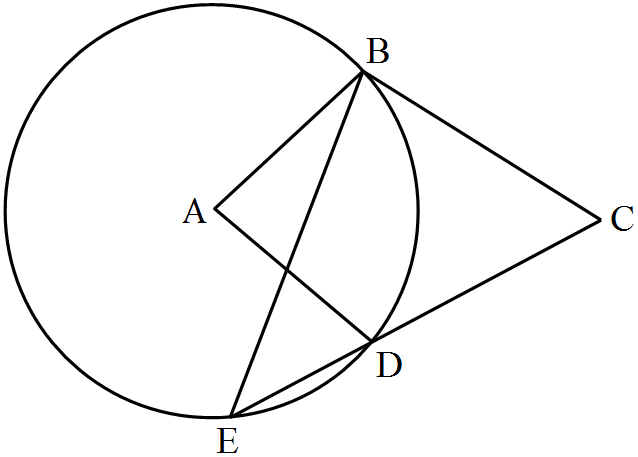
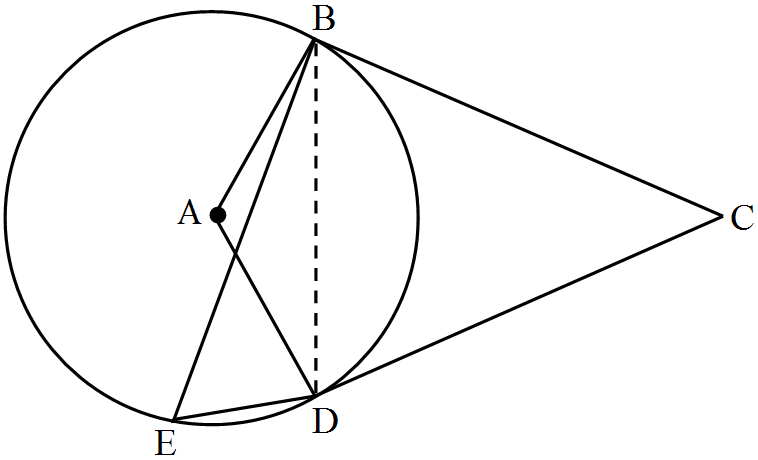 So, we have AB = AD. Whenever a parallelogram has two adjacent sides equal then it is a rhombus. So ‘ABCD’ is a rhombus. Let $\angle\text{BDE}=\text{x}^\circ.$ We know that in a circle the angle subtended by an arc at the centre of the circle is double the angle subtended by the arc in the remaining part of the circle. By this property we have$\angle\text{BAD}=2(\angle\text{BDE})$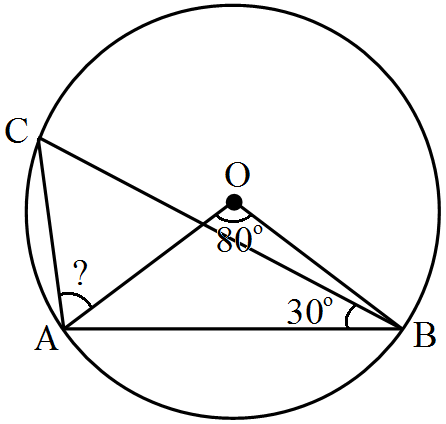
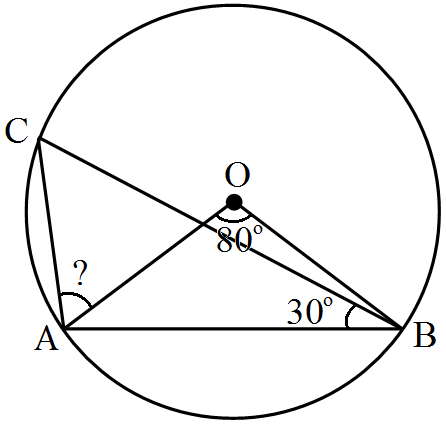 So, here we have$\angle\text{ACB}=\frac{\angle\text{AOB}}{2}$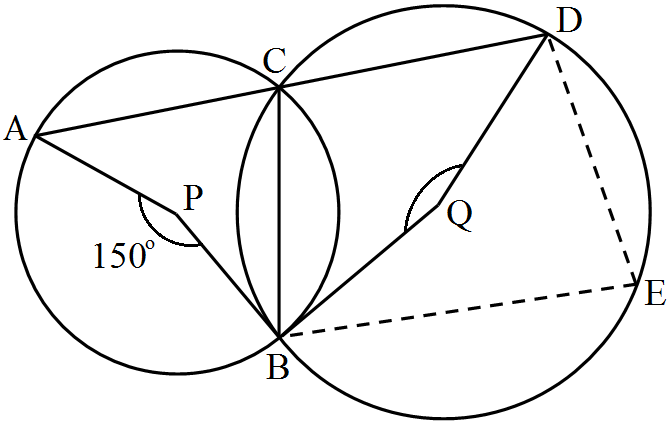
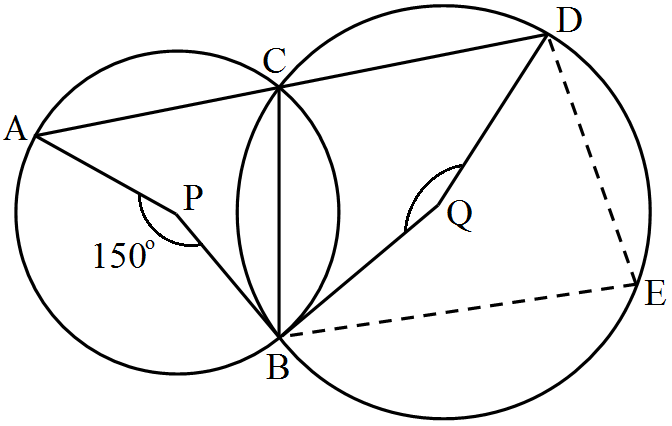 So, here we have$\angle\text{ACB}=\frac{\angle\text{APB}}{2}$