Questions

3 Mark Question

Take a timed test

14 questions · self-marked practice — reveal the answer and mark yourself.
Question 13 Marks
Prove that the quadrilateral formed by joining the midpoints of sides of a quadrilateral in order is a parallelogram.
View full question & answer
Question 23 Marks
In $\square \mathrm{PQRS}$, side $\mathrm{PS} \|$ side $\mathrm{QR}$ and side $\mathrm{PQ} \cong$ side $\mathrm{SR}$, side $\mathrm{QR}>$ side $\mathrm{PS}$ then prove that $\angle \mathrm{PQR} \cong \angle \mathrm{SRQ}$
View full question & answer
Question 33 Marks
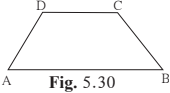
Measures of angles of $\square \mathrm{ABCD}$ are in the ratio $4: 5: 7: 8$. Show that $\square \mathrm{ABCD}$ is a trapezium.
Answer
Let measures of $\angle A, \angle B, \angle C$ and $\angle D$ are $(4 x)^{\circ},(5 x)^{\circ},(7 x)^{\circ}$, and $(8 x)^{\circ}$ respectively.
Sum of all angles of a quadrialteral is $360^{\circ}$.
$\therefore 4 x+5 x+7 x+8 x=360$
$\therefore 24 x=360 \quad \therefore x=15$
$\angle \mathrm{A}=4 \times 15=60^{\circ}, \angle \mathrm{B}=5 \times 15=75^{\circ}, \angle \mathrm{C}=7 \times 15=105^{\circ}$,
and $\angle \mathrm{D}=8 \times 15=120^{\circ}$
Now, $\angle \mathrm{B}+\angle \mathrm{C}=75^{\circ}+105^{\circ}=180^{\circ}$
$\therefore$ side $\mathrm{CD} \|$ side $\mathrm{BA}$
But $\angle \mathrm{B}+\angle \mathrm{A}=75^{\circ}+60^{\circ}=135^{\circ} \neq 180^{\circ}$
$\therefore$ side $\mathrm{BC}$ and side $\mathrm{AD}$ are not parallel
$\therefore \square \mathrm{ABCD}$ is a trapezium.
.[from (I) and (II)]
Image
View full question & answer
Question 53 Marks
$\square \mathrm{PQRS}$ is parallelogram. $\mathrm{M}$ is the midpoint of side $\mathrm{PQ}$ and $\mathrm{N}$ is the mid point of side RS. Prove that $\square$ PMNS and $\square$ MQRN are parallelograms.
View full question & answer
Question 63 Marks
Prove the Theorem : If pairs of opposite sides of a quadrilateral are congruent then that quadrilateral is a parallelogram.
View full question & answer
Question 73 Marks
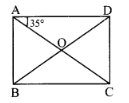
Diagonals of a rectangle ABCD intersect at point O. If AC = 8 cm, then find BO and if ∠CAD = 35°, then find ∠ACB.
Answer

Image
i. AC = 8 cm …(i) [Given]
□ABCD is a rectangle [Given]
∴ BD = AC [Diagonals of a rectangle are congruent]
∴ BD = 8 cm [From (i)]
$ BO =\frac{1}{2} BD \text { [Diagonals of a rectangle bisect each other] }$
$\therefore B O=\frac{1}{2} \times 8$
$\therefore B O=4 cm $
ii. side AD || side BC and seg AC is their transversal. [Opposite sides of a rectangle are parallel]
∴ ∠ACB = ∠CAD [Alternate angles]
∠ACB = 35° [ ∵∠CAD = 35°]
∴ BO = 4 cm, ∠ACB = 35°
View full question & answer
Question 83 Marks
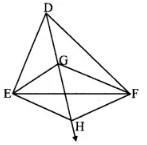
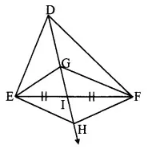
In the adjoining figure, G is the point of concurrence of medians of ADEF. Take point H on ray DG such that D-G-H and DG = GH, then prove that □GEHF is a parallelogram.

Image
Given: Point G (centroid) is the point of concurrence of the medians of ADEF.
DG = GH
To prove: □GEHF is a parallelogram.
Answer
Proof:

Image
Let ray DH intersect seg EF at point I such that E-I-F.
∴ seg DI is the median of ∆DEF.
∴ El = FI ……(i)
Point G is the centroid of ∆DEF.
$\therefore \frac{D G}{G I}=\frac{2}{1}$ [Centroid divides each median in the ratio 2:1]
∴ DG = 2(GI)
∴ GH = 2(GI) [DG = GH]
∴ GI + HI = 2(GI) [G-I-H]
∴ HI = 2(GI) – GI
∴ HI = GI ….(ii)
From (i) and (ii),
□GEHF is a parallelogram [A quadrilateral is a parallelogram, if its diagonals bisect each other]
View full question & answer
Question 93 Marks
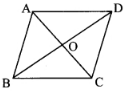
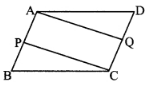
In the adjoining figure, □ABCD is a parallelogram, P and Q are midpoints of sides AB and DC respectively, then prove □APCQ is a parallelogram.Image
Given: □ABCD is a parallelogram. P and Q are the midpoints of sides AB and DC respectively.
To prove: □APCQ is a parallelogram.
Answer
Proof:
$\left.A P=\frac{1}{2} A B \ldots \text {....(i) [P is the midpoint of side } A B\right]$
$\left.Q C=\frac{1}{2} D C \ldots \text {...(ii) [Q is the midpoint of side } C D\right]$
$\square A B C D \text { is a parallelogram. [Given] }$
$\therefore A B=D C \text { [Opposite sides of a parallelogram] }$
$\left.\therefore \frac{1}{2} A B=\frac{1}{2} D C \text { [Multiplying both sides by } \frac{1}{2}\right]$
$\therefore A P=Q C \text {...(iii) [From (i) and (ii)] }$
Also, AB || DC [Opposite angles of a parallelogram]
i.e. AP || QC ….(iv) [A – P – B, D – Q – C]
From (iii) and (iv),
□APCQ is a parallelogram. [A quadrilateral is a parallelogram if its opposite sides is parallel and congruent]
View full question & answer
Question 103 Marks
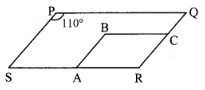
In the adjoining figure, □PQRS and □ABCR are two parallelograms. If ∠P = 110°, then find the measures of all the angles of □ABCR.
Answer

Image
□PQRS is a parallelogram. [Given]
∴ ∠R = ∠P [Opposite angles of a parallelogram]
∴ ∠R = 110° …..(iii)
□ABCR is a parallelogram. [Given]
∴ ∠A + ∠R= 180° [Adjacent angles of a parallelogram are supplementary]
∴ ∠A+ 110°= 180° [From (i)]
∴ ∠A= 180°- 110°
∴ ∠A = 70°
∴ ∠C = ∠A = 70°
∴ ∠B = ∠R= 110° [Opposite angles of a parallelogram]
∴ ∠A = 70°, ∠B = 110°,
∴ ∠C = 70°, ∠R = 110°
View full question & answer
Question 113 Marks
Diagonals of a parallelogram intersect each other at point $O$. If $A O=5$, $B O$ show that $\square A B C D$ is a rhombus.

Image

Given: $A O=5, B O=12$ and $A B=13$.
To prove: $\square A B C D$ is a rhombus.


Answer
Proof:
$AO =5, BO =12, AB =13$ [Given]
$AO ^2+ BO ^2=5^2+12^2$
$=25+144$
$\therefore AO ^2+ BO ^2=169$.....(i)
$A B^2=13^2=169 \ldots$ (ii)
$\therefore AB ^2= AO ^2+ BO ^2[$ From (i) and (ii) $]$
$\therefore \triangle A O B$ is a right-angled triangle. [Converse of Pythagoras theorem]
$\therefore \angle A O B=90^{\circ}$
$\therefore \operatorname{seg} A C \perp \operatorname{seg} B D . . .$. (iii) $[A-O-C]$
$\therefore$ In parallelogram $A B C D$,
$\therefore \operatorname{seg} A C \perp \operatorname{seg} B D[F r o m$ (iii)]
$\therefore \square A B C D$ is a rhombus. [A parallelogram is a rhombus perpendicular to each other]
View full question & answer
Question 123 Marks
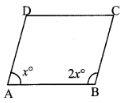
If the ratio of measures of two adjacent angles of a parallelogram is 1 : 2, find the measures of all angles of the parallelogram.
Answer

Image
i. Let □ABCD be the parallelogram.
The ratio of measures of two adjacent angles of a parallelogram is 1 : 2.
Let the common multiple be x.
∴ ∠A = x° and ∠B = 2x°
∠A + ∠B = 180° [Adjacent angles of a parallelogram are supplementary]
∴ x + 2x = 180
∴ 3x = 180
$\therefore x=\frac{180}{3}$

∴ x = 60

ii. ∠A = x° = 60°
∠B = 2x° = 2 x 60° = 120°
∠A = ∠C = 60°
∠B = ∠D= 120° [Opposite angles of a parallelogram]
∴ The measures of the angles of the parallelogram are 60°, 120°, 60° and 120°.
View full question & answer
Question 133 Marks
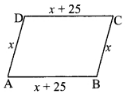
Perimeter of a parallelogram is 150 cm. One of its sides is greater than the other side by 25 cm. Find the lengths of all sides.
Answer

Image

i. Let □ABCD be the parallelogram and the length of AD be x cm.
One side is greater than the other by 25 cm.
∴ AB = x + 25 cm
AD = BC = x cm
AB = DC = (x + 25) cm [Opposite angles of a parallelogram]

ii. Perimeter of □ABCD = 150 cm [Given]
∴ AB + BC + DC + AD = 150
∴ (x + 25) +x + (x + 25) + x – 150
∴ 4x + 50 = 150
∴ 4x = 150 – 50
∴ 4x = 100
$\therefore x=\frac{100}{4}$

∴ x = 25

iii. AD = BC = x = 25 cm
AB = DC = x + 25 = 25 + 25 = 50 cm
∴ The lengths of the sides of the parallelogram are 25 cm, 50 cm, 25 cm and 50 cm.

View full question & answer
Question 143 Marks
Diagonals of a parallelogram WXYZ intersect each other at point O. If ∠XYZ∠ = 135°, then measure of ∠XWZ and ∠YZW? If l(OY) = 5 cm, then l(WY) = ?
Answer

i. ∠XYZ = 135°
□WXYZ is a parallelogram.
∠XWZ = ∠XYZ
∴ ∠XWZ = 135° …..(i)

ii. ∠YZW + ∠XYZ = 180° [Adjacent angles of a parallelogram are supplementary]
∴ ∠YZW + 135°= 180° [From (i)]
∴ ∠YZW = 180°- 135°
∴ ∠YZW = 45°

iii. l(OY) = 5 cm [Given]
$I(O Y)=\frac{1}{2} I(W Y)$ [Diagonals of a parallelogram bisect each other]
∴ l(WY) = 2 x l(OY)
= 2 x 5
∴ l(WY) = 10 cm
∴∠XWZ = 135°, ∠YZW = 45°, l(WY) = 10 cm

View full question & answer