Question 12 Marks
If n(A) = 7, n(B) = 13, n(A ∩ B) = 4, then n(A ∪ B) = ?
Answer
View full question & answer→n(A ∪ B) = n(A) + n(B) – n(A ∩ B)
= 7 + 13 – 4
n(A ∪ B) = 16
= 7 + 13 – 4
n(A ∪ B) = 16
20 questions · self-marked practice — reveal the answer and mark yourself.
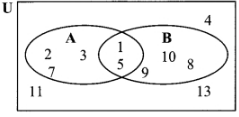
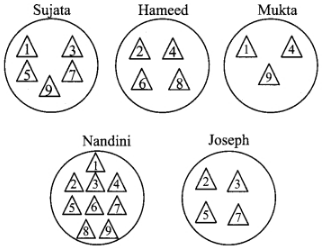
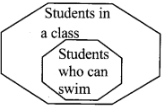
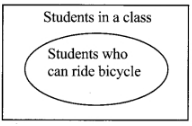
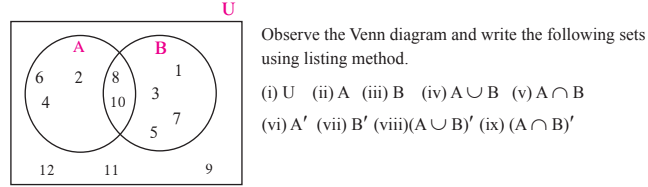
Observe the diagram and draw Venn diagrams for the following subsets.
i. a. Set of students in a class
b. Set of students who can ride bicycles in the same class
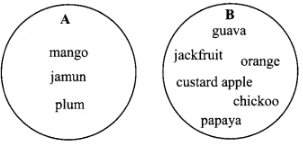
ii. A set of fruits is given as follows.
U = {guava, orange, mango, jackfruit, chickoo, jamun, custard apple, papaya, plum}
Show these subsets.
A = fruit with one seed
B = fruit with more than one seed.
ii. A = {mango, jamun, plum}
B = {guava, orange, jackfruit, chickoo, custard apple, papaya}
ii. B is a set of letters of the word ‘SCIENCE’. Listing method : B = {S, C, I, E, N}
Rule method: B = {x \ x is a letter of the word ‘SCIENCE’}