Questions

3 Mark Question

Take a timed test

10 questions · self-marked practice — reveal the answer and mark yourself.

Question 13 Marks
The exterior angles, obtained on producing the base of a triangle both ways are $104^{\circ}$ and $136^{\circ}$. Find all the angles of the triangle.
Answer
$\angle\text{ACD}=\angle\text{ABC}+\angle\text{BAC}$ [Exterior angle property]Now $\angle\text{ABC}=180^\circ-136^\circ=44^\circ$ [Linera pair]
$\angle\text{ACB}=180^\circ-104^\circ=76^\circ$ [Linera pair]
Now, In $\triangle\text{ABC}$
$\angle\text{A}+\angle\text{ABC}+\angle\text{ACB}=180^\circ$ [Sum of all angles of a triangle]
$\Rightarrow\angle\text{A}+44^\circ+76^\circ=180^\circ$
$\Rightarrow\angle\text{A}+180^\circ-44^\circ-76^\circ$
$\Rightarrow\angle\text{A}=60^\circ$
View full question & answer
Question 23 Marks
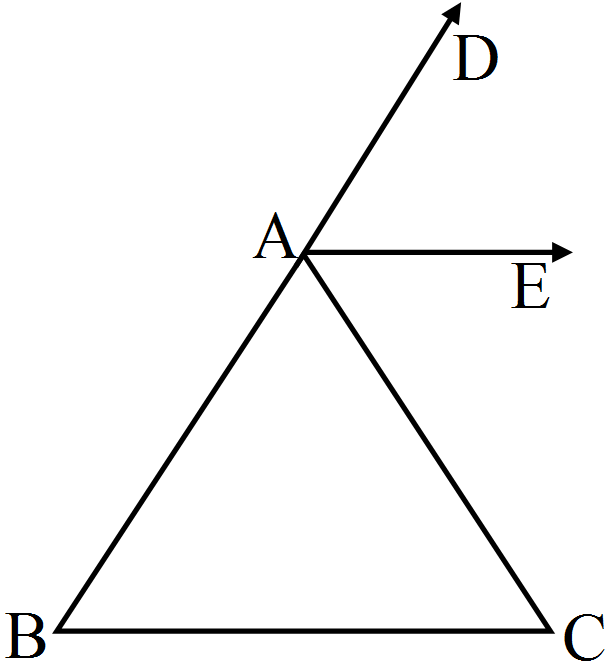
In figure AE bisects $\angle\text{CAD}$ and $\angle\text{B}=\angle\text{C}.$ Prove that AE || BC.
Answer
Let $\angle\text{B}=\angle\text{C}=\text{x}$ Then,$\angle\text{CAD}=\angle\text{B}+\angle\text{C}=2\text{x}$ (exterior angle)
$\Rightarrow\frac{1}{2}\angle\text{CAD}=\text{x}$
$\Rightarrow\angle\text{EAC}=\text{x}$
$\Rightarrow\angle\text{EAC}=\angle\text{C}$
These are alternate interior angles for the lines AE and BC$\therefore\text{AE }||\text{ BC}$
View full question & answer
Question 33 Marks
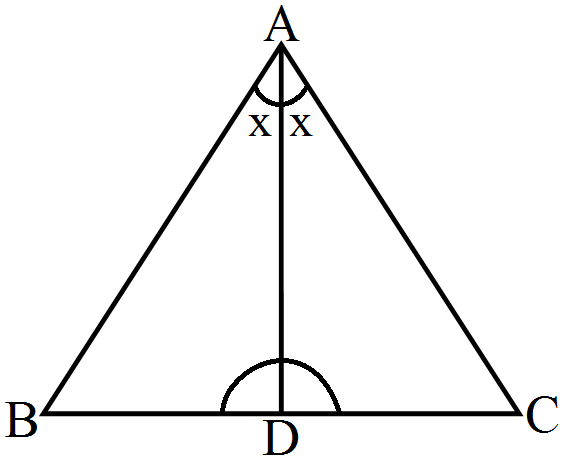
In a $\triangle\text{ ABC},\text{ AD}$ bisects $\angle\text{A}$ and $\angle\text{C} > \angle\text{B}.$. Prove that $\angle\text{ADB} > \angle\text{ADC}.$
Answer
$\therefore\angle\text{C}>\angle\text{B}$ [Given]
$\Rightarrow\angle\text{C}+\text{x} > \angle\text{B}+\text{x}$ [Adding x on both sides]
$\Rightarrow180^\circ-\angle\text{ADC}>180^\circ-\angle\text{ADB}$
$\Rightarrow-\angle\text{ADC}>-\angle\text{ADB}$
$\Rightarrow\angle\text{ADB}>\angle\text{ADC}$
hence proved.
View full question & answer
Question 43 Marks
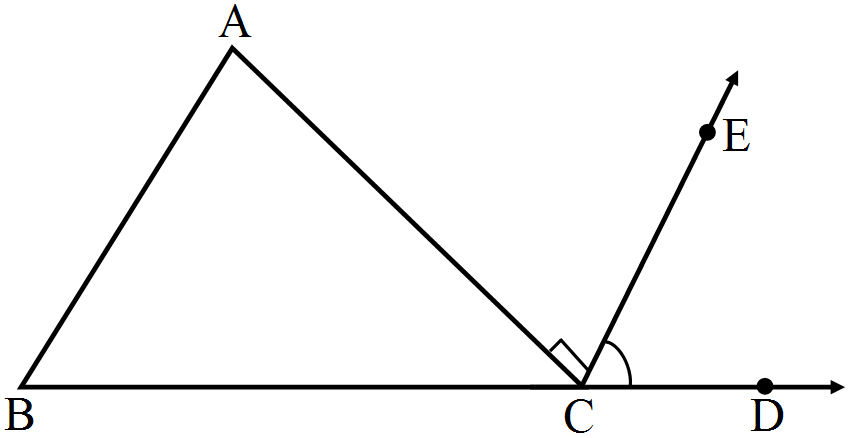
In Fig. $\text{AC}\perp\text{CE}$ and $\angle\text{A}:\angle\text{B}:\angle\text{C}=3:2:1,$ find the value of $\angle\text{ECD}.$
Answer
$\angle\text{A}:\angle\text{B}:\angle\text{C}=3:2:1$Let the angles be 3x, 2x and x
⇒ 3x + 2x + x = 180° [Angle sum property]
⇒ 6x = 180°
$\Rightarrow\text{x}=30=\angle\text{ACB}$
$\therefore\angle\text{ECD}=180^\circ-\angle\text{ACB}-90^\circ$ ° [Linear pair]
$=180^\circ-30^\circ-90^\circ$
$=60^\circ$
$\therefore\angle\text{ECD}=60^\circ$
View full question & answer
Question 53 Marks
Two angles of a triangle are equal and the third angle is greater than each of those angles by 30º. Determine all the angles of the triangle.
Answer
Given that,
Two angles of a triangle are equal and the third angle is greater than each of those angles by 30°.
Let x, x, x + 30° be the angles of a triangle
We know that,
Sum of all angles in a triangle is 180°
x + x + x + 30° = 180°
3x + 30° = 180°
3x = 180° - 30°
3x = 150°
x = 50°
Therefore, the three angles are 50°, 50°, 80°.
View full question & answer
Question 63 Marks
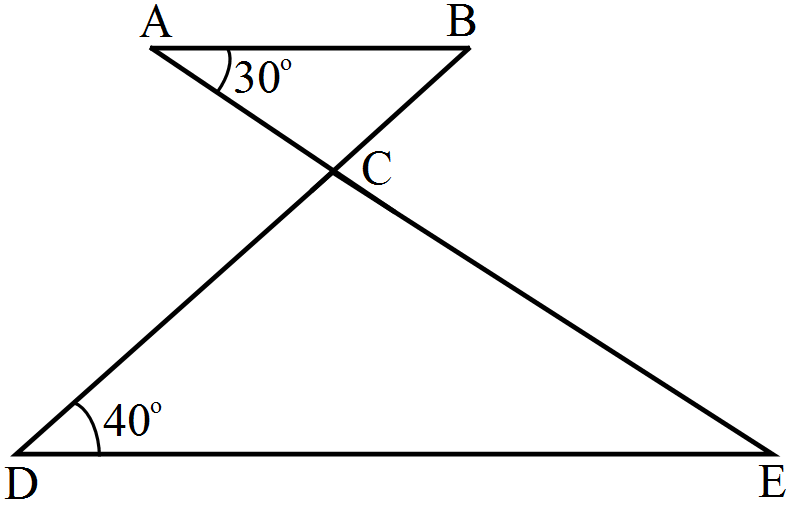
In Fig. AB || DE Find $\angle\text{ACD}.$
Answer
Since AB || DE$\therefore\angle\text{ABC}=\angle\text{CDE}=40^\circ$ [Alternate angles]
$\therefore\angle\text{ACB}=180^\circ-\angle\text{ABC}-\angle\text{BAC}$
$=180^\circ-40^\circ-30^\circ$
$=110^\circ$
$\therefore\angle\text{ACD}=180^\circ-110^\circ$ [Linear pair]
$=70^\circ$
View full question & answer
Question 73 Marks
If the angles of a triangle are in the ratio 1 : 2 : 3, determine three angles.
Answer
Given Data: Angles of a triangle are in the ratio 1: 2: 3 Let the angles be x, 2x, 3x$\therefore$ We know that,
Sum of all angles of triangles is 180°$\text{x}+2\text{x}+3\text{x}=180^\circ$
$\Rightarrow6\text{x}=180^\circ$
$\Rightarrow\text{x}=\frac{180^\circ}{6}$
$\Rightarrow\text{x}=30^\circ$
Since $\text{x}=30^\circ$ 2x = 2(30)° = 60° 3x = 3(30)° = 90° Therefore, angles are 30°, 60°, 90°.
View full question & answer
Question 83 Marks
In a $\triangle\text{ABC},$ if $\angle\text{A}=55^\circ,\angle\text{B}=40^\circ,$ find $\angle\text{C}.$
Answer
Given Data:$\angle\text{B}=55^\circ,\angle\text{B}=40^\circ,$ then $\angle\text{C}=?$
We know that In a $\triangle\text{ABC}$ sum of all angles of a triangle is 180° i.e., $\angle\text{A}+\angle\text{B}+\angle\text{C}=180^\circ$$\Rightarrow55^\circ+40^\circ+\angle\text{C}=180^\circ$
$\Rightarrow95^\circ+\angle\text{C}=180^\circ$
$\Rightarrow\angle\text{C}=180^\circ-95^\circ$
$\Rightarrow\angle\text{C}=85^\circ$
View full question & answer
Question 93 Marks
The angles of a triangle are (x - 40)º, (x - 20)º and $\Big(\frac{1}{2}\text{x}-10\Big)^\circ.$ Find the value of x.
Answer
Given that, The angles of a triangle are$(\text{x}-40^\circ),(\text{x}-20^\circ)$ and $\Big(\frac{1}{2}\text{x}-10^\circ\Big)$
We know that, Sum of all angles of triangle is 180°$\therefore(\text{x}-40^\circ)+(\text{x}-20^\circ)+\Big(\frac{1}{2}\text{x}-10^\circ\Big)=180^\circ$
$2\text{x}+\frac{1}{2}\text{x}-70^\circ=180^\circ$
$\frac{5}{2}\text{x}=180^\circ+70^\circ$
$5\text{x}=2(250)^\circ$
$\text{x}=\frac{500^\circ}{5}$
$\therefore\text{x}=100^\circ$
View full question & answer
Question 103 Marks
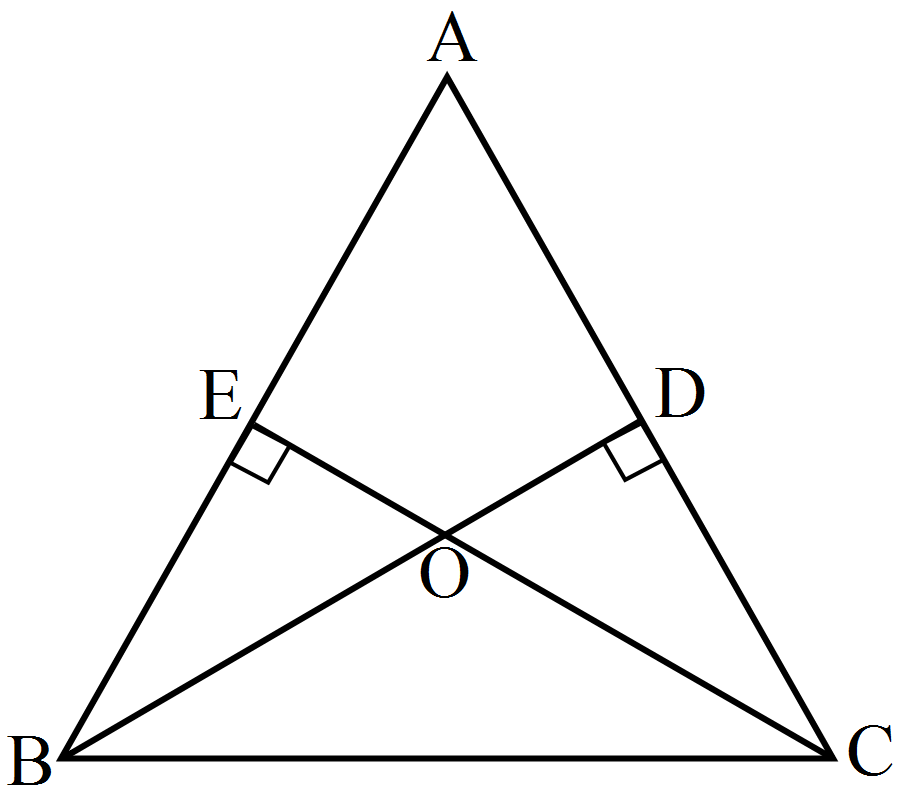
In a $\triangle\text{ ABC},\text{ BD}\perp\text{AC}$ and $\text{ CE}\perp\text{AB}.$ If BD and CE intersect O, prove that $\angle\text{BOC}=180^\circ-\text{A}.$
Answer
In quadrilateral AEOD$\angle\text{A}+\angle\text{AEO}+\angle\text{EOD}+\angle\text{ADO}=360^\circ$
$\Rightarrow\angle\text{A}+90^\circ+90^\circ+\angle\text{EOD}=360^\circ$
$\Rightarrow\angle\text{A}+\angle\text{BOC}=180^\circ$ $[\therefore\angle\text{EOD}=\angle\text{BOC}$ vertically opposite angles$]$
$\Rightarrow\angle\text{BOC}=180^\circ-\angle\text{A}$
View full question & answer
3 Mark Question - Maths STD 9 Questions - Vidyadip