In ∆TPQ, if ∠T = 65°, ∠P = 95° , Which of the following is a true statement?
- APQ < TP
- ✓PQ < TQ
- CTQ < TP < PQ
- DPQ < TP < TQ
Answer: B.
View full solution →68 questions across 7 question groups — pick any mix to generate a Maths paper with step-by-step answer keys.
MCQ(1M)
3 Q→021 Mark Question
6 Q→032 Mark Question
26 Q→043 Mark Question
18 Q→054 Mark Question
6 Q→065 Mark Question
7 Q→07Activity Based Questions.
2 Q→One sample from each question group in this chapter. Select any group above to see the full set with answer keys.
Answer: B.
View full solution →Answer: B.
View full solution →Answer: D.
View full solution →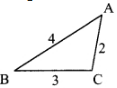
Number of triangle: 1
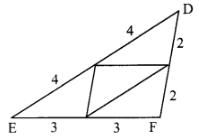
Number of triangles: 4
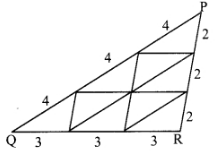
Number of triangles: 9
∆ABC and ∆DEF are similar in the correspondence ABC ↔ DEF.
∠A ≅ ∠D, ∠B ≅ ∠E, ∠C ≅ ∠F
and $\frac{ AB }{ DE }=\frac{4}{8}=\frac{1}{2} ; \frac{ BC }{ EF }=\frac{3}{6}=\frac{1}{2} ; \frac{ AC }{ DF }=\frac{2}{4}=\frac{1}{2} \ldots$ the corresponding sides are inproportion.
Similarly, consider ∆DEF and ∆PQR. Are their angles congruent and sides proportional in the correspondence DEF ↔ PQR?
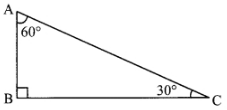

Did you notice any property of sides of right angled triangle with one of the angles measuring 30°?
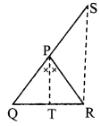
Given: Seg PT is the bisector of ∠QPR.
To prove: PS = PR
Construction: Draw seg SR || seg PT.
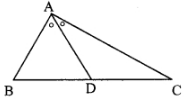
Given: Bisector of ∠BAC intersects side BC at point D.
To prove: AB > BD
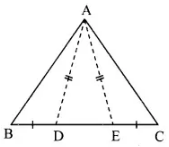
Given: Points D and E are on side BC of ∆ABC,
such that BD = CE and AD = AE.
To prove: ∆ABD ≅ ∆ACE
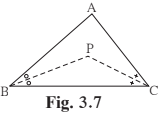
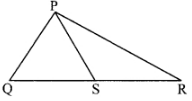
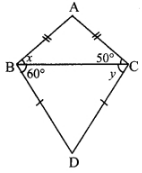
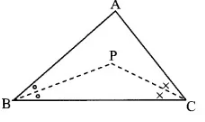
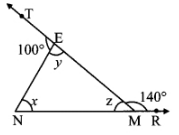
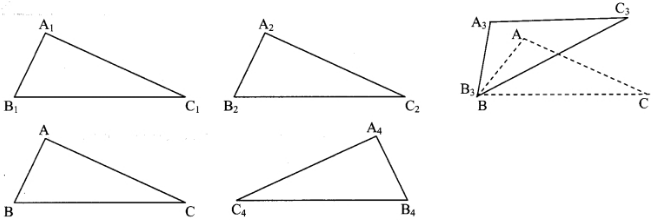
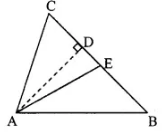
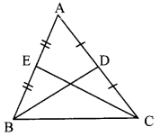
Given: In isosceles ∆ABC, AB = AC. seg BD and seg CE are the medians of ∆ABC.
To prove: BD = CE
Pick question groups from the list above, set marks and difficulty, and export a branded PDF with step-by-step answer keys. First 3 chapters free — no signup.