Questions

5 Mark Question

Take a timed test

5 questions · self-marked practice — reveal the answer and mark yourself.

Question 15 Marks
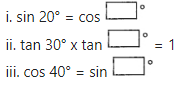
Fill in the blanks.
Image

Answer
i. sin 20° = cos (90° – 20°) …..[∵ sin θ = cos (90 – θ)]
= cos 70°

ii. tan θ x tan (90 – θ) = 1
Substituting θ = 30°,
tan 30° x tan (90 – 30)° = 1
∴ tan 30° x tan 60° = 1

iii. cos 40° = sin (90° – 40°) …[∵ COS θ = sin (90 – θ)]
= sin 50°
View full question & answer
Question 25 Marks
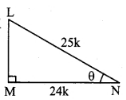
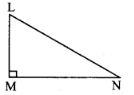
In right angled $\triangle LMN$, if $\angle N =\theta, \angle M =90^{\circ}, \cos \theta=\frac{24}{25}$, find $\sin \theta$ and $\tan \theta$. Similarly, find $\left(\sin ^2 \theta\right)$ and $\left(\cos ^2 \theta\right)$
Image
Answer
$\text { i. } \cos \theta=\frac{24}{25}$
$\text { In } \Delta LMN , \angle M =90^{\circ}, \angle N =\theta$
$\therefore \quad \cos \theta=\frac{\text { Adjacent side of } \theta}{\text { Hypotenuse }}$
$\therefore \quad \cos \theta=\frac{ MN }{ LN } \quad \ldots \text { (ii) }$
$\therefore \quad \frac{ MN }{ LN }=\frac{24}{25}$
Image
Let the common multiple be k.
$\therefore MN = 24k$ and $LN = 25k$
Now, $LN^2= LM^2 + MN^2 … [Pythagoras theorem]$
$\therefore (25k)^2 = LM^2 + (24k)^2$
$\therefore 625 k^2 = LM^2 + 576k^2$
$\therefore LM^2 = 625k^2 – 576k^2$
$\therefore LM^2 = 49k^2$
$\therefore LM =\sqrt{49 k^2} \ldots \text {.TTaking square root of both sides] }$
$=7 k$
$\text { ii. } \sin \theta=\frac{\text { Opposite side of } \theta}{\text { Hypotenuse }}=\frac{L M}{L N}=\frac{7 k }{25 k }=\frac{7}{25}$
$\therefore \quad \sin ^2 \theta=(\sin \theta)^2=\left(\frac{7}{25}\right)^2=\frac{49}{625}$
iii. $\tan \theta=\frac{\text { Opposite side of } \theta}{\text { Adjacent side of } \theta}=\frac{ LM }{ MN }=\frac{7 k }{24 k }=\frac{7}{24}$
iv. $\cos \theta=\frac{24}{25}$
...[Given]
$\therefore \quad \cos ^2 \theta=(\cos \theta)^2=\left(\frac{24}{25}\right)^2=\frac{576}{625}$
View full question & answer
Question 35 Marks
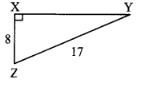
In right angled $\triangle Y X Z, \angle X=90^{\circ}, X Z=8 cm, Y Z=17 cm$, find $\sin Y, \cos Y, \tan Y, \sin Z, \cos Z, \tan Z$.
Image
Answer
i. $XZ = 8 cm, YZ = 17 cm …[Given]$
$In \triangle YXZ, \angle X = 90^\circ … [Given]$
$\therefore YZ^2 = XY^2 + XZ^2 .. .[Pythagoras theorem]$
$\therefore 17^2 = XY^2 + 8^2$
$\therefore 289 = XY^2 + 64$
$\therefore XY^2 = 289 – 64$
$= 225$
$\therefore x=\sqrt{225} \ldots$.. [Taking square root of both sides] $=15$
ii. $\sin Y=\frac{\text { Opposite side of } \angle Y}{\text { Hypotenuse }}=\frac{X Z}{Y Z}=\frac{ 8 }{17}$
iii. $\cos Y =\frac{\text { Adjacent side of } \angle Y }{\text { Hypotenuse }}=\frac{ XY }{ YZ }=\frac{15}{17}$
iv. $\tan Y=\frac{\text { Opposite side of } \angle Y}{\text { Adjacent side of } \angle Y}=\frac{X Z}{X Y}=\frac{8}{15}$
v. $\sin Z=\frac{\text { Opposite side of } \angle Z}{\text { Hypotenuse }}=\frac{X Y}{Y Z}=\frac{15}{17}$
vi. $\cos Z =\frac{\text { Adjacent side of } \angle Z }{\text { Hypotenuse }}=\frac{ XZ }{ YZ }=\frac{8}{17}$
vii. $\tan Z=\frac{\text { Opposite side of } \angle Z}{\text { Adjacent side of } \angle Z}=\frac{X Y}{X Z}=\frac{15}{8}$
View full question & answer
Question 45 Marks
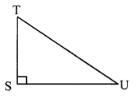
In right angled $\triangle T S U, T S=5, \angle S=90^{\circ}, S U=12$, then find $\sin T, \cos T$, $\tan T$. Similarly find $\sin U, \cos U, \tan U$.


Image
Answer
i. $T S=5, S U=12 \ldots$ [Given]
In $\triangle T S U, \angle S=90^{\circ} \ldots$ [Given]
$\therefore TU ^2= TS ^2+ SU ^2 \ldots[$ Pythagoras theorem]
$=5^2+12^2=25+144=169$
$\therefore TU =\sqrt{169} \ldots$. [Taking square root of both sides] $=13$
ii. $\sin T =\frac{\text { Opposite side of } \angle T }{\text { Hypotenuse }}=\frac{ SU }{ TU }=\frac{12}{13}$
iii. $\quad \cos T =\frac{\text { Adjacent side of } \angle T }{\text { Hypotenuse }}=\frac{ TS }{ TU }=\frac{5}{13}$
iv. $\tan T=\frac{\text { Opposite side of } \angle T}{\text { Adjacent side of } \angle T}=\frac{S U}{T S}=\frac{12}{5}$
v. $\quad \sin U =\frac{\text { Opposite side of } \angle U }{\text { Hypotenuse }}=\frac{ TS }{ TU }=\frac{5}{13}$
vi. $\quad \cos U =\frac{\text { Adjacent side of } \angle U }{\text { Hypotenuse }}=\frac{ SU }{ TU }=\frac{12}{13}$
vii. $\tan U=\frac{\text { Opposite side of } \angle U}{\text { Adjacent side of } \angle U}=\frac{ TS }{ SU }=\frac{ 5 }{ 1 2 }$
View full question & answer
Question 55 Marks
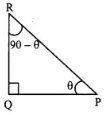
In right angled ∆PQR, ∠Q = 900. Therefore ∠P and ∠R are complementary angles of each other. Verify the following ratios.
i. sin θ = cos (90 – θ)
ii. cos θ = sin (90 – θ)
iii. sin 30° = cos (90° – 30°) = cos 60°
iv. cos 30° = sin (90° – 30°) = sin 60°
Answer
In ∆PQR, ∠Q = 90°, ∠P = θ
∴ ∠R = 90 – θImage
i. sin θ = cos (90 – θ)
$\sin \theta=\frac{\text { Opposite side of } \theta}{\text { Hypotenuse }}$
$=\frac{ QR }{ PR }$
$\cos (90-\theta)=\frac{\text { Adjacent side of } \theta}{\text { Hypotenuse }}$
$=\frac{ QR }{ PR }$
$\therefore \quad \sin \theta=\cos (90-\theta)$
ii. cos θ = sin (90 – θ)
$\begin{aligned} \cos \theta & =\frac{\text { Adjacent side of } \theta}{\text { Hypotenuse }} \\ & =\frac{P Q}{P R} \\ \sin (90-\theta) & =\frac{\text { Opposite side of } \theta}{\text { Hypotenuse }} \\ & =\frac{P Q}{P R} \\ \therefore \quad \cos \theta & =\sin (90-\theta) \quad \ldots \text { (ii) }\end{aligned}$
iii. Let ∠P = θ = 30°
∴ ∠R = 90° – 30°
$\begin{aligned} \sin 30^{\circ} & =\frac{\text { Opposite side of } 30^{\circ}}{\text { Hypotenuse }} \\ & =\frac{ QR }{ PR } \\ \cos \left(90^{\circ}-30^{\circ}\right) & =\frac{\text { Adjacent side of }\left(90^{\circ}-30^{\circ}\right)}{\text { Hypotenuse }} \\ & =\frac{ QR }{ PR } \quad \ldots(\text { ii })\end{aligned}$
sin 30° = cos (90° – 30°) … [From (i) and (ii)]
sin 30° = cos 60°
iv. cos 30° = sin (90° – 30°) = sin 60°
$\cos 30^{\circ}=\frac{\text { Adjacent side of } 30^{\circ}}{\text { Hypotenuse }} \ldots\left[\because \theta=30^{\circ}\right]$
$=\frac{P Q}{P R}$
$\sin \left(90^{\circ}-30^{\circ}\right)=\frac{\text { Opposite side of }\left(90^{\circ}-30^{\circ}\right)}{\text { Hypotenuse }}$
$=\frac{P Q}{P R}$
∴ cos 30° = sin (90° – 30°) .,.[From (i) and (ii)]
∴ cos 30° = sin 60°
View full question & answer