Questions

Answer the following question.

Take a timed test

13 questions · self-marked practice — reveal the answer and mark yourself.

Question 15 Marks
Sickle cell anaemia: symptoms and treatment.
Answer
  • Sickle-cell anaemia is a hereditary disease caused due to mutation in a single gene. It is a monogenic disorder.
  • Normal haemoglobin has glutamic acid as the 6th amino acid in its molecular structure. However, if it is replaced by valine, the shape/structure of the haemoglobin molecule, changes.
  • Due to this, the erythrocytes (RBCs) which are normally biconcave become sickle-shaped. This condition is called sickle-cell anaemia. The oxygen-carrying capacity of haemoglobin in such individuals is very low.
  • In this condition, clumping and thereby, destruction of erythrocytes occurs most often. As a result, blood vessels are obstructed and the circulatory system, brain, lungs, kidneys, etc. are damaged.
  • Symptoms of sickle-cell anaemia are swelling of legs and hands, pain in joints, severe general body aches, frequent cold and cough, constant low-grade fever, exhaustion, pale face, low haemoglobin count.
  • A person suffering from sickle-cell anaemia should take a tablet of folic acid daily.
View full question & answer
Question 25 Marks
Monogenic disorders
Answer
  • Disorders occurring due to mutation in any single gene into a defective one are called monogenic disorders.
  • Approximately 4000 disorders of this type are now known.
  • Due to abnormal genes, their products are either produced in insufficient quantity or not produced at all.
  • It causes abnormal metabolism and may lead to death at a tender age.
  • Examples of monogenic disorders are Hutchinson’s disease, Tay-Sachs disease, galactosaemia, phenylketonuria, sickle cell anaemia, cyctic fibrosis, albinism, haemophilia, night blindness etc.
View full question & answer
Question 35 Marks
Down syndrome
Answer
  • Down syndrome is the disorder arising due to chromosomal abnormality.
  • This is the first discovered and described the chromosomal disorder in human beings.
  • This disorder is characterized by the presence of 47 chromosomes. It is described as the trisomy of the 21st pair.
  • Infants with this disorder have one extra chromosome with the 21st pair in every cell of the body. Therefore, they have 47 chromosomes instead of 46.
  • Children suffering from Down syndrome are usually mentally retarded and have a short lifespan. Mental retardation is the most prominent characteristic.
  • Other symptoms include short height, short wide neck, flat nose, short fingers, scanty hair, single horizontal crease on palm and a life expectancy of about 16-20 years.
View full question & answer
Question 45 Marks
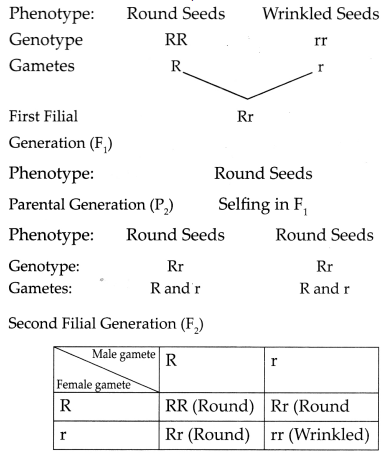
Show the monohybrid cross between (RR) and (rr) and write the phenotypic and genotypic ratio of $F _2$ generation.
Answer
Parental Generation $\left( P _1\right)$

Image

Phenotypic ratio : 3 Round : 1 Wrinkled
Genotypic ratio : 1 RR : 2 Rr : 1 rr

View full question & answer
Question 55 Marks
How do specific traits or characteristics appear in organisms?
Answer
  • Information necessary for synthesis of a particular protein is stored in the DNA.
  • The segment of DNA which contains all the information for synthesis of a particular protein is called a gene for that protein.
  • To understand how a specific trait is expressed, let us consider plant height as an example.
  • We know that there are growth hormones in plants. Increase in the height of plants depends upon the quantity of growth hormones.
  • The quantity of growth hormone produced by a plant depends upon the efficiency of the concerned enzyme.
  • Efficient enzymes produce a greater quantity of the hormone due to which the height of the plant increases.
  • However, if the enzymes are less efficient, a smaller quantity of hormone is produced leading to the stunting of the plant.
  • Thus, the expression of traits is controlled by the genes.
View full question & answer
Question 65 Marks
Distinguish between monohybrid and dihybrid cross.
Answer
Monohybrid crossDihybrid cross
(i) Cross involving a single pair of contrasting characters is called monohybrid cross.(i) Cross involving two pairs of contrasting characters is called a dihybrid cross.
(ii) F1 plants of monohybrid cross produce two types of gametes.(ii) F1 plants of dihybrid cross produce four types of gametes.
(iii) Monohybrid cross has a phenotypic ratio of 3 : 1 in F2 generation.(iii) Dihybrid cross has a phenotypic ratio of 9 : 3 : 3 : 1 in F2 generation.
View full question & answer
Question 75 Marks
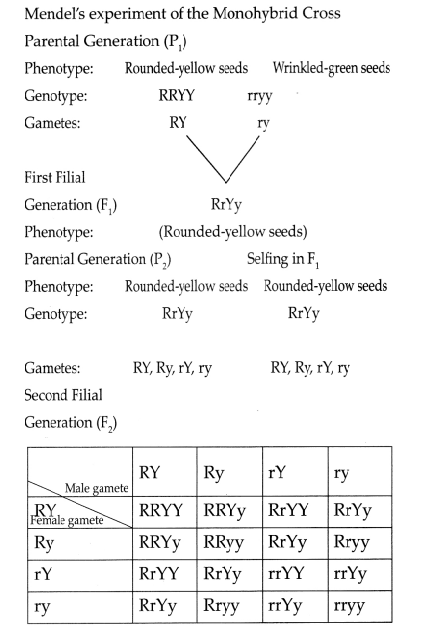
Explain Mendel’s dihybrid ratio with the help of any one cross.
Answer
    • In dihybrid cross, Mendel considered two pairs of contrasting characters.
    • He made a cross between a pea plant producing rounded and yellow couloured seeds and a pea plant with wrinkled and green coloured seeds.
Image
    • All the plants produced in $F_1$_ generation had rounded yellow seeds. This is because in pea plants, round shape of seed is dominant over wrinkled shape and yellow colour of seed is dominant over green colour.
    • When $F_1$ plants are self pollinated, they produce four types of gamates – $RY, Ry, rY, ry.$
    • $F_2$ plants formed by the fusion of four types of male gametes and four types of female gametes, had phenotypes such as round yellow, wrinkled yellow, round green and wrinkled green.
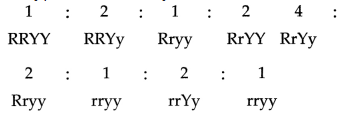
    • Also, $F_2$ generation showed nine different types of genotypes such as $RRYY, RRYy, RRyy, RrYY, RrYy, Rryy, rrYY, rrYy, rryy$.
    • Phenotypic ratio of dihybrid cross is
Image
The genotypic ratio of dihybrid cross is
Image
View full question & answer
Question 85 Marks
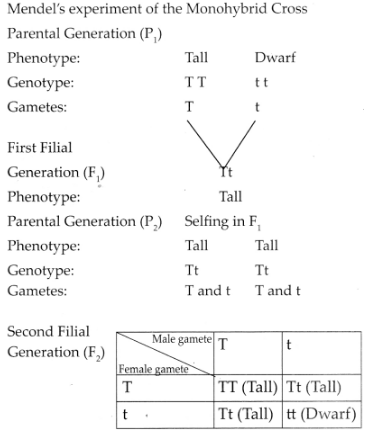
Explain Mendel’s monohybrid progeny with the help of any one cross.
Answer
  • Mendel brought about a cross between two pea plants with only pair of contrasting characters. This type of cross is called a monohybrid cross.
  • Tall pea plants and dwarf pea plants were used in this cross. Hence this is parent generation $(P_1)$.
Image
  • All the plants produced in $F _1$ genration are tall, having genotype Tt . This indicates that the gene responsible for tallness in pea plants is dominant over the gene responsible for dwarfness.
  • When $F_1$ plants are self pollinated they produce second filial generation $\left(F_2\right)$.
  • In $F_2$ generation both tall and dwarf plants appeared in the ratio $3:1.$
  • Thus, the genotypic ratio of $F _2$ generation is $3$ (Tall) : $1$ (Dwarf) and the genotypic ratio is $1 TT : 2 Tt : 1 tt$.
View full question & answer
Question 95 Marks
Which were the seven pairs of contrasting characteristics studied by Mendel in pea plant?
Answer
The seven pairs of contrasting characters studied by Mendel in pea plant were as follows:
CharactersDominantRecessive
Shape of the seedRound(R)Wrinkled (r)
Colour of the seedYellow (Y)Green (y)
Colour of the flowerPurple (C)White (c)
Shape of podInflated (I)Constricted (i)
Colour of podGreen (G)Yellow (g)
Position of flowerAxillary (A)Terminal (a)
Height of the plantTall (T)Dwarf (t)
View full question & answer
Question 105 Marks
Name some dominant and recessive characteristics seen in human beings.
Answer
Some dominant and recessive characteristics of human beings.
DominantRecessive
Rolling tongueNon-rolling tongue
Presence of hair on armsAbsence of hair on arms
Black and curly hairBrown and straight hair
Free earlobeAttached earlobe
View full question & answer
Question 115 Marks
What are the main objectives of National Health Mission?
Answer
The main objectives of National Health Mission are:
  • Strengthening of the rural and urban health facilities.
  • Controlling various diseases and illnesses.
  • Increasing public awareness about health.
  • Offering financial assistance to patients through various schemes.
View full question & answer
Question 125 Marks
Complete the table for number of chromosomes in different organisms.
Answer
OrganismNo. of Chromosomes
Crab200
Maize20
Frog26
Roundworm04
Potato48
Human46
Dog78
Elephant56
Fruit fly08
Mango40
View full question & answer
Question 135 Marks
What are the effects of tobacco consumption?
Answer
  • Smoking of cigarettes and bidis adversely affects the process of digestion.
  • It causes a burning sensation in the throat and cough.
  • Excessive smoking causes instability and trembling of fingers.
  • It causes dry cough which leads to sleeplessness.
  • Tobacco consumption can lead to shortening of life span, chronic bronchitis, pericarditis, cancer of the lungs, mouth, larynx (voice box), pharynx, urinary bladder, lips or tongue.
  • The nicotine present in tobacco affects the central and peripheral nervous system. Arteries become hard i.e. it causes arteriosclerosis and hypertension.
View full question & answer