Questions

Answer the following question.

🎯

Test yourself on this topic

10 questions · timed · auto-graded

Question 13 Marks
Sericulture
Answer
  • Sericulture is the rearing of silkworms (moths) for production of silk.
  • Bombyx mori is the most commonly used variety of silkworm for this purpose.
  • The life cycle of silkworm consist of four stages namely egg, larva, pupa and adult.
  • Thousands of eggs deposited by female moths are incubated artificially to shorten the incubation period.
  • Larvae hatching out of eggs are released on mulberry plants.
  • Larvae are nourished by feeding on mulberry leaves.
  • After feeding for 3-4 days, larvae move to branches of mulberry plant.
  • The silk thread is formed from the secretion of their salivary glands.
  • Larvae spin this thread around themselves to form a cocoon. The cocoon may be spherical in nature.
  • Ten days before the pupa turns into an adult, all the cocoons are transferred into boiling water.
  • Due to the boiling water, the pupa dies in the cocoon and silk fibres become loose.
  • These fibres are unwound, processed and reeled. Various kinds of fabric is woven from silk threads.
View full question & answer
Question 23 Marks
Genetic engineering
Answer
  • Genetic engineering is the deliberate modification of the characteristics of an organism by manipulating its genetic material.
  • An organism that is generated through genetic engineering is called a genetically modified organism (GMO).
  • Genetic engineering is applied in many fields like research, agriculture, industrial biotechnology and medicine.
  • In agriculture, genetic engineering is used in the production of cash crops, improvement in varieties of cash crops, increase in ability of plants to withstand environmental stresses.
  • In medicine, genetic engineering is used for vaccine production, early diagnosis of congenital disease, organ transplant, cancer research, production of artificial skin, cartilage etc. in laboratories.
View full question & answer
Question 33 Marks
Agro-complementary business.
Answer
(i) The business that are complementary to agriculture and generate supplementary income for the farmers are called agro complementary business.
(ii) These include:
  • Animal Husbandry: It is practiced for milk production and for using the cattle as help in farming operations, e.g. cows and buffaloes are raised for milk whereas bulls and male buffaloes for pulling heavy loads.
  • Poultry farming: It is the rearing of egg and meat yielding chickens. Chickens raised for eggs are called layers while those raised for meat are called broilers.
  • Sericulture: It is the rearing of silkworms (moths) for silk production. The silk fibres obtained are processed, reeled and then woven into fabric.
View full question & answer
Question 43 Marks
Striated muscles.
Answer
  • The cells of striated muscles are long, cylindrical, multinucleate and have no branches.
  • These are alternate dark and light bands on these muscles.
  • As they are attached to bones, they are also called skeletal muscles.
  • They move as per our will, hence they are called voluntary muscles.
  • Striated muscles bring about movements of arms and legs, running, speaking etc.
View full question & answer
Question 53 Marks
Xylem
Answer
  • Xylem is a complex permanent tissue in plants.
  • It consists of thick-walled dead cells.
  • The type of cells in xylem are trachieds, vessels, xylem fibres (dead cells) and xylem parenchyma (living cells).
  • Its structure is like interconnected tubes conduct water and minerals only in upward direction.
View full question & answer
Question 63 Marks
Meristematic tissue.
Answer
  • Meristematic tissue is present in specific parts of a plant where growth takes place.
  • Cells of meristematic tissue contain thick cytoplasm, a conspicuous nucleus and a thin cell wall and are compactly packed together.
  • Vacuoles are usually absent in these cells and they are highly active.
  • The main function of meristematic tissue is to bring about plant growth.
  • According to the location, meristematic tissues are of three types: Apical meristem, intercalary meristem and lateral meristem.
View full question & answer
Question 73 Marks
Collect more information about animal husbandry.
Answer
  • The branch of agriculture which deals with the feeding, shelter, health and breeding of domestic animals is called animal husbandry.
  • It is a scientific and systematic management of livestock.
  • Animal husbandry practices include:
    (a) Proper food and clean drinking water.
    (b) Proper shelter
    (c) Proper methods of breeding
    (d) Prevention and cure of disease.
  • Animal husbandary practices serve as an alternative income for the farmers and help to satisfy the need of food for man.
View full question & answer
Question 83 Marks
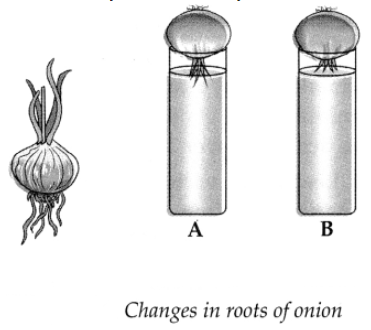
As shown in the figure, place an onion on each gas jar in such a way that its base (roots) will remain dipped in water. Measure and record the length of the roots of both onions on the first, second and third day. On the fourth day, cut off 1 cm of the roots of the onion in flask B Measure the length of the roots of both onions for the next five days and record your observations in the following table.

Image
Length (cm)Day 1Day 2Day 3Day 4Day 5
Flask A
Flask B
Answer
(Students are expected to record their observation in the given table).

(a) Which onion has longer roots? Why?
Answer:
The onion in jar Ahas longer roots as it continues to grow due to the presence of meristematic tissue at root tip which had dividing cells.

(b) Why did the roots of the onion in jar B stop growing?
Answer:
The roots of onion in jar B stopped growing as the meristematic tissue present in the root tips were cut off.

View full question & answer
Question 93 Marks
Explain the types of simple permanent tissues in plants.
Answer
Name of TissueParenchymaCollenchymaSclerenchyma
Struc­ture of cellsLiving cells with thin cell wall and intercellular spaces.Elongated living cells with thickened cell wall at corners due to cellulose and pectin.Dead and fibrous cells with tapering ends, cell wall contains lignin.
Loca­tionAll parts like roots, stem, leaves, flowers and seeds.At the base of leaf petiole, branches and stemStem, veins of leaves, hard coats of seeds, outer covering of coconut.
Func­tionsSupport, storage of food and filling vacant spaces.Support and flexibility to various parts.Give strength and rigidity to parts of the plants.
Sub­ typesChlorenchyma: Leaves, perform photosynthesis. Aerenchyma: Helps aquatic plants, leaves and stem to float.
View full question & answer
Question 103 Marks
Explain types, location and function of Meristematic tissue in tabular form:
Answer
TypesApicalIntercalaryLateral
LocationAt tip of the root and stemAt the base of the petiole of leaves and branchesAt sides of root and stem
FunctionIncrease the length of the root and stemGrowth of branches, the formation of leaves and flowersIncreases diameter of the root and stem
View full question & answer