Questions

Answer the following question.

🎯

Test yourself on this topic

14 questions · timed · auto-graded

Question 15 Marks
Simple tissue and complex tissues in plants.
Answer
Simple Tissue in plantsComplex Tissues in plants
(i) They are made up of only one type of cells.(i) They are made up of more than one type of cells.
(ii) They are found in all parts of the plant.(ii) They are found in the vascular regions of the plant.
(iii) They perform different functions like storage(iii) They mainly perform the function of
of food, support, giving strength etc.conduction of water and food.
(iv) Examples – Parenchyma, Collenchyma, Sclerenchyma.(iv) Example – Xylem and phloem.
View full question & answer
Question 25 Marks
Short Note : Poultry farming.
Answer
  • Rearing of egg and meat yielding chickens is called poultry farming.
  • Chickens raised for laying eggs are called layers . e.g. Leghorn, Minorca, Ancona, Lehman.
  • Chickens raised for meat are called broilers, e.g. Brahma, Long, Cochin, Aseel.
  • Rhode Island Red, New Hampshire, Plymouth Rock, Black Rock are varieties of chicken reared for both eggs as well as meat.
  • The objectives behind development of new hybrid varieties from a cross between Indian varieties like Aseel and exotic varieties like Leghorn are to produce good quality chickens in large numbers.
  • To develop the ability to withstand high temperature, to use by-products of agriculture as poultry feed, etc.
View full question & answer
Question 35 Marks
Short Note : Animal husbandry
Answer
  • In India, animal husbandry is practised for milk production and for using the cattle as help in farming operations.
  • Example – Cows and buffaloes are raised for milk and bulls and male buffaloes for pulling the heavy loads.
  • Local Indian varieties of cows like Sahiwal, Sindhi, Gir, Lai kandhari, Devni, Khillari, Dangi, etc. and exotic varieties like Jersey, Brown swiss, Holstein, etc. are kept for their milk.
  • Proper care of cattle is necessary for a clean and high yield of milk which includes:
    (a) A balanced diet, i.e. all constituents of food should be given to cattle. It must include fibre- rich coarse food, fodder, and sufficient water.
    (b) The cattle-shed should be clean and dry with proper ventilation and a roof.
    (c) Cattle should be regularly vaccinated.
View full question & answer
Question 45 Marks
Suppose you want to grow a garden like the one shown in the picture, around your home or school. What would you do to achieve that? By which methods will you cultivate the seedlings?

Image

Answer
  • To grow a garden around the school or home, one must cultivate seedlings of different plants and those seedlings must be watered regularly and nurtured properly.
  • Seedlings can be cultivated by the following methods:
    (a) Seed sowing: Seeds are sown, watered and allowed to germinate.
    (b) Transplantation: Seeds are sown somewhere else and then the seedlings are transplanted in the garden.
View full question & answer
Question 55 Marks
Explain the meaning of biotechnology and its impact on agricultural management with suitable examples.
Answer
The techniques of bringing about improvements in living organisms by artificial genetic changes and by hybridization for the welfare of human beings, are together called biotechnology. Impact of biotechnology on agricultural management:
  • Genetically modified crops (GM crops) are being produced by introducing changes in DNA of natural crops.
  • Normally such varieties are not found in nature.
  • Thus, new varieties are produced artificially Different useful characters are introduced in such varieties.
  • Some naturally occurring varieties cannot withstand environmental stress like frequently changing temperature.
  • Wet and dry famines, changing climates etc. However, GM crops can grow in any of such adverse conditions.
  • As GM crops are resistant to insect pests, pathogens, chemical weedicides, etc. the use of harmful chemicals like pesticides can be avoided.
  • Due to use of seeds of GM crops, there is improvement in nutritive value and decrease in loss of crops.
View full question & answer
Question 65 Marks
Define the term tissue and explain the concept of tissue culture.
Answer
A group of cells having the same origin, same structure and same function is called tissue. Concept of tissue culture:

    • Ex vivo growth of cells or tissues in an aseptic and nutrient-rich medium is called tissue culture.
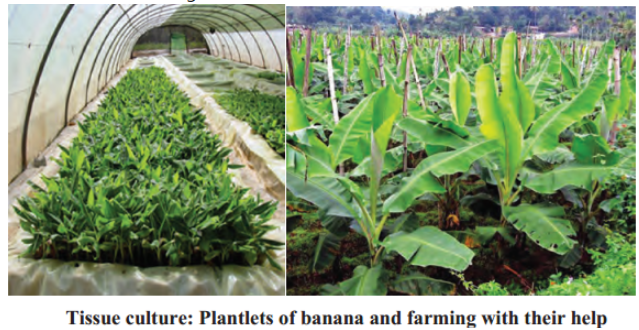
    • Nowadays, a complete organism can be developed from a single cell or from tissue with the help of the tissue culture technique.
    • A liquid, solid or gel-like medium prepared from agar, which supplies nutrients and energy necessary for tissue culture is used in this technique.
    • Tissue culture can be used to grow plants on a large scale, which bear flowers, fruits of excellent quality, in shorter durations and are disease free.
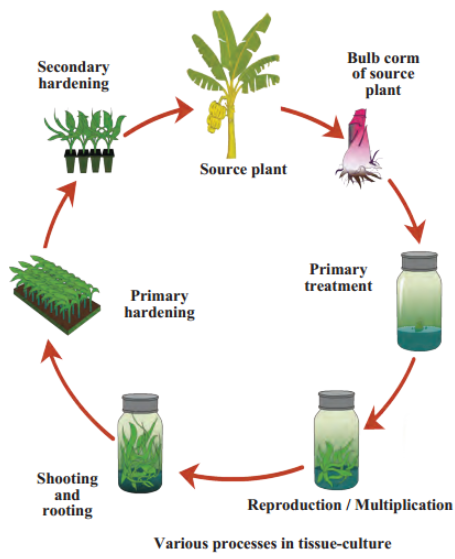
    • The various processes involved in tissue culture are:

Image

View full question & answer
Question 75 Marks
Explain the types of complex permanent tissues.
Answer

Name of tissue

Xylem

Phloem

Characteristics

Consists of thick-walled dead cells

Consists of cytoplasm containing living cells.

Types of cells

Tracheids, vessels and xylem fibres – dead cells. Xylem parenchyma – living cells.

Sieve tubes, companion cells, phloem parenchyma – living cells. Phloem fibres – dead cells.

Function

A structure like interconnected tubes, conduct water and minerals only in upward direction.

Tubes joined to each other, conduct sugar and amino acids from leaves to various parts in upward and downward direction

View full question & answer
Question 95 Marks
Are the structure and functions of the bodies of plants and animals the same?
No. The structure and functions of the bodies of plants and animals are not the same. Some differences between plants and animals:
Answer
PlantsAnimals
Plants continue to grow throughout their life.Animals grow only for a specific period of life.
Growth in plants in not uniform.Growth in animals is uniform.
Plants have dividing and non-dividing tissues.Animals do not have different dividing and non­dividing tissues.
Plants are sedentary.Animals generally move from place to place in search of food, shelter and partners.
Energy needs of plants are less.Energy needs of animals are greater.
Plants can prepare their own food by photosynthesis.Animals cannot prepare their own food. They depend on plants and other animals for their food.
View full question & answer
Question 105 Marks
Collect information about GM varieties of crops in your area and make a note of them. Also find out if there are adverse effects of GM crops on human beings and environment.
Answer
  • Some of the GM crops are:
    (a) Maize: MON 810, MON 863
    (b) Rice: Golden rice
    (c) Brinjal: BT brinjal
    (d) Cotton: BT cotton
  • Effects of GM Crops on human beings: GM crops may cause toxicity and allergic reactions in humAnswer:
  • Effects of GM Crops on environment:
    (a) GM crops may be toxic to pollinators and non-target species like butterflies.
    (b) Many GM crops may be a threat to soil ecosystem as they secrete their toxins into the soil.
View full question & answer
Question 115 Marks
Write down the applications of biotechnology (tissue culture) in floriculture, nurseries and forestry.
Answer
Applications of biotechnology (tissue culture) in floriculture, nurseries and foresty:
  • Tissue culture can be used to grow those plants on a large scale which bear flowers, fruits of excellent quality.
  • Fully grown plants can be produced in shorter durations.
  • Plants can be grown on a large scale even if means of pollination or germinating seeds are not available.
  • For example, orchids or pitcher plants do not germinate but these plants can easily be produced by means of tissue culture.
  • In a bioreactor, cells can be grown in a more nutritive medium and protected from pathogens.
  • Bioreactors are useful for producing plantlets on a very large scale.
  • A large number of seedlings/plantlets can be produced in a short time using minimum resources and materials.
  • Usually, plants produced by tissue culture and genetic modification techniques are disease-free.
  • Plantlets produced by tissue culture technique of the meristem are virus-free.
  • Embryos produced using conventional hybridization technique between two or more varieties may not grow fully for some reasons.
  • However, embryos produced by tissue culture technique always complete their growth.
  • Rare and endangered plants can be grown using tissue culture technique and can thus be protected from extinction.
  • Similarly, various parts and seeds of such plants can be preserved by tissue culture and those varieties can be protected.
View full question & answer
Question 125 Marks
Describe the structure of nervous tissue with the help of a neat labelled diagram.
Answer
  • Nervous tissue enables us to respond to stimuli like touch, sound, odour, colour, etc.
  • Cells of the nervous tissue are specifically made to become excited and conduct the excitation from one part of the body to another.
  • The main part of the nerve cell is the cell body which contains the cytoplasm and the nucleus.
  • Numerous, small, branched fibres called dendrites arise from the cell body.
  • One of the fibres, is extremely long and is called
    the axon.
  • The length of the nerve cell may be up to one metre.
  • Many nerve cells are bound together with the help of connective tissue to form a nerve.
  • Nervous tissue is present in the brain, spinal cord and the network of nerves spread all throughout the body.
  • In most animals, action in response to a stimulus occurs due to the integrated functioning of the nervous tissue and muscular tissue.
Image
View full question & answer
Question 135 Marks
Write the structure and function of the following connective tissues:
(a) Blood
(b) Lymph
(c) Areolar tissue
(d) Adipose tissue
(e) Cartilage
(f) Bones
(g) Tendons and ligaments
View full question & answer
Question 145 Marks
Write the location, structure and function of following epithelial tissues:
(a) Squamous epithelium
(b) Stratified epithelium
(c) Glandular epithelium
(d) Columnar epithelium
(e) Ciliated epithelium
(f) Cuboidal epithelium
View full question & answer
Answer the following question. - Science STD 9 Questions - Vidyadip