MCQ 1511 Mark
The volume of the greatest sphere that can be cut off from a cylindrical $\log$ of wood of base radius $1\ cm$ and height $5\ cm$ is :
- ✓
$\frac{4}{3}\pi$
- B
$\frac{10}{3}\pi$
- C
$5\pi$
- D
$\frac{20}{3}\pi$
AnswerCorrect option: A. $\frac{4}{3}\pi$
Radius of cylindrical $\log (r) = 1\ cm$
and height $(h) = 5\ cm$
The radius of the greatest sphere cut off from the cylindrical $\log$ will be $=$ radius of
the $\log = 1\ cm$
$\therefore$ Volume $=\frac{4}{3}\pi\text{r}^3$
$=\frac{4}{3}\pi(1)^3=\frac{4}{3}\pi\text{ cm}^3$
View full question & answer→MCQ 1521 Mark
The diameters of the ends of a frustum of a cone are $32\ cm$ and $20\ cm$. If its slant height is $10\ cm,$ then its lateral surface area is :
- A
$321\pi\ \text{ cm}^2$
- B
$300\pi\ \text{ cm}^2$
- ✓
$200\pi\ \text{ cm}^2$
- D
$250\pi\ \text{ cm}^2$
AnswerCorrect option: C. $200\pi\ \text{ cm}^2$
$\text{r}_1=\frac{32}{2}$
$=16\text{ cm}$
$\text{r}_2=\frac{20}{2}$
$=10\text{ cm}$
Slant height $= 10\ cm$
Total lateral surface area
$=\pi(\text{r}_1+\text{r}_2)\text{l}$
$=\pi(16+10)10$
$=260\pi\ \text{ cm}^2$
View full question & answer→MCQ 1531 Mark
The area of the base of a rectangular tank is $6500 \mathrm{~cm}^2$ and the volume of water contained in it is $2.6 \mathrm{~m}^3$. The depth of water in the tank is :
AnswerArea of the base of the rectangular tank
$=6500\text{cm}^2$
$=\frac{(6500)}{100^2}\text{m}^2$
Let the depth of the water be $h$ metres.
So, $\frac{(6500)}{(100^2)}\times\text{h}=2.6$
$\Rightarrow\text{h}=4\text{m}$
Hence, the depth of the water is $4m.$
View full question & answer→MCQ 1541 Mark
If three metallic spheres of radii $6\ cm, 8\ cm$ and $10\ cm$ are melted to form a single sphere, the diameter of the sphere is :
- A
$12\ cm$
- ✓
$24\ cm$
- C
$30\ cm$
- D
$36\ cm$
AnswerCorrect option: B. $24\ cm$
Let radii of $3$ metallic spheres are $r_1=6 \mathrm{~cm}$
$\mathrm{r}_2=8 \mathrm{~cm}$
$\mathrm{r}_3=10 \mathrm{~cm}$
Volume of first sphere $=\frac{4}{3}\pi\text{r}_1^3=\frac{4}{3}\pi(6)^3$
$=\frac{4}{3}\times216\pi\text{ cm}^3$
$=\frac{864}{3}\pi\text{cm}^3$
Volume of secound sphere
$=\frac{4}{3}\pi\text{r}_2^3=\frac{4}{3}\pi\times(8)^3\text{ cm}^3$
$=\frac{4}{3}\times512\pi=\frac{2048}{3}\pi\text{ cm}^3$
Volume of third sphere
$=\frac{4}{3}\pi\text{r}_3^3=\frac{4}{3}\pi(10)^3\text{ cm}^3$
$=\frac{4}{3}\pi\times1000=\frac{4000}{3}\pi\text{ cm}^3$
$\therefore$ Sum of volume of the $3$ sphere
$=\frac{864}{3}\pi+\frac{2048}{3}\pi+\frac{4000}{3}\pi$
$=\frac{864+2048+4000}{3}\pi=\frac{6912}{3}\pi\ \text{cm}^3$
Let $R$ be its radius, then
$\frac{4}{3}\pi\text{R}^3=\frac{6912\pi}{3}$
$\text{R}^3=\frac{6912\pi}{3}\times\frac{3}{4\pi}$
$=1728=(12)^3$
$\therefore R = 12\ cm$
$\therefore$ Diameter of the new sphere $= 2R $
$= 2 \times 12 = 24\ cm$
View full question & answer→MCQ 1551 Mark
The diameter of a sphere is $6\ cm$. It is melted and drawn in to a wire of diameter $2\ mm$. The length of the wire is :
AnswerDiameter of sphere $= 6\ cm$
$\therefore$ Radius $(r) =\frac{6}{2}=3\text{ cm}$
Volume $=\frac{4}{3}\pi\text{r}^3=\frac{4}{3}\pi\times(3)^3\text{ cm}^3$
$=\frac{4}{3}\pi\times3\times3\times3=36\pi\text{ cm}^3$
Diameter of wire $= 2mm$
$\therefore$ Radius $(r) =\frac{2}{2}=1\text{ mm}=\frac{1}{10}\text{ cm}$
let $h$ be its length, then
$\pi\text{r}_2^2\text{h}=36\pi$
$\Rightarrow\pi\times\Big(\frac{1}{10}\Big)^2\text{h}=36\pi$
$\Rightarrow\frac{\pi}{100}\text{h}=36\pi$
$\Rightarrow\text{h}=\frac{36\pi\times100}{\pi}=3600\text{ cm}$
$\therefore$ height or lenght of wire $= 3600\ cm$
$=\frac{3600}{100}=36\text{m}$
View full question & answer→MCQ 1561 Mark
In a right circular cone, the cross section made by a plane parallel to the base is a :
AnswerIn a right circular cone, the cross section made by a plane parallel to the base is a cricle.
View full question & answer→MCQ 1571 Mark
Choose the correct answer from the given four options : A right circular cylinder of radius $r \ cm$ and height $h \ cm (h > 2r)$ just encloses a sphere of diameter :
- A
$r \ cm$
- ✓
$2r \ cm$
- C
$h \ cm$
- D
$2h \ cm$
AnswerCorrect option: B. $2r \ cm$
Because the sphere encloses in the cylinder,
therefore the diameter of sphere is equal to diameter of cylinder which is $2r \ cm.$
View full question & answer→MCQ 1581 Mark
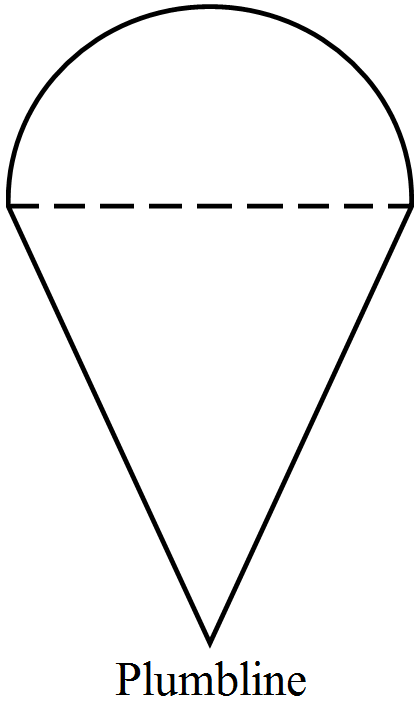
A plumb line $($sahul$)$ is the combination of :
- ✓
- B
- C
A cylinder and frustum of a con.
- D
AnswerA plumbline $($sahul$)$ is the combination of a hemisphere and a cone,
the hemisphere being on top and lower poetion being the cone.
View full question & answer→MCQ 1591 Mark
The surface area of a sphere is $154 \mathrm{~cm}^2$. The volume of the sphere is :
- ✓
$179\frac{2}{3}\text{ cm}^3$
- B
$359\frac{1}{3}\text{ cm}^3$
- C
$1437\frac{1}{3}\text{ cm}^3$
- D
$\text{None of these}$
AnswerCorrect option: A. $179\frac{2}{3}\text{ cm}^3$
Surface area of sphere $= 154 \mathrm{~cm}^2$
$4\pi^2=154$
$4\times\frac{22}{7}\text{r}^2=154$
$\text{r}^2=154\times\frac{7}{4\times22}$
$\text{r}^2=\frac{49}{4}$
$\text{r}=\frac{7}{2}\text{ cm}$
Volume of sphere $=\frac{4}{3}\pi\text{r}^3$
$=\frac{4}{3}\times\frac{22}{7}\times\Big(\frac{7}{2}\Big)^3$
$=179\frac{2}{3}\text{ cm}^3$
View full question & answer→MCQ 1601 Mark
A hollow sphere of internal and external diameters $4\ cm$ and $8\ cm$ respectively is melted into a cone of base diameter $8\ cm$. The height of the cone is :
- A
$12\ cm$
- ✓
$14\ cm$
- C
$15\ cm$
- D
$18\ cm$
AnswerCorrect option: B. $14\ cm$
Internal diameter of a hollow sphere $= 4\ cm$
and external diameter $= 8\ cm$
$\therefore$ Internal radius (r) $=\Big(\frac{4}{2}\Big)=2\text{ cm}$
and external radius $(R) =\Big(\frac{8}{2}\Big)=4\text{ cm}$
$\therefore$ Volume of metal used $=\Big(\frac{4}{3}\Big)\pi(\text{R}^3-\text{r}^3)$
$=\frac{4}{3}\pi(4^3-2^3)=\frac{4}{3}\pi(64-8)\text{cm}^3$
$=56\times\frac{4}{3}\pi=\frac{224}{3}\pi\ \text{ cm}^3$
$\therefore$ Volume of cone $=\frac{224}{3}\pi\ \text{ cm}^3$
Diameter of cone $= 8\ cm$
$\therefore$ Radius ($r_1$) $=\frac{8}{2}=4\text{ cm}$
$\therefore\frac{1}{3}\pi\text{r}_1^2\text{h}_1=\frac{224}{3}\pi$
$\Rightarrow\frac{1}{3}\pi(4)^2\text{h}_1=\frac{224}{3}\pi$
$\Rightarrow\frac{16}{3}\pi\text{h}_1=\frac{224}{3}\pi$
$\Rightarrow\text{h}_1=\frac{224\pi}{3}\times\frac{3}{16}\pi=14$
$\therefore$ Height of cone $= 14\ cm$
View full question & answer→MCQ 1611 Mark
A solid is hemispherical at the bottom and conical $($of same radius$)$ above it. If the surface areas of the two parts are equal, then the ratio of its radius and the slant height of the conical part is :
- ✓
$1 : 2$
- B
$2 : 1$
- C
$1 : 4$
- D
$4 : 1$
AnswerCorrect option: A. $1 : 2$
Given that the radius of the hemisphere and the cone are equal.
Since the surface of the two parts are given to be equal.
$2\pi\text{r}^2=\pi\text{r}\text{l}$
$\Rightarrow2\text{r}=\text{l}$
$\Rightarrow\frac{\text{r}}{\text{l}}=\frac{1}{2}$
So, the ratio $1: 2$
View full question & answer→MCQ 1621 Mark
A solid sphere of radius $r$ is melted and cast into the shape of a solid cone of height $r,$ the radius of the base of the cone is :
AnswerVolume of sphere $=$ volume of the cone
$\frac{4}{3}\pi\text{r}^3=\frac{1}{3}\pi\text{R}^2\times\text{r}$
$R^2=4 r^2$
$R = 2r$
View full question & answer→MCQ 1631 Mark
A sphere of diameter $18\ cm$ is dropped into a cylindrical vessel of diameter $36\ cm,$ partly filled with water. If the sphere is completely submerged, then the water level rises by :
- ✓
$3\ cm$
- B
$4\ cm$
- C
$5\ cm$
- D
$6\ cm$
AnswerCorrect option: A. $3\ cm$
Let the rise in the water level be $h$.
Radii of the sphere and cylindrical vessel are :
$\text{r}=\frac{18}{2}=9\text{ cm}$ and $\text{R}=\frac{36}{2}=18\text{ cm}$
Volume of the water level risen $=$ volume of the sphere
$\Rightarrow\pi\text{R}^2\text{h}=\frac{4}{3}\pi\text{r}^3$
$\Rightarrow\text{h}=\frac{4\times9\times9\times9}{3\times18\times18}$
$\Rightarrow\text{h}=3\text{ cm}$
Hence, the water level rises by $3\ cm.$
View full question & answer→MCQ 1641 Mark
A right triangle with sides $3\ cm, 4\ cm$ and $5\ cm$ is rotated about the side of $3\ cm$ to form a cone. The volume of the cone so formed is :
- A
$12\pi\text{ cm}^3$
- B
$15\pi\text{ cm}^3$
- ✓
$16\pi\text{ cm}^3$
- D
$20\pi\text{ cm}^3$
AnswerCorrect option: C. $16\pi\text{ cm}^3$
A cone is formed be rotating the right angled triangle above the side $3\ cm$
Height of cone $(h) = 3\ cm$
and radius $(r) = 4\ cm$
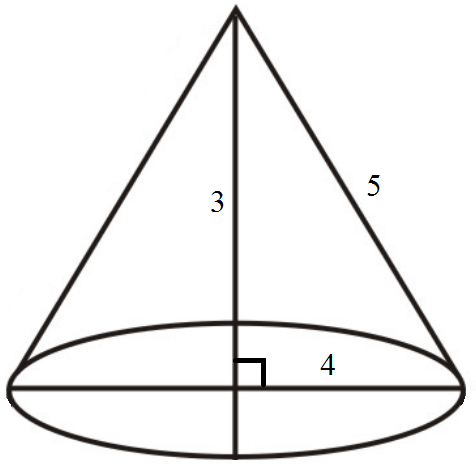
$\therefore =\frac{1}{3}\pi\text{r}^2\text{h}$
$=\frac{1}{3}\pi\times(4)^2\times3\text{ cm}^3$
$=\frac{1}{3}\pi\times16\times3=16\pi\text{ cm}^3$ View full question & answer→MCQ 1651 Mark
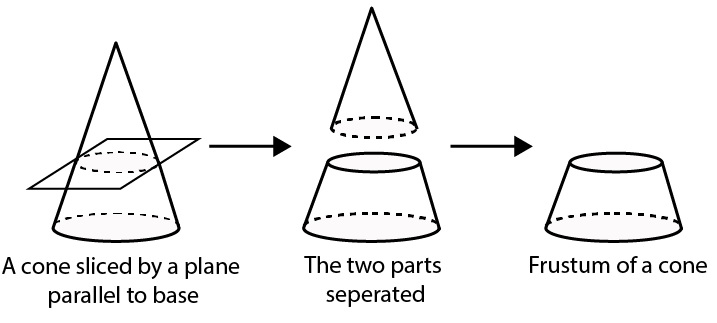
A cone is cut through a plane parallel to its base and then the cone that is formed on one side of that plane is removed. The new part that is left over on the other side of the plane is called :
AnswerA cone is cut through a plane parallel to its base and the small cone is $($upper part$)$ removed.
The part that is left over is called Frustum of a cone.
View full question & answer→MCQ 1661 Mark
How many bags of grain can be stored in a cuboidal granary $(8m \times 6m \times 3m),$ if each bag occupies a space of $0.64 \mathrm{~m}^3?$
AnswerVolume of the cuboidal granary $= (8m \times 6m \times 3m)$
Volume of each bag $= 0.64 \mathrm{~m}^3$
number of bags that can be srored in the cuboidal granary
$=\frac{\text{Volume of the cuboidal granary}}{\text{Volume of each bag}}$
$=\frac{8\times6\times3}{0.64}$
$=225$
View full question & answer→MCQ 1671 Mark
The length of the diagonal of a cube is $6\sqrt{3}\text{ cm}.$ Its total surface area is :
- A
$144 \mathrm{~cm}^2$
- ✓
$216 \mathrm{~cm}^2$
- C
$180 \mathrm{~cm}^2$
- D
$108 \mathrm{~cm}^2$
AnswerCorrect option: B. $216 \mathrm{~cm}^2$
Let the edge of the cube be $x \ cm.$
So, length of the diagonal of the cube $=\sqrt{3}\text{x}$
$\sqrt{3}\text{x}=6\sqrt{3}$
$\Rightarrow\text{x}=6\text{ cm}$
Thus, the total surface area of the cube $6 x^2$
$=6(6)^2$
$=216 \mathrm{~cm}^2$
View full question & answer→MCQ 1681 Mark
The curved surface area of a right circular cone of height $15\ cm$ and base diameter $16\ cm$ is :
- A
$60\pi\text{ cm}^2$
- B
$68\pi\text{ cm}^2$
- C
$120\pi\text{ cm}^2$
- ✓
$136\pi\text{ cm}^2$
AnswerCorrect option: D. $136\pi\text{ cm}^2$
Height,
$h = 15\ cm$
$\text{r}=\frac{16}{2}$
$= 8\ cm$
$\text{l}=\sqrt{\text{r}^2+\text{h}^2}$
$=\sqrt{8^2+15^2}$
$=\sqrt{64+225}$
$\sqrt{289}$
$l = 17\ cm$
The $\text{C.S.A}$. of cone
$=\pi\text{rl}$
$=\pi\times8\times17$
$=136\pi\text{ cm}^3$
View full question & answer→MCQ 1691 Mark
A shoe box is a $15\ cm$ long, $10\ cm$ broad and $9\ cm$ high. The volume of the box is :
- A
$1500 \text{ cu. cm}$
- B
$1200 \text{ cu. cm}$
- C
$1000 \text{ cu. cm}$
- ✓
$1350 \text{ cu. cm}$
AnswerCorrect option: D. $1350 \text{ cu. cm}$
The volume of cuboid $= l \times b \times h$
$= 15 \times 10 \times 9$
$= 1350 \text{ cu. cm}$
View full question & answer→MCQ 1701 Mark
The height and radius of the cone of which the frustum is a part are $h_1$, and $r_1$ respectively. If $h_2$ and $r_2$ are the heights and radius of the smaller base of the frustum respectively and $h_2: h_1=1: 2$, then $r_2: r_1$ is equal to :
- A
$1 : 3$
- ✓
$1 : 2$
- C
$2 : 1$
- D
$3 : 1$
AnswerCorrect option: B. $1 : 2$
Height of cone $=h_1$
and radius $=r_1$
Height of frustum $=h_2$
and radius $=r_2$
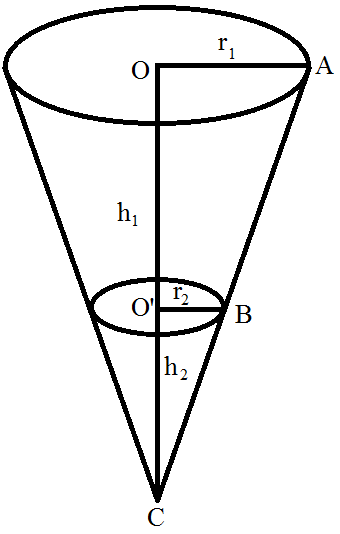
In $\triangle\text{AOC}$ and $ \triangle\text{O'BC}$
$\angle\text{OCA}=\angle\text{O'CA}$
$\angle\text{OCA}=\angle\text{CO'B}$
$\therefore\triangle\text{OAC}\sim\angle\text{O'BC}$
$\therefore\frac{\text{O'C}}{\text{OC}}=\frac{\text{O'B}}{\text{OA}}$
$\Rightarrow\frac{\text{h}_2}{\text{h}_1}=\frac{\text{r}_2}{\text{r}_1}=\frac{1}{2}$$(\because\text{h}_2:\text{h}_2=1:2)$
$\therefore\frac{\text{r}_2}{\text{r}_1}=\frac{1}{2}$
$\therefore\text{r}_2:\text{r}_1=1:2$ View full question & answer→MCQ 1711 Mark
A sphere of maximum volume is cut-out from a solid hemisphere of radius $r$. What is the ratio of the volume of the hemisphere to that of the cut-out sphere?
- ✓
$4: 1$
- B
$2: 3$
- C
$1: 1$
- D
$1: 4$
AnswerCorrect option: A. $4: 1$
(a) : Here, radius of hemisphere $=r$
$\therefore \quad$ Volume of hemisphere $=\frac{2}{3} \pi r^3$
$\because \quad$ Diameter of sphere of maximum volume that is cutout from it is $r$.
$\Rightarrow$ Radius of sphere $=\frac{r}{2}$
Volume of sphere $=\frac{4}{3} \pi\left(\frac{r}{2}\right)^3=\frac{\pi}{6} r^3$
$\therefore \quad$ Required ratio $=\frac{\frac{2}{3} \pi r^3}{\frac{\pi}{6} r^3}=4: 1$
View full question & answer→MCQ 1721 Mark
Two cones have their heights in the ratio $1: 3$ and radii in the ratio $3: 1$. The ratio of their volumes will be
- ✓
$3: 1$
- B
$1: 3$
- C
$2: 3$
- D
$1: 4$
AnswerCorrect option: A. $3: 1$
(a) : Let height of one cone be $h$ and height of another cone be $3 h$. Radius of one cone is $3 r$ and radius of another cone is $r$.
$\therefore \quad$ Ratio of their volumes $=\frac{\frac{1}{3} \pi(3 r)^2 \times h}{\frac{1}{3} \pi r^2 \times(3 h)}$ $=\frac{9 r^2 h}{3 r^2 h}=\frac{9}{3}=3: 1$
View full question & answer→MCQ 1731 Mark
If the radius and slant height of a cone are in ratio $4: 7$ and its curved surface area is $792 cm ^2$, then its radius will be
- A
$10 cm$
- B
$11 cm$
- ✓
$12 cm$
- D
$13 cm$
AnswerCorrect option: C. $12 cm$
(c) : Let the radius $(r)$ and the slant height $(l)$ of cone be $4 x$ and $7 x$ respectively.
$\therefore \quad$ Curved surface area of cone $=\pi r l=\pi(4 x)(7 x)$
$\Rightarrow 792=28 \times \frac{22}{7} \times x^2$
[Given]
$\Rightarrow x^2=\frac{792 \times 7}{28 \times 22}=9 \Rightarrow x=3$
$\therefore$ Radius of cone $=4 x=4 \times 3=12 cm$
View full question & answer→MCQ 1741 Mark
A hemisphere and a cone have equal bases. If their heights are also equal, then the ratio of their curved surface areas is
- A
$\sqrt{2}: 3$
- B
$1: \sqrt{2}$
- ✓
$\sqrt{2}: 1$
- D
$1: 1$
AnswerCorrect option: C. $\sqrt{2}: 1$
(c) : Let $r$ be the radii of bases of both hemisphere and cone.
$\because \quad$ Height of hemisphere, $h=r$
$\Rightarrow$ Height of cone, $h=r$
$\therefore$ Curved surface area of hemisphere $=2 \pi r^2$
Also, curved surface area of cone $=\pi r l=\pi r \sqrt{r^2+h^2}$
$
=\pi r \sqrt{r^2+r^2}[\because h=r]=\sqrt{2} \pi r^2
$
$\therefore \quad$ Required ratio $=2 \pi r^2: \sqrt{2} \pi r^2=\sqrt{2}: 1$
View full question & answer→MCQ 1751 Mark
The internal and external radii of a hemispherical bowl are $r_1$ and $r_2$ respectively. Then, the curved surface area of the bowl is
- ✓
$2 \pi\left(r_1^2+r_2^2\right)$
- B
$\left(r_1^2+r_2{ }^2\right)$
- C
$\pi\left(r_1^2+r_2^2\right)$
- D
AnswerCorrect option: A. $2 \pi\left(r_1^2+r_2^2\right)$
(a) : The curved surface area of the hemispherical bowl
$
=2 \pi r_1^2+2 \pi r_2^2=2 \pi\left(r_1^2+r_2^2\right) \text {. }
$
View full question & answer→MCQ 1761 Mark
A toy is in the form of a right circular cylinder surmounted by a right circular cone as shown in the figure. If $A D=D E=D C=1 cm$, then the volume of the toy $\left(\right.$ in $cm ^3$ ) is
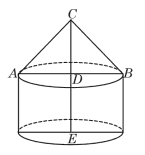
- ✓
$\frac{4}{3} \pi$
- B
$\frac{3}{4} \pi$
- C
$3 \pi$
- D
$4 \pi$
AnswerCorrect option: A. $\frac{4}{3} \pi$
(a) : Let $r$ be the radius and $h$ be the height of cylindrical part and conical part.
$
\therefore r=h=1 cm
$.
Volume of the toy
$=$ Volume of cylindrical part + Volume of conical part
$
=\pi r^2 h+\frac{1}{3} \pi r^2 h=\pi(1)^2(1)+\frac{1}{3} \pi(1)^2(1)=\frac{4 \pi}{3} cm ^3
$
View full question & answer→MCQ 1771 Mark
Find the volume of the largest right circular cone that can be cut out from a cube of edge 6.4 $cm$.
- A
$49.65 cm ^3$
- B
$62.6 cm ^3$
- C
$48.2 cm ^3$
- ✓
$68.65 cm ^3$
AnswerCorrect option: D. $68.65 cm ^3$
(d) : Diameter of cone $=$ length of cube $=6.4 cm$
$\therefore$ Radius of cone, $r=\frac{6.4}{2}=3.2 cm$
Height of cone $=$ Height of cube $=6.4 cm$
$\therefore \quad$ Volume of the cone $=\frac{1}{3} \pi r^2 h$
$=\frac{1}{3} \times \frac{22}{7} \times \frac{32}{10} \times \frac{32}{10} \times \frac{64}{10}=68.65 cm ^3$ (approx.)
View full question & answer→MCQ 1781 Mark
The volume of a hemisphere is $2425 \frac{1}{2} cm ^3$. Its curved surface area is $\left[\right.$ Use $\left.\pi=\frac{22}{7}\right]$
- A
$793 cm ^2$
- B
$963 cm ^2$
- ✓
$693 cm ^2$
- D
AnswerCorrect option: C. $693 cm ^2$
(c) : Given, volume of hemisphere $=\frac{4851}{2} cm ^3$
Let the radius of the hemisphere be ' $r$ ' $cm$.
$\therefore \quad$ Volume of hemisphere $=\frac{2}{3} \pi r^3$
$\Rightarrow \frac{2}{3} \pi r^3=\frac{4851}{2}$
$\Rightarrow r^3=\frac{4851 \times 3 \times 7}{2 \times 2 \times 22} \Rightarrow r=\frac{21}{2} cm$
Now, curved surface area of hemisphere $=2 \pi r^2$
$
=2 \times \frac{22}{7} \times \frac{21 \times 21}{2 \times 2}=693 cm ^2
$
View full question & answer→MCQ 1791 Mark
A cone and a cylinder have the same radii but the height of the cone is 3 times that of the cylinder. The ratio of their volumes is/are
- A
$1: 2$
- B
$2: 1$
- ✓
$1: 1$
- D
$2: 3$
AnswerCorrect option: C. $1: 1$
(c) : Let the radius and the height of the cylinder are $r$ and $h$ respectively.
So, radius of the cone is $r$ and height of the cone is $3 h$.
$\therefore \quad$ Volume of the cylinder $=\pi r^2 h$
Volume of the cone $=\frac{1}{3} \pi r^2 3 h=\pi r^2 h$
So, required ratio $=\frac{\pi r^2 h}{\pi r^2 h}=1: 1$
View full question & answer→MCQ 1801 Mark
The total surface area of a cube is $32 \frac{2}{3} m ^2$. The volume of the cube (in $m ^3$ ) is
- ✓
$12 \frac{19}{27}$
- B
$19 \frac{12}{27}$
- C
$12 \frac{7}{27}$
- D
AnswerCorrect option: A. $12 \frac{19}{27}$
(a) : Let the side of the cube be $x m$.
$\therefore$ Total surface area $=6 x^2 m ^2$
$\Rightarrow \quad 6 x^2=32 \frac{2}{3} \Rightarrow 6 x^2=\frac{98}{3}$
$\Rightarrow x^2=\frac{98}{3} \times \frac{1}{6}=\frac{49}{9} \Rightarrow x=\frac{7}{3} m$.
$\therefore \quad$ Volume of the cube $=x^3 m ^3$
$
=\left(\frac{7}{3}\right)^3 m ^3=\frac{343}{27} m ^3=12 \frac{19}{27} m ^3 \text {. }
$
View full question & answer→MCQ 1811 Mark
A solid is hemispherical at the bottom and conical (of same radius) above it. If the surface areas of the two parts are equal, then what will be the ratio of its radius and the slant height of the conical part?
- A
$2: 1$
- ✓
$1: 2$
- C
$3: 2$
- D
$2: 3$
AnswerCorrect option: B. $1: 2$
(b) : Let $r$ be the radius of hemisphere and conical part. Also, let $l$ be the slant height of conical part.
Given that, surface area of hemisphere
$=$ surface area of conical part
$\Rightarrow 2 \pi r^2=\pi r l \Rightarrow 2 r=l$
$\Rightarrow \frac{r}{l}=\frac{1}{2}$ i.e., $r: l=1: 2$
View full question & answer→MCQ 1821 Mark
If curved surface area of cylinder is equal to its volume. The radius of cylinder will be
Answer(a) : Let $h$ and $r$ be the height and radius of the base of the right circular cylinder respectively, then
$2 \pi r h=\pi r^2 h$ i.e., $r=2$
View full question & answer→MCQ 1831 Mark
The total surface area of solid opened at the top in the given figure is
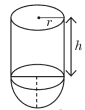
- ✓
$2 \pi r(h+r)$
- B
$\pi r(2 h+r)$
- C
$2 \pi h(h+r)$
- D
AnswerCorrect option: A. $2 \pi r(h+r)$
(a) : Total surface area of solid = Curved surface area of cylinder + Curved surface area of hemisphere $=2 \pi r h+2 \pi r^2=2 \pi r(h+r)$
View full question & answer→MCQ 1841 Mark
The radius of a sphere $($in $cm )$ whose volume is $12 \pi \ cm ^3$ is
- ✓
$3^{2 / 3}$
- B
$3^{3 / 2}$
- C
$3^{1 / 3}$
- D
$3^{1 / 2}$
AnswerCorrect option: A. $3^{2 / 3}$
Let radius of the sphere be $r \ cm$.
According to question,
$\frac{4}{3} \pi r^3=12 \pi$
$\Rightarrow r^3=\frac{3 \times 12}{4}=9=3^2 $
$\Rightarrow r=\left(3^2\right)^{1 / 3}=(3)^{2 / 3} \ cm$
View full question & answer→MCQ 1851 Mark
If the length, breadth and height of a cuboid are made 2,4 and 6 times respectively, then by what percent the volume increases?
- A
$47 \%$
- B
$470 \%$
- ✓
$4700 \%$
- D
AnswerCorrect option: C. $4700 \%$
(c) : We know that if length, breadth and height of a cuboid are made by $x, y$ and $z$ times respectively then volume be increased by
$
(x y z-1) \times 100 \% \text {. }
$
In our problem, $x=2, y=4, z=6$
$\therefore \%$ increase in volume $=(2 \times 4 \times 6-1) \times 100 \%=4700 \%$
View full question & answer→MCQ 1861 Mark
The volume of the largest right circular cone that can be carved out of a solid hemisphere of radius $r$ can be calculated as:
Radius of largest cone $=$ Radius of hemisphere $=$ $r$ (Step 1)
Height of largest cone $=$ Radius of hemisphere $=r$ (Step 2)
$\therefore \quad$ Volume of cone $=\frac{1}{3} \pi r^2 h=\frac{1}{3} \pi r^2 r=\frac{1}{3} \pi r^3$
(Step 3)In which step is there an error involving?
Answer(d) : Radius of largest cone $=$ Radius of hemisphere $=r$ (Step 1)
Height of largest cone $=$ Radius of hemisphere $=r$ (Step 2)
$\therefore \quad$ Volume of cone $=\frac{1}{3} \pi r^2 h=\frac{1}{3} \pi r^2 r=\frac{1}{3} \pi r^{\prime}$ (Step 3)
View full question & answer→MCQ 1871 Mark
The volume of the largest right circular cone that can be cut out from a cube of edge $4.2 cm$ is
- A
$9.7 cm ^3$
- B
$72.6 cm ^3$
- C
$58.2 cm ^3$
- ✓
$19.4 cm ^3$
AnswerCorrect option: D. $19.4 cm ^3$
(d) : Diameter of cone $=$ length of cube $=4.2 cm$
$\therefore$ Radius of cone, $r=\frac{4.2}{2}=2.1 cm$
Height of cone $=$ Height of cube $=4.2 cm$
$\therefore \quad$ Volume of the cone $=\frac{1}{3} \pi r^2 h$
$
=\frac{1}{3} \times \frac{22}{7} \times \frac{21}{10} \times \frac{21}{10} \times \frac{42}{10}=19.4 cm ^3 \text { (approx). }
$
View full question & answer→MCQ 1881 Mark
A right triangle with sides $3 cm , 4 cm$ and $5 cm$ is rotated about the side of $3 cm$ to form a cone. The volume of the cone so formed is
- A
$12 \pi cm ^3$
- B
$15 \pi cm ^3$
- ✓
$16 \pi cm ^3$
- D
$20 \pi cm ^3$
AnswerCorrect option: C. $16 \pi cm ^3$
(c) : Here, radius $(r)=4 cm$ and height $(h)=3 cm$
$\therefore \quad$ Volume of the cone $=\frac{1}{3} \pi r^2 h$
$
=\frac{\pi}{3} \times 4 \times 4 \times 3=16 \pi cm ^3
$
View full question & answer→MCQ 1891 Mark
The curved surface area of a right circular cone of height $15 cm$ and base diameter $16 cm$ is
- A
$60 \pi cm ^2$
- B
$68 \pi cm ^2$
- C
$120 \pi cm ^2$
- ✓
$136 \pi cm ^2$
AnswerCorrect option: D. $136 \pi cm ^2$
(d) : Let $r$ be the radius, $h$ be the height and $l$ be the slant height of right circular cone.
Now, $h=15 cm$, Diameter $=16 cm$
[Given]
$
\therefore r=\frac{16}{2}=8 cm
$Also, $l=\sqrt{r^2+h^2}=\sqrt{8^2+15^2}=\sqrt{289}=17 cm$
$\therefore \quad$ Curved surface area of the cone $=\pi r l$
$
=\pi \times 8 \times 17=136 \pi cm ^2
$
View full question & answer→MCQ 1901 Mark
The ratio of the radii of two spheres is $4: 5$. Then the ratio of their total surface area is
- ✓
$16: 25$
- B
$2: \sqrt{3}$
- C
$5: 4$
- D
$2: 3$
AnswerCorrect option: A. $16: 25$
(a) : Let $r_1$ and $r_2$ be radii of two spheres.
$
\therefore \quad \frac{r_1}{r_2}=\frac{4}{5}
$
(Given)
Ratio of total surface area of two spheres
$
\frac{4 \pi r_1^2}{4 \pi r_2^2}=\left(\frac{r_1}{r_2}\right)^2=\left(\frac{4}{5}\right)^2=\frac{16}{25}
$
View full question & answer→MCQ 1911 Mark
The length of the longest pole that can be kept in a room of dimensions $12 m \times 9 m \times 8 m$ is
- A
$29 m$
- B
$21 m$
- C
$19 m$
- ✓
$17 m$
AnswerCorrect option: D. $17 m$
(d) : Given, length $(l)=12 m$, breadth $(b)=9 m$ and height $(h)=8 m$
Length of the longest pole
$=$ Length of diagonal of the room
$
=\sqrt{l^2+b^2+h^2}=\sqrt{(12)^2+(9)^2+(8)^2}=\sqrt{289}=17 m
$
View full question & answer→MCQ 1921 Mark
If two cubes, each of edge $4 cm$ are joined end to end, then the surface area of the resulting cuboid is
- A
$100 cm ^2$
- ✓
$160 cm ^2$
- C
$200 cm ^2$
- D
$80 cm ^2$
AnswerCorrect option: B. $160 cm ^2$
(b) : Two cubes of edge $4 cm$ each are joined end to end to form a cuboid.
$\therefore$ For resulting cuboid, length $(l)=4+4=8 cm$, breadth $(b)=4 cm$ and height $(h)=4 cm$
$\therefore \quad$ Surface area of cuboid
$
=2(l b+b h+h l)=2(8 \times 4+4 \times 4+4 \times 8)=160 cm ^2
$
View full question & answer→MCQ 1931 Mark
The radius of spherical balloon increases from $8 \ cm$ to $12 \ cm$. The ratio of the surface areas of the balloon in two cases is
- A
$2: 3$
- B
$3: 2$
- C
$8: 27$
- ✓
$4: 9$
AnswerCorrect option: D. $4: 9$
Let $r_1$ and $r_2$ be the radius of smaller spherical balloon and bigger spherical balloon respectively.
$\therefore r_1=8 \ cm$ and $r_2=12 \ cm$
Hence, required ratio
$=\frac{\text { Surface area of smaller spehrical sphere }}{\text { Surface area of bigger spherical sphere }}=\frac{4 \pi r_1^2}{4 \pi r_2^2}=\left(\frac{r_1}{r_2}\right)^2$
$=\left(\frac{8}{12}\right)^2=\left(\frac{2}{3}\right)^2=\frac{4}{9}=4: 9$
View full question & answer→MCQ 1941 Mark
If the total surface area of a solid hemisphere is $462 cm ^2$, then find its volume. $\left[\right.$ Take $\left.\pi=\frac{22}{7}\right]$
- A
$518 cm ^3$
- B
$726 cm ^3$
- C
$816 cm ^3$
- ✓
$718.67 cm ^3$
AnswerCorrect option: D. $718.67 cm ^3$
(d) : Let radius of hemisphere $=r cm$Total surface area of hemisphere $=462 cm ^2$
$
\Rightarrow 3 \pi r^2=462 \Rightarrow r^2=\frac{462 \times 7}{3 \times 22}=49 \Rightarrow r=7
$
$\therefore \quad$ Volume of hemisphere
$
=\frac{2}{3} \pi r^3=\frac{2}{3} \times \frac{22}{7} \times 7 \times 7 \times 7=718.67 cm ^3
$
View full question & answer→MCQ 1951 Mark
Two cubes each of volume $27 \ cm ^3$ are joined end to end to form a solid. Find the surface area of the resulting cuboid.
- ✓
$90 \ cm ^2$
- B
$80 \ cm ^2$
- C
$70 \ cm ^2$
- D
$60 \ cm ^2$
AnswerCorrect option: A. $90 \ cm ^2$
Let the edge of each cube be $a \ cm$.
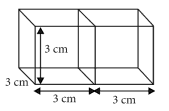
$\therefore$ Volume of each cube $=a^3 \ cm ^3$
i.e., $a^3=27=(3)^3$
$\Rightarrow a=3$
$\therefore \quad$ Surface area of the cuboid
$=2(l b+b h+h l)$
$=2(6 \times 3+3 \times 3+3 \times 6)$
$=2 \times 45=90 \ cm ^2$ View full question & answer→MCQ 1961 Mark
The total surface area of a cube is $864 cm ^2$. Its volume is
- A
$3456 cm ^3$
- B
$432 cm ^3$
- ✓
$1728 cm ^3$
- D
$3460 cm ^3$
AnswerCorrect option: C. $1728 cm ^3$
(c) : Let $a$ be the side of the cube.Given, total surface area of cube $=864 cm ^2$
$
\therefore \quad 6 a^2=864 \Rightarrow a^2=144 \Rightarrow a=12 cm
$
$\therefore$ Volume of the cube $=(12 \times 12 \times 12) cm ^3=1728 cm ^3$
View full question & answer→MCQ 1971 Mark
A cube whose edge is $20 cm$ long, has circles on each of its faces painted black. What is the total area of the unpainted surface of the cube, if the circles are of the largest possible areas?
- A
$90.72 cm ^2$
- B
$256.72 cm ^2$
- C
$330.3 cm ^2$
- ✓
$514.28 cm ^2$
AnswerCorrect option: D. $514.28 cm ^2$
(d) : Diameter of circle $=20 cm$
$\therefore \quad$ Area of a circle $=100 \pi cm ^2$
$\therefore \quad$ Area of 6 circles $=6 \times 100 \pi=600 \pi cm ^2$
Surface area of cube $=6 \times(20)^2=2400 cm ^2$
Area of unpainted surface $=(2400-600 \pi) cm ^2$
$
=2400-600 \times \frac{22}{7}=514.28 cm ^2
$
View full question & answer→MCQ 1981 Mark
The length of the diagonal of a cube is $6 \sqrt{3}$ $cm$. Its total surface area is
- A
$144 cm ^2$
- ✓
$216 cm ^2$
- C
$180 cm ^2$
- D
$108 cm ^2$
AnswerCorrect option: B. $216 cm ^2$
(b) : Let $a$ be the side of the cube.Given, diagonal of cube $=6 \sqrt{3} cm$
$
\therefore \sqrt{3} a=6 \sqrt{3} \Rightarrow a=6 cm
$
$\therefore$ Total surface area $=6 a^2=(6 \times 6 \times 6) cm ^2=216 cm ^2$
View full question & answer→MCQ 1991 Mark
The volume of the greatest sphere that can be cut off from a cylindrical log of wood of base radius $1 cm$ and height $5 cm$ is
- ✓
$\frac{4}{3} \pi cm ^3$
- B
$\frac{10}{3} \pi cm ^3$
- C
$5 \pi cm ^3$
- D
$\frac{20}{3} \pi cm ^3$
AnswerCorrect option: A. $\frac{4}{3} \pi cm ^3$
(a) : The radius of the greatest sphere that can be cut off from the cylinder $=1 cm$$\therefore \quad$
Volume of the sphere $=\frac{4}{3} \pi r^3=\frac{4}{3} \pi(1)^3=\frac{4}{3} \pi cm ^3$
View full question & answer→MCQ 2001 Mark
A glass cylinder with diameter $20 \ cm$ has water to a height of $9 \ cm$. A metal cube of $8 \ cm$ edge is immersed in it completely. The height by which water will rise in the cylinder is $($Take $\pi=3.14)$
- ✓
$1.6 \ cm$
- B
$2.5 \ cm$
- C
$1 \ cm$
- D
$2.6 \ cm$
AnswerCorrect option: A. $1.6 \ cm$
Volume of the water displaced $=$ Volume of the cube of edge $8 \ cm$
$\Rightarrow \pi r^2 h=8^3 $
$\Rightarrow 3.14 \times 10^2 \times h=8 \times 8 \times 8$
$\Rightarrow h=\frac{8 \times 8 \times 8}{3.14 \times 100} \ cm =1.6 \ cm$
View full question & answer→