MCQ 1011 Mark
A rectangular sheet of paper $40\ cm \times 22\ cm,$ is rolled to form a allow cylinder of height $40\ cm$. The radius of e cylinder $($in $\ cm)$ is :
- ✓
$3.5$
- B
$7$
- C
$\frac{80}{7}$
- D
$5$
AnswerSince the height of the cylinder is given to be $40\ cm,$
the sheet to paper when converted to a cylinder,
Has its circum ference to be $22\ cm.$
So, circum ference $= 22\ cm$
$\Rightarrow2\pi\text{r}=22$
$\Rightarrow2\times\frac{22}{7}\times\text{r}=22$
$\Rightarrow\text{r}=3.5\text{ cm}$
Hence, the radius of the cylinder is $3.5\ cm.$
View full question & answer→MCQ 1021 Mark
$12$ spheres of the same size are made from melting a solid cylinder of $16\ cm$ diameter and $2\ cm$ height. The diameter of each sphere is :
- A
$\sqrt{3}\text{ cm}$
- B
$2\ cm$
- C
$3\ cm$
- ✓
$4\ cm$
AnswerCorrect option: D. $4\ cm$
Diameter of solid cylinder $=16 \mathrm{~cm}$
$\therefore \text { Radius }\left(\mathrm{r}_1\right)=\frac{16}{2}=8 \mathrm{~cm}$
$\text { Height }\left(\mathrm{h}_1\right)=2 \mathrm{~cm}$
$\therefore \text { Volume }=\pi \mathrm{r}^2 \mathrm{~h}=\pi \times 8 \times 8 \times 2 \mathrm{~cm}^3$
$=128 \pi \mathrm{cm}^3$
Now Volume $12$ sphere $=128 \pi\ \mathrm{cm}^3$
$\therefore$ volume of $1$ sphere $=\frac{128 \pi}{12}=\frac{32}{3} \pi\ \mathrm{cm}$
Let $r_2$ be its radius, then
$\frac{4}{3} \pi r_2^3=\frac{32}{3} \pi $
$\Rightarrow r_2^3=\frac{32 \pi}{3} \times \frac{3}{4 \pi}$
$\Rightarrow r^3=8=(2)^3 $
$\Rightarrow r=2$
$\therefore$ Radius of each sphere $=2 \mathrm{~cm}$
$\therefore$ Diameter $=2 r_2=2 \times 2=4 \mathrm{~cm}$.
View full question & answer→MCQ 1031 Mark
A spherical ball of radius $r$ is melted to make $8$ new identical balls each of radius $r_1$. Then $r : r_1 =$
- ✓
$2 : 1$
- B
$1 : 2$
- C
$4 : 1$
- D
$1 : 4$
AnswerCorrect option: A. $2 : 1$
Radius of the bigger sphere $= r \ cm$
Radius of the smallerer sphere $= r_1 \ cm$
$\frac{\text{Volume of bigger sphere}}{\text{Volume of smaller sphere}}=\frac{\frac{4}{3}\pi\text{r}^3}{\frac{4}{3}\pi\text{r}_1^3}=\frac{\text{r}^3}{\text{r}_1^3}=8$
$\Rightarrow\Big(\frac{\text{r}}{\text{r}_1}\Big)^3=\Big(\frac{2}{1}\Big)^3$
$\Rightarrow\Big(\frac{\text{r}}{\text{r}_1}\Big)=\Big(\frac{2}{1}\Big)$
Hence $, r : r_1 = 2 : 1$
View full question & answer→MCQ 1041 Mark
A circus tent is cylindrical to a height of $4m$ and conical above it. If its diameter is $105m$ and its slant height is $40m,$ the total area of the canvas required in $m^2$ is :
- A
$1760$
- B
$2640$
- C
$3960$
- ✓
$7920$
AnswerCorrect option: D. $7920$
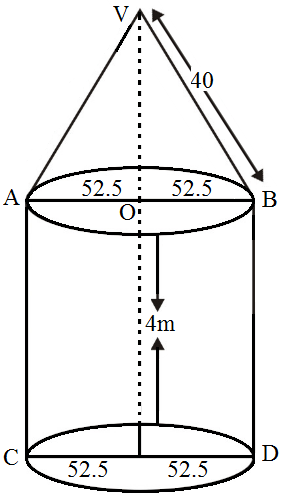
For conical portion
$r = 52.5$ and $l = 40m$
Curved surface area of the conical portion
$=\pi\text{rl}$
$=\pi\times52.5\times40$
$=2100\pi\ \text{m}^2$
For cylindrical portion we have
$r = 52.5m$ and $h = 4m$
Then,
Curved surface area of cylindrical portion
$=2\pi\text{rh}$
$=2\times\pi\times52.5\times4$
$=420\pi\ \text{m}^2$
Area of canvas used for making the tent. View full question & answer→MCQ 1051 Mark
The area of the base of a right circular cone is $154 \mathrm{~cm}^2$ and its height is $14\ cm.$ Its curved surface area is :
AnswerCorrect option: A. $154\sqrt{5}\text{ cm}^2$
Area of the base of the cone $= 154$
$\Rightarrow\pi\text{r}^2=154$
$\Rightarrow\frac{22}{7}\times\text{r}^2=154$
$\Rightarrow\text{r}^2=49$
$\Rightarrow\text{r}=7\text{ cm}$
$\text{l}=\sqrt{\text{r}^2+\text{h}^2}$
$\Rightarrow\text{l}=\sqrt{7^2+14^2}$
$\Rightarrow\text{l}=\sqrt{49+196}$
$\Rightarrow\text{l}=\sqrt{245}$
$\Rightarrow\text{l}=7\sqrt{5}\text{ cm}$
Curve surface area of the cone $=\pi\text{rl}$
$=\frac{22}{7}\times7\times7\sqrt{5}$
$=154\sqrt{5}\text{ cm}^2$
View full question & answer→MCQ 1061 Mark
A cylindrical cone sharpened on both the edges is the combination of :
- A
A frustum of a cone and a cylinder
- ✓
- C
- D
A hemisphere and a cylinder
AnswerA cylindrical cone sharpened on both the edges is the combination of two cones and a cylinder.
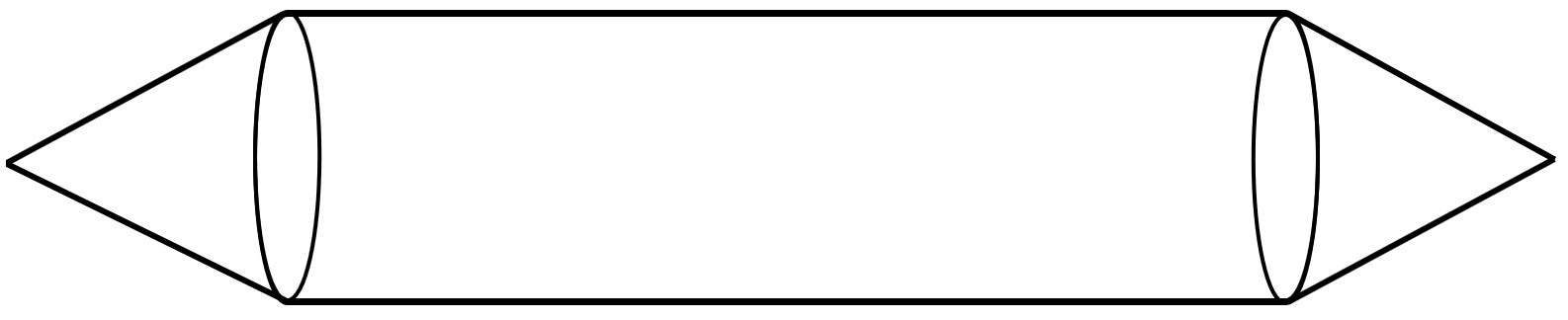
View full question & answer→MCQ 1071 Mark
The ratio between the volume of two spheres is $8 : 27$. What is the ratio between their surface areas?
- A
$2 : 3$
- B
$4 : 5$
- C
$5 : 6$
- ✓
$4 : 9$
AnswerCorrect option: D. $4 : 9$
Let the radii of the spheres be $R$ and $r.$
Ratio of volumes $=\frac{\frac{4}{3}\pi\text{R}^3}{\frac{4}{3}\pi\text{r}^3}$
$\Rightarrow\frac{\frac{4}{3}\pi\text{R}^3}{\frac{4}{3}\pi\text{r}^3}=\frac{8}{27}$
$\Rightarrow\Big(\frac{\text{R}}{\text{r}}\Big)^3=\Big(\frac{2}{3}\Big)^3$
$\Rightarrow\frac{\text{R}}{\text{r}}=\frac{2}{3}$
Ratio between their surface areas
$=\frac{4\pi\text{R}^2}{4\pi\text{r}^2}$
$\Rightarrow\Big(\frac{\text{R}}{\text{r}}\Big)^2$
$=\Big(\frac{2}{3}\Big)^2$
$=\frac{4}{9}$
View full question & answer→MCQ 1081 Mark
If the radius of the base of a right circular cylinder is halved, keeping the height the same, then the ratio of the volume of the cylinder thus obtained to the volume of orginal cylinder is :
- A
$1 : 2$
- B
$2 : 1$
- C
$1 : 4$
- ✓
$4 : 1$
AnswerCorrect option: D. $4 : 1$
Let $h$ be height in each case of the cylinder
Let $r$ be radius in first case, then
Volume $=\pi\text{r}^2\text{h}$
and if radius is halved
i.e. radius $=\frac{\text{r}}{2}$then
Volume $=\pi\frac{\text{r}_2\text{h}}{4}$
$\therefore$ ratio $\pi\text{r}^2\text{h}$
$=\pi\frac{\text{r}_2\text{h}}{4}$
$=1:\frac{1}{4}=4:1$
View full question & answer→MCQ 1091 Mark
Choose the correct answer from the given four options : A plumbline $($sahul$)$ is the combination of see Fig.
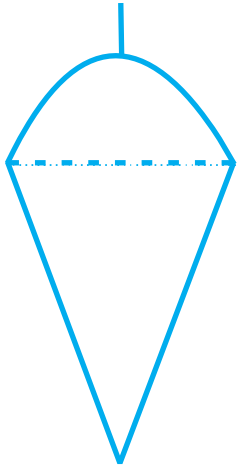
- A
- ✓
- C
Frustum of a cone and a cylinder.
- D
AnswerA hemisphere and a cone.
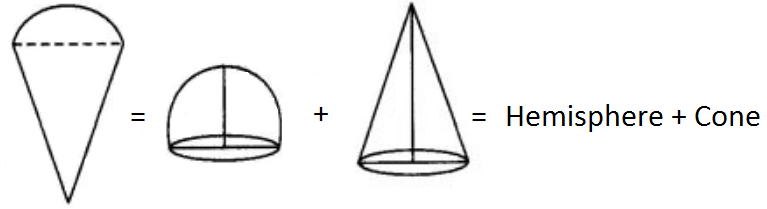
View full question & answer→MCQ 1101 Mark
A solid consists of a circular cylinder with an exact fitting right circular cone placed at the top. The height of the cone is $h$. If the total volume of the solid is $3$ times the volume of the cone, then the height of the circular is :
- A
$2\text{h}$
- ✓
$\frac{2\text{h}}{3}$
- C
$\frac{3\text{h}}{2}$
- D
$4\text{h}$
AnswerCorrect option: B. $\frac{2\text{h}}{3}$
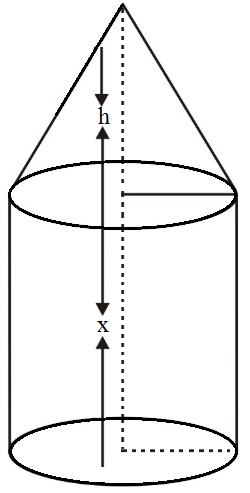
Let $r$ be the radius of the base of solid.
Clearly,
The volume of solid $= 3 \ \times $ volume of cone
Vol. of cone $+$ Vol. of cylinder $= 3$ Volume of cone
Vol. of cylinder $= 2$ Vol. of cone
$\pi\text{r}^2\text{x}=2\times\frac{1}{3}\pi\text{r}^2\text{h}$
$\text{x}=\frac{2}{3}\text{h}$
Thus,
The height of cylinder $=\frac{2}{3}\text{h}$ View full question & answer→MCQ 1111 Mark
The total surface area of a cube is $864 \mathrm{~cm}^2$. Its volume is :
- A
$3456 \mathrm{~cm}^3$
- B
$432 \mathrm{~cm}^3$
- ✓
$1728 \mathrm{~cm}^3$
- D
$3456 \mathrm{~cm}^3$
AnswerCorrect option: C. $1728 \mathrm{~cm}^3$
Let the edge iof the cube be $x \mathrm{~cm}$.
Total surface area of a cube $=6 x^2$
$\Rightarrow 6 x^2=864$
$\Rightarrow x^2=144$
$\Rightarrow x=12 \mathrm{~cm}$
So, the volume of the cube $=x^3$
$=(12)^3$
$=1728 \mathrm{~cm}^3$
View full question & answer→MCQ 1121 Mark
The surface area of a cube whose volume is $64 \mathrm{~cm}^3$ is :
- A
$108 \mathrm{~cm}^2$
- B
$72 \mathrm{~cm}^2$
- ✓
$96 \mathrm{~cm}^2$
- D
$64 \mathrm{~cm}^2$
AnswerCorrect option: C. $96 \mathrm{~cm}^2$
Given : Volume of cube $=64 \mathrm{~cm}^3$
$\Rightarrow a^ 3=64$
$\Rightarrow a^3=(4)^3$
$\Rightarrow a=4 \mathrm{~cm}$
$\therefore$ Surface Area of cube $=6 a^2$
$=6(4)^2=96\ \mathrm{sq} . \mathrm{cm}$
View full question & answer→MCQ 1131 Mark
Choose the correct answer from the given four options : A shuttle cock used for playing badminton has the shape of the combination of :
- A
- B
A cylinder and a hemisphere.
- C
- ✓
Frustum of a cone and a hemisphere.
AnswerCorrect option: D. Frustum of a cone and a hemisphere.
Because the shape of the shuttle cock is equal to sum of frustum of a cone and hemisphere.
View full question & answer→MCQ 1141 Mark
A medicine capsule is in the shape of a cylinder of diameter $0.5\ cm$ with a hemisphere tucked at each end. The length of the entire capsule is $2\ cm.$ The capacity of the capsule is :
- A
$0.33 \mathrm{~cm}^2$
- B
$0.34 \mathrm{~cm}^2$
- C
$0.35 \mathrm{~cm}^2$
- ✓
$0.36 \mathrm{~cm}^2$
AnswerCorrect option: D. $0.36 \mathrm{~cm}^2$
Radiud of the capsule $= 0.25\ cm$
Let the length of the cylindrical part of the capsule be $x \ cm.$
So $, 0.25 + x + 0.25 = 2$
$\Rightarrow 0.5 + x = 2$
$\Rightarrow x = 1.5$
Capacity of the capsule
$= 2 \times \ ($Volume of the hemisphere$) \ + \ ($Volume of the cylinder$)$
$=2\times\Big(\frac{2}{3}\pi\text{r}^3\Big)+(\pi\text{r}^2\text{h})$
$=2\times\Big(\frac{2}{3}\times\frac{22}{7}\times0.25^3\Big)+\Big(\frac{22}{7}\times0.25^2\times1.5\Big)$
$=0.36\text{ cm}^2$
View full question & answer→MCQ 1151 Mark
The slant height of a bucket is $45\ cm$ and the radii of its top and bottom are $28\ cm$ and $7\ cm,$ respectively. The curved surface area of the bucket is :
- A
$4953 \mathrm{~cm}^2$
- B
$4952 \mathrm{~cm}^2$
- C
$4951 \mathrm{~cm}^2$
- ✓
$4950 \mathrm{~cm}^2$
AnswerCorrect option: D. $4950 \mathrm{~cm}^2$
The curved surface area of the bucket.
$=\pi\text{l}(\text{R}+\text{r})$
$=\frac{22}{7}\times45\times(28+7)$
$=4950\text{ cm}^2$
Hence, the curved surface area of the bucket is $4950 \mathrm{~cm}^2$.
View full question & answer→MCQ 1161 Mark
The sum of length, breadth and height of a cuboid is $19\ cm$ and its diagonal is $\sqrt[5]{5}\text{ cm}.$ Its surface area is
- A
$361 \mathrm{~cm}^2$
- B
$125 \mathrm{~cm}^2$
- ✓
$236 \mathrm{~cm}^2$
- D
$486 \mathrm{~cm}^2$
AnswerCorrect option: C. $236 \mathrm{~cm}^2$
Given that $ l+b+h=19$
$\Rightarrow(l+b+h)^2=19^2$
$\Rightarrow l^2+b^2+h^2+2 l b+2 b h+2 l h=361$
$\Rightarrow l^2+b^2+h^2+2(l b+b h+I h)=361$
Wen know that, the diagonal of a cuboid $=l^2+b^2+h^2$
That is, $(5 \sqrt{5})^2=\mathrm{l}^2+\mathrm{b}^2+\mathrm{h}^2$
So, from $(i),$ we get
$(5 \sqrt{5})^2+2(\mathrm{lb}+\mathrm{bh}+\mathrm{lh})=361$
$\Rightarrow 125+2(\mathrm{lb}+\mathrm{bh}+\mathrm{lh})=361$
$\Rightarrow 2(\mathrm{lb}+\mathrm{bh}+\mathrm{lh})=236$
$\Rightarrow \text { Sirface area }=236 \mathrm{~cm}^2$
Hence, the surface area of the cuboid is $236 \mathrm{~cm}^2$
View full question & answer→MCQ 1171 Mark
The volume of a hemisphere is $19404 \mathrm{~cm}^3$. The total surface area of the hemisphere is :
- ✓
$4158 \mathrm{~cm}^2$
- B
$16632 \mathrm{~cm}^2$
- C
$8316 \mathrm{~cm}^2$
- D
$3696 \mathrm{~cm}^2$
AnswerCorrect option: A. $4158 \mathrm{~cm}^2$
Volume of hemisphere $=\frac{2}{3}\pi\text{r}^3$
$\frac{2}{3}\pi\text{r}^3=19404$
$\frac{2}{3}\times\frac{22}{7}\text{r}^3=19404$
$\text{r}^3=19404\times\frac{3\times7}{2\times22}$
$\text{r}^3=9261$
$\text{r}^3=21^3$
$\text{r}=21\text{ cm}$
Surface area of hemisphere $=3\pi\text{r}^2$
$=3\times\frac{22}{7}\times21^2$
$=4158\text{ cm}^2$
View full question & answer→MCQ 1181 Mark
The radii of two cylinders are in the ratio $2 : 3$ and their heights are in the ratio $5 : 3.$ The ratio of their volumes is :
- A
$27 : 20$
- ✓
$20 : 27$
- C
$4 : 9$
- D
$9 : 4$
AnswerCorrect option: B. $20 : 27$
Let the radii of the two cylinders be $2x$ and $3x,$
and the heights of the two cylinders be $5y$ and $3y$ respectively
Ratio of the volume of the cylinders $=\frac{\pi(2\text{x})^2(5\text{y})}{\pi(3\text{x})^2(3\text{y})}$
$=\frac{20}{27}$
That is, the ratio of their volume is $20 : 27$.
View full question & answer→MCQ 1191 Mark
The radii of the ends of a bucket $16\ cm$ height are $20\ cm$ and $8\ cm$. The curved surface area of the bucket is :
- ✓
$1760 \mathrm{~cm}^2$
- B
$2240 \mathrm{~cm}^2$
- C
$880 \mathrm{~cm}^2$
- D
$3120 \mathrm{~cm}^2$
AnswerCorrect option: A. $1760 \mathrm{~cm}^2$
Radius of top of bucket $r_1=20 \mathrm{~cm}$
Radius of bottom of bucket $r_2=8 \mathrm{~cm}$
Height of bucket $= 16\ cm$
The curved surface area of bucket $=\pi(\text{r}_1+\text{r}_2)\text{l}$
$\text{l}=\sqrt{\text{h}^2+(\text{r}_1-\text{r}_2)^2}$
$=\sqrt{16^2+(20-8)^2}$
$=\sqrt{256+144}$
$\text{l}=\sqrt{400}$
$\text{l}=20\text{ cm}$
$\text{C.S.A}$. of bucket
$=\pi(20+8)\times20$
$=\frac{22}{7}\times28\times20$
$=22\times80$
$=1760\text{ cm}$
View full question & answer→MCQ 1201 Mark
During conversion of a solid from one shape to another, the volume of the new shape will :
AnswerDuring conversion of a solid from one shape to another, the volume of the new shape will remain altered.
View full question & answer→MCQ 1211 Mark
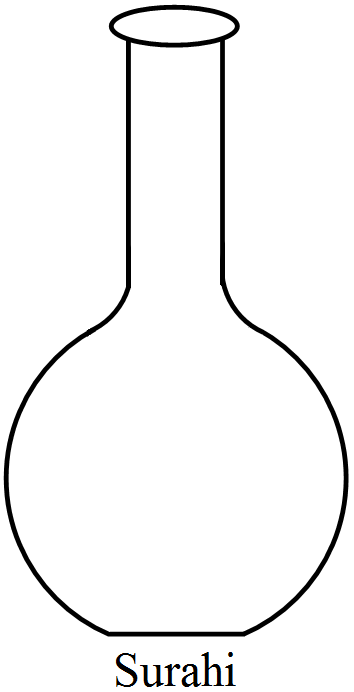
A surahi is a combination of:
- A
- ✓
A hemisphere and a cylinder.
- C
- D
AnswerCorrect option: B. A hemisphere and a cylinder.
A hemisphere and a cylinder.
View full question & answer→MCQ 1221 Mark
In a right circular cone, the cross $-$ section made by a plane parallel to the base is a :
AnswerWhen a plane parallel to the base of a cone cuts it, then a frustum and a smaller cone is formed.
The cross $-$ section thus formed will be a circle.
Hence, the correct answer is option.
View full question & answer→MCQ 1231 Mark
The ratio of lateral surface area to the total surface area of a cylinder with base diameter $1.6m$ and height $20\ cm$ is :
- A
$1 : 7$
- ✓
$1 : 5$
- C
$7 : 1$
- D
$8 : 1$
AnswerCorrect option: B. $1 : 5$
Ratio in lateral surface area and total surface area
Base diameter $= 1.6m = 160\ cm$
Height $(h) = 20\ cm$
$\therefore$ Radius $= 80\ cm$
Now, lateral surface $=2\pi\text{rh}=2\pi\times80\times20=3200\pi$
and $2\pi\text{rh}+2\pi\text{r}^2=3200\pi+2\pi(80)^2$
$=3200\pi+2\pi\times6400$
$=(3200+12800)\pi=16000\pi$
Ratio $=3200\pi:16000\pi=1:5$
View full question & answer→MCQ 1241 Mark
A right circular cylinder of radius $r$ and height $h \ (h > 2r)$ just encloses a sphere of diameter :
AnswerBecause the sphere enclose in the cylinder,
therefore the diameter of sphere is equal to diameter of cylinder which is $2r.$
View full question & answer→MCQ 1251 Mark
Directions : In the following questions, a statement of assertion $(A)$ is followed by a statement of reason $(R).$ Mark the correct choice as:
Assertion : No.of spherical balls that can be made out of a solid cube of lead whose edge is $44\ cm,$ each ball being $4\ cm$. in diameter, is $2541$
Reason : $\text{Number of balls}=\frac{\text{Volume of one ball}}{\text{Volume of lead}}$
- A
Both assertion $(A)$ and reason $(R)$ are true and reason $(R)$ is the correct explanation of assertion $(A)$.
- B
Both assertion $(A)$ and reason $(R)$ are true but reason $(R)$ is not the correct explanation of assertion $(A).$
- ✓
Assertion $(A)$ is true but reason $(R)$ is false.
- D
Assertion $(A)$ is false but reason $(R)$ is true.
AnswerCorrect option: C. Assertion $(A)$ is true but reason $(R)$ is false.
Assertion $(A)$ is true but reason $(R)$ is false
View full question & answer→MCQ 1261 Mark
Choose the correct answer from the given four options : A hollow cube of internal edge $22\ cm$ is filled with spherical marbles of diameter $0.5 \ cm$ and it is assumed tha $\frac{1}{8}$ sqace of the cube remains unfilled. Then the number of marbles that the cube can accomodate is :
- ✓
$142244.$
- B
$142396$
- C
$142496$
- D
$142596$
AnswerCorrect option: A. $142244.$
Given, edge of the cude $= 22\ cm$
$\therefore$ Volume of the cude $=(22)^3=10648 \mathrm{~cm}^2$
Also, given diameter of marble $= 0.5\ cm$
$\therefore$ Radius of a marble, $\text{r}=\frac{0.5}{2}=0.25\text{ cm}$
$[\because\text{diameter}=2\times\text{radius}]$
Volume of one marble $=\frac{4}{3}\pi\text{r}^3=\frac{4}{3}\times\frac{22}{7}\times(0.25)^3$
$\Big[\because\text{volume of sphere}=\frac{4}{3}\times\pi\times(\text{radius})^3\Big]$
$=\frac{1.375}{21}=0.0655\text{ cm}^3$
Filled space of cude $=$ Volume of the cube $\frac{1}{8} \times $ Volume of cube
$=10648-10648\times\frac{1}{8}$
$=10648\times\frac{7}{8}=9317\text{ cm}^3$
$\therefore\ \text{Required number of marbles}=\frac{\text{Total space filled by marbles in a cube}}{\text{Volume of one marble}}$
$=\frac{9317}{0.0655}=142244\ (\text{ approx})$
Hence, the number of marbles that the cube can accomodate is $142244.$
View full question & answer→MCQ 1271 Mark
A solid is hemispherical at the bottom and conical above. If the surface areas of the two parts are equal, then the ratio of its radius and the height of its conical part is :
- A
$1 : 3$
- ✓
$1:\sqrt{3}$
- C
$1 : 1$
- D
$\sqrt{3}:1$
AnswerCorrect option: B. $1:\sqrt{3}$
Surface area of hemispherical part $=$ surface area of conical part
$\Rightarrow2\pi\text{r}^2=\pi\text{rl}$
$\Rightarrow2\text{r}\text{l}$
$\Rightarrow2\text{r}=\sqrt{\text{r}^2+\text{h}^2}$
$\Rightarrow4\text{r}^2=\text{r}^2+\text{h}^2$
$\Rightarrow3\text{r}^2=\text{h}^2$
$\Rightarrow\frac{\text{r}^2}{\text{h}^2}=\frac{1}{3}$
$\Rightarrow\frac{\text{r}}{\text{h}}=\frac{1}{\sqrt{3}}$
$\therefore\text{Roots}=1:\sqrt{3}$
View full question & answer→MCQ 1281 Mark
The inner dimensions of a closed box are $12\ cm, 10\ cm $ and $8\ cm$. If the thickness of the wood is $1\ cm,$ then the capacity of the box is :
- A
$1200 \text{ cu. cm}$
- ✓
$960 \text{ cu. cm}$
- C
$480 \text{ cu. cm}$
- D
$1920 \text{ cu. cm}$
AnswerCorrect option: B. $960 \text{ cu. cm}$
Given : $l = 12 \ cm, b = 10 \ cm$ and $h = 8 \ cm$
$\therefore$ Capacity of a closed box $= l \times b \times h $
$= 12 \times 10 \times 8 = 960 \text{ cu. cm}$
Capacity of box of thickness $1 \ cm =\frac{960}{1}=960 \text{ cu. cm}$
View full question & answer→MCQ 1291 Mark
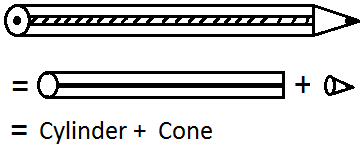
Choose the correct answer from the given four options : A cylindrical pencil sharpened at one edge is the combination of :
- ✓
- B
Frustum of a cone and a cylinder.
- C
A hemisphere and a cylinder.
- D
AnswerBecause the shape of sharpened pencul is,
View full question & answer→MCQ 1301 Mark
The volume of a wall, $5$ times as high as it is broad and 8 times as long as it is high, is $128 \mathrm{~m}^3$. The breadth of the wall is :
- A
$30\ cm$
- ✓
$40\ cm$
- C
$22.5\ cm$
- D
$25\ cm$
AnswerCorrect option: B. $40\ cm$
Let the breadth of the wall be $x \mathrm{~cm}$.
So, its height $=5 \times \mathrm{cm}$
Length of the wall $=8 \times 5 x=40 x \mathrm{~cm}$
Given that the volume of the wall $=12.8 \mathrm{~m}^3=12800000$
Thus, the volume of the wall $=$ length $\times$ breadth $\times$ height
$12800000=40 x \times x \times 5 x$
$12800000=200 x^3$
$\frac{12800000}{200}=\text{x}^3$
$\text{x}=\sqrt[3]{64000}$
$\text{x}=40\text{ cm}$
View full question & answer→MCQ 1311 Mark
Choose the correct answer from the given four options : During conversion of a solid from one shape to another, the volume of the new shape will :
AnswerDuring conversion of a solid from one shape to another, the volume of the new shape will remain unaltered.
View full question & answer→MCQ 1321 Mark
The radii of two cylinders are in the ratio $3 : 5$. If their heights are in the ratio $2 : 3,$ then the ratio of their curved surface areas is :
- ✓
$2 : 5$
- B
$5 : 2$
- C
$2 : 3$
- D
$3 : 5$
AnswerCorrect option: A. $2 : 5$
Given that
$r_1: r_2=3: 5$ and $h_1: h_2=2: 3$
Then,
The ratio of $\text{C.S.A}$. of cylinders
$\frac{\text{S}_1}{\text{S}_2}=\frac{2\pi\text{r}_1\text{h}_1}{2\pi\text{r}_2\text{h}_2}$
$\frac{\text{S}_1}{\text{S}_2}=\Big(\frac{\text{r}_1}{\text{r}_2}\Big)\times\Big(\frac{\text{h}_1}{\text{h}_2}\Big)$
$=\frac{3}{5}\times\frac{2}{3}$
$\frac{\text{s}_1}{\text{s}_2}=\frac{2}{3}$
$\text{S}_1:\text{S}_2=2:5$
View full question & answer→MCQ 1331 Mark
The curved surface are of a cylinder is $1760 \mathrm{~cm}^2$ and its base radius is $14\ cm$. The height of the cylinder is :
- A
$10\ cm$
- B
$15\ cm$
- ✓
$20\ cm$
- D
$40\ cm$
AnswerCorrect option: C. $20\ cm$
The curved surface area of the cylinder $=2\pi\text{r}\text{h}$
$=2\times\frac{22}{7}\times14\times\text{h}$
$\Rightarrow2\times\frac{22}{7}\times14\times\text{h}=1760$
$\Rightarrow\text{h}=\frac{1760}{88}=20\text{ cm}$
Hence, the height of the cylinder is $20\ cm.$
View full question & answer→MCQ 1341 Mark
The volumes of two cubes are in the ratio $1 : 27$. The ratio of their surface area is :
- A
$1 : 3$
- B
$1 : 8$
- ✓
$1 : 9$
- D
$1 : 18$
AnswerCorrect option: C. $1 : 9$
The ratio of the volumes of the two cube is $1 : 27.$
Let the sides of the two cubes be $a$ and $b$.
So, $\frac{\text{a}^3}{\text{b}^3}=\frac{1}{27}$
$\Rightarrow\frac{\text{a}}{\text{b}}=\frac{1}{3}$
$\Rightarrow\Big(\frac{\text{a}}{\text{b}}\Big)^2=\Big(\frac{1}{3}\Big)^2$
$\Rightarrow\frac{\text{a}^2}{\text{b}^2}=\frac{1}{9}$
$\Rightarrow\frac{6\text{a}^2}{6\text{b}^2}=\frac{1}{9}$
So, the ratio of the surface areas the two cubes is $1 : 9$
View full question & answer→MCQ 1351 Mark
The diameter of a cylinder is $28\ cm$ and its height is $20\ cm$. The total surface area of the cylinder is :
- A
$2993 \mathrm{~cm}^2$
- ✓
$2992 \mathrm{~cm}^2$
- C
$2292 \mathrm{~cm}^2$
- D
$2229 \mathrm{~cm}^2$
AnswerCorrect option: B. $2992 \mathrm{~cm}^2$
Diameter $= 28\ cm $
$\Rightarrow $ radius $= 14\ cm$
The total surface area of the cylinder
$=2\pi\text{r}(\text{h}+\text{r})$
$=2\times\frac{22}{7}\times14(20+14)$
$=2992\text{ cm}^2$
View full question & answer→MCQ 1361 Mark
Choose the correct answer from the given four options : Twelve solid spheres of the same size are made by melting a solid metallic cylinder of base diameter $2\ cm$ and height $16\ cm$. The diameter of each sphere is :
- A
$4\ cm$
- B
$3\ cm$
- ✓
$2\ cm$
- D
$6\ cm$
AnswerCorrect option: C. $2\ cm$
Given, diameter of the cylinder $= 2\ cm$
$\therefore$ Radius $= 1\ cm$ and height of the cylinder $= 16\ cm$
$[\because\text{diameter}=2\times\text{radius}]$
$\therefore$ Volume of the cylinder $=\pi\times(1)^2\times16=16\pi\text{ cm}^3$
$\big[\because\text{volume of cylinder}=\pi\times(\text{radius})^2\times\text{height}\big]$
Now, let the radius of soild sphere $= r \ cm$
Volume of the twele solid sphere $=$ Volume of cylinder
$\Rightarrow\ \ 12\times\frac{4}{3}\pi\text{r}^3=16\pi$
$\Rightarrow\ \ \text{r}^3=1$
$\Rightarrow\ \text{r}=1\text{ cm}$
$\therefore$ Diameter of each sphere $, d = 2r = 2 \times 1 = 2\ cm$
Hence, the required diameter of each sphere is $2\ cm.$
View full question & answer→MCQ 1371 Mark
The radii of the circular ends of a frustum are $6\ cm$ and $14\ cm$. If its slant height is $10\ cm,$ then its vertical height is :
- ✓
$6\ cm$
- B
$8\ cm$
- C
$4\ cm$
- D
$7\ cm$
AnswerCorrect option: A. $6\ cm$
$r_1=14 \mathrm{~cm}, r_2=6 \mathrm{~cm}$
Slant height
$\mathrm{l}=10 \mathrm{~cm}, \mathrm{~h}=?$
$\mathrm{l}=\sqrt{\mathrm{h}^2+\left(\mathrm{r}_1-\mathrm{r}_2\right)^2}$
$\mathrm{l}^2=\sqrt{\mathrm{h}^2+\left(\mathrm{r}_1-\mathrm{r}_2\right)^2}$
squaring on both sides
$h^2=l^2-\left(r_1-r_2\right)^2$
$h^2=(10)^2-(14-6)^2$
$h^2=100-64$
$h^2=36$
$h=6 \mathrm{~cm}$
View full question & answer→MCQ 1381 Mark
The curved surface area of a cylindrical pillar is $264 \mathrm{~m}^2$ and its volume is $924 \mathrm{~m}^3$. The height of the pillar is :
AnswerThe curved surface area of the cylinder $=2\pi\text{rh}$
$\Rightarrow264=2\pi\text{rh}$
Volume of the cylinder $=\pi\text{r}^2\text{h}$
$\Rightarrow924=\pi\text{r}^2\text{h}$
So, $\frac{264}{924}=\frac{2\pi\text{rh}}{\pi\text{r}^2\text{h}}$
$\Rightarrow\frac{264}{924}=\frac{2}{\text{r}}$
$\Rightarrow\text{r}=\frac{924\times2}{264}$
$\Rightarrow\text{r}=7\text{m}$
So, $2\pi\text{rh}=264$
$\Rightarrow2\times\frac{22}{7}\times7\times\text{h}=264$
$\Rightarrow\text{h}=\frac{264}{44}$
$\Rightarrow\text{h}=6\text{m}$
Hence, the height of the pillar is $6m.$
View full question & answer→MCQ 1391 Mark
The length of the longest pole that can be kept in a room $(12m \times 9m \times 8m)$ is :
AnswerLenght of the longest pole that can that can be kept in a room
$=$ Lenght of the diagonal of the room
$=\sqrt{\text{l}^2+\text{b}^2+\text{h}^2}$
$=\sqrt{12^2+9^2+8^2}$
$=\sqrt{289}$
$=17\text{m}$
View full question & answer→MCQ 1401 Mark
A solid right circular cone is cut into two parts at the middle of its height by a plane parallel to its base. The ratio of the volume of the smaller cone to the whole cone is :
- A
$1 : 2$
- B
$1 : 4$
- C
$1 : 6$
- ✓
$1 : 8$
AnswerCorrect option: D. $1 : 8$
Let the height of the smallr and cone be $h$ and $H$ respecti vely.
Let the radii of the smaller and larger cone be $r$ and $R$ respectively.
Given that the plane cuts the larger cone at the middle of its height.
So $, H = 2h ...(i)$
Consider, $\triangle\text{AQD}$ and $\triangle\text{APC},$
$\angle\text{QAD}-\angle\text{PAC} .... ($Common angle$)$
$\angle\text{AQD}=\angle\text{APC} .... (90^\circ $ angle$)$
$\therefore\triangle\text{AQD}\sim\triangle\text{APC} ....(\text{AA} $ criterion for similarity$)$
$\Rightarrow\frac{\text{AQ}}{\text{AP}}=\frac{\text{QD}}{\text{PC}}$
$\Rightarrow\frac{\text{h}}{\text{H}}=\frac{\text{r}}{\text{R}}$
$\Rightarrow\frac{\text{h}}{2\text{h}}=\frac{\text{r}}{\text{R}}$
$\Rightarrow\frac{\text{r}}{\text{R}}=\frac{1}{2}$
That is $, R - 2r ...(ii)$
$\frac{\text{Volume of the smaller cone}}{\text{Volume of the larger cone}}$
$=\frac{\frac{1}{3}\pi\text{r}^2\text{h}}{\frac{1}{3}\pi\text{R}^2\text{H}}$
$=\frac{\text{r}^2\text{h}}{(2\text{r})^2(2\text{h})}$
$=\frac{\text{r}^2\text{h}}{8\text{r}^2\text{h}}$
$=\frac{1}{8}$
Hence, the ratio of the volume of the smaller cone to the larger cone is $1 : 8$
View full question & answer→MCQ 1411 Mark
Rainfall in an area is $5\ cm$. The volume of the water that falls on $2$ hectares of land is :
- A
$100 \mathrm{~m}^3$
- B
$10 \mathrm{~m}^3$
- ✓
$1000 \mathrm{~m}^3$
- D
$10000 \mathrm{~m}^3$
AnswerCorrect option: C. $1000 \mathrm{~m}^3$
Volume of the water that falls on $2$ hectares of land
$= ($Amounts of rainfall $\times $ Area of the ground$)$
$=\Big(\frac{5}{100}\times2\times1000\Big)\ ...\Big($Since $5 \ cm=\frac{5}{100} m $ and $2$ hectares $= 2000\ m^2\Big)$
$=1000\ \text{m}^3$
View full question & answer→MCQ 1421 Mark
A sphere of radius $6\ cm$ is dropped into a cylindrical vessel partly filled with water. The radius of the vessel is $8\ cm.$ If the sphere is submerged completely, then the surface of the water rises by :
- ✓
$4.5\ cm$
- B
$3\ cm$
- C
$4\ cm$
- D
$2\ cm$
AnswerCorrect option: A. $4.5\ cm$
Radius of the sphere $= 6\ cm.$
Volume of the sphere
$=\frac{4}{3}\pi\text{r}^3$
$=\frac{4}{3}\pi\times6\times6\times6$
and
Radius of the cylinder $= 8\ cm$
Volume of the cylinder
$=\pi\text{r}^2\text{h}$
$=\pi\times8\times8\times\text{h}$
Therefore,
Volume of the sphere $=$ volume of the cylinder
$\frac{4}{3}\pi(6)^3=\pi(8)^2\text{h}$
or
$\text{h}=\frac{4\times72}{64}=4.5\text{ cm}$
View full question & answer→MCQ 1431 Mark
If each edge of a cube is increased by $50\%,$ the percentage increase in the surface area is :
- A
$50\%$
- B
$75\%$
- C
$100\%$
- ✓
$125\%$
AnswerCorrect option: D. $125\%$
Let the surface area of the cube $x.$
So, the surface area of the cube $= 6 x^2$
Since the edge og the cube is increased by $50\%$
The new sdge $=\text{x}+\frac{\text{x}}{2}=\frac{3\text{x}}{2}$
So, the new surface area $=6\Big(\frac{3\text{x}}{2}\Big)^2$
$=6\Big(\frac{9\text{x}^2}{4}\Big)$
$=\frac{27\text{x}^4}{2}$
Increase in the surface area $=\frac{27\text{x}^2}{2}-6\text{x}^2=\frac{15\text{x}^2}{2}$
Percentage increase $=\frac{\frac{15\text{x}^2}{2}}{6\text{x}^2}\times100$
$=\frac{15}{12}\times100$
$=125\%$
View full question & answer→MCQ 1441 Mark
A metalic solid cone is melted to form a solid cylinder of equal radius. If the height of the cylinder is $6\ cm,$ then the height of the cone was :
- A
$10\ cm$
- B
$12\ cm$
- ✓
$18\ cm$
- D
$24\ cm$
AnswerCorrect option: C. $18\ cm$
Let the height of the cone be $h.$
Volume of cylinder $=$ Volume of cone
$\Rightarrow\pi\text{r}^2(6)=\frac{1}{3}\pi\text{r}^2\text{h}$
$\Rightarrow\text{h}=18\text{ cm}$
View full question & answer→MCQ 1451 Mark
A hollow metallic sphere with external diameter $8\ cm$ and internal diameter $4\ cm$ is melted and moulded into a cone of base radius $8\ cm$. The height of the cone is :
- A
$12\ cm$
- ✓
$14\ cm$
- C
$15\ cm$
- D
$18\ cm$
AnswerCorrect option: B. $14\ cm$
The radii of the spherical shell is $2\ cm$ and $4\ cm.$
Volume of the spherical shell $=\frac{4}{3}\pi(\text{R}^3-\text{r}^3)$
$=\frac{4}{3}\pi(4^3-2^3)$
$=\frac{4}{3}\pi(56)$
Radius of the cone $= 4\ cm$
Volume of the cone $=\frac{1}{3}\pi\text{r}^2\text{h}$
$=\frac{1}{3}\pi(4)^2\text{h}$
$\therefore\frac{1}{3}\pi(4)^2\text{h}=\frac{4}{3}\pi(56)$
$\Rightarrow16\text{h}=4(56)$
$\Rightarrow\text{h}=14\text{ cm}$
View full question & answer→MCQ 1461 Mark
The diameter of the base of a cone is $42\ cm$ and its volume is $12936 \mathrm{~cm}^3$. Its height is :
- ✓
$28\ cm$
- B
$21\ cm$
- C
$35\ cm$
- D
$14\ cm$
AnswerCorrect option: A. $28\ cm$
Diameter $= 42$
So, radius $=\frac{42}{2}=21\text{ cm}$
Volume of the cone $=\frac{1}{3}\pi\text{r}^2\text{h}$
$\Rightarrow12936=\frac{1}{3}\times\frac{22}{7}\times(21)^2\text{h}$
$\Rightarrow\text{h}=\frac{12936}{22\times21}=28\text{ cm}$
Hence, the height of the cone is $28\ cm.$
View full question & answer→MCQ 1471 Mark
If the height of a bucket in the shape of frustum of a cone is $16\ cm$ and the diameters of its two circular ends are $40\ cm$ and $16\ cm,$ then its slant height is :
- ✓
$20\text{ cm}$
- B
$12\sqrt{5}\text{ cm}$
- C
$8\sqrt{13}\text{ cm}$
- D
$16\text{ cm}$
AnswerCorrect option: A. $20\text{ cm}$
Height of the frustum $, h = 16\ cm$
Radii of the circular ends $, R$ and $r$ are:
$\text{R}=\frac{40}{2}=20\text{ cm}$ and $\text{r}=\frac{16}{2}=8\text{ cm}$
The slant height of the frustum,
$\text{l}=\sqrt{(\text{R}-\text{r})^2+\text{h}^2}$
$\Rightarrow\text{l}=\sqrt{(20-8)^2+16^2}$
$\Rightarrow\text{l}=\sqrt{12^2+16^2}$
$\Rightarrow\text{l}=\sqrt{144+256}$
$\Rightarrow\text{l}=\sqrt{400}$
$\Rightarrow\text{l}=20\text{ cm}$
View full question & answer→MCQ 1481 Mark
If four times the sum of the areas of two circular faces of a cylinder of height $8\ cm$ is equal to twice the curve surface area, then diameter of the cylinder is :
- A
$4\ cm$
- ✓
$8\ cm$
- C
$2\ cm$
- D
$6\ cm$
AnswerCorrect option: B. $8\ cm$
Let $r$ be the radius of cylinder.
Area of circular base of cylinder $=\pi\text{r}^2$
The height of cylinder $h = 8\ cm$
The $\text{C.S.A}. $ of cylinder $=2\pi\text{r}\times8=16\pi\text{r}$
Clearly,
$4\times(\pi\text{r}^2+\pi\text{r}^2)=2\times(\pi\text{r})$
$8\pi\text{r}^2=32\pi\text{r}$
$8\text{r}^2=32\text{r}$
$\text{r}=4\text{ cm}$
The diameter of cylinder
$d = 4 \times 2 = 8\ cm$
View full question & answer→MCQ 1491 Mark
If a cone is cut into two parts by a horizontal plane passing through the mid $-$ point of its axis, the ratio of the volumes of the upper part and the cone is :
- ✓
$1 : 2$
- B
$1 : 4$
- C
$1 : 6$
- D
$1 : 8$
AnswerCorrect option: A. $1 : 2$
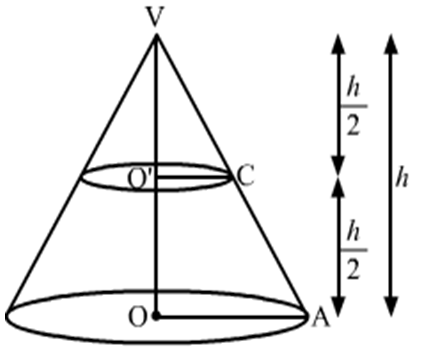
Since,
$\triangle\text{VOA}\sim\triangle\text{VO'C}$
Therefore,
$\text{In}\ \triangle\text{VOA}$ and $\sim\triangle\text{VO'C}$
$\frac{\text{O'V}}{\text{OV}}=\frac{\text{O'C}}{\text{OA}}$
$\triangle\text{VOA}\sim\triangle\text{VO'C}$
$\frac{\frac{\text{h}}{2}}{\text{h}}=\frac{\text{O'C}}{\text{OA}}$
$\frac{1}{2}=\frac{\text{O'C}}{\text{OA}}$
$\frac{\text{O'C}}{\text{OA}}=\frac{1}{2}$
The ratio of the volume of upper part and the cone, View full question & answer→MCQ 1501 Mark
If the surface area of a sphere is $616\ cm \ 2$ its diameter $($in $\ cm)$ is :
AnswerSurface area of a sphere $= 616 \mathrm{~cm}^2$
$\Rightarrow4\pi\text{r}^2=616$
$\Rightarrow4\times22\times\text{r}^2=616$
$\Rightarrow\text{r}^2\frac{616\times7}{22\times4}$
$\Rightarrow\text{r}=7\text{ cm}$
So, the diameter $=2\text{r}=2\times7=14\text{ cm}.$
View full question & answer→