Questions · Page 2 of 2

5 Marks Questions

Question 515 Marks
How many coins 1.75cm in diameter and 2mm thick must be melted to form a cuboid 11cm × 10cm × 7cm?
Answer
Given that dimension of a cuboid 11cm × 10cm × 7cm
So its volume $({V}_1)$ = 11cm × 10cm × 7cm
$=11 \times 10 \times 7cm^3 ...(i)$
Given diameter (d) = 1.75cm
$\text{radius}(\text{r})=\frac{\text{d}}{2}=\frac{1.75}{2}=0.875\text{cm}$
Thickness (h) = 2mm = 0.2cm
$\text{volume of a cylinder}=\pi\text{r}^2\text{h}$
$\text{V}_2=\pi(0.875)^2(0.2)\text{cm}^3 $
$\text{V}_1=\text{V}_2\times\text{n}$
Since volume of a cuboide is equal to sum of n volume of 'n' coins
$\text{n}=\frac{\text{V}_1}{\text{V}_2}$
n = no of coins
$\text{n}=\frac{11\times10\times7}{\pi(0.875)^2(0.2)}$
n = 1600
$\therefore$ No of coins (n) = 1600.
View full question & answer
Question 525 Marks
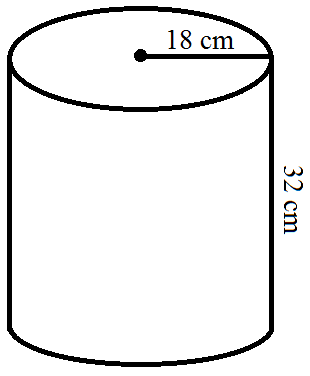
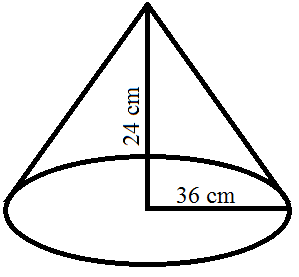
A cylindrical bucket of height 32cm and base radius 18cm is filled with sand. This bucket is emptied on the ground and a conical heap of sand is formed. If the height of the concial heap is 24cm, find the radius and slant height of the heap.
Answer
Given, radius of the base of the bucket = 18cm
Height of the bucket = 32cm
So, volume of the sand in cylindrical bucket
$=\pi\text{r}^2\text{h}=\pi(18)^2\times32=10368\pi$
Also, given height of the conical heap (h) = 24cm
Let radius of heap be r cm
Then, volume of the sand in the heap $=\frac{1}{3}\pi\text{r}^2\text{h}$
$=\frac{1}{3}\pi\text{r}^2\times24=8\pi\text{r}^2$
According to the condition, Volume of the sand in cylindrical bucket = Volume of the sand in conical heap
$\Rightarrow10368\pi=8\pi\text{r}^2$
$\Rightarrow10368 = 8\text{r}^2$
$\Rightarrow\text{r}^2=\frac{10368}{8}=1296$
$\Rightarrow\text{r}=36\text{cm}$
Again, let the slant height of the conical heap = l
Now,$ l^2 = h^2 + r^2 = (24)^2 + (36)^2$
$l^2$ = 576 + 1296 = 1872
$\text{l}=\sqrt{1872}$
$\therefore$ l = 43.267cm
Hence, radius of conical heap of sand = 36cm
and slant height of conical heap = 43.267cm
View full question & answer
Question 535 Marks
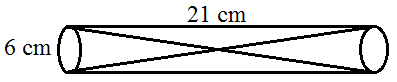
Two solid cones A and B are placed in a cylindrical tube as shown in the figure. The ratio of their capacitites are 2 : 1. Find the heights and capacities of the cones. Also, find the volume of the remaining portion of the cylinder.
Answer
$V_1 : V_2 = 2 : 1$
Diameter of the cylinder = 6cm
Radius, r = 3cm
Height of the cylinder = 21cm
let the height of one cone be H.
So, the height of the other cone will be 21 - H
$\frac{\text{V}_1}{\text{V}_2}=\frac{\pi(3)^2\text{H}}{\pi(3)^2(21-\text{H})}$
$\Rightarrow\frac{2}{1}=\frac{\text{H}}{21-\text{H}}$
$\Rightarrow42-2\text{H}=\text{H}$
$\Rightarrow\text{H}=14\text{cm}$
Height of one of the cones will be 14cm and of the other will be 21 - H = 21 - 14 = 7cm
Volume of cone with height 14cm $=\text{V}_1=\pi(3)^2\times14=396\text{cm}^3$
Volume of cone with height 7cm $=\text{V}_2=\frac{1}{3}\pi(3)^2\times7=66\text{cm}^3$
Volume of the remaining portion of the cylinder = Volume of the cylinder - Volume of cone 1 - Volume of cone 2
$\Rightarrow\text{V}=\pi(3)^2\times21-396-66$
$=594-396-66$
$=132\text{cm}^3$
View full question & answer
Question 545 Marks
A cylindrical bucket, 32cm high and with radius of base 18cm, is filled with sand. This bucket is emptied out on the ground and a conical heap of sand is formed. If the height of the conical heap is 24cm, find the radius and slant height of the heap.
Answer
Radius of cylinderical bucket (r) = 18cm
and height (h) = 32cm

$\therefore$ Volume of sand in it $=\pi\text{r}^2\text{h}$
$=\pi(18)^2\times32$
$=\pi\times324\times32=1036\pi\text{cm}^3$
$\therefore$ conical shape of sand $=10368\pi\text{cm}^3$
Hieght of heap = 24cm
Let radius be r, then
Volume $=\frac{1}{3}\pi\text{r}^2\text{h}$

$\Rightarrow10368\pi=\frac{1}{3}\times\pi\text{r}^2\times24$
$\Rightarrow\text{r}^2=\frac{10368\pi\times3}{\pi\times24}=1296=(36)^2$
$\therefore$ r = 36cm
$\therefore$ Radius = 36cm
and slant hieght (l) = $\sqrt{\text{r}^2+\text{h}^2}$
$=\sqrt{(36)^2+(24)^2}$
$\sqrt{1296+576}=\sqrt{1872}$
$\begin{array}{c|c} 2 & 1872 \\ \hline 2 & 936\\ \hline 2 & 468\\ \hline 2&234\\ \hline3 & 117\\ \hline 3 & 39\\ \hline &13 \end{array}$
$=\sqrt{144\times13}=12\sqrt{13}\text{cm}$
View full question & answer
Question 555 Marks
A spherical ball of radius 3cm is melted and recast into three spherical balls. The radii of two of the balls are 1.5cm and 2cm. Find the diameter of the third ball.
Answer
Radius of big spherical ball (R) = 3cm
$\therefore\text{volume}=\frac{4}{3}\pi\text{R}^3=\frac{4}{3}\pi\times(3)^3\text{cm}^3$
$=\frac{4}{3}\pi\times27=36\pi\text{cm}^3$
Similarly volume of ball of radius $(r_1)$ = 1.5cm
$\therefore\text{volume}=\frac{4}{3}\pi(1.5)^3$
$=\frac{4}{3}\pi\Big(\frac{3}{2}\Big)^3\text{cm}^3$
$=\frac{4}{3}\pi\times\frac{27}{8}=\frac{9\pi}{2}\text{cm}^3$
And Volume of ball of radius $(r_2)$ = 2cm
$=\frac{4}{3}\pi\times\pi(2)^3$
$=\frac{4}{3}\pi\times8=\frac{32}{3}\pi\text{cm}^3$
$\therefore\text{Volume of third ball}=36\pi-\Big(\frac{9}{2}\pi+\frac{32}{3}\pi\Big)$
$=36\pi-\Big(\frac{27+64}{6}\pi\Big)$
$=36\pi-\frac{91}{6}\pi$
$=\frac{216\pi-91\pi}{6}=\frac{125}{6}\pi\text{cm}^3$
$\therefore$ radius of the third ball
$=3\sqrt{\frac{125}{6}\pi\times\frac{3}{4\pi}}=3\sqrt{\frac{125}{8}}$
$=3\sqrt{\Big(\frac{5}{2}\Big)^3}=\frac{5}{2}\text{cm}=2.5\text{cm}$
$\therefore\text{diameter}=2\times\text{radius}$
$=2\times2.5=5\text{cm}$
View full question & answer
Question 565 Marks
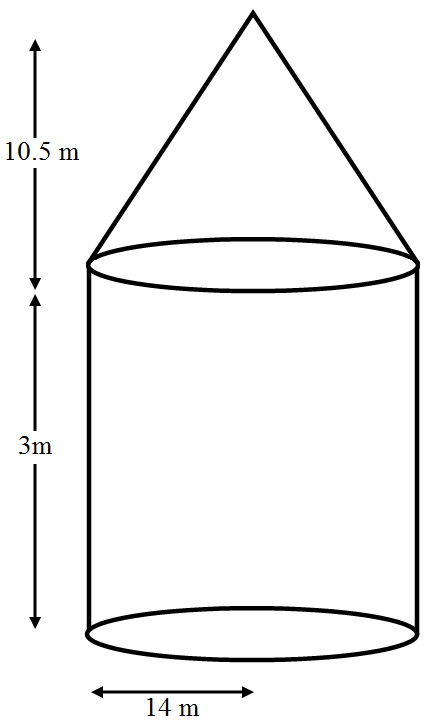
A tent is of the shape of a right circular cylinder upto a height of 3m and then becomes a right circular cone with a maximum height of 13.5m above the ground. Calculate the cost of painting the inner side of the tent at the rate of Rs. 2 per square metre, if the radius of the base is 14m.
Answer


Let r m be the radius of cylindrical base of cylinder of height by m
r = 14m and $h_1$ = 3m
Curved surface area of cylinder
$=2\pi\text{r}\text{h}_1\text{m}^2$
$=2\times\frac{22}{7}\times14\times3\text{ m}^2$
$=264\text{m}^2$
The radius of cylindrical box of cylinder is also equal to the radius of right circular cones.
Let $h_2$ be the height of cone and l be the slant height of cone.
$\text{r}=14\text{m}$ and $\text{h}_2=(13.5-3)$
$=10.5\text{m}$
$\text{l}^2=\text{r}^2+\text{h}^2_2$
$\text{l}^2=(14)^2+(10.5)^2$
$\text{l}=\sqrt{196+110.25}$
$\sqrt{306.25}=17.5\text{m}$
Curved surface area of the cone
$=\pi\text{rl}$
$=\frac{22}{7}\times14\times17.5$
Curved surface of area of cone
$=\pi\text{rl}$
$=\frac{22}{7}\times14\times17.5$
$=770\text{m}^2$
Therefore,
Total area of tent which is to be painted
$=\text { curved surface area of cylinder }+ \text { curved surface area of cone }$
$=(264+770) m^2$
$=1034 m^2$
Now cost of painting $1 m^2$ of inner side of tent = Rs. 2
Cost of painting $1034 m^2$ inner side of tent
$=2 \times 1034$
$=\text { Rs. } 2068$
View full question & answer
Question 575 Marks
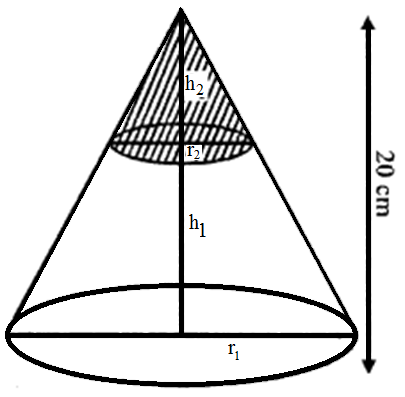
The height of a cone is 20cm. A small cone is cut off from the top by a plane parallel to the base. If its volume be $\frac{1}{125}$ of the volume of the original cone, determine at what height above the base the section is made.
Answer
Total height of the cone ($h_1$) = 20cm
Let a cone whose height is $h_2$ is cut off Then height of the remaining portion (frustum)

$h_1=\left(20-h_2\right) cm$
Let $r_1$ and $r_2$ be the radii of the bigger cone and smaller cone respectively.
$\therefore$ Volume of bigger cone $=\frac{1}{3}\pi \text{r}_1^2\text{h}_1$
and of smaller cone $=\frac{1}{3}\pi\text{r}^2_2\text{h}_2$
$\therefore\frac{\frac{1}{3}\pi\text{r}^2_2\text{h}_2}{\frac{1}{3}\pi\text{r}^2_1\text{h}}=\frac{1}{125}$
$\Rightarrow\frac{\text{r}^2_2\times\text{h}_2}{\text{r}^2_1\times\text{h}}=\frac{1}{125}=\frac{1}{5}\times\frac{1}{25}$
$\Rightarrow\frac{\text{r}^2_2}{\text{r}^2_1}\times\frac{\text{h}_2}{\text{h}}=\bigg(\frac{1}{2}\bigg)^2\times\frac{1}{5}$
$\Rightarrow\bigg(\frac{\text{r}_2}{\text{r}_1}\bigg)^2\bigg(\frac{\text{h}_2}{\text{h}}\bigg)$
$\Rightarrow\bigg(\frac{1}{5}\bigg)^2\times\frac{1}{5}$
$\Rightarrow\bigg(\frac{\text{r}_2}{\text{r}_1}\bigg)^2=\bigg(\frac{1}{5}\bigg)^2$ by comparing
and $\frac{\text{h}_2}{\text{h}}=\frac{1}{5}$
$\Rightarrow5{\text{h}_2}={\text{h}}\Rightarrow5{\text{h}_2}=20$ $(\therefore\text{h}=20\text{cm})$
$\Rightarrow{\text{h}_2}=\frac{20}{5}=4\text{cm}$
$\therefore$$ h_1= h - h_2= 20 - 4 = 16cm$
$\therefore$ Height from the base of the section = 16cm
View full question & answer
Question 585 Marks
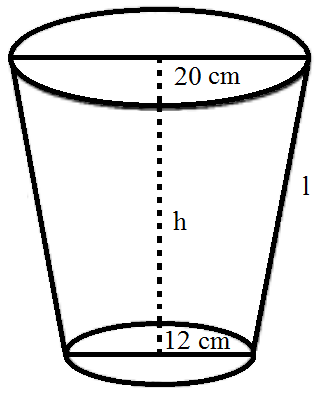
A bucket is in the form of a frustum of a cone with a capacity of $12308.8 cm^3$ of water. The radii of the top and bottom circular ends are 20 cm and 12 cm respectively. Find the height of the bucket and the area of the metal sheet used in its making.(use $\pi=3.14$ )
Answer
Volume of frustum (bucket) $=12308.8 cm^3$
Upper radius $\left(r_1\right)=20 cm$
and lower radius $\left(r_2\right)=12 cm$

Let h be the height of the bucket, the
Volume $=\frac{\pi}{3}\big[\text{r}^2_1+\text{r}_1\text{r}_2+\text{r}^2_2\big] \times\text{h}$
$\Rightarrow 12308.8=\frac{3.14}{3}\big[20^2+20\times12+12^2\big]\times\text{h}$
$\Rightarrow 12308.8=\frac{3.14}{3}\big[400+240+144\big]\times\text{h}$
$\Rightarrow \frac{12308.8\times3}{3.14}=784\ \text{h}$
$\text{h}= \frac{12308.8\times3}{3.14 \times784}=15$
$\therefore$ Height of the bucket = 15cm
Now slant height $\text{l}= \sqrt{(\text{h)}^2+(\text{r}_1-\text{r}_2)}^2$
$=\sqrt{(15)^2+(20-12)^2}=\sqrt{(15)^2+(8)^2}$
$=\sqrt{225+64}=\sqrt{289}=17\text{cm}$
$\therefore$ Surface area $=\pi (\text{r}_1+\text{r}_2)\ \text{l}+\pi \text{r}_1^2$
$=\pi\big[ (\text{r}_1+\text{r}_2) \ \text{l}+ \text{r}_1^2$
$=3.14\big[ (20+12)\times15+(12)^2\big]\text{cm}^2$
$=3.14\big[ (32\times15+(12)^2\big]\text{cm}^2$
$=3.14 (480+144)\text{cm}^2$
$=3.14\times624\text{cm}^2$
$=1959.36\text{cm}^2$
$\therefore$ Area of metal sheet used = 1959.36cm$^2$
View full question & answer
Question 595 Marks
An iron spherical ball has been melted and recast into smaller balls of equal size. If the radius of each of the smaller balls is $\frac{1}{4}$ of the radius of the original ball, how many such balls are made? Compare the surface area, of all the smaller balls combined together with that of the original ball.
Answer
Let R be the radius of the original ball, then
Radius of each smaller ball (r) $=\frac{1}{2}$ of the original ball $=\frac{1}{4}\text{R}$
Now volume of original ball $=\frac{4}{3}\pi\text{r}^3$
$=\frac{4}{3}\pi\Big(\frac{1}{4}\text{R}\Big)^3$
$=\frac{1}{64}\times\frac{4}{3}\pi\text{R}^3$
  1. $\therefore\text{No. of smaller balls}=\frac{4}{3}\pi\text{R}^3\div\frac{1}{64}\times\frac{4}{3}\pi\text{R}^3$
$=\frac{4\pi}{3}\text{R}^3\times\frac{64\times3}{4\pi\text{R}^3}=64$
  1. Surface area of original ball = $4\pi\text{R}^2$
and surface area of 64 smaller balls $=64\times4(\pi\text{r}^2)$

$=256\pi\Big(\frac{1}{4}\text{R}\Big)^2=256\pi\times\frac{1}{16}\text{R}^2$

$=16\pi\text{R}^2$

$\therefore\text{Ratio}=16\pi\text{R}^2\Rightarrow16:4=4:1$
View full question & answer
Question 605 Marks
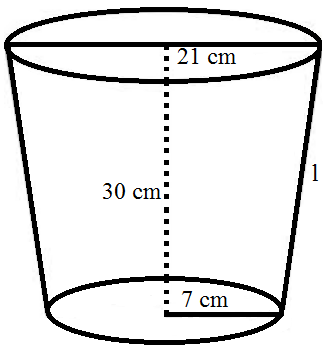
The radii of the ends of a bucket 30cm high are 21cm and 7cm. Find its capacity in litres and the amount of sheet required to make this bucket.
Answer
Height of the bucket (frustum) $( h )=30 cm$
Upper radius $\left( r _1\right)=21 cm$
and lower radius $\left(r_2\right)=7 cm$
Slant height (l) $=\sqrt{\text{h}^2+(\text{r}_1-\text{r}_2)^2}$
$=\sqrt{(30)^2+(21-7)^2}=\sqrt{30^2+14^2}$
$=\sqrt{900+196}=\sqrt{1096}\text{cm}=33.106\text{cm}$

Volume $=\frac{\pi}{3}[\text{r}_1^2+\text{r}_1\text{r}_2+\text{r}_2^2]\times\text{h}$
$=\frac{22}{3\times7}[21^2+21\times7+7^2]\times30\text{cm}^3$
$=\frac{22}{21}\times30[637]=20020\text{cm}^3$
$\therefore$ Capacity $= 20020\text{cm}^3$
$=\frac{20020}{1000}=20.2\ \text{l}$
Total surface area $=\pi(\text{r}_1+\text{r}_2)\ \text{l}+\pi\text{r}_2^2$
$=\frac{22}{7}[21+7]\times33.106+\frac{22}{7}(7)^2\text{cm}^2$
$=\frac{22}{7}\times28\times33.106+\frac{22}{7}\times49\text{cm}^2$
$=2913.328+154\text{cm}^2$
$=3067.328\text{cm}^2$
View full question & answer
Question 615 Marks
How many spherical lead shots each of diameter 4.2cm can be obtained from a solid rectangular lead piece with dimensions 66cm × 42cm × 21cm.
Answer
Given that, lots of spherical lead of shots made from a solid rectangular lead piece.
$\therefore$ Number of spherical lead shots
$=\frac{\text{volume of solid rectangular lead piece}}{\text{volume of a spherical lead shot}}\ ...(\text{i})$
Also, given that diameter of a spherical lead shot i.e. sphere = 4.2cm
$\therefore$ Radius of a spherical lead shot,
$\text{r}=\frac{4.2}{2}=2.1\text{cm}[\therefore\text{radius}=\frac{1}{2}\text{diameter}]$
So, volume of a spherical lead shot i.e.
$\text{sphere}=\frac{4}{3}\pi\text{r}^3$
$=\frac{4}{3}\times\frac{22}{7}\times(2.1)^3$
$=\frac{4}{3}\times\frac{22}{7}\times2.1\times2.1\times2.1$
$=\frac{4\times22\times21\times21\times21}{3\times7\times1000}$
Now, length of rectangular lead piece, l = 66cm
Breadth of rectangular lead piece, b = 42cm
Hieght of rectangular lead piece, h = 21cm
$\therefore$ Volume of a solid rectangular lead piece i.e.
cuboid = l × b × h = 66 × 42 × 21
From Eq. (i), Number of spherical lead, shots
$\frac{66\times42\times21}{4\times22\times21\times21\times21}\times3\times7\times1000$
$=\frac{3\times22\times21\times2\times21\times21\times1000}{4\times22\times21\times21\times21}$
$=3\times2\times250$
$=6\times250=1500$
Hence, the required number of spherical lead shots is 1500.
View full question & answer
Question 625 Marks
The perimeters of the ends of a frustum of a right circular cone are 44cm and 33cm. If the height of the frustum be 16cm, find its volume, the slant surface and the total surface.
Answer
Given perimeters of ends of frustum right circular cone are 44cm an 33cm Height of frustum cone = 16cm
Perimeter $=2\pi\text{r}$
$2\pi\text{r}_1=44$
$\text{r}_1=7\text{cm}$
$2\pi \text{r}_2=33$
$\text{r}_2=\frac{21}{4}=5.25\text{cm}$
Let slant heightof frustum right circular cone be 1.
$\text{l}=\sqrt{(\text{r}_1-\text{r}_2)^2+\text{h}^2}$
$\text{l}=\sqrt{(7-5.25)^2+16^2\text{cm}}$
$\text{l}=16.1\text{cm}$
$\therefore$ slant height of frustum cone = 16.1cm curved surface area of frustum cone $= \pi (\text{r}_1+\text{r}_2)\text{l}$
$=\pi (7+5.25)16.1$
C.S.A. of a cone $= 619.65cm^2$
Voume of a cone $=\frac{1}{3}\pi \Big(\text{r}^2_1+\text{r}^2_2+\text{r}_1\text{r}_2\Big)\times\text{h}$
$=\frac{1}{3}\big(7^2+(5.25)^2+7(5.25)\times16$
$=1898.56\text{cm}^3$
$\therefore$ Volume of a cone $= 1898.56cm^3$
Total surface area of frustum cone $=\pi\big(\text{r}_1+\text{r}_2\big)\text{l}+\pi\text{r}^2_1+\pi\text{r}^2_2$
$=\pi (7+5.25)16.1+\pi(7^2+5.25^2)$
$=860.27\text{cm}^2$
$\therefore$ Total surface area of frustum cone $= 860.27cm^2​​​​​​​$​​​​​​​
View full question & answer
Question 635 Marks
A reservoir in the form of the frustum of a right circular cone contains $44 \times 10^7$ litres of water which fills it completely. The radii of the bottom and top of the reservoir are 50 metres and 100 metres respectively. Find the depth of water and the lateral surface area of the reservoir.
Answer
A reservoir in the form of the frustum of a right circular cone contains $44 \times 10^7$ litres of water which fills it completely. The radii of the bottom and top of the reservoir are 50 metres and 100 metres respectively. Find the depth of water and the lateral surface area of the reservoir.
$\text{V}=\frac{1}{3}\pi(\text{r}_1^2+\text{r}_1\text{r}_2+\text{r}_2^2)\times\text{h}$
$\frac{1}{3}\pi(100^2+100\times50+50^2)\times\text{h}$
$=\frac{1}{3}\times\frac{22}{7}\times17500\times\text{h}$
$=\frac{1}{3}\times22\times2500\times\text{h}\ \text{cm}^3$
$=\frac{1}{3}\times22\times2500\times\text{h}\times10^6\text{m}^3$
$=\frac{1}{3}\times22\times2500\times\text{h}\times10^3\ \text{liters}$
Given that the volume of the reservoir is $44 \times 10^7$. Thus, we have
$=\frac{1}{3}\times22\times2500\times\text{h}\times10^3=44\times10^7$
$\Rightarrow\text{h}=\frac{3\times44\times10^7}{22\times2500\times10^3}$
$\Rightarrow\text{h}=24$
Hence, the depth of water in the reservoir is 24m
The slant height of the reservoir is
$\text{l}=\sqrt{(\text{r}_1-\text{r}_2)^2+\text{h}^2}$
$=\sqrt{(100-50)^2+24^2}$
$=\sqrt{3076}$
= 55.46169 meter
The lateral surface area of the reservoir is
$\text{S}_1=\pi(\text{r}_1+\text{r}_2)\times\text{l}$
$=\pi\times(100+50)\times55.46169$
$=\pi\times150\times55.46169$
$=26145.225\text{m}^2$
Hence, the lateral surface area is $= 26145.225m^2$
View full question & answer
Question 645 Marks
A bucket has top and bottom diameter of 40cm and 20cm respectively. Find the volume of the bucket if its depth is 12cm. Also, find the cost of tin sheet used for making the bucket at the rate of Rs. 1.20 per $dm^2$. $(\text{use}\ \pi=3.14)$
Answer
Given diameter to top of bucket = 40cm
Radius $(\text{r}_1)=\frac{40}{2}=20\text{cm}$
Depth of a bucket $(\text{h})=12\text{cm}$
Volume of a buket $=\frac{1}{3}\pi\Big(\text{r}^2_1+\text{r}^2_2+\text{r}_1\text{r}_1\Big)\text{h}$
$=\frac{3}{1}\pi \Big(20^2+10^2+20\times10\Big){12}$
$ =8800\text{cm}^3.$
Let '1' be slant height of bucket
$\Rightarrow \text{l}=\sqrt{(\text{r}_1-\text{r}_2)^2+\text{h}^2}$
$\Rightarrow \text{l}=\sqrt{(20-10)^2+12^2}$
$\Rightarrow \text{l}=2\sqrt{61}=15.620\text{cm}$
Total surface area of buket $=\pi (\text{r}_1+\text{r}_2)\times\text{l}+\pi\text{r}^2_2$
$=\pi (20+10)\times15.620+\pi (10)^2$
$=\frac{1320\sqrt{61}+2200}{7}\text{cm}^2$
$=\frac{1320\sqrt{61}+2200}{7\times100}\text{dm}^2=17.87\text{dm}^2$
Given that cost of tin sheet used for making buket per $dm ^2=$ Rs. 1.20 So total cost for $17.87 dm ^2=1.20 \times 17.87 dm ^2$ $=21.40 Rs$.
$\therefore$ cost of tin sheet $17.87 dm ^2=$ Rs. 2140 Ps
View full question & answer
Question 655 Marks
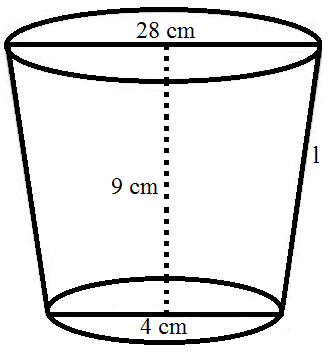
A frustum of a cone is 9cm thick and the diameters of its circular ends are 28cm and 4cm. Find the volume and lateral surface area of the frustum.$(\text{Take}\ \pi=\frac{22}{7})$
Answer
Upper diameter = 28cm
and lower diameter = 4cm
Height (h) = 9cm

Upper radius $\left( r _1\right)=\frac{28}{2}=14 cm$ and lower radius $\left( r _2\right)=\frac{4}{2}=2 cm$
$\therefore$ Lateral height (l) $=\sqrt{\text{h}^2+(\text{r}_1-\text{r}_2)^2}$
$=\sqrt{(9)^2+(14-2)^2}=\sqrt{(9)^2+(12)^2}$
$=\sqrt{81+144}=\sqrt{225}=15\text{cm}$
Volume $=\frac{\pi}{3}[\text{r}_1^2+\text{r}_1\text{r}_2+\text{r}_2^2]\times\text{h}$
$=\frac{\pi}{3}[(14)^2+14\times2+(2)^2]\times9\text{cm}^3$
$=\frac{\pi}{3}[196+28+4]\times9\text{cm}$
$=\frac{\pi}{3}\times228\times9=\frac{2052}{3}\pi\ \text{cm}^3$
$=684\pi\ \text{cm}^3$
So lateral surface area
$=\pi(\text{r}_1+\text{r}_2)\ \text{l}=\pi(14+2)\times15\text{cm}^2$
$\pi\times16\times15=240\pi\ \text{cm}^2$
View full question & answer
Question 665 Marks
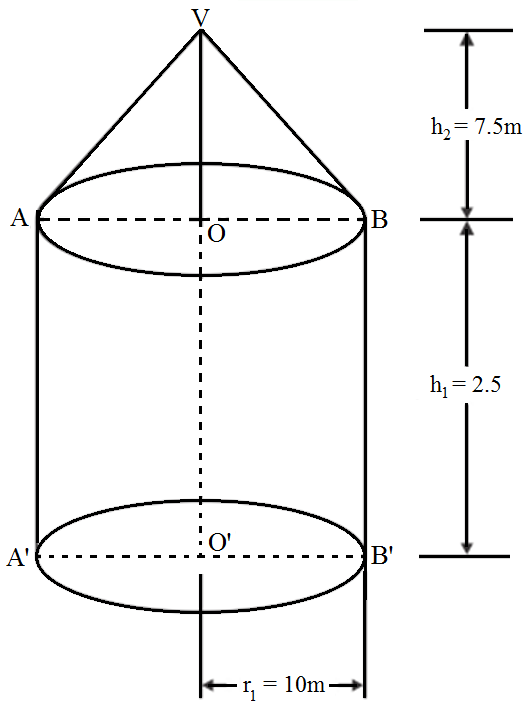
A tent is in the form of a cylinder of diameter 20m and height 2.5m, surmounted by a cone of equal base and height 7.5m. Find the capacity of the tent and the cost of the canvas at Rs 100 per square metre.
Answer
Given that:
Radius of the base $\text{r}=\frac{\text{d}}{2}=\frac{20}{2}=10\text{m}$
Height of the cylinder $\text{h}_1=2.5\text{m}$
Height of the cone $\text{h}_2=7.5\text{m}$

Slant height of the cone
$\text{l}=\sqrt{\text{r}^2+\text{h}^2}$
$=\sqrt{10^2+7.5^2}$
$=12.5\text{m}$
The total capacity of the tent is given by
$\text{V}=\pi\text{r}^2\text{h}_1+\frac{1}{3}\pi\text{r}^2\text{h}_2$
$=\pi\times10^2\times2.5+\frac{1}{3}\times\pi\times10^2\times7.5$
$=\pi\times250+\pi\times250$
$=500\pi\ \text{m}^3$
The total area of canvas required for the tent is
$\text{S}=2\pi\text{rh}_1+\pi\text{rl}$
= 2 × 3.14 × 10 × 2.5 + 3.14 × 10 × 12.5
$=\pi(2\times10\times2.5+10\times12.5)$
$=\pi(50+125)$
$=\frac{22}{7}\times175$
$=550\text{m}^2$
Therefore, the total cost of the canvas is
= 100 × 550
= Rs. 55000
Hence, the total capacity and cost is $\text{V}=500\pi\text{m}^3,\text{and}\ \text{Rs.}55000$
View full question & answer
Question 675 Marks
A bucket made of a aluminium sheet is of height 20cm and its upper and lower ends are of radius 25cm and 10cm respectively. Find the cost of making the bucket if the aluminium sheet costs Rs 70 per $100cm^2$. $(\text{use}\ \pi=3.14)$
Answer
Given height of bucket $( h )=20 cm$
Upper radius of bucket $\left( r _1\right)=25 cm$
Lower radius of bucket $\left(r_2\right)=10 cm$
Let ' 1 ' be slant height of busket
$\text{l}=\sqrt{(\text{r}_1-\text{r}_2)^2+\text{h}^2}$
$\text{l}=\sqrt{(25-10)^2+20^2}=\sqrt{225+400}$
$\text{l}=25\text{m}$ $\therefore$ Slant height of bucket (1) = 25cm
Curved surface area of bucket $=\pi \big(\text{r}_1+\text{r}_2\big)\text{l}+\pi\text{r}^2_2$
$=\pi \big(25+10)25+\pi(10)^2$
$=\pi(35)25+\pi(100)=975\pi$
C. S. $A=3061.5 cm^2$
Curved surface area $=3061.5 cm^2$
Cost of marking bucket per $100 cm^2=$ Rs 70
Cost of marking per $3016.5 cm^2=\frac{3061.5}{100} \times 70$
= Rs 2143.05
$\therefore$ Total cost for $3016.5 cm^2=$ Rs 2143.05 per
View full question & answer
Question 685 Marks
A right angled triangle whose sides are 3cm, 4cm and 5cm is revolved about the sides containing the right angle in two ways. Find the difference in volumes of the two cones so formed. Also, find their curved surfaces.
Answer
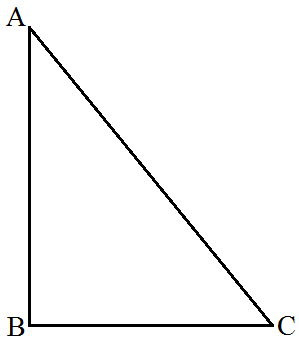
We consider the following figure as follows

Let the angle B is right angle and the sides of the triangle are AB = 4cm, BC = 3cm,
AC = 5cm.
When the triangle is revolved about the side AB, then the base-radius, height and slant height of the produced cone becomes BC, AB and AC respectively. Therefore, the volume of the produced cone is
$\text{V}_1=\frac{1}{3}\pi\times\text{BC}^2\times\text{AB}$
$=\frac{1}{3}\pi\times(3)^2\times4$
$=12\pi$ cubic cm
In this case, the curved surface area of the cone is
$\text{S}_1=\pi\times\text{BC}\times\text{AC}$
$=\pi\times3\times5$
$=15\pi$ square cm
When the triangle is revolved about the side BC, then the base-radius, height and slant height of the produced cone becomes AB, BC and AC respectively. Therefore, the volume of the produced cone is
$\text{V}_2=\frac{1}{3}\pi\times\text{AB}^2\times\text{BC}$
$=\frac{1}{3}\pi\times(4)^2\times3$
$=16\pi$ cubic cm
View full question & answer
Question 695 Marks
A solid is in the shape of a frustum of a cone. The diameters of the two circular ends are 60cm and 36cm and the height is 9cm. Find the area of its whole surface and the volume.
Answer
Given height of a fristum cone $=9 cm$ Lower end radius $\left(r_1\right)=\frac{60}{2} cm=30 cm$ Upper end radius $\left( r _2\right)=\frac{36}{2} cm=18 cm$
Let slant height of frustum cone be l
$\text{l}=\sqrt{(\text{r}_1-\text{r}_2)^2+\text{h}^2}$
$\text{l}=\sqrt{(30-18)^2+9^2}$
$\text{l}=\sqrt{144+81}$
$\text{l}=15\text{cm}$
Volume of frustum cone $=\frac{1}{3}\pi(\text{r}^2_1+\text{r}^2_2+\text{r}_1\text{r}_2)\text{h}$
$=\frac{1}{3}\pi(30^2+18^2+30(18))9$
$=5292\pi\text{cm}^3$
Total surface area of frustum cone =
$\pi(\text{r}_1+\text{r}_2)\times\text{l}+\pi\text{r}^2_1+\pi\text{r}^2_2$
$=\pi(30+18)15+\pi(30)^2+\pi(18)^2$
$=\pi(48(15)+(30)^2+(18)^2)$
$=\pi(720+900+324)$
$=1944\pi\text{cm}^2$
$\therefore$ Total surface area $=1944\pi\text{cm}^2$
View full question & answer
Question 705 Marks
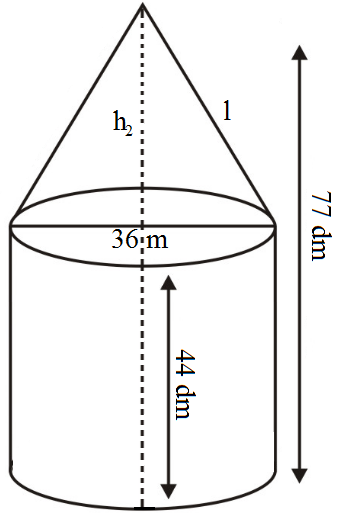
A tent of height 77 dm is in the form a right circular cylinder of diameter 36 m and height 44 dm surmounted by a right circular cone. Find the cost of the canvas at Rs. 3.50 per $m ^2$. [use $\left.\pi=\frac{22}{7}\right]$
Answer
Total height of the tent $=77 dm$ Height of the cylindrical part $\left( h _1\right)=44 dm =4.4 m$ Height of conical part $\left( h _2\right)=77-$ $44=33 dm =3.3 m$ Diameter of the base of the tent $=36 m$

$\therefore$ Radius (r) $=\frac{36}{2}=18\text{m}$ $\therefore$ Slant height of the conical part $=\sqrt{\text{r}^2+{\text{h}_2}^2}$ $\text{l}=\sqrt{18^2+(3.3)^2}=\sqrt{324+11}=\sqrt{335}=18.30\text{m}$C.S.A of cylinder $=2\pi\text{r}\text{h}$
$=2\times\frac{22}{7}\times18\times4.4$ $=\frac{3484.8}{7}$ $=497.82$ $=498\text{m}^2$ S.A of cone $=\pi\text{r}\text{l}$ $=\frac{22}{7}\times18\times18.30$ $=1035.25$ Total area = Area of cylinder + Area of cone $=498+1035.25$ $=1533.25\text{m}^2$ Cost of canvas $=1533.25\times3.50$ $=5366.4$
View full question & answer
Question 715 Marks
A milk container is made of metal sheet in the shape of frustum of cone whose volume is $10459 cm^3$. The radii of its lower and upper circular ends are 8 cm and 20 cm respectively. Find the cost of metal sheet used in making the container at the rate of Rs. 1.40 per $cm ^2$. (use $\pi=\frac{22}{7}$ )
Answer
Let the depth of the container is h cm . The radii of the top and bottom circles of the container are $r_1=20 cm$ and $r_2$ $=8 cm$ respectively.
The volume/ capacity of the container is
$\text{V}=\frac{1}{3}\pi(\text{r}_1^2+\text{r}_1\text{r}_2+\text{r}^2_2)\times\text{h}$
$=\frac{1}{3}\pi(20^2+20\times8+8^2)\times\text{h}$
$=\frac{1}{3}\times\frac{22}{7}\times624\times\text{h}$
$=\frac{22}{7}\times208\times\text{h}\ \text{cm}^3$
Given that the capacity of the bucket is $10459\frac{3}{7}\text{cm}^3.$ Thus, we have
$\Rightarrow\frac{22}{7}\times208\times\text{h}=10459\frac{3}{7}$
$\Rightarrow\text{h}=\frac{73216}{22\times208}$
$\Rightarrow\text{h}=16\text{cm}$
Hence, the height of the container is 16cm.
The slant height of the container is
$\text{l}=\sqrt{(\text{r}_1-\text{r}_2)^2+\text{h}^2}$
$=\sqrt{(20-8)^2+16^2}$
$=\sqrt{400}$
$=20\text{cm}$
The surface area of the used metal sheet to make the container is
$\text{S}_1=\pi(\text{r}_1+\text{r}_2)\times\text{l}+\pi\text{r}^2_2$
$=\pi\times(20+8)\times20+\pi\times8^2$
$\pi\times28\times20+64\pi$
$=624\pi\ \text{cm}^2$
The cost to make the container is $=624\pi\times1.4=624\times\frac{22}{7}\times1.4=\text{Rs}.\ 2745.6$
View full question & answer
Question 725 Marks
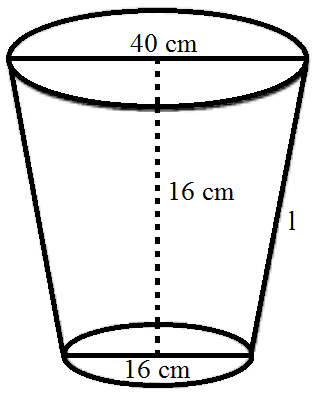
A bucket made up of a metal sheet is in the form of a frustum of a cone of height 16cm with diameters of its lower and upper ends as 16cm and 40cm respectively. Find the volume of the bucket. Also, find the cost of the bucket if the cost of metal sheet used in Rs. 20 per $100cm^2$. $(\text{use}\ \pi=3.14)$
Answer
Lower radius of bucket $\text{(r)}=\big(\frac{16}{2}\big)=8\text{cm}$
and upper radius $\text{(r)}=\big(\frac{40}{2}\big)=20\text{cm}$
Height $\text{(h)}=16\text{cm}$

$\therefore$ Slant height $\text{(l)}=\sqrt{\text{h}^2+(\text{R}-\text{r})^2}$
$=\sqrt{16^2+(20-8)^2}=\sqrt{16^2+12^2}$
$=\sqrt{256+144}=\sqrt{400}=20\text{cm}$
Volume of the bucket $=\frac{1}{3}\pi\big(\text{R}^2+\text{r}^2+\text{Rr})\text{h}$
$=\frac{1}{3}\times 3.14\big[20^2+8^2+20\times8\big]\times16$
$=\frac{1}{3}\times 3.14\big[400+64+160\big]\times16$
$=\frac{3.14}{3}\times624\times16=3.14\times208\times16\text{cm}^3$
$=10449.92\text{cm}^3$
Tolat surface area of the bucket
$=\pi(\text{R}+\text{r})\text{l}+\pi\text{r}^2=\pi\big[(\text{R}+\text{r})\text{l}+\text{r}^2\big]$
$=3.14\big[(20+8)20+(8)^2\big] \text{cm}^2=1959.3\text{cm}^2$
Now cost of metal sheet at the rate of
$Rs. 20 per 100cm^2$
$=1959.36\times\frac{20}{100}=\text{Rs}\ 391.87 \ \text{(approx)}$
View full question & answer
Question 735 Marks
The height of a cone is 10cm. The cone is divided into two parts using a plane parallel to its base at the middle of its height. Find the ratio of the volumes of the two parts.
Answer
We have,
Radius of the solid cone, R = CP
Height of the solid cone, AP = H
Radius of the smaller cone, QD = r
Height of the smaller cone, AQ = h
Also, $\text{AQ}=\frac{\text{AP}}{2}\text{ i.e. }\text{h}=\frac{\text{H}}{2}\ \text{or}\ \text{H}=2\text{h}\ ...(\text{i})$
Now, in $\triangle\text{AQD}\ \text{and}\ \triangle\text{APC},$
$\angle\text{QAD}=\angle\text{PAC}$ (common angles)
$\angle\text{AQD}=\angle\text{APC}=90^\circ$
So, bt AA criteria
$\triangle\text{AQD}\sim\text{APC}$
$\Rightarrow\frac{\text{AQ}}{\text{AP}}=\frac{\text{QD}}{\text{PC}}$
$\Rightarrow\frac{\text{h}}{\text{H}}=\frac{\text{r}}{\text{R}}$
$\Rightarrow\frac{\text{h}}{\text{2h}}=\frac{\text{r}}{\text{R}}\ [\text{using (i)]}$
$\Rightarrow\frac{1}{2}=\frac{\text{r}}{\text{R}}$
$\Rightarrow\text{R}=2\text{r}\ ....(\text{ii})$
As, Volume of smaller cone $=\frac{1}{3}\pi\text{r}^2\text{h}$
And, Volume of solid cone $=\frac{1}{3}\pi\text{R}^2\text{H}$
$=\frac{1}{3}\pi(2\text{r})^2\times(2\text{h})\ \ [\text{Using (i) and (ii)]}$
$=\frac{8}{3}\pi\text{r}^2\text{h}$
So,
Volume of frustum = Volume of solid cone - Volume of smaller cone
$=\frac{8}{3}\pi\text{r}^2\text{h}-\frac{1}{3}\pi\text{r}^2\text{h}$
$=\frac{7}{3}\pi\text{r}^2\text{h}$
Now, the ratio of the volumes of the two parts $=\frac{\text{Volume of the smaller cone}}{\text{Volume of the frustum}}$
$=\frac{\Big(\frac{1}{3}\pi\text{r}^2\text{h}\Big)}{\Big(\frac{7}{3}\pi\text{r}^2\text{h}\Big)}$
$=\frac{1}{7}$
$=1:7$
So, the ratio of the volume of the two parts of the cone is 1 : 7.
View full question & answer
5 Marks Questions - Page 2 - MATHS STD 10 Questions - Vidyadip