Questions

[5 marks Questions]

🎯

Test yourself on this topic

3 questions · timed · auto-graded

Question 15 Marks
In the following schematic diagram for the preparation of hydrogen gas as shown in Figure, what would happen if following changes are made?
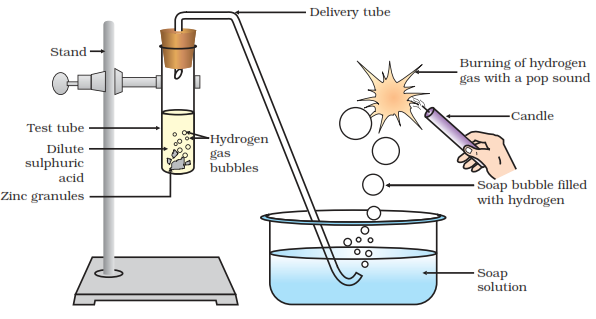
  1. In place of zinc granules, same amount of zinc dust is taken in the test tube.
  2. Instead of dilute sulphuric acid, dilute hydrochloric acid is taken.
  3. In place of zinc, copper turnings are taken.
  4. Sodium hydroxide is taken in place of dilute sulphuric acid and the tube is heated.
Answer
  1. The reaction will become faster because zinc dust has more surface area.
  2. Nearly same amount of hydrogen gas will be evolved.
  3. No reaction will take place as copper is less reactive than hydrogen.
  4. The reaction will take place and hydrogen gas will be evolved.
$\text{Zn}\ \ +\ \ 2\text{NaOH}\ \ \xrightarrow{\text{heat}}\ \ \text{Na}_2\text{ZnO}_2\ \ +\ \ \text{H}_2\text{(g)}\\\text{Zinc}\ \ \ \ \text{Sodium}\ \ \ \ \ \ \ \ \ \ \ \ \ \ \ \ \text{Sodium}\ \ \ \ \ \ \ \ \ \ \ \text{Hydrogen}\\ \ \ \ \ \ \ \ \ \ \ \ \text{hydroxide}\ \ \ \ \ \ \ \ \ \ \ \ \ \text{zincate}$​​​​​​​
View full question & answer
Question 25 Marks
How would you distinguish between baking powder and washing soda by heating?
Answer
Baking soda is sodium hydrogen carbonate $\left( NaHCO _3\right)$ which forms sodium carbonate $\left( Na _2 CO _3\right)$, water and carbon dioxide gas while heating. $2 NaHCO _3 \rightarrow Na _2 CO _3+ H _2 O + CO _2 \uparrow$
Presence of $CO _2$ can be detected with the help of lime water which turns milky after reacting with carbon dioxide gas
Washing soda is sodium carbonate deca-hydrate $\left( Na _2 CO _3 \cdot 10 H _2 O \right)$ which means there are 10 water molecules present with crystal hence named as water of crystallization
On heating washing soda, it becomes anhydrous and presence of water of crystallization can be detected with the help of anhydrous $CuSO _4$ which shows colour change from white to blue with moisture.
$Na _2 CO _3 \cdot 10 H _2 O \rightarrow Na _2 CO _3+10 H _2 O$
View full question & answer
Question 35 Marks
A metal carbonate X on reacting with an acid gives a gas which when passed through a solution Y gives the carbonate back. On the other hand, a gas G that is obtained at anode during electrolysis of brine is passed on dry Y, it gives a compound Z, used for disinfecting drinking water. Identity X, Y, G and Z.
Answer
Here X is calcium carbonate which is a metal carbonate which reacts with dilute HCl to form calcium carbonate $\left( CaCO _3\right)$, water and carbon dioxide gas.
$CaCO _3+$ dil. $2 HCl \rightarrow CaCl _2+ H _2 O + CO _2 \uparrow$
When carbon dioxide gas is passed through lime water or calcium hydroxide $\left( Ca ( OH )_2\right)$, it gives the calcium carbonate back. So Y is calcium hydroxide.
$Ca ( OH )_2+ CO _2 \rightarrow CaCO _3 \downarrow+ H _2 O$
Brine is saturated solution of sodium chloride ( NaCl $)$. Electrolysis of brine forms hydrogen gas at cathode and chlorine gas at anode.
$2 NaCl +2 H _2 O \xrightarrow{\text { Electrolysis }} 2 NaOH + Cl _2(g)+ H _2(g)$
So G is chlorine gas which is passed through dry calcium hydroxide $\left( Ca ( OH )_2\right)$, produces bleaching powder, $CaOCl _2$
(Z). $Ca ( OH )_2+ Cl _2 \rightarrow CaOCl _2+ H _2 O$ Hence, $X =$ Calcium carbonate; $Y =$ Lime water; $G =$ Chlorine gas and $Z =$
Calcium oxychloride or bleaching powder
View full question & answer
[5 marks Questions] - Science STD 10 Questions - Vidyadip