Questions

[5 marks Questions]

🎯

Test yourself on this topic

10 questions · timed · auto-graded

Question 15 Marks
Solution A turns universal indicator blue to purple whereas solution B turns universal indicator orange to red.
  1. What will be the action of solution A on litmus?
  2. What will be action of solution B on litmus?
  3. Name any two substances which can give solutions like A.
  4. Name any two substances which can give solutions like B.
  5. What sort of reaction takes place when solution A reacts with solution B?
Answer
  1. Solution A turns universal indicator blue to purple so it is basic in nature and will turn litmus blue.
  2. Solution B turns universal indicator orange to red so it is acidic in nature and will turn litmus red.
  3. Milk of magnesia and sodium hydroxide solution are bases like solution A.
  4. Lemon juice and hydrochloric acid are acids like solution B.
  5. Neutralisation reaction.
View full question & answer
Question 25 Marks
Write the chemical formula of ammonium chloride. Explain why an aqueous solution of ammonium chloride is acidic in nature? Illustrate your answer with the help of a chemical equation.
Answer
The chemical formula of ammonium chloride is $NH _4 Cl$. Since, ammonium chloride is the salt of a strong acid HCl and a weak base $NH _4 OH$, so an aqueous solution of ammonium chloride is acidic in nature. When dissolved in water, it gets hydrolysed to some extent to form HCl and $NH _4 OH . HCl$ being a strong acid is fully ionised and gives a large amount of hydrogen ions whereas $NH _4 OH$ is only slightly ionised. So, $NH _4 Cl$ contains more of hydrogen ions than hydroxide ions and is hence acidic in nature.
$\text{NH}_4\text{Cl}\text{(s)}+\text{H}_2\text{O}\text{(l)}\xrightarrow{\text{hydrolysis}}\text{NH}_4\text{OH}\text{(aq)}+\text{HCl(aq)}$
View full question & answer
Question 35 Marks
The pH values of five solutions A, B, C, D and E are given below:
  1. 1
  2. 5
  3. 7
  4. 11
  5. 13
Which solution is:
  1. Weakly alkaline.
  2. Neutral.
  3. Strongly acidic.
  4. Strongly alkaline, and.
  5. Weakly acidic?
Answer
  1. Solution D, with a pH value of 11, is weakly alkaline.
  2. Solution C, with a pH value of 7, is neutral.
  3. Solution A, with a pH value of 1, is strongly acidic.A.
  4. Solution E, with a pH value of 13, is strongly alkaline.
  5. Solution B, with a pH value of 5, is weakly acidic.
View full question & answer
Question 45 Marks
State two uses each of the following compounds:
  1. Sodium hydroxide.
  2. Chlorine.
  3. Hydrogen.
  4. Hydrochloric acid.
Answer
  1. Sodium hydroxide:
  1. It is used for making soaps and detergents.
  2. It is used in the manufacture of paper.
  1. Chlorine:
  1. It is used in the production of bleaching powder.
  2. It is used in the production of hydrochloric acid.
  1. Hydrogen:
  1. It is used in the production of hydrochloric acid.
  2. It is used in the hydrogenation of oils.
  1. Hydrochloric acid:
  1. It is used in medicines and cosmetics.
  2. It is used in textile/ dyeing and tanning industries.
View full question & answer
Question 55 Marks
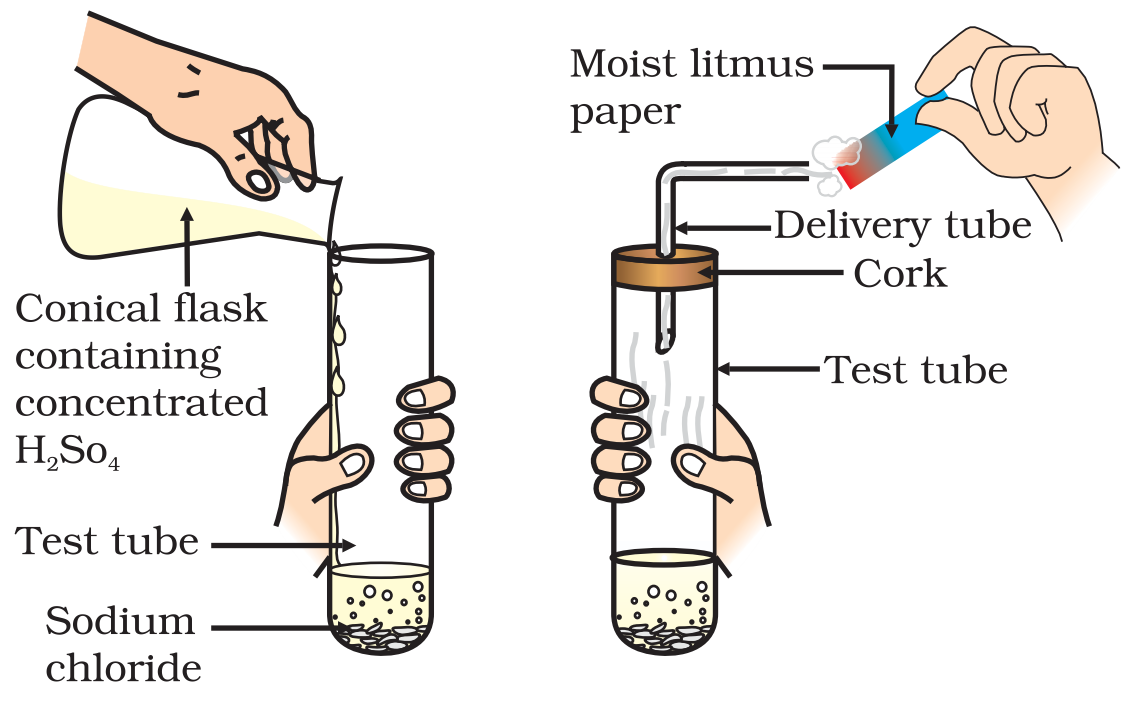
With the help of labelled diagrams, describe an activity to show that acids produce ions only in aqueous solutions.
Answer
Activity: Take about 1g solid NaCl in a clean and dry test tube and add some concentrated sulphuric acid to it. Fit a rubber cork with a small delivery tube in the mouth of the test tube. Concentrated sulphuric acid reacts with sodium chloride to form hydrogen chloride gas. The hydrogen chloride gas starts coming out of the open end of the glass tube.

Now, hold a ‘dry’ blue litmus paper in HCl gas. There is no change in colour of the ‘dry’ blue litmus paper. This shows that HCl gas does not behave as an acid in the absence of water. However, when we hold a ‘moist’ blue litmus paper in HCl gas, we will see that the ‘moist’ blue litmus paper turns red. This indicates that HCl gas shows acidic behavior in the presence of water as hydrogen ions are formed. This proves that acids produce ions only in aqueous solutions or in presence of water.
View full question & answer
Question 65 Marks
Consider the following substances :$NaCl , Ca ( OH )_2, NaHCO _3, NH _3, Na _2 CO , H _2 O , Cl _2, CO _2, CaSO _4 \cdot 2 H _2 O , 2 CaSO _4 \cdot H _2 O , CaOCl _2$
a. Which two substances combine to form bleaching powder?
b. Which four substances are utilised in the production of washing soda?
c. Which compound represents plaster of Paris?
d. Which compound is a part of baking powder?
e. Which compound is used as an antacid?
Answer
a. $Ca ( OH )_2$ and $Cl _2$
b. $NaCl , NH _3, H _2 O$ and $CO _2$
c. $2 CaSO _4 \cdot H _2 O$
d. $NaHCO _3$
e. $NaHCO _3$​​​​​​​
View full question & answer
Question 75 Marks
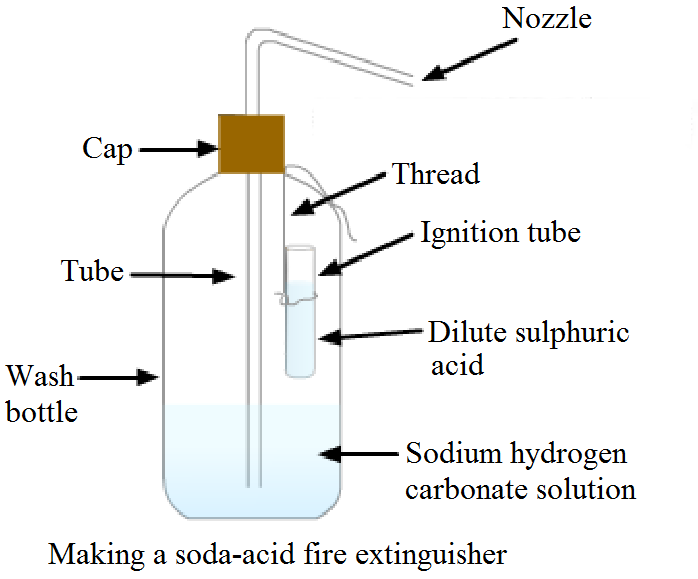
What does a soda-acid type fire extinguisher contain? How does it work?
Explain the working of a soda- acid fire extinguisher with the help of a labelled diagram.
Answer
Working: A soda-acid type fire extinguisher contains a solution of sodium hydrogencarbonate and sulphuric acid in separate containers in separate containers inside them. When the knob of the fire extinguisher is pressed, then sulphuric acid mixes with sodium hydrogencarbonate solution to produce carbon dioxide gas which forms a blanket around the burning substance and cuts off the supply of air to burning substance; this stops the process of burning and fire gets extinguished.
View full question & answer
Question 85 Marks
A group of students measured the pH of some substances they found in their homes. Their results are given in the following table:
Sabstance pH Sabstance pH
Apples 3.0 Salt 7.0
Baking soda 8.5 Sugar 7.0
Black coffee 5.0 Toothpaste 9.0
Houshold ammonoa 12.0 Vinegar 3.0
Lemon juoce 2.5 Wasimg soda 11.5
Milk 6.0    
  1. What would the students have used to measure the pH?
  2. Which solution is the most acidic (c) Which solution is the most alkaline?
  3. Which solutions are neutral?
  4. Which solution can be used to treat wasp stings?
  5. Which solution can be used to treat bee stings?
Answer
  1. Universal indicator paper is used to measure the pH.
  2. Lemon juice with pH = 2.5 is the most acidic.
  3. Household ammonia with pH = 12 is the most alkaline.
  4. Salt solution and sugar solution with pH = 7 are neutral.
  5. Vinegar (acid) can be used to treat wasp stings since it injects an alkaline liquid into the skin.
  6. Baking soda can be used to treat bee stings since it injects methanoic acid into the skin.
View full question & answer
Question 95 Marks
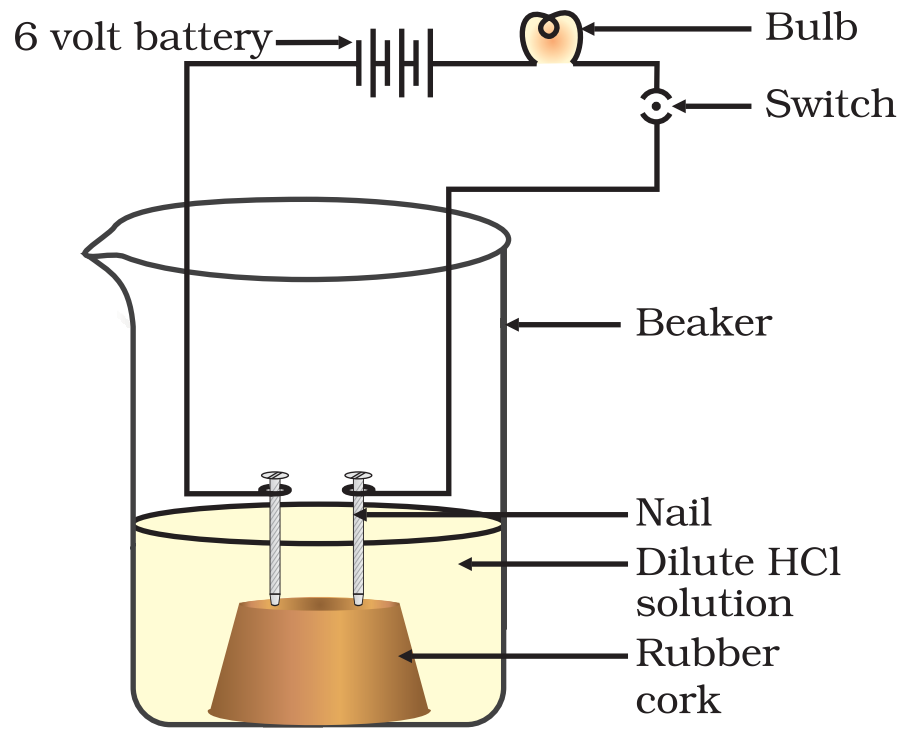
Compounds such as alcohol and glucose also contain hydrogen but are not categorised as acids. Describe an activity to prove it.
Answer
Activity.
Take solutions of glucose, alcohol, hydrochloric acid and sulphuric acid. Fix two nails on a cork, and place the cork in a 100 ml beaker. Connect the nails to the two terminals of a 6 volt battery through a bulb and a switch. Now pour some dilute HCl in the beaker and switch on the current. The bulb starts glowing. This shows that HCl solution taken in the beaker conducts electricity. If we replace hydrochloric acid with sulphuric acid and perform the experiment, the bulb would glow again. This shows that an aqueous solution of an acid conducts electricity due to the presence of charged particles called ions in it.

Now, if we take glucose solution in the beaker and switch on the current, the bulb would not glow. If we repeat the experiment by taking alcohol solution in the beaker, the bulb would not glow again. This shows that due to the absence of ions, glucose and alcohol solutions do not conduct electricity. From this activity, we conclude that the hydrogen containing compounds such as glucose and alcohol are not categorised as acids because they do not dissociate (or ionise) in water to produce hydrogen ions [H(aq) ions].
View full question & answer
Question 105 Marks
Describe how washing soda is produced starting from sodium chloride (common salt). Write equations of all the reactions involved.
Answer
  1. Production of washing soda: Washing soda is produced from sodium chloride (or common salt) in the following three steps:
  1. A cold and concentrated solution of sodium chloride (called brine) is reacted with ammonia and carbon dioxide to obtain sodium hydrogen carbonate:
$\ \ \ \ \ \ \text{N}\bar{\text{a}}\text{Cl}\ \ +\ \ \text{NH}_3\ \ +\ \ \text{H}_2\text{O}\ \ +\ \ \text{CO}_2\rightarrow\text{NaHCO}_3\ \ +\ \ \text{NH}_4\text{Cl}\\^{\text{Sodium chloride}}\ ^{\text{Ammonia}}\ \ \ \ \ \ ^{\text{Water}}\ \ \ \ \ \ \ \ ^\text{Carbon}\ \ \ ^{\text{Sodium hydrogen}}\ \ \ \ \ \ ^{\text{Ammonium}}\\\ ^{\text{(Common Salt)}}\ \ \ \ \ \ \ \ \ \ \ \ \ \ \ \ \ \ \ \ \ \ \ \ \ \ \ \ \ \ \ \ \ \ \ \ \ ^{\text{dioxde}}\ \ \ \ \ \ ^{\text{Carbonate}}\ \ \ \ \ \ \ \ \ \ \ \ ^{\text{Chloride}}$

Sodium hydrogen carbonate formed is only slightly soluble in water, so it precipitates out as a solid.
  1. Sodium hydrogen carbonate is separated by filtration, dried and heated. On heating, sodium hydrogen carbonate decomposes to form sodium carbonate:
$\ \ 2\text{NaCHO}_3\ \ \xrightarrow{\text{Heat}}\ \ \text{Na}_2\text{CO}_3\ \ +\ \ \text{CO}_2\ \ +\ \ \text{H}_2\text{O}\\^{\text{Sodium hydrogen}}\ \ \ \ \ \ \ \ ^{\text{Sodium carbonate}}\ \ \ ^{\text{Carbonate}}\ \ \ \ \ \ ^{\text{Water}}\\\ \ \ \ \ ^\text{Carbonate}\ \ \ \ \ \ \ \ \ \ \ \ \ \ \ \ \ ^{\text{(Sodaash)}}\ \ \ \ \ \ \ \ \ \ ^{\text{dioxide}}$

The anhydrous sodium carbonate obtained here is called soda ash.
  1. Anhydrous sodium carbonate (soda ash) is dissolved in water and recrystallised to get washing soda crystals containing 10 molecules of water of crystallisation:
$\ \ \ \ \ \ \ \ \ \ \text{Na}_2\text{CO}_3\ \ \ \ \ \ \ \ \ +1\text{CH}_2\text{O}\rightarrow\ \ \ \text{Na}_2\text{CO}_3,1\text{CH}_2\text{O}\\^{\text{Anhydroussdiuumcarbonate}}\ \ \ \ \ \ ^{\text{Water}}\ \ \ \ \ \ \ \ ^{\text{Sodiumcarbonatedecahydrate}}\\\ \ \ \ \ \ \ \ \ \ \ \ \ ^{\text{(Sodaas)}}\ \ \ \ \ \ \ \ \ \ \ \ \ \ \ \ \ \ \ \ \ \ \ \ \ \ \ \ \ \ \ \ \ \ \ \ \ \ \ \ \ \ ^{\text{(Washingsoda)}}$
  1. An aqueous solution of washing soda is alkaline because it turns red litmus to blue.
  2. Washing soda has detergent properties because it can remove dirt and grease from dirty clothes.
  1.  
  1. It is used as cleansing agent for domestic purposes.
  2. It is used for removing permanent hardness of water.
View full question & answer