Question
Describe how washing soda is produced starting from sodium chloride (common salt). Write equations of all the reactions involved.

Answer

  1. Production of washing soda: Washing soda is produced from sodium chloride (or common salt) in the following three steps:
  1. A cold and concentrated solution of sodium chloride (called brine) is reacted with ammonia and carbon dioxide to obtain sodium hydrogen carbonate:
$\ \ \ \ \ \ \text{N}\bar{\text{a}}\text{Cl}\ \ +\ \ \text{NH}_3\ \ +\ \ \text{H}_2\text{O}\ \ +\ \ \text{CO}_2\rightarrow\text{NaHCO}_3\ \ +\ \ \text{NH}_4\text{Cl}\\^{\text{Sodium chloride}}\ ^{\text{Ammonia}}\ \ \ \ \ \ ^{\text{Water}}\ \ \ \ \ \ \ \ ^\text{Carbon}\ \ \ ^{\text{Sodium hydrogen}}\ \ \ \ \ \ ^{\text{Ammonium}}\\\ ^{\text{(Common Salt)}}\ \ \ \ \ \ \ \ \ \ \ \ \ \ \ \ \ \ \ \ \ \ \ \ \ \ \ \ \ \ \ \ \ \ \ \ \ ^{\text{dioxde}}\ \ \ \ \ \ ^{\text{Carbonate}}\ \ \ \ \ \ \ \ \ \ \ \ ^{\text{Chloride}}$

Sodium hydrogen carbonate formed is only slightly soluble in water, so it precipitates out as a solid.
  1. Sodium hydrogen carbonate is separated by filtration, dried and heated. On heating, sodium hydrogen carbonate decomposes to form sodium carbonate:
$\ \ 2\text{NaCHO}_3\ \ \xrightarrow{\text{Heat}}\ \ \text{Na}_2\text{CO}_3\ \ +\ \ \text{CO}_2\ \ +\ \ \text{H}_2\text{O}\\^{\text{Sodium hydrogen}}\ \ \ \ \ \ \ \ ^{\text{Sodium carbonate}}\ \ \ ^{\text{Carbonate}}\ \ \ \ \ \ ^{\text{Water}}\\\ \ \ \ \ ^\text{Carbonate}\ \ \ \ \ \ \ \ \ \ \ \ \ \ \ \ \ ^{\text{(Sodaash)}}\ \ \ \ \ \ \ \ \ \ ^{\text{dioxide}}$

The anhydrous sodium carbonate obtained here is called soda ash.
  1. Anhydrous sodium carbonate (soda ash) is dissolved in water and recrystallised to get washing soda crystals containing 10 molecules of water of crystallisation:
$\ \ \ \ \ \ \ \ \ \ \text{Na}_2\text{CO}_3\ \ \ \ \ \ \ \ \ +1\text{CH}_2\text{O}\rightarrow\ \ \ \text{Na}_2\text{CO}_3,1\text{CH}_2\text{O}\\^{\text{Anhydroussdiuumcarbonate}}\ \ \ \ \ \ ^{\text{Water}}\ \ \ \ \ \ \ \ ^{\text{Sodiumcarbonatedecahydrate}}\\\ \ \ \ \ \ \ \ \ \ \ \ \ ^{\text{(Sodaas)}}\ \ \ \ \ \ \ \ \ \ \ \ \ \ \ \ \ \ \ \ \ \ \ \ \ \ \ \ \ \ \ \ \ \ \ \ \ \ \ \ \ \ ^{\text{(Washingsoda)}}$
  1. An aqueous solution of washing soda is alkaline because it turns red litmus to blue.
  2. Washing soda has detergent properties because it can remove dirt and grease from dirty clothes.
  1.  
  1. It is used as cleansing agent for domestic purposes.
  2. It is used for removing permanent hardness of water.

Need a full question paper?

Generate a complete, print-ready paper with questions like this in minutes — across 16+ boards, with answer keys.
Start Generating Free

Similar questions

When a spherical mirror is held towards the sun and its sharp image is formed on a piece of a carbon paper for some time, a hole is burnt in the carbon paper.
  1. What is the nature of spherical mirror?
  2. Why is a hole burnt in the carbon paper?
  3. At which point of the spherical mirror the carbon paper is placed?
  4. What name is given to the distance between spherical mirror and carbon paper?
  5. What is the advantage of using a carbon paper rather than a white paper?
How do the following change on going from left to right in a period of the periodic table?
  1. Chemical reactivity of elements.
  2. Nature of oxides of elements Give examples in support of your answer.
Derive the expression for the heat produced due to a current 'l' flowing for a time interval 't' through a resistor 'R' having a potential difference 'V' across its ends. With which name is the
relation known? How much heat will an instrument of 12W produce in one minute if it is connected to a battery of 12V?
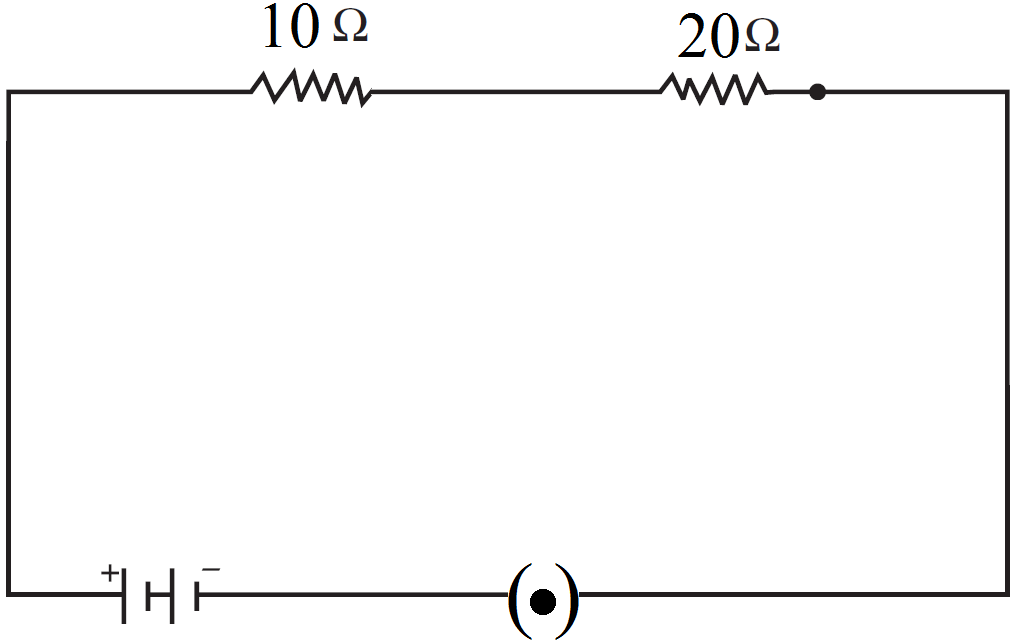
Study the following electric circuit and find.
  1. The current flowing in the circuit and
  2. The potential difference across $10\Omega$ resistor.
Differentiate between myopia and hypermetropia. What type of spectacles should be worn by a person having the defects of myopia as well as hypermetropia? How does it help?
A scientist removed some cells from the growing point of a plant and placed it in a suitable medium leading to the formation of a shapeless lump of mass X. X is then transferred to another medium which stimulates it to develop roots. When X with developed roots is placed in a yet another medium, then it develops shoots to form tiny plantlets. These plantlets can then be transplanted in pots or soil where they can grow to form mature plants.
  1. What is the shapeless lump of mass X known as?
  2. What name is given to this method of producing new plants?
  3. The growth medium used in this method contains plant nutrients in the form of a 'jelly'. Name this jelly.
  4. What is the general name of chemicals used to stimulate the growth of plant cells and development of roots and shoots?
  5. Name any two plants which are produced by this method.
  6. State any two advantages of this method of producing plants.
  7. What is the other name of this method [other then that given in (b) above]?
What happens once the Sun's energy reaches the Earth? Explain with the help of a diagram.
Soaps and detergents are both types of salts. State the difference between the two. Write the mechanism of the cleansing action of soaps. Why do soaps not form lather (foam) with hard water? Mention any two problems that arise due to the use of detergents instead of soaps.
Bacteria have a simpler body plan when compared with human beings. Does it mean that human beings are more evolved than bacteria? Provide a suitable explanation.
Explain the three pathways of breakdown in living organisms.
An organism A which cannot move from one place to another, makes a simple food B from the substances C and D available in the environment. This food is made in the presence of a green coloured substance E present in organs F in the presence of light energy in a process called G. Some of the simple food B also gets converted into a complex food H for storage purposes. The food H gives a blue-black colour with dilute iodine solution.
  1. What is (i) organism A, (ii) food B and (iii) food H?
  2. What are C and D?
  3. Name (i) green coloured substance E, and (ii) organ F.
  4. What is the process G?