Questions · Page 2 of 3

[1 Mark Questions]

Question 521 Mark
If the potential difference between the end of a wire of fixed resistance is doubled, by how much does the electric power increase?
Answer
$\text{P}=\frac{\text{V}_2}{\text{R}}$R is fixed.
V becomes double.
Now, $\text{P}=\frac{(2\text{V})2}{\text{R}}=\frac{4\text{V}_2}{\text{R}}$
So, the electric power becomes four times its previous value.
View full question & answer
Question 531 Mark
Explain the following.
Why are copper and aluminium wires usually employed for electricity transmission?
Answer
Copper and aluminium are good conductors of electricity also they have low resistivity. So they are usually used for electricity transmission.
View full question & answer
Question 541 Mark
What is meant by saying that the potential difference between two points is 1 volt?
Answer
The potential difference between two points is 1 volt means 1 joule of work is done in moving 1coulomb of electric charge from one point to the other.
View full question & answer
Question 561 Mark
Name a device that helps to maintain a potential difference across a conductor.
Answer
Cell or battery eliminator.
View full question & answer
Question 571 Mark
Keeping the resistance constant, the potential difference applied across the ends of a component is halved. By how much does the current change?
Answer
V = R
Keeping R Constant, $\text{V}\propto\text{I}$
So, when V is halved, I also becomes half.
View full question & answer
Question 581 Mark
What does an electric circuit mean?
Answer
An electric circuit consists of electric devices, switching devices, source of electricity, etc. that are connected by conducting wires.
View full question & answer
Question 591 Mark
Why should the resistance of:
An ammeter be very small?
Answer
The resistance of an ammeter should be very small so that it may not change the value of the current flowing in the circuit.
View full question & answer
Question 611 Mark
In which direction does conventional current flow around a circuit?
Answer
Conventional current flows from positive terminal of a battery to the negative terminal, through the outer circuit.
View full question & answer
Question 621 Mark
Will current flow more easily through a thick wire or a thin wire of the same material when connected to the same source? Give reason for your answer.
Answer
Current will flow more easily through thick wire because the resistance of the thick wire will be lesser than that of thin wire.
View full question & answer
Question 631 Mark
Name a device which helps to maintain potential difference across a conductor (say, a bulb).
Answer
Cell or battery helps to maintain potential difference across a conductor.
View full question & answer
Question 651 Mark
An electric fan/motor becomes warm when continuously used for a long time. Why?
Answer
This is because in electric fan electrical energy converts into mechanical energy. And it generates heat.
View full question & answer
Question 671 Mark
Explain the following.
Why are the conductors of electric heating devices, such as bread-toasters and electric irons, made of an alloy rather than a pure metal?
Answer
The conductors of electric heating devices such as bread toasters and electric irons are made of alloy because resistivity of an alloy is more than that of metals which produces large amount of heat.
View full question & answer
Question 681 Mark
If different resistors have the same value of electric potential across them, in which way they are connected to each other?
Answer
The resistors are connected in parallel. In a parallel combination, the voltage across each resistor remains the same.
View full question & answer
Question 691 Mark
Which of the following equation shows the correct relationship between electrical units?
1A = 1C/ s or 1C = 1A/ s.
Answer
1A = 1C/ s.
View full question & answer
Question 711 Mark
Explain why, filament type electric bulbs are not power efficient.
Answer
Filament type electric bulbs are not power efficien because most of the electric power consumed by the filament of a bulb appears as heat and only a small amount of electric power is converted into light.
View full question & answer
Question 721 Mark
Explain the following.
Why is the series arrangement not used for domestic circuits?
Answer
In series circuits voltage is divided. Each component of a series circuit receives a small voltage so the amount of current decreases and the device becomes hot and does not work properly. Hence, series arrangement is not used in domestic circuits.
View full question & answer
Question 731 Mark
Write down the formula for the heat produced when a current I is passed through a resistor R for time.
Answer
Heat produced, $H = I ^2 Rt$.
View full question & answer
Question 741 Mark
State the relation between potential difference, work done and charge moved.
Answer
$\text{Potential difference} = \frac{\text{Work done}}{\text{Charge moved} }$
View full question & answer
Question 761 Mark
State the factors on which the strength of electric current flowing in a given conductor depends.
Answer
Strength of electric current flowing in a given conductor depends on:
  1. Potential difference across the ends of the conductor.
  2. Resistance of the conductor.
View full question & answer
Question 771 Mark
Out of 60 W and 40 W lamps, which one has a higher electrical resistance when in use?
Answer
Let us assume that the two bulbs are connected to the same supply. Let us say the value of the supply is voltage V. Now for 40W bulb Resistance of $40\text{W bulb}=\frac{\text{v}^2}{40}$ Similarly, Resistance of $60\text{W bulb}=\frac{\text{v}^2}{60}$Since the denominator of first is less, hence the Resistance of 40W bulb will be MORE than the resistance of 60W bulb.
View full question & answer
Question 781 Mark
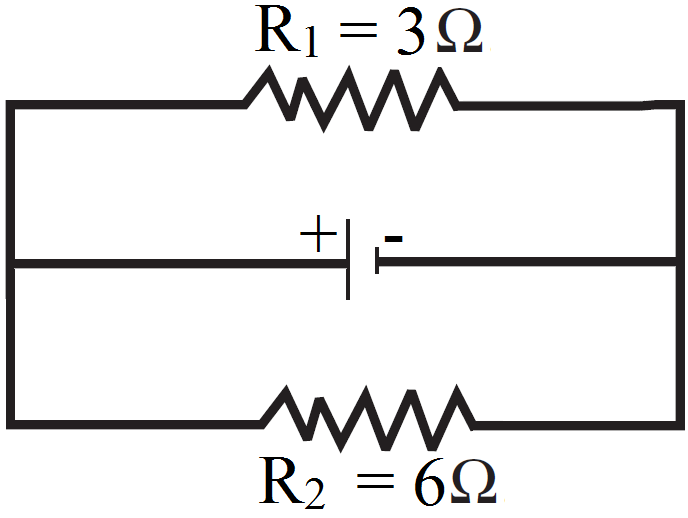
Two exactly similar heating resistances are connected (i) in series, and (ii) in parallel, in two different circuits, one by one. If the same current is passed through both the combinations, is more heat obtained per minute when they are connected in series or when they are connected in parallel? Give reason for your answer.
Answer
In series, because total resistance in series connection is more than that in parallel connection.
View full question & answer
Question 791 Mark
You are given three bulbs of 40W, 60W and 100W. Which of them has lower resistance?
Answer
The 100w should have a lower resistance, due to inverse P and R relationship of $\text{P}=\frac{\text{V}^{2}}{\text{R}}$ If V is constant (assume 120Vdc) solving the equation results in:
40w = 360ohms
60w= 240ohms
100w= 144ohms
Thus we can say that: 100W will have the lower resistance.
View full question & answer
Question 801 Mark
What happens to the other bulbs in a parallel circuit if one bulb blows off?
Answer
All the other bulbs keep glowing.
View full question & answer
Question 811 Mark
What is electric potential?
Answer
An electric potential (also called the electric field potenial, potential drop or the electrostatic potential) is the amount of work needed to move a unit of charge from a Reference point to a
specific point inside the field without producing an acceleration.
View full question & answer
Question 831 Mark
What do the following symbols mean in circuit diagrams?
Answer
  1. Variable resistance.
  2. A closed plug key.
View full question & answer
Question 841 Mark
Name the quantity whose unit is (i) kilowatt, and(ii) kilowatt-hour.
Answer
  1. Electric power.
  2. Electric energy.
View full question & answer
Question 851 Mark
Christmas tree lamps are usually wired in series. What happens if one lamp breaks?
Answer
All the other lamps stop glowing.
View full question & answer
Question 861 Mark
How should the two resistances of 2 ohms each be connencted so as to produce an equivalent resistance of 1 ohm?
Answer
Since the resultant resistance is less than the individual resistances, so the resistances should be connected in parallel.
View full question & answer
Question 871 Mark
How can you change the brightness of the lamps?
Answer
The brightness of the lamps can be changed by connecting the lamps in parallel.
View full question & answer
Question 881 Mark
Write down the formula which states the relation between potential difference, current and resistance.
Answer
Potential difference = Current x Resistane.
View full question & answer
Question 891 Mark
A potential difference of 20 volts is applied across the ends of a resistance of 5 ohms. What current will flow in the resistance?
Answer
Potential difference, V = 20V Resistance, R = 5 ohms Current, I = ? We know that V = IR 20 = I × 5$\text{I}=\frac{20}{5}=4\text{A}$
View full question & answer
Question 901 Mark
What do you understand by the term “potential difference”?
Answer
Potential difference between two points in an electric circuit is defined as the amount of work done in moving a unit charge from one point to the other point.
View full question & answer
Question 911 Mark
Keeping the potential difference constant, the resistance of a circuit is halved. By how much does the current change?
Answer
V = R$\text{I}=\frac{\text{V}}{\text{R}}$
Keeping V Constant $\text{I}\propto\frac{1}{\text{R}}$ So, when R is halved, I also becomes double.
View full question & answer
Question 921 Mark
Which one has a higher electrical resistance: a 100 watt bulb or a 60 watt bulb?
Answer
60 watt bulb, because power is inversely proportional to the resistance.
View full question & answer
Question 931 Mark
Mention the condition under which charges can move in a conductor.
Answer
Charge can flow in a conductor only when there is a potential difference between two points in a circuit. potential difference causes charge to flow. And, we can maintain potential
difference in circuit with the help of a battery or cell.
View full question & answer
Question 951 Mark
The potential difference across wire is 75V and its electric resistance is $30\Omega$ Find out the electric current through the wire.
Answer
Acoording to ohms law$\text{v}=\text{ir}$
$75=\text{i}\times30$
$\text{i}=\frac{75}{30}=2.5$ ampere.
View full question & answer
Question 981 Mark
Which electric heating devices in your home do you think have resistors which control the flow of electricity?
Answer
Electric iron, electric oven, water heater, room heater.
View full question & answer
Question 1001 Mark
Write a high resistance device name which is always connected in parallel.
Answer
Voltmeter is a high resistance device which is always connected in parallel is used to measure the voltage across a component.
View full question & answer
[1 Mark Questions] - Page 2 - Science STD 10 Questions - Vidyadip
