Questions · Page 3 of 3

[1 Mark Questions]

Question 1011 Mark
State the relation between work, charge and potential difference for an electric circuit.
Answer
The difference in electric potential between two points is known as Potential difference.
The potential difference between two points in an electric field is defined as amount of work done in moving a unit charge from one point to other point. Potential difference = Work
Done/ Quantity of Chargemoved.
If W joules of work has to be done to move charge Q from one point to other point then potential difference V between two points is given by : $\text{V}=\frac{\text{W}}{\text{Q}}$
View full question & answer
Question 1021 Mark
Electrons are responsible for conduction in a conductor. The speed of electron is not very high. Then, how the bulb is on immediately even through the switch and bulb are far away from
each other in a household circuit?
Answer
A calculation shows that the electron is traveling at about 2,200 kilometers per second. That's less than 1% of the speed of light, but it's fast enough to get it around the Earth in just
over 18 seconds. Read up on what happens when nothing can go faster than the speed of light.
View full question & answer
Question 1041 Mark
What is the meaning of the symbol kWh? Which quantity does it represent?
Answer
kWh is the short form of kilowatt-hour, which is the commercial unit of electrical energy.
View full question & answer
Question 1051 Mark
Which has less electrical resistance : a thin wire or a thick wire (of the same length and same material)?
Answer
Thick wire.
View full question & answer
Question 1061 Mark
Draw a circuit diagram showing two electric lamps connected in parallel together with a cell and a switch that works both lamps. Mark an on your diagram to show where an ammeter should be placed to measure the current.
View full question & answer
Question 1071 Mark
If 20C of charge pass a point in a circuit in 1s, what current is flowing?
Answer
Given, Q = 20C, t = 1s I = ? We know that:$\text{I}=\frac{\text{Q}}{\text{T}}$
$\text{I}=\frac{20}{1}=20\text{A}$
View full question & answer
Question 1081 Mark
One coulomb of charge flows through any cross-section of a conductor in 1 second. What is the current flowing through the conductor?
Answer
1 ampere.
View full question & answer
Question 1091 Mark
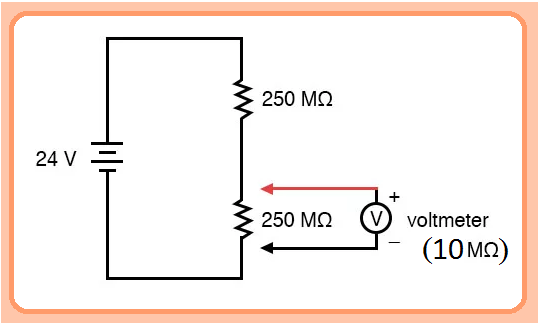
A simple circuit consists of a resistor, a battery, and connecting wires. How must a voltmeter be connected to a resistor in order to read the potential difference across it?
Answer
The voltmeter must be connected in parallel to the resistor to read the potential difference across the resistor. Voltmeter has very high resistance to ensure that it's connection do not
change the flow of current in the circuit. Now if it is connected in series then no current will be there in the circuit due to its high resistance. Hence it is connected in parallel to the load
across which potential difference is to be measured. Also the voltage in the parallel connection is constant; therefore we will not get any error while measuring the voltage across resistor.
View full question & answer
Question 1101 Mark
How does the resistance of a pure metal change if its temperature decreases?
Answer
On decreasing the temperature, the resistance decreases.
View full question & answer
Question 1111 Mark
An electrician has wired a house in such a way that if a lamp gets fused in one room of the house, all the lamps in other rooms of the house stop working. What is the defect in the wiring?
Answer
All lamps are connected in series.
View full question & answer
Question 1121 Mark
Is electric current a scalar or vector quantity? Sate the smaller unit of current.
Answer
Electric current is a SCALAR quantity! Sure it has magnitude and direction, but it still is a scalar quantity!
View full question & answer
Question 1131 Mark
The graph between V and 1 for a conductor is a straight line passing through the origin.
Which law is illustrated by such a graph?
What should remain constant in a statement of this law?
Answer
  1. Ohm’s law.
  2. Temperature.
View full question & answer
Question 1141 Mark
How much work is done in moving a charge of 2C across two points having a potential difference of 12V?
Answer
Given,
Potential difference = 12V, Charge moved = 2C
We know that,
Work done= p.d. × charge moved
= 12 × 2
= 24 joules.
View full question & answer
Question 1151 Mark
Why do electricians wear rubber hand gloves while working with electricity?
Answer
Electricians wear rubber hand gloves while working with electricity because rubber is an insulator and protects them from electric shocks.
View full question & answer
Question 1161 Mark
State two factors on which the electrical energy consumed by an electrical appliance depends.
Answer
Electrical energy consumed by an electrical appliance depends on:
  1. Power rating of the appliance.
  2. Time for which the appliance is used.
View full question & answer
Question 1181 Mark
Name the commercial unit of electric energy.
Answer
Kilowatt-hour is the commercial unit of electric energy.
View full question & answer
Question 1191 Mark
Explain the following.
How does the resistance of a wire vary with its area of cross-section?
Answer
Resistance (R) of a wire is inversely proportional to its area of cross-section (A), i.e. when area of cross section increases the resistance decreases or vice versa.
View full question & answer
Question 1201 Mark
How do you think the brightness of two lamps arranged in parallel compares with the brightness of two lamps arranged in series (both arrangements having one cell)?
Answer
The brightness of two lamps arranged in parallel is much more those arranged in series.
View full question & answer
Question 1211 Mark
Calculate the potential difference between the two terminals of a battery if 100 J of work is required to transfer 20 C of charge from one terminal of the battery to the other.
Answer
Potential difference (V) – is measured in volts (V). Potential difference is the work done per unit charge. A potential difference of 1V means that 1 joule of work is done per coulomb of charge.$\text{P.D}= \frac{\text{Work done}}{\text{Charge}}$.
$\text{P.D}=\frac{100\text{J}}{20\text{C}}.$
$\text{P.D}=5\text{V}.$
View full question & answer
Question 1221 Mark
What happens to the other bulbs in a series circuit if one bulb blows off?
Answer
All the other bulbs also stop glowing.
View full question & answer
Question 1231 Mark
Which type of circuit, series or parallel, is preferred while connecting a large number of bulbs:
  1. For decorating a hotel building from outside?
  2. For lighting inside the rooms of the hotel?
Answer
  1. Series.
  2. Parallel.
View full question & answer
Question 1251 Mark
Define one coulomb charge.
Answer
One coulomb of charge is that quantity of charge which exerts a force of 9 × 10⁹ Newton on an equal charge is placed at a distance of 1m from it.
View full question & answer
Question 1261 Mark
A simple circuit consists of a resistor, a battery, and connecting wires. Draw the circuit diagram.
Answer

Below is the circuit diagram for the voltmeter.
View full question & answer
Question 1271 Mark
Write down the formula which relates electric charge, time and electric current.
Answer
$\text{I}=\frac{\text{Q}}{\text{t}}$
View full question & answer
Question 1281 Mark
Name the material which is used for making the filaments of an electric bulb.
Answer
Tungsten is used for making the filaments of an electric bulb.
View full question & answer
Question 1291 Mark
In which direction do electrons flow?
Answer
Electrons flow from negative terminal to positive terminal of the battery (opposite to the direction of conventional current).
View full question & answer
[1 Mark Questions] - Page 3 - Science STD 10 Questions - Vidyadip