Questions

[5 marks Questions]

🎯

Test yourself on this topic

11 questions · timed · auto-graded

Question 15 Marks
What is placenta? Mention its role during pregnancy?
Answer
Followed by fertilization, placenta is developed which serve to provide nutrition and oxygen to developing embryo from the mother's blood. It is a disc embedded in the uterine wall and contains villi on the embryo's side of the tissue while blood spaces surrounding the villi are present on mother’s side. The embryo is connected to the placenta by umbilical cord, a tube like structure.Placenta serves to fulfill all nutritional requirements of developing embryo by supplying food and oxygen from mother’s blood to the embryo. Waste products of developing embryo are removed by transferring them into the mother's blood through the placenta. Functions of placenta are facilitated by villi that provide large surface areas for passage of nutrition and oxygen to embryo from mother through blood.
View full question & answer
Question 25 Marks
What are various ways to avoid pregnancy? Elaborate any one method.
Answer
Methods to avoid undesired pregnancy are called contraceptive methods. It includes:
  1. Mechanical barrier that prevent arrival of sperm to the egg, e.g., condom.
  2. Chemical Drugs or contraceptive pills-Small dosage of female hormones that prevent released of egg.
  3. Loop or copper-T-physical devices to prevent pregnancy.
  4. Surgical method-permanent contraception by vasectomy and tubectomy.
Surgical methods: Vasectomy refers to surgical method in which vasa deferentia in human males are cut and sealed to prevent pregnancy by making seminal fluid devoid of sperms. Tubectomy refers to surgical process in which oviducts in human females are cut and sealed to prevent pregnancy by inhibiting released of egg.
View full question & answer
Question 35 Marks
Distinguish between pollination and fertilisation. Mention the site and product of fertilisation in a flower.
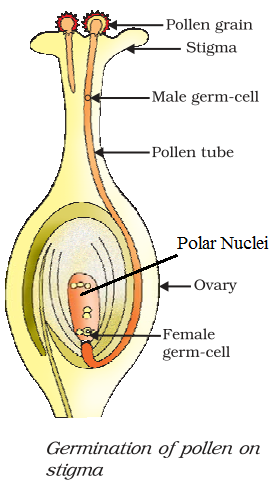
Draw a neat, labelled diagram of a pistil showing pollen tube growth and its entry into the ovule.
Answer
  1. Differences between Pollination and Fertilization:
 
Pollination
Fertilization
1.
Definition: It is transfer of pollen grains from anther to the stigma of a flower.
It is the fusion of male and female gametes.
2.
Step: Pollination precedes fertilization.
Fertilization occurs only after pollination when the pollen grain has germinated and male gametes are carried into ovule.
3.
Purpose: It carries the male gamete production pollen grains to the female sex organ.
It actually brings about fusion of gametes.
4.
Process: Pollination is a physical process.
Fertilization is a physico-chemical (biological) process.
5.
Occurrence: It occurs only in seed plants.
It occurs in both plants and animals of various types.
  1.  
  1. Site of Fertilization. Embryo sac in ovule.
  2. Product of Fertilization. Zygote, Primary endosperm cell.
  1.  
View full question & answer
Question 45 Marks
Distinguish between a gamete and zygote. Explain their roles in sexual reproduction.
Answer
 
Gamete
Zygote
1.
Formed after meiosis.
Formed after fusion of two gametes.
2.
Has haploid number of chromosomes.
Has diploid number of chromosomes.
3.
Produced by male and female parts.
Formation takes place in female part.
4.
Role in sexual reproduction: Gamete are necessary for sexual reproduction to take place, because zygote cannot be formed without gametes. Brings gene pool from two individuals.
Role in sexual reproduction: Zygote formation is a precursor of embryo formation.
View full question & answer
Question 55 Marks
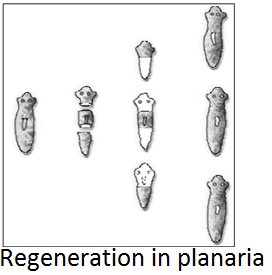
Why are budding, fragmentation and regeneration all considered as asexual types of reproduction? With neat diagrams explain the process of regeneration in Planaria.
Answer
Budding, fragmentation and regeneration are considered as asexual types of reproduction because none of them includes gamete formation and fertilization. All of these give rise to offspring from single parent only.
Regeneration in Planaria It exhibits regeneration i.e. ability to grow the broken body part again. If the body of Planaria is cut into any number of pieces, each piece grows into a complete organism i.e. reproduction through regeneration.
Regeneration is carried out by specialized cells which proliferate and produce large numbers of daughter cells. Different cells from the group of daughter cells then differentiate into various cell types and tissues.
View full question & answer
Question 65 Marks
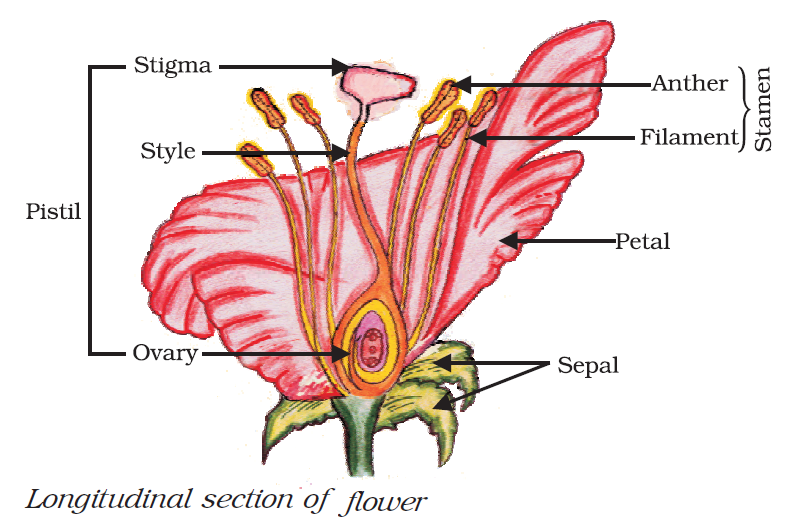
Draw the diagram of a flower and label the four whorls. Write the names of gamete producing organs in the flower.
Answer
  1.  
  1. Male gamete forming part: Pollen grain, produced in anther of stamen.
Female gamete forming part: Embryo sac developed inside ovule of ovary part of pistil.
View full question & answer
Question 75 Marks
How does fertilisation take place? Fertilisation occurs once in a month. Comment.
Answer
Fusion of male gamete sperm and female gamete egg in fallopian tube (oviduct) is called as fertilization. The process starts with introduction of sperms, produced in testes of male, into the vagina of the woman through penis during copulation or mating. Highly active and mobile sperms pass from cervix through the uterus into the oviducts. Ovulation, in female, releases ovum in oviduct. Irrespective of release of millions of sperms into the vagina at one time, only one sperm fuses with the ovum in the oviduct to form a zygote i.e. fertilization.
Ovulation is release of ovum from ovary into oviduct and takes place only once in a month i.e. 14$^{th}$ day of menstrual cycle. Hence, fertilization can occur only once in a month.
View full question & answer
Question 85 Marks
Reproduction is essentially a phenomenon that is not for survival of an individual but for the stability of a species. Justify.
Answer
Survival of an individual depends on many factors. An individual can survive if he/ she gets food and shelter. An individual can survive if he/ she is not killed by a predator. An individual can survive if he/ she is not killed by a competitor. In biological sense, an individual can survive if all the life processes continue in the body.
But reproduction creates a new individual and the new individual carries the lineage of the species even after the death of parents. Moreover, a good rate of reproduction ensures a large population which counterbalances mortality in the population. We know that a higher birth rate and lower mortality rate helps in growth of population. If mortality rate becomes more than birth rate, then a population can be wiped out. Thus, reproduction helps in maintaining the stability of a species.
View full question & answer
Question 95 Marks
Write two points of difference between asexual and sexual types of reproduction. Describe why variations are observed in the offspring formed by sexual reproduction.
Answer
  1. Differences between Asexual and Sexual Reproduction:
  Asexual Reproduction Sexual Reproduction
1. Parents: It is monoparental. It is generally biparental.
2. Meiosis: Meiosis does not occur during asexual reproduction. There are no gametes and no fertilization. Meiosis occur. Gametes are formed and fertilization occurs in sexual reproduction.
3. Ex. Binary fission in Amoeba, Budding in yeast. Ex. Offspring in Wheat, Human.
  1. Development of Variation in Sexual Reproduction:
Sexual reproduction produces a number of variations in the population due to:
  1. Chance separation of chromosomes at the time of meiosis.
  2. Crossing over during meiosis.
  3. Chance combination of chromosomes during fertilization. It produces a unique combination of variations already accumulated by each individual in its DNA obtained from its parents,
  4. Mutations or defective DNA replication.
View full question & answer
Question 105 Marks
Describe sexually transmitted diseases and mention the ways to prevent them.
Answer
Sexualy transmitted diseases: Diseases which spread from one person to another through sexual act are called sexually transmitted diseases. he organisms that cause sexually transmitted diseases may pass from person to person in blood, semen, or vaginal and other bodily fluids.HIV, Gonorrhoea, Herpes, etc. are examples of STDs.
Ways to prevents STDs:
  • Use of condoms or other physical barriers.
  • Avoiding sexual contacts with unknown partners.
  • Avoid sharing towels or underclothing.
  • Get a vaccination for hepatitis B. This is a series of three shots.
View full question & answer
Question 115 Marks
Trace the path of sperm during ejaculation and mention the gland and their functions associated with the male reproductive system.
Answer
Ejaculated sperms are the ones which are stored in epididymes. They are formed regularly in seminiferous tubules from where they pass through vasa efferentia into epididymes. At the time of ejaculation, the sperms are first pushed through vasa deferentia, enter ejaculatory duct where they receive secretion of seminal vesicles and then urinogenital duct where the secretion of prostate gland is poured to form semen. The urinogenital duct is lubricated by secretion of a pair of Cowper’s glands (bulbourethral glands).
Secretion of Seminal Vesicles. Nourishment, activation and providing fluid medium for sperm transport.
Secretion of Prostates Gland. Motility of Sperms.
View full question & answer