Questions · Page 1 of 3

[2 Mark Questions]

🎯

Test yourself on this topic

50 questions · timed · auto-graded

Question 12 Marks
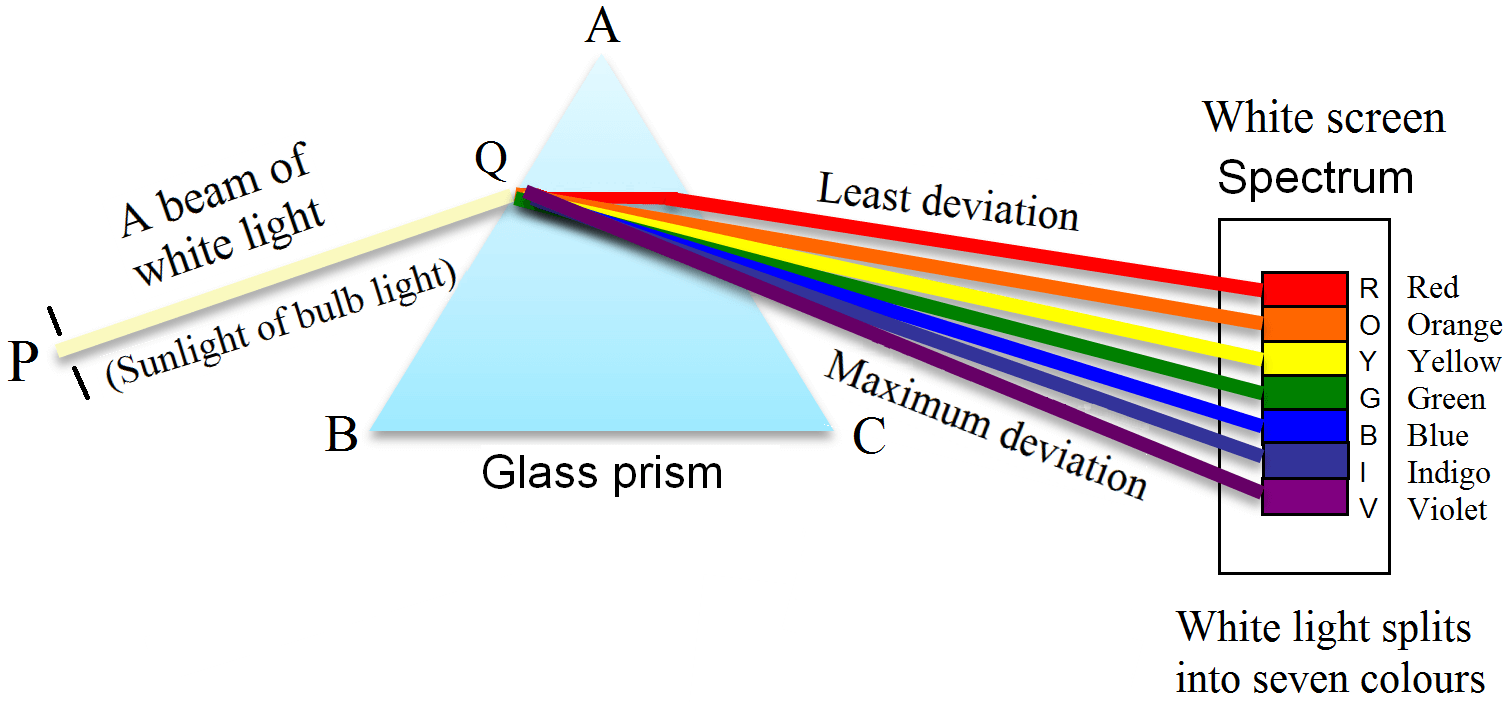
Draw a labelled ray diagram to illustrate the dispersion of a narrow beam of white light when it passes through glass prism.
View full question & answer
Question 22 Marks
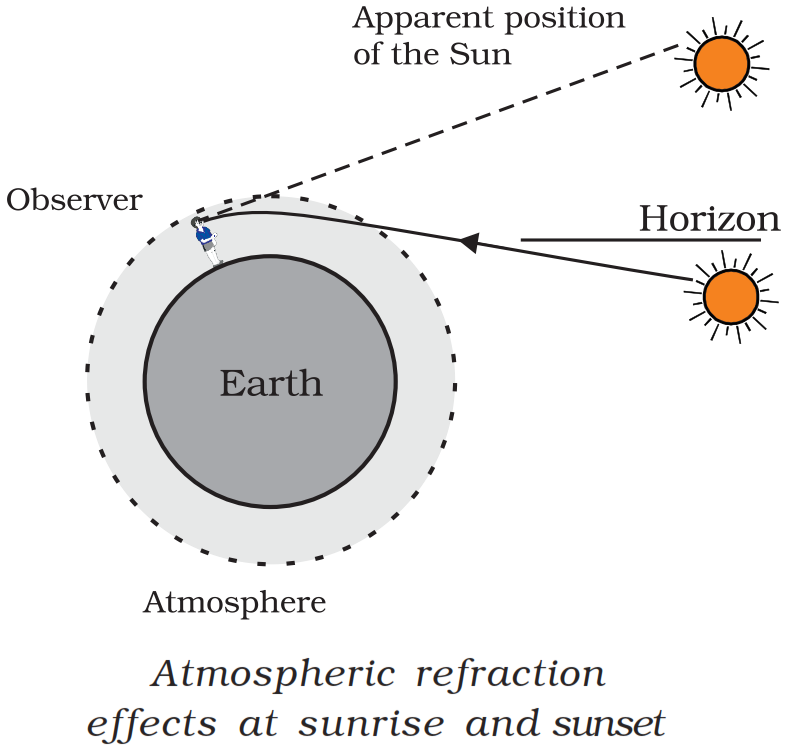
Explain with the help of a diagram, how we are able to observe the sunrise about two minutes before the sun gets above the horizon.
Answer

Sunrise can be observed two minutes before the sun actually gets above the horizon because of the phenomenon of bending of light as a result of atmospheric refraction. The rays coming from the sun get refracted because of the difference in the density of the atmospheric layers and then reach the observer. Thus, the light coming is perceived as coming from the sun and hence, the sunrise is seen two minutes before it actually rises.
View full question & answer
Question 32 Marks
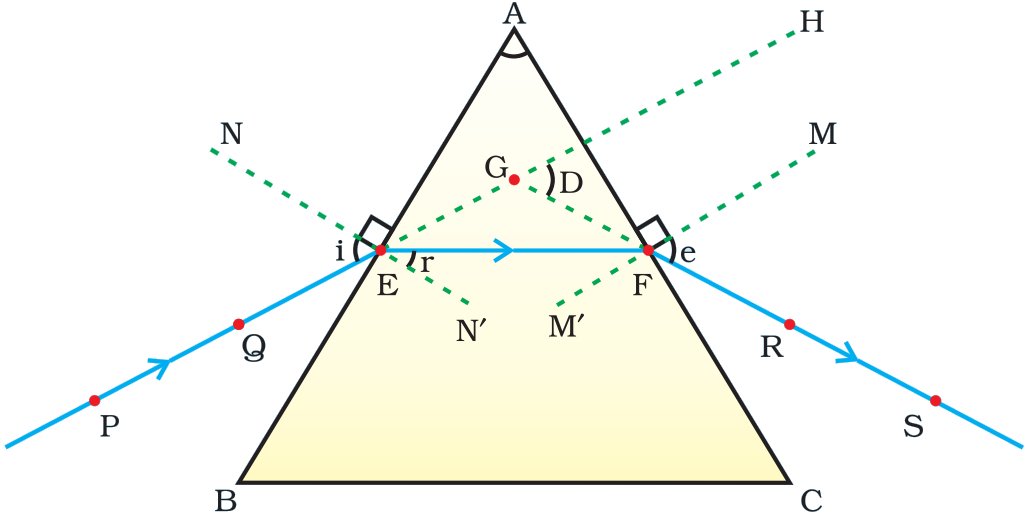
Draw a ray diagram to show the refraction of light through a glass prism. Mark on it,
  1. The incident ray,
  2. The emergent ray,
  3. The angle of deviation.
Answer
Incident ray, the emergent ray and the angle of deviation is as marked in the diagram below:
View full question & answer
Question 42 Marks
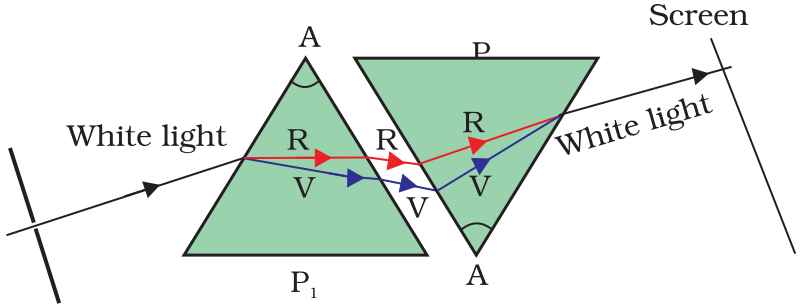
When we place a glass prism in the path of a narrow beam of white light a spectrum is obtained. What happens when a second identical prism is placed in an inverted position with respect to the first prism? Draw a labelled ray diagram to illustrate it.
Answer
When the second identical prism is placed in an inverted position with respect to the first prism recombination of the spectrum from white light again.
View full question & answer
Question 52 Marks
A star sometimes appears brighter and some other times fainter. What is this effect called? State the reason for this effect.
Answer
A star sometimes appears brighter and some other times fainter because of twinkling effect. Atmospheric refraction gives rise to twinkling effect. Light which is travelling through different layers of the atmosphere bents in different directions making the stars twinkle.
View full question & answer
Question 62 Marks
What is meant by the dispersion of white light? Draw a diagram to show dispersion of white light by the glass prism.
Answer
The splitting up of white light into its constituent colours on passing through a refracting medium like a glass prism is called dispersion of light.
View full question & answer
Question 72 Marks
Explain why the planets do not twinkle but the stars twinkle.
Answer
Planets, being much closer to the earth are considered as extended source of light. Stars, being distant, are taken as point sized sources of light. The light coming from stars goes on varying due to atmospheric refraction pro-during twinkling effect.
View full question & answer
Question 82 Marks
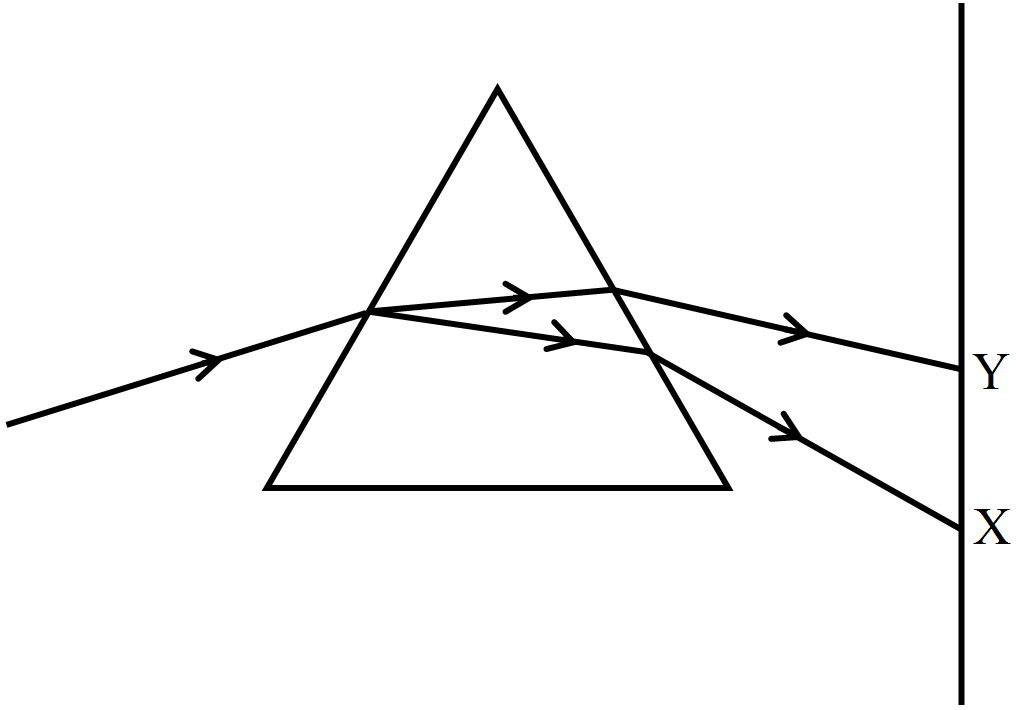
In the figure given below a narrow beam of white light is shown to pass through a triangular glass prism. After passing through the prism it produces a spectrum XY on a screen.
  1. State the colour seen at X and Y.
  2. Why do different colours of white light bend through different angles with respect to the incident beam of light?
Answer
  1. X-Violet, Y-Red.
  2. Different colors of white light bend through different angles with respect to the incident beam of light due to the difference in speed of light of different wavelengths and Refractive index of glass is different for different colours of light.
View full question & answer
Question 92 Marks
How it can be proved that the basic structure of the modern periodic table is based on the electronic configuration of atoms of different elements?
Answer
Modern periodic table consists of groups and periods. Where number of valence electrons determines the group and number of shells determines the period.
View full question & answer
Question 102 Marks
The electronic configuration of an element is 2, 8, 4. State its:
  1. Group and period in the modern periodic table.
  2. Name and write its one physical property.
Answer
  1. Group - 14, Period - 3.
  2. Silicon.
Non - metallic/ poor conductor of electricity.
View full question & answer
Question 112 Marks
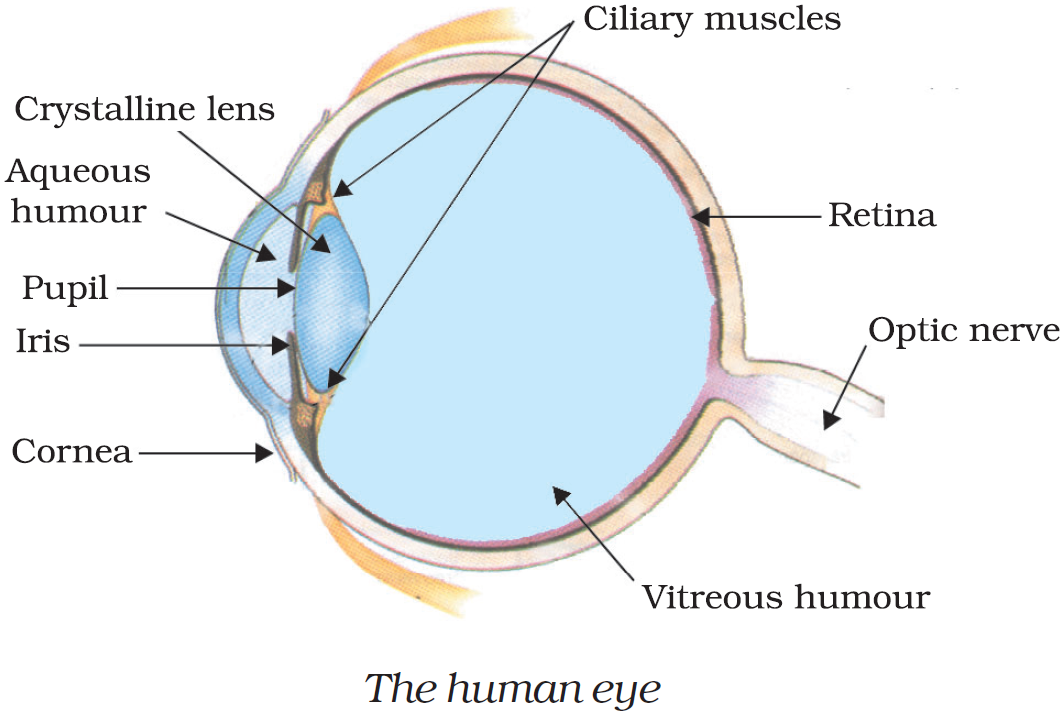
Write the structure of eye lens and state the role of ciliary museles in the human eye.
Answer

The eye lens being convex in nature converges the light rays incident on it. Hence, it focuses the light falling on it on a thin layer of nerve cells called the retina. Two Ciliary muscles hold the lens within the eye-ball and it relaxes and tightens to change the focal length of the eye lens to get the clear image on the retina.
View full question & answer
Question 122 Marks
Define the term power of accommodation. Write the modification in the curvature of the eye lens which enables us to see the nearby objects clearly?
Answer
The ability of the eye lens to adjust its focal length is called the power of accommodation. There should be a contract in ciliary muscles, that will increase the curvature of the eye lens and becomes thicker consequently the focal length of the eye lens will decrease. It will enable us to see near objects clearly.
View full question & answer
Question 132 Marks
What are the advantages of having two eyes instead of just one?
Answer
Following are the advantages of having two eyes instead of one:
  1. Having two eyes gives a wider field of view.
  2. Having two eyes enables us to judge distances more accurately.
View full question & answer
Question 152 Marks
Complete the following statements:
When the sun is setting, the light from it has to travel a ____ thickness of the earth's atmosphere and only ____ wavelength _____ light is able to reach us. Sunset is therefore ___.
Answer
When the sun is setting, the light from it has to travel a greater thickness of the earth's atmosphere and only the longer wavelength red light is able to reach us. Sunset is therefore red in colour.
View full question & answer
Question 162 Marks
What is spectrum? What is the name of glass shape used to produce a spectrum?
Answer
The band of seven colours formed on a white screen, when a beam of white light is passed through a glass prism is called spectrum of white light. A glass prism is used to produce a spectrum.
View full question & answer
Question 172 Marks
What shape are your eye-lenses:
  1. When you look at your hand?
  2. When you look at a distant tree?
Answer
  1. When we look at our hand, the eye lens is thick. When we look at a nearby object, the eye lens becomes thick or more convex to converge the rays of light from the nearby object (our hand) to form an image on the retina.
  2. When we look at a distant tree, the eye lens is thin. When we look at a far-off object, the eye is in a relaxed state. The eye lens becomes thin or less convex because a small converging power of the eye lens is sufficient to focus the parallel light rays from the distant object (the tree) to form an image on the retina.
View full question & answer
Question 182 Marks
Ciliary muscles of human eye can contract or relax. How does it help in the normal functioning
of the eye?
Answer
Ciliary muscles get relaxed and the eye lens becomes thin when the eye is looking at a distant object, and these muscles contract and make the eye-lens thick when the eye is looking at a nearby object. Thus, ciliary muscles help in the normal functioning of the eye by changing thethickness of the eye-lens while focussing.
View full question & answer
Question 192 Marks
Which colour of light has.
  1. Minimum speed in glass?
  2. Minimum frequency?
Answer
  1. Violet light has the shortest wavelength and is bent the most. Thus violet light travels more slowly through glass than does any other color and red light travels fastest.
  2. Red light has maximum wavelength and violet has minimum wavelength. As the frequency and wavelength of a wave are inversely proportional to each other so, red light has minimum frequency and violet light has maximum frequency.
View full question & answer
Question 202 Marks
Explain the nature of image formed by human eye lens.
Answer
The lens present in human eye is a convex lens. Mostly it forms real and inverted images, but when the object is placed between the focal point and centre of the length then virtual and erect image is formed.
View full question & answer
Question 212 Marks
The far point of a myopic person is 80 cm in front of the eye. What is the nature and power of the lens required to correct the problem?
Answer
The person is suffering from an eye defect called myopia. In this defect, the image is formed in front of the retina. Hence, a concave lens is used to correct this defect of vision. Object distance, u = infinity = $\infty$ Image distance, v = - 80 cm Focal length = f According to the lens formula,$\frac{1}{\text{v}}-\frac{1}{\text{u}}=\frac{1}{\text{f}}$
$-\frac{1}{80}-\frac{1}{\infty}=\frac{1}{\text{f}}$
$\frac{1}{\text{f}}=-\frac{1}{80}$
$\text{f} = -80 \text{ cm} = -0.8\text{ cm}$
We know, Power, $\text{P}=\frac{1}{\text{f(in metres)}}$$\text{P}=\frac{1}{-0.8}=-1.25 \ \text{D}$
A concave lens of power -1.25 D is required by the person to correct his defect.
View full question & answer
Question 222 Marks
Give the relationship between the wavelength of light and its angle of deviation, when it is passed through a prism.
Answer
Let, A = angle of prism D = angle of deviation N = refractive index $\lambda\text{vaccum}=$ wavelength in vacuum $\lambda\text{medium}=$ wavelength in medium We knowa$\text{n}=\frac{\text{sin}(\frac{\text{A}+\text{D}}{2})}{\text{sin}(\frac{\text{A}}{2})}$
$\frac{\text{n}\lambda\text{vaccum}}{\lambda\text{medium}}$
So,$\lambda\text{vacuum}=\lambda\text{medium}\frac{\text{sin}\big(\frac{\text{A}}{2}\big)}{\text{sin}\big(\frac{\text{A+D}}{2}\big)}$
View full question & answer
Question 232 Marks
Why does the sun appear red at sunrise?
Answer
The sun and the surrounding sky appear red at sunrise because at that time most of the blue color present in sunlight has been scattered out and away from our line of sight, leaving behind mainly red color in the direct sunlight beam that reaches our eyes.
View full question & answer
Question 242 Marks
Write the function of each of the following parts of human eye.
  1. Cornea.
  2. Iris.
  3. Crystalline lens.
  4. Ciliary muscles.
Answer
  1. Cornea: focuses light rays and permits the light to enter the eye.
  2. Iris: Controls amount of light entering the eye and controls the size of pupil.
  3. Crystalline Lens: Converges light rays onto retina.
  4. Cilliary Muscles: Adjusts focal length of eye lens by contraction and relaxation so that sharp image can be obtained on the retina. It helps in accommodation.
View full question & answer
Question 252 Marks
What are rods and cones in the retina of an? Why is our night vision relatively poor compared to the night vision of an owl?
Answer
Rods are the rod-shaped cells present in the retina of an eye which are sensitive to dim light. Cones are the cone-shaped cells present in the retina of an eye which are sensitive to bright light. Our night vision is relatively poor compared to the night vision of an owl due to the presence of relatively smaller number of rod cells in the retinas of our eye.
View full question & answer
Question 262 Marks
What will happen if another similar glass prism is placed upside down behind the first prism?
Answer
If another similar glass prism is placed upside down behind the first prism, then the seven coloured rays from the first prism which are incident on the second prism recombine to form the original white beam.
View full question & answer
Question 272 Marks
No rainbow could be observed from the surface of Moon by the astronauts. What could be the possible reason?
Answer
No rainbow could be observed from the surface of moon by the astronauts because The rainbow is formed only if the atmosphere contain large number of tiny droplets of water suspended in the air. As moon has neither atmosphere nor water therefore no rainbow is formed.
View full question & answer
Question 282 Marks
Among animals, the predators (like lions) have their eyes facing forward at the front of their heads, whereas the animals of prey (like rabbit) usually have eyes at the sides of their head. Why is this so?
Answer
The predators (like lions) have their eyes facing forward at the front of their heads, whereas the animals of prey (like rabbit) usually have eyes at the sides of their head so that they can see their enemies (predators) in a very large area around them and try to escape from them.
View full question & answer
Question 292 Marks
Why does it take some time to see objects in a dim room when you enter the room from bright
sunshine outside?
Answer
It takes some time to see objects in a dim room when we enter the room from bright sunshine outside because it takes some time to the small pupil of our eye to become large so that more light enters our eye and we can see clearly.
View full question & answer
Question 302 Marks
What happens when a beam of sunlight enters a dusty room through a window? Explain your answer.
Answer
When a beam of sunlight enters a dusty room through a window, then its path become visible to us. The tiny dust particles present in the air of room scatter the beam of light all around the room.
View full question & answer
Question 322 Marks
Explain why, when the sun is overhead at noon, it appears white, but when the same sun is near the horizon at sunset, it appears red?
Answer
When the sun is overhead at noon, sunlight has to travel a shorter distance through the earth's atmosphere to reach us. During this short journey of sunlight through the atmosphere, only a small amount of the blue light is scattered from the white light, keeping most of the white colour intact within it. However, at sunset or sunrise, the sun appears red because it is near the horizon, and sunlight has to travel a relatively longer distance through the earth's atmosphere to reach us. During this long journey, most of the blue colour is scattered from our line of sight. Therefore, the light reaching our eyes consists of the colour red of sunlight, which is of longer wavelength and is scattered the least.
View full question & answer
Question 332 Marks
Name the defect which is caused when a person’s eye lens hardens.
Answer
Presbyopia is caused by a hardening of the lens of your eye, which occurs with aging. As your lens becomes less flexible, it can no longer change shape to focus on close-up images. As a result, these images appear out of focus.
View full question & answer
Question 342 Marks
Why are the ‘danger signal’ lights red in colour?
Answer
Danger’ signls are red in colour because the red coloured light having longer wavelength is the least scattered by fog or smoke particles. Due to this the red light can be seen in the same colour even from a distance.
View full question & answer
Question 352 Marks
Which is refracted most by a prism: red light or violet light? Explain why?
Answer
Violet light is refracted the most because violet colour has the minimum speed in glass prism.
View full question & answer
Question 362 Marks
Where are light-sensitive cells present in abundance and give their function?
Answer
Light-sensitive cells are present in the retina in abundance to be more specific the fovea centralis is the place of highest concentration.
View full question & answer
Question 372 Marks
What are the two most common defects of vision (or defects of eye)? How are they corrected?
Answer
The two most common defects of vision are myopia and hypermetropia. Myopia can be corrected by using a concave lens and hypermetropia can be corrected by using a convex lens.
View full question & answer
Question 382 Marks
Why does the sky appear blue on a clear day?
Answer
The sky appears blue on a clear day because of the scattering of blue component of white sunlight by air molecules presents in the atmosphere. When sunlight passes through the atmosphere, most of the longer wavelength lights do not get scattered much and hence pass straight through the atmosphere. The shorter wavelength blue light is, however, scattered all around the sky and whichever direction we look, some of this scattered blue light enters our eyes.
View full question & answer
Question 392 Marks
How does the eye adjust itself to deal with light of varying intensity?
Answer
The eye adjusts itself to deal with ight of vaying intensity with the help of the iris. The iris automatically adjusts the size of the pupil according to the intensity of light received by the eye. If the intensity of light is large, then iris contracts the pupil and reduces the amount of light entering the eye. And, if the inteintensity of light is small, then iris expands the pupil so that more light may enter the eyes.
View full question & answer
Question 402 Marks
A person needs a lens of power, -5.5 dioptres for correcting his distant vision. For correcting his near vision, he needs a lens of power, +1.5 dioptres. What is the focal length of the lens required for correcting
  1. Distant vision, and
  2. Near vision?
Answer
  1. For distant vision:
$\text{p}=-5.5\text{D}$

$\text{p}=\frac{1}{\text{f}}$

$\text{f}=\frac{1}{-5.5}=-0.1818\text{m}=18.18\text{cm}$
  1. For near vision:
$\text{p}=1.5\text{D}$

$\text{1}=\frac{1}{\text{f}}$

$\text{f}=\frac{1}{\text{p}}=\frac{1}{1.5}$

$=0.6666$

$=0.66.66\text{cm}$
View full question & answer
Question 412 Marks
The picture given here shows a person wearing 'half-moon' spectacles. What sort of eye-defect do do you think he has? Why are these particular spectacles useful to him?
Answer
As the person is wearing half-moon spectacles, he should be suffering from the eye defect called long-sightedness, or hypermetropia, because his spectacles are fitted with convex lens. The convex lenses form the images of nearby objects at the near point of his eye, and he can, therefore, see these objects clearly.
View full question & answer
Question 422 Marks
Five persons A, B, C, D and E have diabetes, leukaemia, asthma, meningitis and hepatitis, respectively.
  1. Which of these persons can donate eyes?
  2. Which of these persons cannot donate eyes?
Answer
  1. A and B,
  2. D and E.
View full question & answer
Question 432 Marks
A student sitting in the last row of the class-room is not able to read clearly the writing on the
blackboard.
  1. Name the type of defect he is suffering from.
  2. How can this defect by corrected?
Answer
  1. Myopia (Short – Sightedness).
  2. Concave lens.
View full question & answer
Question 442 Marks
Draw a diagram to show how white light can be dispersed into a spectrum by using a glass prism. Mark the various colours of the spectrum.
View full question & answer
Question 452 Marks
Write the function of the retina in the human eye.
Answer
The innermost coating of the eye, covering the rear of inner surface is the retina. It is the screen on which the image is formed by the eye lens. Retina contains a large number of nerve fibres and blood vessels and act as a light sensitive screen to receive the images. The light sensitive cells get activated upon illumination and generate electrical signals. The sensation of vision in the retina is carried to the brain by optic nerve fibres, which are more than one million.
View full question & answer
Question 462 Marks
Name the atmospheric phenomenon due to which the sun can be seen above the horizon about two minutes before actual sunrise.
Answer
It's All about refraction. Not just we watch propelled dawn however additionally deferred sunset. This is on the grounds that when light enters from vacuum to earth's
air, It essentially enters from rarer to denser medium and twists towards skyline.
Amid dawn, when the sun is simply underneath the skyline, our environment causes the light.
View full question & answer
Question 472 Marks
When a beam of white light is passed through a prism, it splits to form lights of seven colours. Is it possible to recombine the lights of seven colours to obtain the white light again? Explain your answer.
Answer
Yes, it is possible to recombine the lights of seven colours to obtain the white light again by placing another similar prism alongside the first one in the inverted position as shown below. The first prism disperses the white light into seven coloured rays. the second prism receives all the seven coloured rays from the first prism and recombines them into original white light. This is because the refration produced by the second prism is equal and opposite to that produced by the first prism.
View full question & answer
Question 482 Marks
What is atmospheric refraction?What causes atmospheric refraction?
Answer
The refraction of light caused by the earth’s atmosphere is called atmospheric refraction. It is caused due to the varying optical densities of different layers of earth’s atmosphere.
View full question & answer
Question 492 Marks
Name the colour for which angle of deviation while passing through the glass prism is.
  1. Maximum.
  2. Minimum.
Answer
  1. The angle of deviation while passing through the the glass prism is maximum for violet colour since it has minimum wavelength.
  2. The angle of deviation while passing through the glass prism is minimum for red colour since it has maximum wavelength.
View full question & answer
Question 502 Marks
Name the type of lens used to correct.
  1. Myopia.
  2. Presbyopia.
Answer
  1. Myopia: The type of lens used to correct Myopia is concave lens.
  2. Presbyopia: An eye that suffers from myopia as well as from hypermetropia is said to suffer from presbyopia. A person with this defect cannot see objects distinctly placed at any distance from him. To correct this defect, a person is prescribed bifocal lens that has both types of lenses convex and concave.
View full question & answer
[2 Mark Questions] - Science STD 10 Questions - Vidyadip