Questions

[5 marks Questions]

🎯

Test yourself on this topic

6 questions · timed · auto-graded

Question 15 Marks
How does refraction take place in the atmosphere? Why do stars twinkle but not the planets?
Answer
Atmosphere is made up of several layers. The layer at the top is optically rare, while the layer at the bottom is optically denser. Due to this, when light travels through different layers of the atmosphere, refraction takes place. Since light passes through denser and denser layer as it moves through atmosphere, it tends to bend towards the normal. Stars are very far from us; compared to planet. Due to this, stars serve as point source of light. As a result, even a slightest change in their apparent position in the sky is clearly perceived by us. Hence, stars appear to twinkle. Planets on the other hand, are near to us. Hence, they do not serve as point source of light. Hence, minor changes in their apparent position are not perceived by us. Hence, planets do not appear to twinkle.
View full question & answer
Question 25 Marks
Explain the structure and functioning of Human eye. How are we able to see nearby as well as distant objects?
Answer

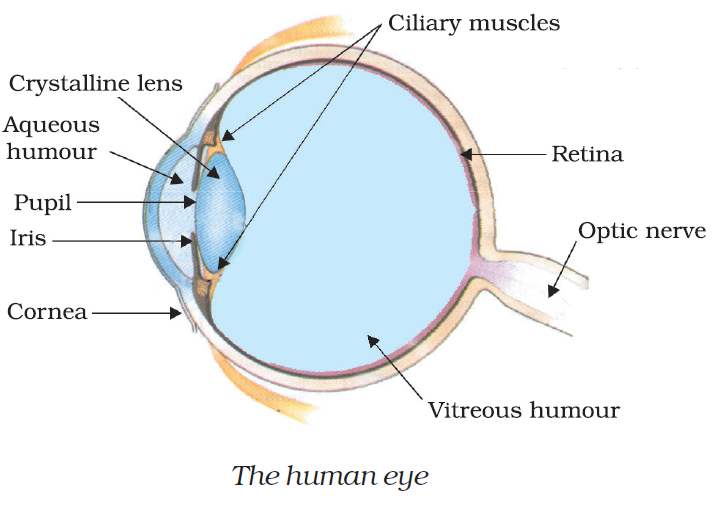
The human eye has following main parts:

Cornea: Human eye is spherical in shape. It has tough white coat which protects the interior of the eye. The front portion of this coat is transparent and is called cornea.
Iris: This is a dark muscular structure behind the cornea. Unique colour of a person’s eye is because of colour of iris.
Pupil: The small opening in the iris is called pupil. Iris controls the size of the pupil and thus controls the amount of light entering the eye. Light enters the eye through pupil.
Lens: Lens is thicker at the middle and is made of transparent material. Lens focuses the light on the back of the eye; called retina.
Retina: The back of the eye is called retina. It works like a screen; on which image is formed. Rods and cones function as photoreceptors in the retina of the eye, turning visible light into neuronal signals, which are sent to the brain. This process is called transduction. These nerve cells are connected to optic nerve.
Formation of Image in Eye: Light rays enter the eye through pupil and pass through lens. Lens focuses light rays on retina. Real, inverted and smaller image is formed on retina. Optic nerve carries the message to the brain. The brain interprets the message and we get the sense of vision.
View full question & answer
Question 35 Marks
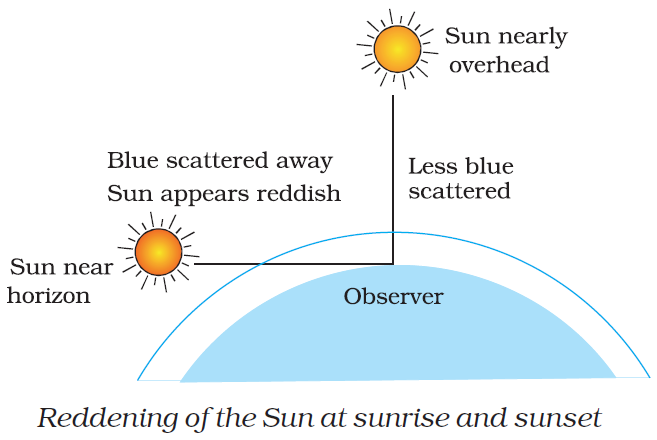
How can we explain the reddish appearance of sun at sunrise or sunset? Why does it not appear red at noon?
Answer
It is caused by Rayleigh scattering of sunlight. The molecules in the air scatter blue light more than red light as blue light has shortest wavelength as compared to that of red light which has about 1.8 times greater than blue light. Sky appears blue. During sunrise/ sunset, the sun looks reddish because at this stage, Sun rays travel longer distance in atmosphere and blue and green light (having shortest wavelength) of visible spectrum is scattered away fully while the red light having largest wavelength is scattered the least.Sun is directly over head and sunlight travel relatively shorter distance causing only little of the blue and violet colors to be scattered.
View full question & answer
Question 45 Marks
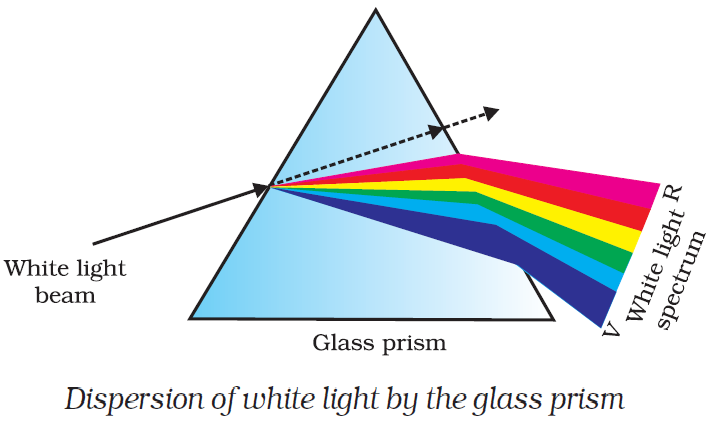
Explain the phenomenon of dispersion of white light through a glass prism, using suitable ray diagram.
Answer

Splitting of light into its constituent colors is referred to as dispersion. When a narrow beam of white light falls on a triangular glass prism, light of different colors have different refractive indices in glass. However, the speed of light is same irrespective of its colors. Different refractive indices of different colors of light lead to their different bending pattern. This causes splitting of white light into light of seven colors called as VIBGYOR. V = violet, I = indigo, B = blue, G = green, Y = yellow, O = orange, R = red.
The light of red colour bends the least on passing through the prism and appears at the top while violet colour bends through maximum angle and appears at bottom.
View full question & answer
Question 55 Marks
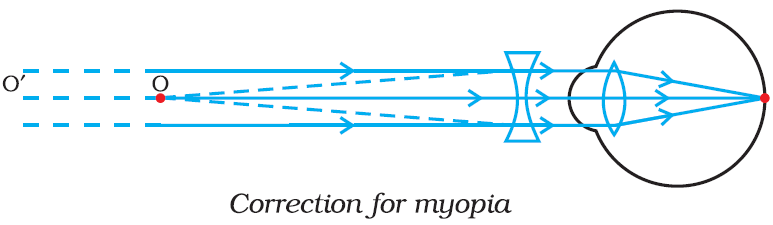
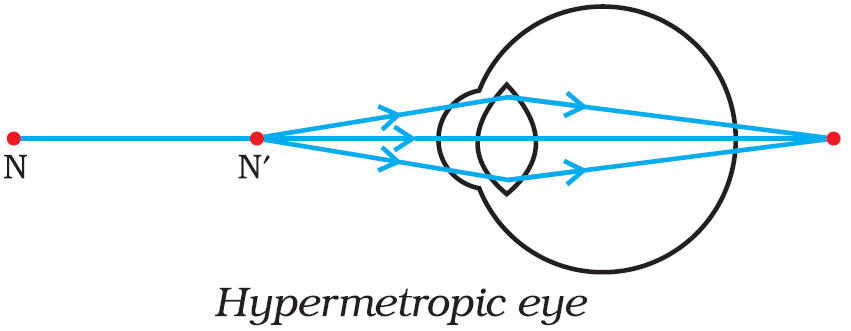
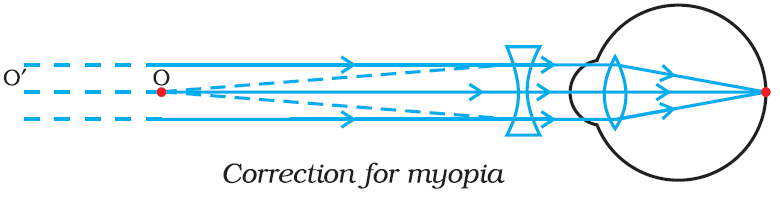
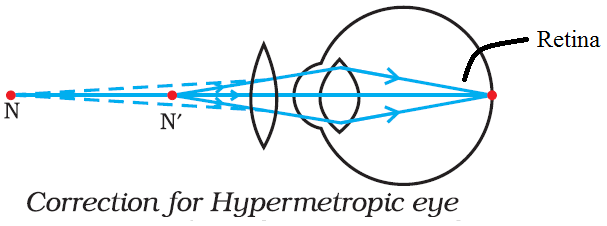
When do we consider a person to be myopic or hypermetropic? Explain using diagrams how the defects associated with myopic and hypermetropic eye can be corrected?
Answer

When a person is unable to clearly see distant objects, he is considered a myopic person. Such a person is suffering from myopia. This happens when image is formed in front of the retina.

When a person is unable to clearly see a nearby object, he is considered a hypermetropic person. Such a person is suffering from hypermetropia. This happen when image is formed behind the retina.

Correction of Myopia: A person suffering from myopia needs to use a concave lens of suitable focal length. The concave lens diverges the rays coming from infinity. After refraction from the concave lens, the rays appear to be coming from the far point of this person’s eye. Due to this, a clear image of distant object is made on the retina of that person. That is how a myopic person is able to clearly see distant objects; with the help of suitable concave lens.

Correction of Hypermetropia: A hypermetropic person needs to use a convex lens of suitable focal length. The convex lens converges the light rays coming from a nearby object. As a result, these light rays appear to be coming from the near point of this person’s eyes. Due to this, a clear image of nearby object is made on the retina of that person. That is how a hypermetropic person is able to clearly see nearby objects; with the help of suitable convex lens.
View full question & answer
Question 65 Marks
What is the difference in colours of the Sun observed during sunrise/ sunset and noon? Give explanation for each.
Answer

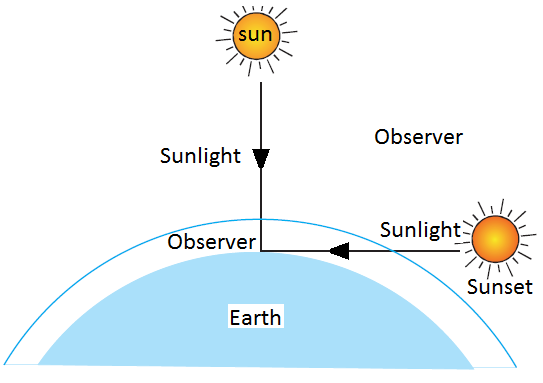
At the time of sunrise or sunset, the position of the sun is very far away from us (Figure).

The sunlight travels longer distance through the atmosphere of the earth before reaching our eyes. Scattering of blue light is more than the scattering of red light. As a result of this, more red light reaches our eyes than any other colour. Hence sunset and sunrise appear red.
During noon, the sun is overhead and sunlight travels less distance through the earth’s atmosphere to reach our eyes. In this case, the scattering of almost all colours is very small. Hence, the sun appears white.
View full question & answer
[5 marks Questions] - Science STD 10 Questions - Vidyadip