MCQ 1011 Mark
The laws of reflection hold good for :
- A
- B
- C
- ✓
All mirrors irrespective of their shape.
AnswerCorrect option: D. All mirrors irrespective of their shape.
The laws of reflection holds good for light reflected form any smooth surface i.e., all mirrors regardless of its shape.
View full question & answer→MCQ 1021 Mark
The refractive index of glass with respect to air is $\frac{3}{2}$ and the refractive index of water with respect to air is $\frac{4}{3}.$ The refractive index of glass with respect to water will be :
- A
$1.525$
- B
$1.225$
- C
$1.425$
- ✓
$1.125$
AnswerCorrect option: D. $1.125$
Refractive index of glass with respect to water $=\frac{\text{Refractive index of glass with respect to air}}{\text{Refractive index of water with respect to air}}$
$=\frac{\frac{3}{2}}{\frac{4}{3}}=1.25$
View full question & answer→MCQ 1031 Mark
A $10\ mm$ long awl pin is placed vertically in front of a concave mirror. A $5\ mm$ long image of the awl pin is formed at $30\ cm$ in front of the mirror. The focal length of this mirror is :
- A
$-\ 30\ cm.$
- ✓
$-\ 20\ cm.$
- C
$-\ 40\ cm.$
- D
$-\ 60\ cm.$
AnswerCorrect option: B. $-\ 20\ cm.$
$\text{m}=\frac{\text{h}'}{\text{h}}=\frac{-\text{v}}{\text{u}}$ or
$\text{u}=\frac{-\text{v}\times\text{h}}{\text{h}'}=\frac{-(-30\text{cm})\times(10\text{mm})}{-5\text{mm}}$
$=-60\text{ cm}$
$\therefore\ \frac{1}{\text{f}}=\frac{1}{\text{u}}+\frac{1}{\text{v}}$
$=-\frac{1}{60}-\frac{1}{30}=-\frac{1}{20}$
or ${f }=-20\text{ cm}.$
View full question & answer→MCQ 1041 Mark
The angle of reflection is equal to the angle of incidence :
- ✓
- B
- C
Under special conditions.
- D
AnswerIn accordance with the first law of reflection, which states that the angle of reflection is equal to the angle of incidence.
View full question & answer→MCQ 1051 Mark
The magnification produced by a spherical lens and a spherical mirror is $+\ 2.0.$
- A
The lens and mirror are both concave.
- B
The lens and mirror are both convex.
- ✓
The lens is convex but the mirror is concave.
- D
The lens is concave but the mirror is convex.
AnswerCorrect option: C. The lens is convex but the mirror is concave.
Because both concave mirror and convex lens have positive magnification.
View full question & answer→MCQ 1061 Mark
The focal lengths of four convex lenses $\ce{P, Q, R}$ and $S$ are $20\ cm, 15\ cm, 5\ cm$ and $10\ cm,$ respectively. The lens having greatest power is :
Answer$\text{Power}=\frac{1}{\text{Focal length}}$
Therefore, a lens with a small focal length will have more power.
View full question & answer→MCQ 1071 Mark
A diverging lens has a focal length of $0.10m.$ The power of this lens will be :
- A
$+\ 10.0D$
- B
$+\ 1.0D$
- C
$-\ 1.0D$
- ✓
$-\ 10.0D$
AnswerCorrect option: D. $-\ 10.0D$
Since, power of lens $=\frac{1}{\text{focal length}}=\frac{1}{-0.10}=-10.0\text{D}$
View full question & answer→MCQ 1081 Mark
If a magnification of $,-1$ is to be obtained by using a converging lens of focal length $12\ cm,$ then the object must be placed :
- A
Within $12\ cm.$
- ✓
At $24\ cm.$
- C
At $6\ cm.$
- D
Beyond $24\ cm.$
AnswerCorrect option: B. At $24\ cm.$
For an object placed at a distance of $2F$ from a convex lens, the size of the image so formed is equal to the size of the object.
View full question & answer→MCQ 1091 Mark
Figure shows a ray of light as it travels from medium $A$ to medium $B$. Refractive index of the medium $B$ relative to medium $A$ is :
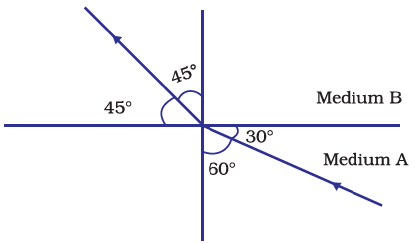
AnswerCorrect option: A. $\frac{\sqrt{3}}{\sqrt{2}}$
$\text{n}_{\text{BA}}=\frac{\sin\text{i}}{\sin\text{r}}=\frac{\sin60^\circ}{\sin45^\circ}$
$=\frac{\frac{\sqrt{3}}{2}}{\frac{1}{\sqrt{2}}}=\frac{\sqrt{3}}{\sqrt{2}}$
View full question & answer→MCQ 1101 Mark
The refractive indices of four substance $P, Q, R$ and $S$ are $1.50, 1.36, 1.77$ and $1.31$ respectively. The speed of light is the maximum in the substance :
AnswerWe know that,
$\text{Refractive index (n)} =\frac{\text{Speed of light in air}}{\text{Speed of light in a medium}}$
According to this formula, speed of light will be maximum in a substance whose refractive index is minimum.
Therefore, speed of light will be maximum in substance $S$ whose refractive index is $1.31.$
View full question & answer→MCQ 1111 Mark
A diverging lens is used in :
- A
- B
A car to see objects on rear side.
- ✓
Spectacles for the correction of short sight.
- D
AnswerCorrect option: C. Spectacles for the correction of short sight.
A diverging lens is used in spectacles to correct short $-$ sightedness.
View full question & answer→MCQ 1121 Mark
A virtual, erect and magnified image of an object is to be obtained with a convex lens. For this purpose,the object should be placed :
AnswerCorrect option: B. Between $F$ and optical centre.
When an object is placed between $F$ and the optical centre, the image of the object formed by convex lens is virtual, erect and magnified.
View full question & answer→MCQ 1131 Mark
Rays from Sun converge at a point $15\ cm$ in front of a concave mirror. Where should an object be placed so that size of its image is equal to the size of the object?
- A
$15\ cm$ in front of the mirror.
- ✓
$30\ cm$ in front of the mirror.
- C
Between $15\ cm$ and $30\ cm$ in front of the mirror.
- D
More than $30\ cm$ in front of the mirror in front of the mirror.
AnswerCorrect option: B. $30\ cm$ in front of the mirror.
Sun is at infinite distance from the surface of the earth. Now light rays from sun rays after reflection from concave mirror will converge at focus.
It is given that sun rays converge at $15\ cm.$
So, focal length of the mirror $= f = 15\ cm.$
In case of a concave mirror, the size of image and object will be same if the object is placed at $2f.$
Hence, in this case object must be place at $2f$ or $2 \times 15 = 30\ cm.$
View full question & answer→MCQ 1141 Mark
Which of the following can form a virtual image which is always smaller than the object?
AnswerA concave lens always forms a virtual image, smaller than the size of the object.
View full question & answer→MCQ 1151 Mark
- A
- ✓
- C
Always forms virtual image.
- D
Always forms a real image.
AnswerA convex lens is a converging lens. When parallel rays of light pass through a convex lens the refracted rays converge at one point called the principal focus.
View full question & answer→MCQ 1161 Mark
A thick plane $-$ convex lens made of crown glass $($refractive index $1.5)$ has thickness of $3\ cm$ at its centre.
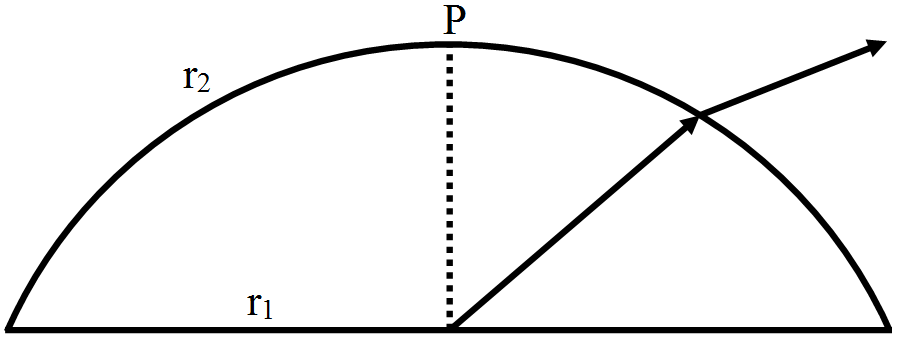
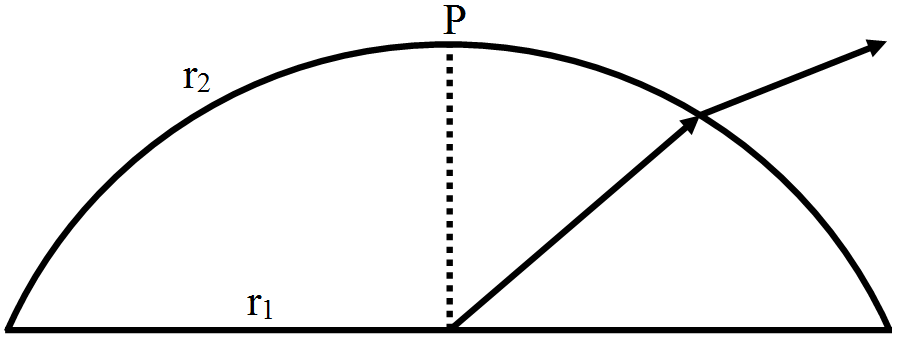
An ink mark made at the centre of its plane face, when viewed normal through the curved face, appears to be at a distance $x$ from the curved face. Then $, x$ is equal to: - A
$2\ cm$
- B
$2.1\ cm$
- C
$2.3\ cm$
- ✓
$2.5\ cm$
AnswerCorrect option: D. $2.5\ cm$
The ray of light from the object $O\ ($ink mark$)$ gets refracted at the interface between lens and air and therefore appears to start from the point $I\ ($Fig$)$.
So, I is the refracted image of the object $O$. The object distance $'u\ '$ is $PO$ and the image distance $'v\ ’$ is $PI.\ [P$ is the pole of the spherical surface$].$
We have,
$\frac{\text{n}_2}{\text{v}}-\frac{\text{n}_1}{\text{u}}=\frac{(\text{n}_2-\text{n}_1)}{\text{R}}$
so that $\frac{1}{\text{v}}-\frac{1.5}{(-3)}=\frac{(1-1.5)}{(-5)}$
Note that we did not bother about the sign of the unknown quantity $'v\ ’.$ [In this problem we could have put negative sign for $'v\ ’$ since the image I is on the same side as the object. Since we don’t apply sign to the unknown quantity $'v’,$ we will obtain a negative value for $'v\ ’$ on solving the problem$]$. The sign of $'u\ ’$ is negative in accordance with the Cartesian convention. Since the incident ray is encountering a concave surface the radius of curvature is negative, in accordance with the convention.
Rearranging the above equation,
we obtain $\frac{1}{\text{v}}=\frac{0.5}{5}-\frac{1.5}{3}$
$=\frac{-6}{15}$
from which $\text{v}=-2.5\text{ cm}$
Then the image will appear at distance of $2.5\ cm$ from the plane surface of the mirror.
View full question & answer→MCQ 1171 Mark
Which of the following ray diagrams is correct for the ray of light incident on a lens shown in Fig.?
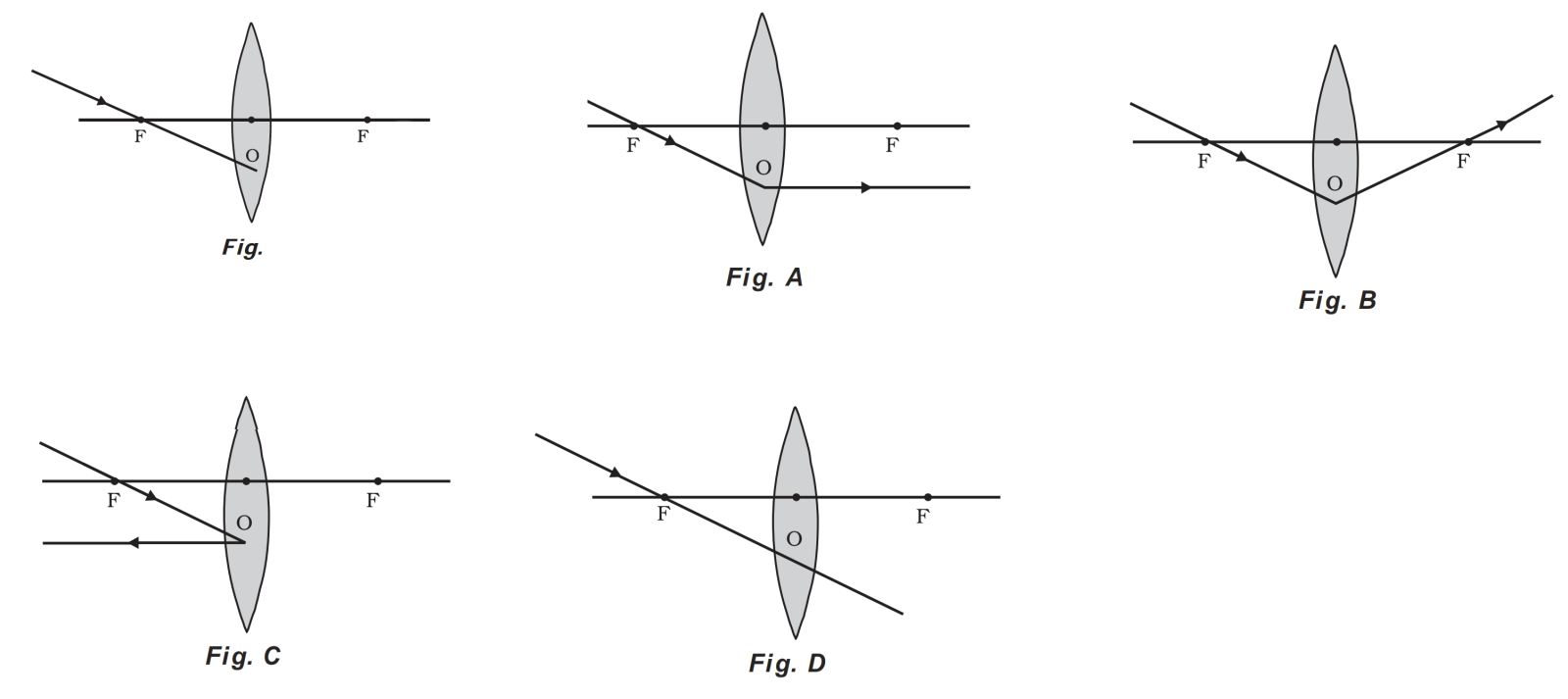
- ✓
Fig. $A$
- B
Fig. $B$
- C
Fig. $C$
- D
Fig. $D$
AnswerCorrect option: A. Fig. $A$
In convex lens, the incident ray passing through $F$ goes parallel to the principal axis after refraction.
View full question & answer→MCQ 1181 Mark
A boy is standing in front of and close to a special mirror. He finds the image of his head bigger than normal, the middle part of his body of the same size, and his legs smaller than normal. The special mirror is made up of three types of mirrors in the following order from top downwards :
Answer
- Concave : A concave mirror forms an image larger than the object.
- Plane : A convex mirror forms an image smaller than the object.
- Convex : A plane mirror forms an image similar to the size of the object.
View full question & answer→MCQ 1191 Mark
A spherical mirror to be made from a cut portion of :
AnswerA spherical mirror is a mirror which has the shape of a piece cut out of a spherical surface. There are two types of spherical mirrors: concave, and convex. These are illustrated. The most commonly occurring examples of concave mirrors are shaving mirrors and makeup mirrors.
View full question & answer→MCQ 1201 Mark
A spherical mirror and a spherical lens each have a focal length of $,-15\ cm$. The mirror and the lens are likely to be :
- ✓
- B
- C
The mirror is concave but the lens is convex.
- D
The mirror is convex but the lens is concave.
AnswerAccording to the sign convention, the focal length for both a concave mirror and a concave lens is negative.
View full question & answer→MCQ 1211 Mark
The refractive index of water with respect to air is $\frac{4}{3}.$ The refractive index of air with respect to water will be :
- A
$1.75$
- B
$0.50$
- ✓
$0.75$
- D
$0.25$
AnswerCorrect option: C. $0.75$
Refractive index of air with respect to water $=\frac{1}{\text{Refractive index of water with respect to air}}$
Refractive index of air with respect to water $=\frac{3}{4}=0.75$
View full question & answer→MCQ 1221 Mark
In order to obtain a magnification of $−2\ ($minus $2)$ with a concave mirror, the object should be placed :
- A
- ✓
Between focus and centre of curvature.
- C
At the centre of curvature.
- D
Beyond the centre of curvature.
AnswerCorrect option: B. Between focus and centre of curvature.
In order to obtain a magnification of $−2\ ($minus $2)$ with a concave mirror, the object should be placed between the focus and the centre of curvature.
View full question & answer→MCQ 1231 Mark
The focal length of a small concave mirror is $2.5\ cm$. In order to use this concave mirror as a dentist's mirror, the distance of tooth from the mirror should be :
- A
$2.5\ cm$
- ✓
$1.5\ cm$
- C
$4.5\ cm$
- D
$3.5\ cm$
AnswerCorrect option: B. $1.5\ cm$
When an object is placed between the pole and the focus of a concave mirror, an enlarged image is formed.
View full question & answer→MCQ 1241 Mark
In order to obtain a magnification of $, -3\ ($minus $3)$ with a convex lens, the object should be placed :
AnswerCorrect option: B. Between $F$ and $2F.$
In the case of a convex lens, for an object placed between $F$ and $2F,$ the image formed will be real, inverted and enlarged.
View full question & answer→MCQ 1251 Mark
A convex lens of focal length $15 \ cm$ produces a magnification of $+\ 4$. The object is placed :
AnswerCorrect option: C. At less than $15\ cm.$
A convex lens forms a virtual, erect and magnified image when an object is placed within the focus.
View full question & answer→MCQ 1261 Mark
In case refraction of light through a glass slab :
- A
Angle of incidence is equal to angle of refraction.
- B
Angle of refraction is equal to angle of emergence.
- ✓
Incident ray is parallel to emergent ray.
- D
Incident ray is parallel to refracted ray.
AnswerCorrect option: C. Incident ray is parallel to emergent ray.
The incident ray and the emergent ray are parallel to each other. The light ray enters the slab from air which is why it bends towards the normal. In the case of emergent ray, the same refracted ray exits the slab into air, hence moving away from the normal. If we produce the incident ray, we can find that it is parallel to the emergent ray.
View full question & answer→MCQ 1271 Mark
If an object is placed $21\ cm$ from a converging lens, the image formed is slightly smaller than the object. If the object is placed $19\ cm$ from the lens, the image formed is slightly larger than object. The approximate focal length of the lens is :
- A
$5\ cm$
- ✓
$10\ cm$
- C
$18\ cm$
- D
$20\ cm$
AnswerCorrect option: B. $10\ cm$
We know that a converging lens forms an image of same size as object when object is placed at a distance of $2f$ from the lens. It is given that the image is smaller than the object if object is kept at a distance of $21\ cm.$ Similarly, the image is bigger than the object if object is kept at a distance of $19\ cm.$ Therefore, at $20\ cm,$ the distance should be $2f$. This means that the focal length is approximately $10\ cm.$
View full question & answer→MCQ 1281 Mark
A convex lens of focal length $10\ cm$ is placed in contact with a concave lens of focal length $20\ cm$. The focal length of this combination of lenses will be :
- A
$+\ 10\ cm$
- ✓
$+\ 20\ cm$
- C
$-\ 10\ cm$
- D
$-\ 20\ cm$
AnswerCorrect option: B. $+\ 20\ cm$
We know that,
$\text{Power(P)}=\frac{1}{\text{Focal length}}$
Therefore,
Power of convex lens $\text{P}_1=\frac{1}{10\text{ cm}}=\frac{1}{0.1\text{m}}=+10\text{D}$
Power of convex lens $\text{P}_2=\frac{1}{-20\text{ cm}}=\frac{1}{0.2\text{m}}=-5\text{D}$
View full question & answer→MCQ 1291 Mark
A concave mirror produces magnification of $+\ 4$. The object is placed :
- A
- B
Between focus and centre of curvature.
- ✓
- D
Between the centre of curvature.
AnswerA concave mirror produces a magnification of $+\ 4$ when the object is placed between the focus and the pole.
View full question & answer→MCQ 1301 Mark
When a ray of light travelling in glass enters into water obliquely :
- A
It is refracted towards the normal.
- B
It is not refracted at all.
- C
It goes along the normal.
- ✓
It is refracted away from the normal.
AnswerCorrect option: D. It is refracted away from the normal.
Because if a ray of light goes form a denser medium $($glass$)$ to a rarer medium $($water$),$ it bends away from the normal.
View full question & answer→MCQ 1311 Mark
An object is placed $f$ and $2f$ of a convex lens. Which of the following statements correctly describes its image
- A
Real, larger than the object.
- B
Erect, smaller than the object.
- ✓
Inverted, same size as object.
- D
Virtual, larger than the object.
AnswerCorrect option: C. Inverted, same size as object.
The reason being, the image of an object placed between $f$ and $2f$ of a convex lens is real, inverted and magnified.
View full question & answer→MCQ 1321 Mark
An object is placed at a distance of $20\ cm$ in front of concave mirror of focal length $10\ cm.$ The image produced is :
- A
Real, inverted and diminished.
- B
Real, inverted and enlarged.
- ✓
Real, inverted and same size.
- D
Virtual, erect and enlarged.
AnswerCorrect option: C. Real, inverted and same size.
Concave mirror
$\text{u}=-20$
$\text{f}=-10$
$\frac{1}{\text{f}}=\frac{1}{\text{v}}+\frac{1}{\text{u}}$
$\frac{1}{-10}=\frac{1}{\text{v}}+\frac{1}{-20}$
$\frac{1}{\text{v}}=\frac{1}{20}-\frac{1}{10}$
$\frac{1}{\text{v}}=1-\frac{2}{20}$
$\frac{1}{\text{v}}=-\frac{1}{20}$
$\text{v}=-20$
Image is formed $20\ cm$ from the pole in front of the lens nature :
$\text{m}=-\frac{\text{v}}{\text{u}}$
$=-\frac{(-20)}{-20}$
$=-1$
So the image is real, inverted and same size image.
View full question & answer→MCQ 1331 Mark
Beams of light are incident through the holes $A$ and $B$ and emerge out of box through the holes $C$ and $D$ respectively as shown in the Figure. Which of the following could be inside the box?
- ✓
A rectangular glass slab.
- B
- C
- D
AnswerCorrect option: A. A rectangular glass slab.
In this case, incident rays fall perpendicularly on the point of incidence. A rectangular glass slab would refract and then re $-$ refract it.
View full question & answer→MCQ 1341 Mark
Magnification produced by a convex mirror is always :
- A
More than $1.$
- ✓
Less than $1.$
- C
Equal to $1.$
- D
More or less than $1.$
AnswerCorrect option: B. Less than $1.$
Magnification produced by a convex mirror is always less than $1.$ This is because the size of the image formed by a convex mirror is smaller than the object.
View full question & answer→MCQ 1351 Mark
To obtain a magnification of, $-0.5$ with a convex lens, the object should be placed :
AnswerCorrect option: D. Beyond $2F.$
Since the magnification is negative and less than $1$, the image formed is real, inverted and diminished. Therefore, the object should be placed beyond $2F.$
View full question & answer→MCQ 1361 Mark
Which of the following ray diagrams is correct for the ray of light incident on a concave mirror as shown in Figure?
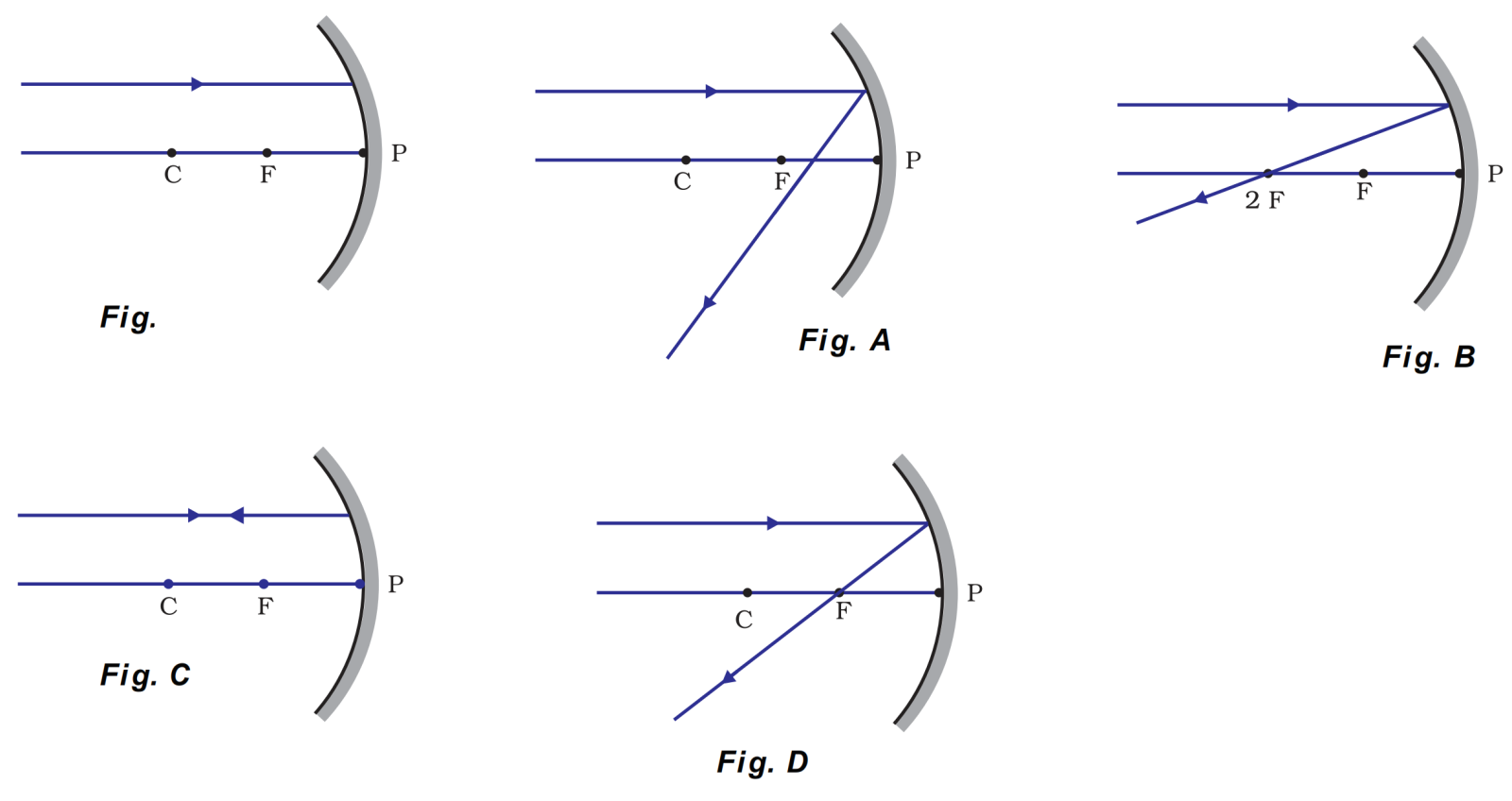
- A
Fig. $A$
- B
Fig. $B$
- C
Fig. $C$
- ✓
Fig. $D$
AnswerCorrect option: D. Fig. $D$
Any ray of light parallel to the principal axis passes through the focus $(F)$ after reflecting from the concave mirror.
View full question & answer→MCQ 1371 Mark
In order to obtain a magnification of, $−1.5$ with a concave mirror of focal length $16\ cm,$ the object will have to be placed at a distance.
- A
Between $6\ cm$ and $16\ cm$
- ✓
Between $32\ cm$ and $16\ cm$
- C
Between $48\ cm$ and $32\ cm$
- D
Beyond $64\ cm$
AnswerCorrect option: B. Between $32\ cm$ and $16\ cm$
To obtain a magnification of $-1.5,$ the object needs to be placed between the focus and the centre of curvature.
View full question & answer→MCQ 1381 Mark
The refractive index of water is :
- ✓
$1.33$
- B
$1.50$
- C
$2.42$
- D
$1.36$
AnswerCorrect option: A. $1.33$
Velocity of light in water $= 225,563,010m/ s$
Velocity of light in air $= 300,000,000m/ s$
$\text{Refractive index}=\frac{\text{Velocity of light in air}}{\text{Velocity of light in water}}$
Refractive index $=\frac{300,000,000}{225,563,010}$
Refractive index $=1.33$
View full question & answer→MCQ 1391 Mark
A perfecting reflecting mirror has an area of $1 \mathrm{~cm}^{2}$. Light energy is allowed to fall on it for an hour at the rate of $10 \mathrm{~cm}^{-2}$. The force that acts on the mirror is :
- A
$3.35 \times 10^{-7} \mathrm{~N}$
- B
$6.7 \times 10^{-7} \mathrm{~N}$
- C
$3.35 \times 10^{-8} \mathrm{~N}$
- ✓
$6.7 \times 10^{-8} \mathrm{~N}$
AnswerCorrect option: D. $6.7 \times 10^{-8} \mathrm{~N}$
Given,
Area of the mirror $= 1 \mathrm{~cm}^{2}$,
Power transmitted to the mirror $= 10 \mathrm{~cm}^{-2}$,
Calculations :
The average force is given by $\frac{\triangle\text{p}}{\triangle\text{t}},$
Since the surface is perfectly reflecting we can write $\triangle\text{p}=2\frac{\triangle\text{t}}{\text{c}}$
So,
$\text{f}=2\Big(\frac{\triangle\text{E}}{\text{c}\triangle\text{t}}\Big)=2\frac{\text{p}}{\text{c}}$
$=2.\frac{10\times10^4\times1\times10^{-4}}{3\times10^8}$
$\frac{20}{3}\times10^{-8}\text{N}$
$=6.7\times10^{-8}\text{N}$
View full question & answer→MCQ 1401 Mark
Linear magnification $(m)$ produced by a rear view mirror fitted in vehicles :
- A
- ✓
- C
- D
In be more less than one depending on the position of object.
AnswerLinear magnification $(m)$ produced by a rear view mirror, installed in vehicles, is less than one.
View full question & answer→MCQ 1411 Mark
When sunlight is concentrated on a piece of paper by a spherical mirror or lens, then a hole can be burnt in it. For doing this, the paper must be placed at he focus of :
- A
Either a convex mirror or convex lens.
- B
Either a concave mirror or concave lens.
- ✓
Either a concave mirror or convex lens.
- D
Either a convex mirror or concave lens.
AnswerCorrect option: C. Either a concave mirror or convex lens.
Both a concave mirror and a convex lens focus parallel light beams coming from a distant object onto the focus.
View full question & answer→MCQ 1421 Mark
An object is place placed at a distance of half the focal length of a convex lens. The Image will be :
- ✓
At $2F,$ virtual and erect.
- B
At $F,$ virtual and double in size.
- C
Beyond $2F,$ real inverted.
- D
At $F,$ real inverted.
AnswerCorrect option: A. At $2F,$ virtual and erect.
When an object is placed at a distance further than the focal distance of a convex lens, light rays originating from any point on the object will be refracted by the lens such that they will form a real but inverted image of the object on the opposite side of the lens.
View full question & answer→MCQ 1431 Mark
The refractive indices of four materials $\ce{A, B, C}$ and $D$ are $1.33, 1.43, 1.71$ and $1.52$ respectively. When the light rays pass from air into these materials, they refract the maximum in :
- A
Material $A.$
- B
Material $B.$
- ✓
Material $C.$
- D
Material $D.$
AnswerCorrect option: C. Material $C.$
The refraction in a material depends on its refractive index. Refractive index is calculated by $\frac{\sin\text{i}}{\sin\text{r}}$
This ratio is maximum for material $C$ therefore, it produces maximum refraction.
View full question & answer→MCQ 1441 Mark
Which of the following lenses would you prefer to use while reading small letters found in a dictionary?
- A
A convex lens of focal length $50 \ cm.$
- B
A concave lens of focal length $50 \ cm.$
- ✓
A convex lens of focal length $5 \ cm.$
- D
A concave lens of focal length $5 \ cm.$
AnswerCorrect option: C. A convex lens of focal length $5 \ cm.$
View full question & answer→MCQ 1451 Mark
The power of a concave lens is $10D$ and that of a convex lens is $6D$. When these two lenses are placed in contact with each other, the power of their combination will be :
- A
$+\ 16D$
- B
$+\ 4D$
- C
$-\ 16D$
- ✓
$-\ 4D$
AnswerCorrect option: D. $-\ 4D$
The powers of the lenses add up when brought in contact.
So, net power $= +\ 6D + (-10D) = -\ 4D$
View full question & answer→MCQ 1461 Mark
The refractive index of glass for light going from air to glass is $\frac{3}{2}.$ The refractive index for light going from glass to air will be :
- A
$\frac{1}{3}$
- B
$\frac{4}{5}$
- ✓
$\frac{4}{6}$
- D
$\frac{5}{2}$
AnswerCorrect option: C. $\frac{4}{6}$
Refractive index of material $2$ with respect to material $1$ is given by :
$_1\text{n}_2$
$\ \ \ \searrow$
$\ \ \ \ \ \ \ \ \ {_1\text{n}_2}=\frac{\text{Speed of light in medium 1}}{\text{Speed of light in medium 2}}$
By the same argument, refractive index of medium $1$ with respect to medium $2$ is given by :
$_1\text{n}_2=\frac{\text{Speed of light in medium 2}}{\text{Speed of light in medium 1}}=\frac{1}{_1\text{n}_2}$
$_1\text{n}_2\text{ is }\frac{2}{3},$ therefore, $_2{n_1}$ Will be $\frac{1}{\big(\frac{3}{2}\big)}$
Therefore, refractive index of light going from glass to air will be $\frac{4}{6}$
View full question & answer→MCQ 1471 Mark
A burning candle whose flame is $1.5\ cm$ tall is placed at a certain distance in front of a convex lens. An image of candle flame is received on a white screen kept behind the lens. The image of flame also measures $1.5\ cm.$ If f is the focal length of convex lens, the candle is placed :
- A
At $f.$
- B
Between $f$ and $2f.$
- ✓
At $2f.$
- D
Beyond $2f.$
AnswerCorrect option: C. At $2f.$
This is because a convex lens produces an image of the same size as the object when the object is placed at $2f.$
View full question & answer→MCQ 1481 Mark
A small bulb is placed at the focal point of a converging lens. When the bulb is switched on, the lens produces :
- A
A convergent beam of light.
- B
A divergent beam of light.
- ✓
A parallel beam of light.
- D
A patch of coloured light.
AnswerCorrect option: C. A parallel beam of light.
The reason being, a beam of light coming from the focus of a converging lens becomes parallel, after refraction from the lens.
View full question & answer→MCQ 1491 Mark
The image formed by a spherical mirror is virtual. The mirror will be :
- A
- ✓
- C
Either concave or convex.
- D
AnswerA convex mirror always forms a virtual image.
View full question & answer→MCQ 1501 Mark
According to New Cartesian Sign Convention :
- A
Focal length of concave mirror is positive and that of convex mirror is negative.
- B
Focal length of both concave and convex mirrors is positive.
- C
Focal length of both concave and convex mirrors is negative.
- ✓
Focal length of concave mirror is negative and that of convex mirror is positive.
AnswerCorrect option: D. Focal length of concave mirror is negative and that of convex mirror is positive.
This is because the focus of a concave mirror is in front of the mirror, on the left side, and the focus of a convex mirror is behind the mirror, on the right side.
View full question & answer→